The government ignored students protesting for nearly a month. But the moment the conversation shifted from NEET mismanagement to the uncomfortable question of reservation, Dharmendra Pradhan resigned.
Call the timing a coincidence if you want. I don’t.
They can tolerate anger over paper leaks. What they fear is a nationwide debate on whether a student’s birth should decide their opportunities.
I missed the UPSC prelims cutoff by just 2 marks.
When I shared my story-how I exhausted all my attempts, started again from zero and became an AI engineer-many people asked me what mistake I had made.
Honestly, sometimes it feels like my only mistake was being born in the General Category.
This is not against any community. It is against a system where your birth can decide how many chances you get.
General Category candidates also need to come together and speak for themselves. We cannot keep waiting for someone else to fight for us. If peaceful protest or even a hunger strike is what it takes to make our voices heard, we should be ready.
It is time to seriously question birth-based reservation.
@LPI4India@talk2anuradha@PMOIndia
#जंतर_मंतर_ब्रेकिंग_न्यूज
I lost my prelims by 2 marks... when I shared my story - how I exhausted all my attempts and became an AI engineer, many asked what mistake did I make. Well my mistake was that I belonged to general category.. if needed and all general category candidates come together... I and we all will go on hunger strike... we won't ask anybody else to do it for us.. Let's end reservation
We need a real Right wing party - one that believes in Merit, Dharma & Fearless Progressive politics.
I announced @DharmaPartyInd last year.
If I get enough support, I'll leave everything and work on it full-time.
I refuse to let this country be held hostage by leftists.
I've been thinking about where software is heading over the next few years. I don't believe AI agents will replace every application—we'll still need great products. But I do think they'll change how we interact with them. Instead of jumping between five different apps to finish a task, we'll simply describe what we want, and an AI agent will decide which tools to use, move information between them, and return the result. In that world, the value won't come from having the most buttons or features. It'll come from building products that AI agents can understand, trust, and work with. That's the direction I'm betting on while building CharFlow.
Switched to Codex today because I kept hitting Claude's token limits. My 5-hour allowance would disappear within an hour of heavy coding. With Codex, I've been coding continuously for 5 hours on a large project. The output quality feels on par with Claude, but execution is a little slower.
Why does a protest supposedly about NEET increasingly look like a coalition of completely different political and identity groups?
If NEET is really the issue, why does the conversation keep drifting toward caste, sexuality, religion and unrelated political grievances?
At some point, you have to ask: is NEET the real cause here, or just the convenient banner under which a much broader political movement is assembling?
Weird thought I keep coming back to: future historians might not call social media a communication technology at all. They might call it the first big pollutant of human attention.
We've polluted rivers before. Forests. The air. This might be the first time we're doing it to something inside our own heads. Every notification, every headline, every short video and outrage cycle, all of it fighting over the same limited thing, and there's no more of it coming. Unlike oil, you can't extract more attention once today's is gone. Whatever you gave it to, that's where it went. Nowhere else got that time.
And I don't think we've really sat with what that does to things that need slowness to survive. Science needs long boring stretches with no reward. So does art. So does an actual conversation with someone you love, not the three-line version you send between tasks. The whole system right now pays better the moment it interrupts you than the moment it lets you sit still.
Maybe the real fight of this century isn't making more information. We're drowning in that already. Maybe it's just protecting a few uninterrupted hours a day, which sounds small until you notice almost nothing in your life is built to let you have them.
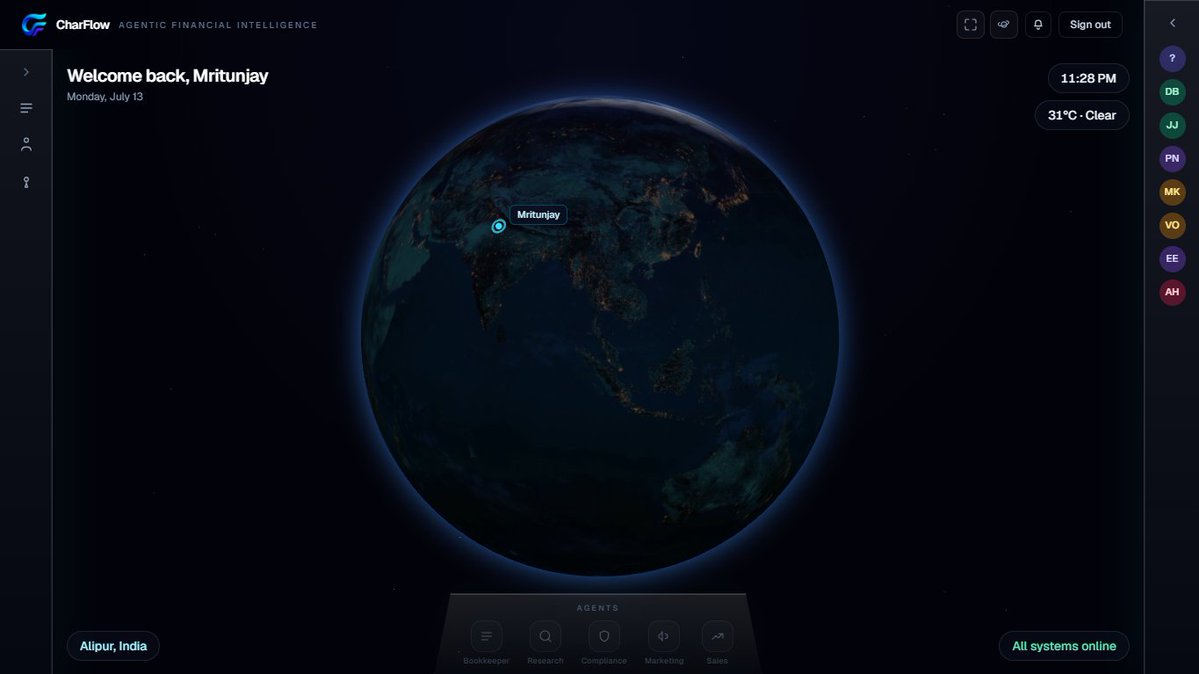
Most AI products today feel like tools. I wanted CharFlow to feel like a place.
Less another dashboard, more an office floating in deep space, where every client, team member, and AI agent exists inside the same connected ecosystem, orbiting the same mission.
The globe isn't decoration. It's the idea that accounting firms aren't limited by geography anymore. A bookkeeper in India, a CPA in North Carolina, a client in California, AI agents running in a data center somewhere, all working inside the same digital workspace, in real time.
During huddles, animated arcs connect people live across the globe. Team chat and client collaboration run inside the platform itself, not bolted on from Slack or email.
This is a very different experience from traditional accounting software. That was the point. I wanted to know what an AI-native, globally connected workspace could actually feel like.
To me, it feels like the future. And it gives CharFlow an identity no other accounting tool has.
Not every unfinished UPSC story is a tragedy.
I spent years preparing this examination, going deep into economics, governance, public policy, institutions. Life had other plans.
Today I build a different kind of system. Instead of studying how organizations operate, I'm building something big in fintech, an intelligence layer that helps them operate better.
The destination changed. The mission never did.
Some roads don't end where you expected. Some take you somewhere you couldn't have imagined when you first started walking.
The UPSC journey can end in the most heartbreaking ways. We have a neighbour whose son dedicated years of his life to preparing for the exam. He gave it everything and exhausted all his attempts, but never made it through. Today, he runs a small bakery near our house. Every time I pass by, I can’t help but wonder what goes through his mind from once dreaming of becoming a public servant to ending up here. Life can be unbelievably cruel sometimes.
I'm seeing this firsthand. The combination of modern models, APIs, and coding agents has allowed me to work on things that previously required entire departments: AI document extraction, financial intelligence systems, bank connectivity, client portals, reporting engines, and agent workflows.
AI isn't replacing the builder in this equation.
It's amplifying what the builder can accomplish.
so far at least, i'm pretty sure AI has been net job-creating.
this was not what i expected--although i was much less pessimistic than others, i thought by this level of capability we'd have seen some impact.
it is possible this direction keeps going!
⚠️Attention UPSC mains appearing candidates.
The intro-body-conclusion template gets taught like it's the one correct shape for every answer. It isn't.
It works for some questions. It fails for case studies, scenario-based questions, short conceptual ones. But coaching centres teach it as universal because it's easier to hand 500 students one format than to teach judgment.
That's the actual problem. Not the template itself, the idea that one shape fits every question. You follow it, you feel like you're improving, then the real exam gives you a question it doesn't fit, and you're back buying the next test series trying to figure out what went wrong.
The structure was never the skill. Knowing when to break from it was.
For two hundred years, humanity has asked the same question in different forms: what can we automate next. First physical labor, then calculations, then memory. Now, for the first time, we're automating parts of thinking itself.
Every conversation about AI starts with "what can it do." The more interesting question is what we should refuse to hand over.
Should we outsource writing, if writing is how we discover what we actually think? Should we outsource the hard conversation, just because a model can generate smoother words than we can?
Convenience and value aren't the same thing.
Nobody climbs a mountain because elevators don't exist. Some things matter precisely because they're difficult — the difficulty is the point, not the obstacle.
The defining skill of the next twenty years probably isn't knowing how to use every new tool. It's knowing which parts of being human are worth protecting from optimization.
A tool that saves time is useful. A tool that quietly removes the meaning from an experience is a different thing entirely, and we rarely notice the difference until it's already gone.
I find it fascinating that for most of human history, being intelligent meant remembering things.
The person who remembered the stars could navigate.
The person who remembered medicinal plants could heal.
The person who remembered laws, stories, and history became valuable to society.
Memory was status.
Today, memory is becoming cheap.
My phone remembers phone numbers better than I do.
Search engines remember facts better than I do.
Artificial intelligence remembers programming syntax better than I do.
For the first time in history, forgetting information isn't necessarily a disadvantage because we can retrieve it almost instantly.
So I've been wondering:
if remembering is no longer the bottleneck, what becomes valuable next?
Maybe judgment.
Maybe taste.
Maybe the ability to connect ideas that don't obviously belong together.
Maybe the future rewards people who know what matters rather than people who know the most.
I'm not sure of the answer.
But it feels like we're living through a moment where the definition of intelligence itself is quietly changing.
I'm documenting the entire journey of building an enterprise AI platform from scratch.
The wins.
The mistakes.
The architectural decisions.
The trade-offs.
If that sounds interesting, follow along.
Everyone is talking about using AI to write code.
Very few people are talking about using AI to design software.
For the last few days, I didn't ask Claude to write a single production feature.
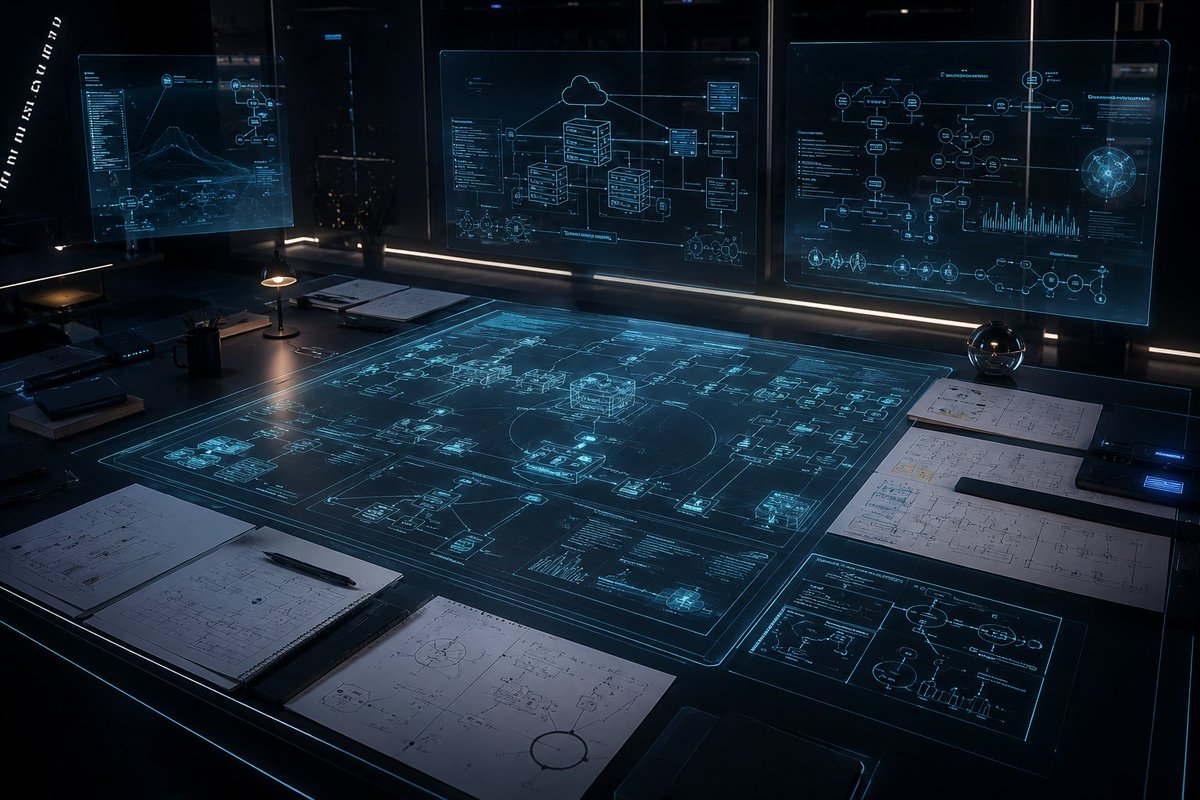
Instead, we designed an enterprise AI platform from the ground up.
No code.
Just architecture.
It completely changed the quality of everything that came after.
🧵
My biggest takeaway:
AI isn't replacing software architecture.
It's making good architecture exponentially more valuable.
The better your blueprint...
the more leverage AI gives you.
Don't just ask AI to build software.
Teach it how to think about building systems.