We at Wärtsilä are very exited to start this collaboration with Hycamite TCD Technologies. Could this be the quickest and easiest way to guarantee hydrogen availability onboard vessels? It might be! #LNG#Hydrogen https://t.co/ng7Cjx4nDx
Nyt kun YLE näyttää uudestaan ja uudestaan Sofia Virran ja Ville Rydmanin eilistä yhteenottoa, ikäänkuin silminnäkijänä, tuli mieleen sellainenkin journalistinen idea, että ehtiskö kukaan toimituksessa tarkastaa mitä he oikein sanoivat ja puhuivatko totta?
@calvinfroedge Hope you manage to stay around and remain vocal here, you are one of the very few reasons I am still around here. Been away for a good while but knew when the war started I needed to come back and listen to what you are saying.
QATARENERGY CEO TELLS REUTERS: TWO OUT OF 14 OF OUR LNG TRAINS AND ONE OUT OF TWO OF OUR GAS-TO-LIQUIDS (GTL) FACILITY WERE DAMAGED IN THE ATTACKS
WE WILL BE LOSING 12.8 MILLION TONS PER YEAR OF LNG FOR THREE TO FIVE YEARS, AROUND 17% OF QATAR’S EXPORT LNG
WE MAY HAVE TO DECLARE FORCE MAJEURE ON LONG-TERM CONTRACTS FOR UP TO FIVE YEARS FOR LNG SUPPLIES TO ITALY, BELGIUM, KOREA AND CHINA
Entering a more dangerous phase of the war as Iran begins to directly target energy infrastructure
Hormuz stoppage is like a kinked garden hose—you can unkink it and flow will resume
Hitting infra is like taking a shotgun & blowing off the faucet to which that hose is attached
Hegseth says the Navy is performing better than expected.
He says the Navy had a comprehensive plan for the Strait of Hormuz.
He says we have the best warships in the world.
He says we have enough munitions.
All of that can be true.
And yet the Strait is still closed.
The real problem isn’t capability. It’s capacity.
The U.S. Navy has 74 destroyers. Roughly a third are in maintenance and another third are between deployments. That leaves about 24 ready ships for the entire planet.
Those ships aren’t sitting idle waiting for Hormuz.
They defend carrier strike groups, support amphibious forces, and cover global commitments.
The Iwo Jima Amphibious Ready Group in the Caribbean ideally should have several destroyers. It reportedly has one.
Another amphibious group in Okinawa likely has only one as well.
Carrier groups consume even more.
Traditionally you’d assign three destroyers and a cruiser to protect each carrier. But the cruisers are being scrapped, so destroyers now fill that role too.
The Ford reportedly has 4 DDGs.
The Lincoln has 3.
The George Washington in Japan likely has at least 3.
Now we’re down to roughly a dozen destroyers left for everything else the US Navy does worldwide.
And that’s before anything goes wrong.
The fleet structure makes things worse.
We eliminated most of our smaller frigates & we’re scrapping the cruisers. So destroyers are forced to do everything from missions too small for them to missions too big.
Then there’s physics.
Warships can’t teleport. A destroyer’s top speed is under half the average highway speed. Moving them across oceans can take weeks.
Each destroyer carries about 96 vertical-launch missiles. But they aren’t all air defense. Roughly 1/3rd are Tomahawks, a third anti-submarine, & 1/3 anti-air.
That leaves about 32 air-defense missiles per ship.
When those run out, the ship has to sail to port to reload. The Navy eliminated most at-sea missile reload capability, so the round trip.. transit, reload, & return.. can take weeks. During the Red Sea operation typically 3 weeks.
In practical terms, a destroyer escorting convoys may spend most of a month cycling through reloads.
So your “12 destroyers” quickly becomes something closer to three on station at any given time.
3 ships. Roughly 96 air-defense missiles total.
If Iran can launch 97 per week, missiles or drones, they overwhelm the defense.
Yes, destroyers also have backup systems like their guns & CIWS. But those are last-ditch defenses.
CIWS literally means Close-In Weapon System. Close is the key word.
To use it effectively, the destroyer has to stay very close to the merchant ships it’s defending. That shrinks the defensive umbrella and forces convoys to be smaller.
Small convoys don’t move much oil.
The Strait of Hormuz is about 100 nautical miles long. A destroyer could sprint through it in roughly three hours but convoys move at the speed of the slowest ship.
Supertankers average about 12 knots.
100 nautical miles at 12 knots is about eight hours.
Then the escorts have to turn around and bring empty tankers back out.
Even in optimistic scenarios, say one destroyer protecting four supertankers carrying two million barrels each, you’re moving roughly eight million barrels per convoy cycle.
And that assumes no mines, no drones, no delays, no damaged ships, no orders from cautious admirals.
With two destroyers taking serious risk while one reloads CWIS & fuel at sea… & everything going perfectly, you might move most of the oil.
But my napkin math has more assumptions than a block of dollar store Swiss cheese.
Option 2
Pull the carriers, send the airwings to Dubai airport & free up 7 destroyers for convoy duty.
But carriers without air or DDG would have to go far from shore around Africa to get home.
American supercarriers sailing home empty cover wouldn’t exactly project strength.
P.S. that’s why we 💯 need Battleships. Large guns = wider umbrella and lots more ammo/fuel storage.
Kuten täällä jo kerroin, olen vahvasti TACO-leirissä. Eli lähden olettamasta, että Trump haluaa taputella tämänkin konfliktin mahdollisimman nopeasti pois päiväjärjestyksestä. Tähän uskon yhä.
Mutta nyt on pakko huomioida tosiasiat: miten ihmeessä tämä konflikti saadaan pikaiseen päätökseen? Ei jenkit voi tuosta noin vaan lähteä alueelta ja jättää liittolaisiaan yksin taistelemaan Irania vastaan. Ja kuka uskoo, että Hormuzinsalmi avataan (kaikille) jos jenkit perääntyy?
Iranissa vallanvaihto on epätodennäköinen koska IRGC ei varmasti länsimielisen hallinnon puolelle asetu. Tuloksena olisi siten lähes varma sisällissota Iranin armeijan ja IRGC:n välillä. Eli käytännössä konflikti lähinnä muuttaisi muotoaan, eikä ole mitään takeita, että salmi saadaan avattua. Tai että hyökkäykset naapurimaita kohtaan lakkaisivat, nekin ovat lähinnä IRGC:n tekosia.
Näkemykseni tällä hetkellä on se, että Trump on pahemman kerran sohaissut ampiaispesää ja todennäköisesti katuu jo päätöstään hyökätä. Pahimmillaan tämä voi osoittautua poliittiseksi itsemurhaksi, bensan hintojen noustessa pilviin. Demarit saavat selvää hyökkäyspintaa välivaaleihin ja vedonlyöjät ennustavatkin nyt jo vaalivoittoa oppositiolle.
Tosiasia on kuitenkin se, että jenkit eivät todellakaan ole suurin kärsijä tässä konfliktissa. Yhdysvallat on lähestulkoon toisella puolella maapalloa Iranista katsottuna, mikä tarkoittaa käytännössä, että myös raaka-aineet tulevat sinne lähempää ja Hormuzin salmen liikenne palvelee lähinnä Eurooppaa ja Aasiaa. Puhumattakaan siitä, että Yhdysvallat on maailman suurin öljyntuottajamaa. Jos joku kuvittelee, että Yhdysvallat ovat lirissä, niin suosittelen vilkaisemaan taalan vaihtokurssia.
Venäjä ja Putin taitavat kuitenkin olla suurimmat voittajat tässä konfliktissa, mikä mielestäni nostaa todennäköisyyttä, että Iranistakin kehittyy sijaissota, joka pitkittyy. Venäjä ei tässä hetkessä uskalla näkyvästi osallistua, mutta jos konflikti kääntyisi sisällissodaksi, niin veikkaan että tilanne olisi toinen. Venäjä todennäköisesti tukisi IRGC:tä hyvinkin vahvasti.
Eli jos yksi twiitti voi lähettää markkinat nousuun, niin mitä siinä lukisi? Viime vuonna kauppasodan aikana ennustin, että yksi Trumpi twiitti voisi nostaa markkinoita 12% ja osuin siinä hämmentävän lähelle. Juuri nyt en tuollaista osaa nähdä ollenkaan. Hormuzinsalmea ei nyt yhdellä twiitillä avata.
Jos minä olisin Trumpin saappaissa, niin pyrkisin tekemään rauhan Khamenein kanssa, lähestulkoon hinnalla millä hyvänsä. Mojtaba kuitenkin menetti pommituksessa isänsä, äitinsä (kiistetty), vaimonsa ja yhden pojistaan, joten rauha ei välttämättä ole ensimmäisenä mielessä. Pyytäisin myös anteeksi tyttökoulun pommittamista. Mutta on varmasti paljon syitä miksi en ole poliittinen johtaja, olen ainakin aivan liian pehmo sellaiseksi.
#pekka
Iran is not on a suicide mission. It is on autopilot. And nobody in Tehran can reach the controls.
In 2003, Major General Mohammad Ali Jafari watched the United States decapitate Saddam Hussein’s centralised command structure in three weeks. He spent the next four years at the IRGC Strategic Studies Centre designing a military architecture that could never be decapitated. In September 2007, he was appointed IRGC Commander and immediately restructured Iran’s entire military into 31 autonomous provincial commands, one per province, each with independent headquarters, command and control, missile and drone arsenals, fast-attack boat flotillas, integrated Basij militias, pre-delegated launch authority, stockpiled munitions, and sealed contingency orders. The doctrine was built for one scenario: the death of the Supreme Leader.
That scenario arrived on 28 February 2026. The doctrine activated within hours. It has been running ever since.
The question nobody has asked is whether anyone inside the Islamic Republic can turn it off.
No. The reason is constitutional.
Article 110 of Iran’s 1979 Constitution vests sole command authority over all armed forces exclusively in the Supreme Leader. He alone is commander-in-chief. He alone appoints and dismisses military leadership. No other institution, not the President, not the Parliament, not the Guardian Council, not the judiciary, possesses constitutional power to issue military orders or rescind the Supreme Leader’s directives.
Ali Khamenei issued the pre-delegation orders. Ali Khamenei is dead. Mojtaba Khamenei was appointed successor on 8th March. He has not spoken. He has not appeared. He has issued no verifiable order. He was wounded in an airstrike and has never addressed his nation in his life. The sole constitutional authority that could override 31 autonomous commands exists in an office occupied by a man who may not be capable of exercising it.
Ghalibaf can reject ceasefires. He cannot order the IRGC to stop. Pezeshkian can issue statements. He cannot countermand a provincial commander in Bushehr launching anti-ship missiles at a tanker. The Guardian Council can vet legislation. It cannot revoke firing authority issued by a dead commander-in-chief whose orders remain legally binding until a living one explicitly rescinds them. No living one has.
The 31 commands are not disobeying. They are obeying. The last orders said: fight independently, with whatever you have, for as long as it takes, without waiting for instructions that may never come. Those orders were designed to survive the death of the man who issued them. That was the entire purpose of Jafari’s twenty-year project.
For insurers: no counterparty can guarantee cessation across 31 independent actors.
For diplomats: no signatory can bind commands they do not control.
For military planners: no single headquarters whose destruction ends the campaign.
For Gulf states: each faces localised harassment from the adjacent Iranian province’s fast-attack boats, drones, and coastal missiles without any central coordination to intercept or negotiate with.
For markets: seven P&I clubs modelled the probability that all 31 commands would simultaneously honour any agreement and concluded near zero. That calculation has not changed because the constitutional mechanism that could compel compliance does not functionally exist.
The doctrine was not designed to win. It was designed to make losing impossible. Jafari studied how centralised armies die. He built one that cannot.
The machine runs without a pilot. The pilot is dead. And the constitution says only the pilot could have turned it off.
Full analysis in the link.
https://t.co/eMrt5qYYst
When the IEA release is announced, my focus won't be on the headline number (say 300-400m barrels). Ignore that number.
The key is the flow, in BARRELS PER DAY, the IEA promises FOR THE FIRST 20-30 DAYS of the stockdraw, and whether there's any regional skew in the release.
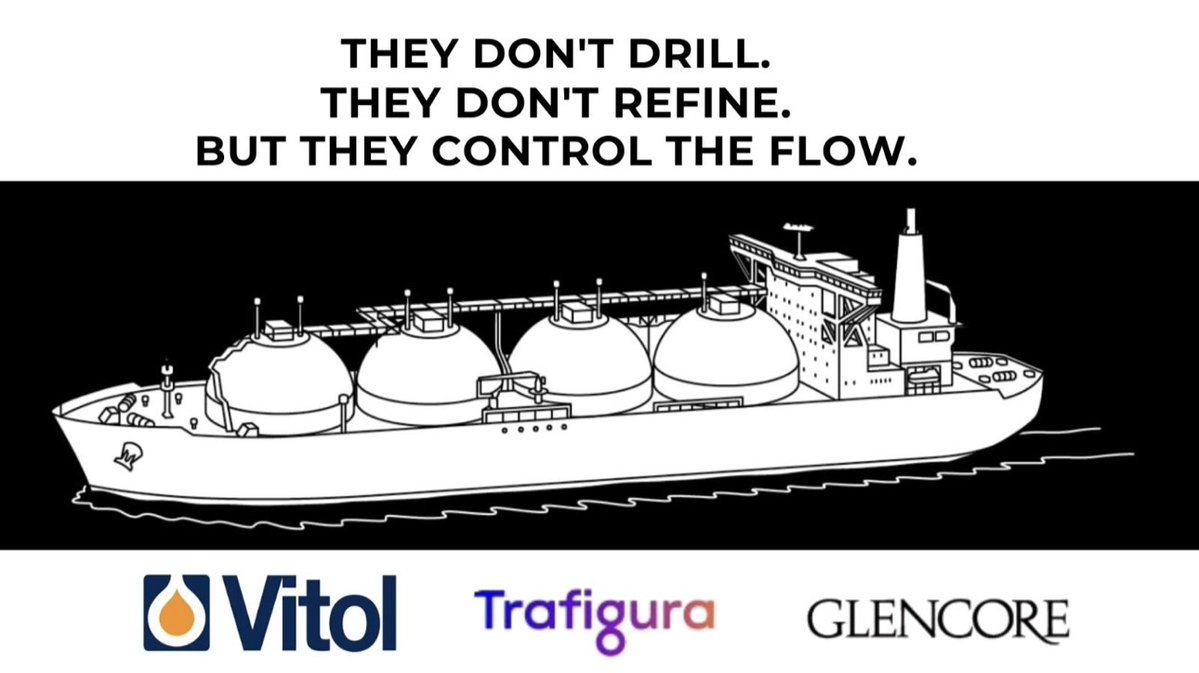
Everyone Knows Shell, bp, and ExxonMobil
But the Real Power Sits Somewhere Else
Shell, bp, ExxonMobil are builders.
💰They spend billions drilling holes in the ground.
But the traders play a different game.
The hidden giants: Vitol, Trafigura, Glencore.
The difference is structural.
👨🏭 Operators
• Take geological risk
• Spend capital years before cash flows
• Make money only if prices cooperate
• 💡Key metric: Reserves Replacement
👨💼 Traders
• Take zero geological risk
• Deploy balance sheet, ships, storage, timing
• Make money on volatility, not direction
• 💡Key metric: Arbitrage spread
Vitol does not care if oil is $100 or $40.
They care if oil is $40 in Texas and $42 in Tokyo.
They charter the tanker
They book the storage
They move the molecule
They pocket the spread millions of times a year.
In 2022, while producers struggled with policy shocks and cost inflation, Vitol made $15 billion in profit.
That is more than the GDP of some countries 🤯
#oott #Brent #WTI
Vi är många som undrar varför media i Sverige och andra västländer är så tysta.
Anledningen är att de inte vill erkänna det mest obekväma: det iranska folket gör uppror mot islam självt - inte bara mot regimen.
För att rapportera ärligt om varför människor riskerar livet måste man förklara att Islamiska republiken i årtionden har kvävt allt: yttrandefrihet, arbete, familj, konst, kvinnor och ekonomiskt överlevnad under ett prästerskap som ser frihet som brott. Det går inte att berätta historien utan att kritisera islam som ideologi.
Men i västerländsk progressiv debatt har islam rasifierats - det behandlas inte som en tro eller politisk lära, utan som en sorts etnicitet eller hudfärg. Att kritisera islam likställs med rasism mot ”bruna människor”, araber eller Mellanöstern. Iranier (som inte är araber) suddas helt ut i den här förenklade världsbilden.
Samtidigt visar Iran hur statskontrollerad ekonomi slutar: centralstyrning, prisreglering, nationalisering och byråkrati har förstört medelklassen, skapat massfattigdom och gjort korruption till det enda "fungerande" systemet. Att rapportera detta ärligt skulle hota många mediers egen ideologi om storskalig statlig styrning och centralplanering.
Därför tiger de. Iranska demonstranter passar inte in i deras enkla mallar om förtryckare/förtryckta, kolonisatör/koloniserad, vit/icke-vit. De visar att auktoritarianism inte är något väst har påtvingat omvärlden – utan något många utanför väst aktivt kämpar för att bli av med.
Därför fortsätter tystnaden. Eller nästan ännu värre, den (kanske) medvetet felaktiga rapporteringen.
If you claim to support human rights yet can’t bring yourself to show solidarity with those fighting for their liberty in Iran, you’ve revealed yourself. You don’t give a damn about people being oppressed and brutalised so long as it’s being done by the enemies of your enemies.