👀 First look at FIP.16
@FlareNetworks is introducing a system where network activity DIRECTLY DRIVES VALUE for #FLR holders ⚡️
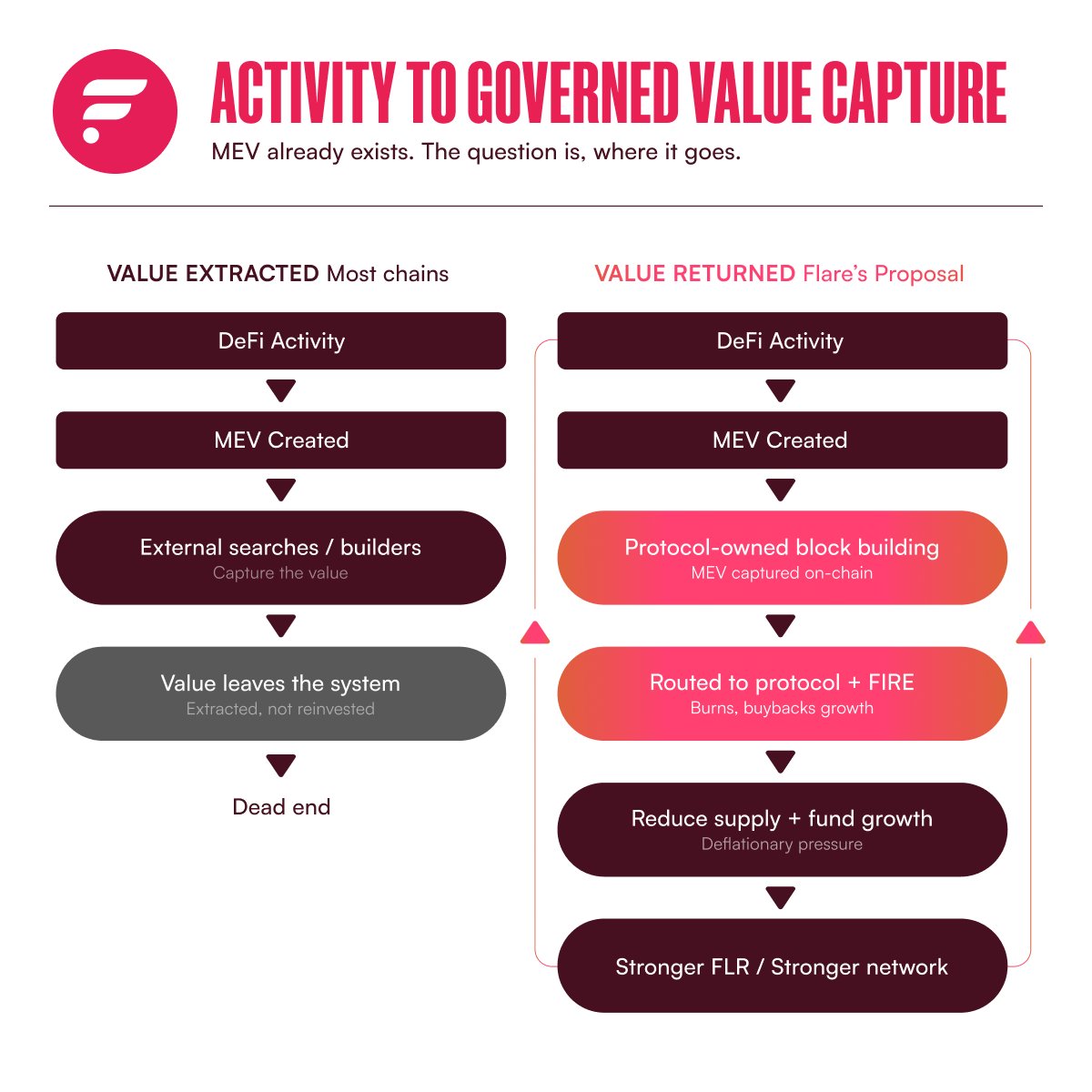
📜FIP.16 connects data, cross-chain assets, and protocol services into real revenue streams—then routes that value back into the ecosystem 🔄
⏬ Reducing supply 🔥
💪 Strengthening #FLR
This is the beginning of true value capture.
🚀Something big is happening on #Flare ⚡️
💠 Network activity is being directly tied to real economic value for #FLR holders 📊
👉 FIP.16 introduces a system where fees, data services, and cross-chain activity flow back into the ecosystem:
✅ Reducing supply 🔥
✅ Strengthening the token 💪
✅ Aligning growth with usage.
💥This is how value accrues💥
What is FIRE?
FIRE = Flare Income Reinvestment Entity.
It's the governed pool that collects protocol revenues and allocates them under a defined mandate.
Primary mandate: reduce FLR supply to the maximum extent possible (buyback + burn).
Secondary: reward asset issuers proportional to activity, support dApp liquidity, and fund ongoing Foundation operations (security, engineering, ecosystem).
Here’s the shift:
📊 Revenue → buybacks 🔁, burns 🔥or inflation offset 📉
If protocol revenue scales with activity, it neutralizes or exceed issuance.
That’s how you create a self-sustaining system ⚙️
🚫Not hype. 🚫Not speculation.
A true on-chain economic engine for #FLR 🚀
🌋Something big is happening on @FlareNetworks 🚀
For the 1st time, network activity is being directly tied to real economic value for #FLR holders.
👉 FIP.16 introduces a system where fees, data services, and cross-chain activity can flow back into the ecosystem—reducing supply, strengthening the token, and aligning growth with usage.
🔥This is how value accrues🔥
🔥FIP.16 is a game changer for $FLR token
FIP.16 + FIRE is @FlareNetworks shift from emissions-first tokenomics to a true network revenue engine🔥
Activity from FAssets, data, Smart Accounts & network-positive MEV can be captured, routed, burned, or reinvested back into the ecosystem.
That’s how value starts flowing back to $FLR ♻️📈
Not hype. Mechanics. The flywheel is turning. 🚀
🎧 WATCH VIDEO 👇
TEEs on Flare let developers run sensitive or complex computation offchain, generate cryptographic evidence about what code ran and what result it produced, then bring that result onchain for smart contracts to use.
The result is a practical bridge between private offchain computation and verifiable onchain execution.
Learn more here: https://t.co/9XobPRPujU
At @SentoraHQ , we have been working on the thesis that vault curation in DeFi will transition from human curation to human-supervised AI curation to fully autonomous agentic curation. Vaults in @Morpho , @eulerfinance , @kamino will be operated by agents. Today, we published a whitepaper about our thesis including some deep dive in the AI techniques that unlock this vision: https://t.co/Z5i3CMQWOG
@SentoraHQ vaults and strategies served hundreds of millions of redemptions during the weekend , fully liquid without any delays. When part of DeFi was closed, @SentoraHQ remained open as one of the few sources of liquidity in the market. Thanks to our partners who worked with us throughout the weekend. This was another test to the resilience of our infrastructure. This thing is not over yet. Stay safe.
As a precautionary measure, we are temporarily pausing FXRP cross-networking via OFTs between Flare, Ethereum, Base, and other supported networks while the rsETH incident is being investigated.
Users holding FXRP on non-Flare networks cannot currently redeem, as redemption requires assets to first be bridged back to Flare.
FXRP on Flare continues to function normally apart from OFT-based cross-networking. Minting, redemption, liquidation, and all other in-network functions on Flare remain operational. There is currently no indication of an issue affecting Flare or FAssets.
We will share further updates as the situation develops.
The key security point about FAssets v1.3 is this:
Minting will route to the Core Vault, governed by explicit safety limits: hourly caps, daily caps, and delays triggered by large mints.
For redemptions, agents still play a role, and the collateralized payout model remains intact.
These are different control surfaces with deliberate speed bumps, resulting in lower risk.
More rollout details to follow.
In FXRP v1.2 the agents act as a limiting factor for how much can cross the bridge in any one time period.
In FXRP v1.3 agents are still a limiting factor on redemptions and the core vault has a limit on how much can be minted in any one time period.
Whilst contra to how the rest of DeFi operates we have designed the system with these speed bumps as a sanity check to reduce risk.