“Functional training” has become an overused buzzword in the fitness industry, often associated with exercises that challenge balance, involve unstable surfaces, engage multiple joints, or mimic everyday movements. While these approaches make good for clickbait marketing hype, do they actually make an exercise more functional?
To help clarify this widely misunderstood concept, I collaborated with an international team of experts to develop a consensus definition of functional training using a modified Delphi approach (PMID: 40102701).
We settled on a few main themes:
1. Functional training is goal-dependent. An exercise is functional to the extent that it helps an individual achieve a desired outcome, whether in sports, daily activities, rehabilitation, or general fitness.
2. Specificity and individualization are key. The functionality of a training program depends on how well it aligns with an individual's goals, needs, and characteristics.
3. No exercise is inherently more functional than another. Squats, leg presses, machines, and free weights can all be functional depending on the intended purpose. The equipment or complexity of a movement does not determine its functionality.
4. The term itself may be redundant. Virtually every member of our expert panel raised concerns that “functional training” overlaps with the broader concept of training itself. Every well-designed training program should have a specific purpose, making the distinction between “functional” and “traditional” training largely unnecessary.
Bottom line: Rather than labeling exercises as “functional” or “nonfunctional,” it is more appropriate to view functionality along a continuum based on how well a training program aligns with an individual’s goals and needs. For most people in the general population, a basic resistance training program focused on building strength will likely be sufficient to improve their ability to perform everyday activities. There’s no need to overcomplicate things with elaborate exercises marketed as “functional.”
https://t.co/su9j3TyMIS
Here is a full list of all the experiments I have conducted on myself so far in 2026
Peptides / research compounds
GLP agonists:
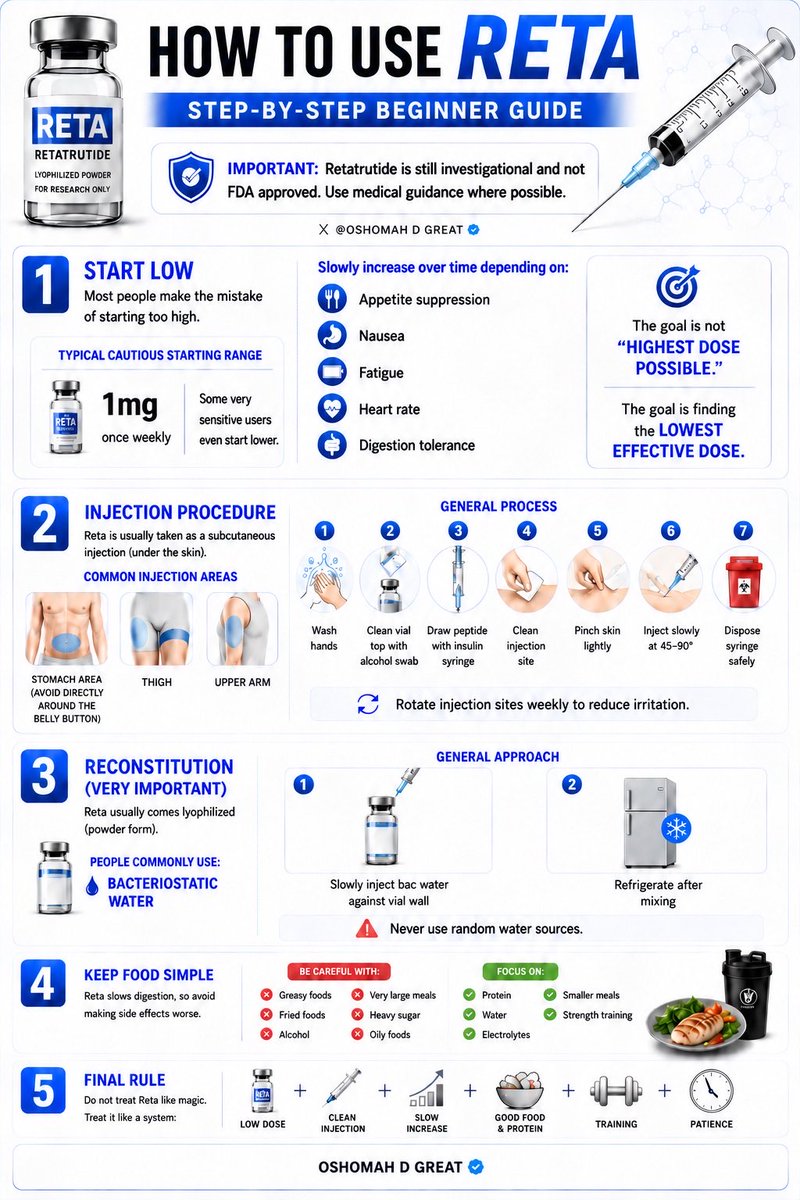
> Reta: Fat loss and appetite control. Goated. RHR went up but it legit changed my life. 206 → 178 in six months. Great appetite suppression, more baseline energy, little to no post meal crash, faster satiety while eating, zero desire for alcohol. Some GI discomfort and burping at the start but resolved quickly
> Tirz: Weight maintenance. Meh. Better sleep and lower RHR, but doesn't have the "reta edge" feeling. Lower baseline energy and a post meal crash. Always end up back on the GLP3
GH axis / IGF:
> HGH: Recovery and body comp for the growth phase. Like it so far, new add-in. Some hand and leg tingling as I titrate up the dose, but overall no clear insulin resistance issues (monitoring this). Feel full and strong. Lots of water retention at the start but starting to level out now
> IGF-1 LR3: Site specific growth/pumps. Good pumps but expensive, likely has run its course. No real interest in continuing at this point
> CJC/Ipa: Sleep, recovery, GH pulse. Loved it at first. Flush before bed in cool sheets was amazing, and the sleep and recovery benefit was real, I noticed it. Then started lumping hard so dropped it
> Tesa: Same, sleep and recovery. Much better experience than the CJC/Ipa, no issues
> Tesa/Ipa blend: Bigger GH pulse. Same benefit but I noticed I started responding poorly to the ipa. Eventually decided to switch to GH
Repair / anti-inflammatory:
> GLOW (BPC-157 / TB-500 / GHK-Cu): Injury repair and skin. My shoulder potentially recovered quicker, but overall, I think GLOW is overhyped. Probably sticking to topical GHK and Wolverine for injury in future
> Oral BPC-157: Gut. GI got better, I like it
> KPV: Inflammation and skin. Love it, noticeable difference. Shoulder acne gone, back acne cleared up a lot
> Glutathione: Antioxidant and liver, came in to replace the NAC. Believer. Also, I believe it helped me recover from illness quicker, keeping it in for a while
Mitochondrial / metabolic:
> SS-31: Mitochondrial membrane repair. Didn't notice much. Stacked with MOTS-c, dropped because I was lumping
> MOTS-c: Energy, work capacity, fat loss. Loved it at the start. Consistent energy, higher gym work capacity, noticeable caffeine sensitivity increase, and fat loss felt accelerated stacked with a GLP-1. Then I developed a mast cell reaction and the lumping got too much. Switched to ATX-304
> ATX-304: Insulin sensitivity, glucose uptake, fat loss. 150mg was too much for me, lethargic af. 50mg now and keeping it for the foreseeable future. Made me nearly shit my pants when I first started on it, but that got better with time
> SANA (MVD1): Thermogenesis and fat loss. Honestly didn't notice much of anything from this. Pushed it up to 500mg per day but going to hold on it for now until I start cutting again
> SLU-PP-915: Endurance and cardio output. Love it, changed cardio completely. Mildly stimulating up front but it wears off quick. The real thing is the gas tank. Steady state and high volume rep work both feel like the ceiling moved rather than like I'm stimmed
> SLU-PP-332: Same, stacked with the 915. Confounded. Ran 20mg 915 / 100mg 332 and felt a solid boost.
> GW0742: Cardio output and endurance. Dropped it because for some reason it makes me cramp bad
Sleep / circadian:
> Epitalon: Sleep onset and circadian rhythm. LOVE this one. Dipped my toes into the bioregulators, will definitely be experimenting with more. Vivid dreams that got more vivid over the run, morning headaches days 1 to 10-11 then gone, sundown fatigue hit hard, easier to get to sleep and maintain sleep hygiene
> Seltorexant: Sleep latency. GAME CHANGER. Cured my racing mind and sleep latency issue, especially on high stim days.
Cognitive:
> Adamax: Focus, drive, cognition. I like it, subtle but solid
> Selank: Anxiolytic, the calm under the stims. Thought the nasal was garbo. Injectable seemed to work decently. Subtle effect but helped calm my mind on high stim days. When stacked with stims evened them out. May try Adalank next
> Dihexa: Memory and learning. Day 2 right now, verdict TBD
Cosmetic:
> MT2: Tan. I mean shit works. Turns me into a lobster acutely but works. Likely will give MT1 a run next spring/summer
Sexual Health:
> HCG: Fertility and testicular function. Balls still work
AAS
> Test: TRT. Staple, always in no matter what. It is the goat, forever and always
> EQ: Lean mass, plus the E2 angle alongside more Test. Chill so far, seems to be controlling E2 well after bumping Test, pending bloodwork
> Mast P: Dry and hard without the bloat. Didn't go bald, super dry, felt amazing
> Oxandrolone: Strength and dry gains. Love it, great PWO, want to run injectable soon
> Proviron: Free T and libido. Added on top of mast, felt even better, ran solo too, amazing for libido
Ancillaries
> Anastrozole: E2 control. Dropped it, bye bye, hopefully never to return. Went to daily pins for TRT.
> Tadalafil: Blood flow and endothelial health. Staple, love it. Better pumps, libido, seems to help some with BP too. Plus the longevity research
> Nebivolol: BP and resting heart rate. Ran at such a low dose I don't really think it did anything. Pulling it because I don't see a reason to have it now that reta is low enough to not cook RHR
Nootropics / stimulants
> Bromantane: Energy and focus without the caffeine crash. Gamechanger, I love it. Mood uplift, clear headed light "locked in" feeling. Onset hour 1-2, peak around hour 4, sustains well past that, no hit to sleep latency. Clean, not cracked out like Adderall.
> L-tyrosine: Dopamine substrate for the bromantane. Stacked with it every time I take it, nice add on, no opinion isolated
> NSI-189: Memory and verbal fluency. Dropped it, didn't feel much of anything from it. On to Dihexa
> J-147: Neuroprotection and mitochondrial function. Stacked with PQQ, solid, ran with this one for a while, fan overall
> PQQ: Mitochondrial biogenesis. Stacked with J-147 but I like the blend
> Nicotine pouches: Focus and working memory. I am addicted
> Kratom: Dropped it and life improved, and so did my labs
> Gorilla Mind energy: Caffeine plus the nootropic actives, and it's what the bromantane rides on in the AM. Love them, staple
> Green tea: Afternoon caffeine. Kinda miss this. When I was cutting I'd drink like 3-4 a day. Good solid kick without nuking sleep
Sleep
> CBN: Sleep. Love it, use nightly in cycles
> Chamomile: Wind down before bed. Dropped it a while back but was a nice tea
Topical / scalp
> RU58841: Hair protection on mast. Still have hair so it's helping.
> Nizoral: Scalp inflammation and mild anti-androgen. Has been in the stack for ages now.
> Topical GHK: Skin and recovery. Used it on a fresh tattoo and a sunburn and recovery was noticeably faster. Breaking out way less since I started using it on my face. Always in the stack
> PDRN: Skin. Been liking it too, my face has been the clearest it has ever been
Supplements
> TUDCA: Liver. ALT went 39 to 24 and GGT 27 to 19. Looks great
> Fish oil: Heart health/lipids. Staple. Latest panel LDL 46, HDL 49, ApoB 45, trigs 76, hs-CRP under 0.2. My LDL came back lower than my HDL. Something is working
> D3 + K2: Immune, bone, and hormone support. A lot of office guys run low so always on it, staple, bloodwork good
> CoQ10: Mitochondrial ATP production and heart protection. Staple
> Vitamin C: Immune cover and collagen. Going to be on now for the winter months
> NAC: Liver and antioxidant support. Phased out because it smelled bad, would rather run TUDCA and glutathione
> Creatine: Strength and cell volume. Turns me into a water log, dropped it quick. Not a fan of what it does to my physique
> Selenium: Thyroid protocol. TPO trending down
> Myo-inositol: Also thyroid, plus insulin sensitivity. TPO better
> Black seed oil: Thyroid stack, like it
> Zinc: Also a thyroid add. Conversion cofactor, immune, and a little aromatase cover once the AI came off. Solid
> Boron: E2. Was kinda dumb, dropped it
> Magnesium: Baseline sleep stack, helps me wind down
> Glycine: Sleep stack, like it, tastes good.
> Taurine: Sleep and heart benefits. Bumped 1g to 3g. Like it
> Pregnenolone: Mood and brain fog. Love it for the mood benefits and sleep
> DHEA: Hormone precursor. Dropped it in July, just didn't see a need for it. In range now and keeping HCG/preg for the neurosteroid side
> B complex: Energy, methylation, homocysteine. Love it but makes my piss neon
Biggest winners of the year: Reta, Selto, 915, Epitalon, KPV, bromantane, proviron
Biggest flops: SS-31, NSI-189, boron, kratom
This is by no means medical advice, a protocol, or recommendation. I am dumb, do not be like me, this is for educational and research purposes only.
A sauna is not a passive activity. Your heart works about as hard as it does during light cardio, and that changes how you should read the survival data.
Sauna gets treated as relaxation, which makes the longevity findings look like magic, but the mechanism is simple. When you sit in heat that intense, your body's main job is to get rid of heat before your core temperature rises. It does this by opening the blood vessels in your skin and sending a large share of your blood to the surface, where the heat can escape. With so many vessels open, your blood pressure would fall, so your heart has to pump faster and harder to hold it steady. Your heart rate climbs and stays up for the whole session.
One study tracked heart rate and blood pressure through a 25-minute sauna session and compared it with an exercise bike test in the same people. The strain on the heart matched light to moderate exercise, roughly the effort of an easy to steady bike ride. Sitting still in the heat was doing real cardiovascular work.
In another study, 102 adults who each had at least one heart disease risk factor did a single 30-minute session. Afterward their arteries were measurably less stiff, and the top number of their blood pressure dropped from 137 to 130. One session moved both in a healthy direction.
The survival data lines up with that. In a study of 2,315 Finnish men followed for about 20 years, the more often someone used the sauna, the less likely he was to die during the study. Death rates dropped step by step. They were highest in men who went once a week, lower in those who went two to three times, and lowest in those who went four to seven times a week. Deaths from heart disease followed the same pattern, so the benefit grew with how often the men went, not just whether they went at all.
This study observed one group of middle-aged Finnish men rather than running a controlled experiment, so it cannot prove that sauna caused the benefit, and the frequent users may have been healthier to begin with. No trial has tested sauna directly against lifespan. What the evidence does show is that heat gives your heart and blood vessels a real workout, and the dose that matters appears to be how often you do it.
References: Laukkanen et al., JAMA Internal Medicine, 2015. Laukkanen et al., Journal of Human Hypertension, 2018. Ketelhut and Ketelhut, Complementary Therapies in Medicine, 2019.
Years ago, as an aspiring exercise science student, I bought into the idea that consuming protein immediately after lifting weights was essential for maximizing muscle growth. However, as I delved more into the research, I became less convinced of its importance.
To gain greater clarity on the topic, I led a study to determine if pre- vs post-protein intake influenced results (PMID: 28070459). We randomized 21 resistance-trained men to consume 25 g of whey protein either immediately before or immediately after training. Participants followed a supervised resistance training program, 3 days/wk. Those consuming protein before training refrained from eating for at least 3 hours afterward.
After 10 weeks, results indicated no statistically significant differences between groups in muscle hypertrophy, strength gains, or body composition. The results are consistent with acute research showing similar anabolic responses to pre- vs post-exercise protein consumption (PMID: 16896166).
The takeaway: Our findings challenge the notion that protein must be consumed immediately after exercise to maximize muscular adaptations. Instead, they support a broader, more flexible peri-workout window in which protein consumed either before or after training can effectively support muscle growth.
It should be noted that the study had a relatively small sample, so the findings should be interpreted with appropriate caution. That said, results align with the broader literature on the topic.
Bottom line: Getting sufficient daily protein is a priority and is by far the most important nutritional consideration for muscle-building. Consuming protein around your workout can be beneficial, but there's no compelling reason to believe you need to slam a protein shake immediately after finishing your last set.
https://t.co/gwj0cCj6gH
Entrenas una hora. ¿Y las otras veintitrés?
Mientras lees esto, tu corazón late, tus pulmones se llenan, tus riñones filtran y tu cerebro sigue encendido. Todo eso cuesta energía. Aunque estés en el sofá.
Lack of time is consistently stated as a primary reason not to lift weights. Our recent study, led by former masters student Ryan Burke, provides evidence that agonist/antagonist supersets can substantially reduce workout duration without compromising muscle growth or strength (10.1016/j.scispo.2025.07.011).
We randomized 43 resistance-trained men and women to perform either traditional resistance training or supersets for 8 weeks. Both groups trained twice weekly, performing the same 6 exercises for 4 sets each, with sets taken to muscular failure.
The key difference was that one group performed all sets of each exercise consecutively, taking 2 min rest between sets before moving to the next exercise. Alternatively, the superset group performed two exercises targeting opposing muscle groups back-to-back, followed by 2 minutes of rest.
Results indicated similar increases in muscle thickness across all assessed muscle groups, as well as similar improvements in maximal strength, muscular endurance, and power. The total volume load was not appreciably different between conditions.
There was one key difference: Supersets reduced workout duration by 36% compared to traditional sets (~44 vs 69 mins). That's nearly 25 mins saved per workout without appreciably compromising muscular adaptations.
The only tradeoff was that supersets produced higher perceived exertion during acute testing, although differences were much smaller when averaged across the 8-week intervention.
Collectively, our findings suggest that pairing exercises targeting opposing muscle groups is a time-efficient strategy for achieving similar gains in muscle size and strength while substantially reducing workout duration. For those with limited time to train, strategically programmed supersets offer a practical way to maximize training efficiency without compromising results. However, it's important to note that these findings are specific to the superset configuration investigated and may not necessarily extend to other superset approaches.
https://t.co/4XnzucfQpI
Most routine physicals check your liver with one number, ALT. If it's under 40, everyone moves on.
The problem is that ALT only rises once enough liver cells are dying to spill the enzyme into your blood. Scarring can build for years before that happens.
In one study, doctors biopsied 51 people with fatty liver disease whose ALT was normal. About 1 in 3 already had advanced scarring or cirrhosis.
Fatty liver affects about 1 in 4 adults worldwide. Imaging and a simple FIB-4 score, which is calculated from routine bloodwork, catch it far earlier than ALT does.
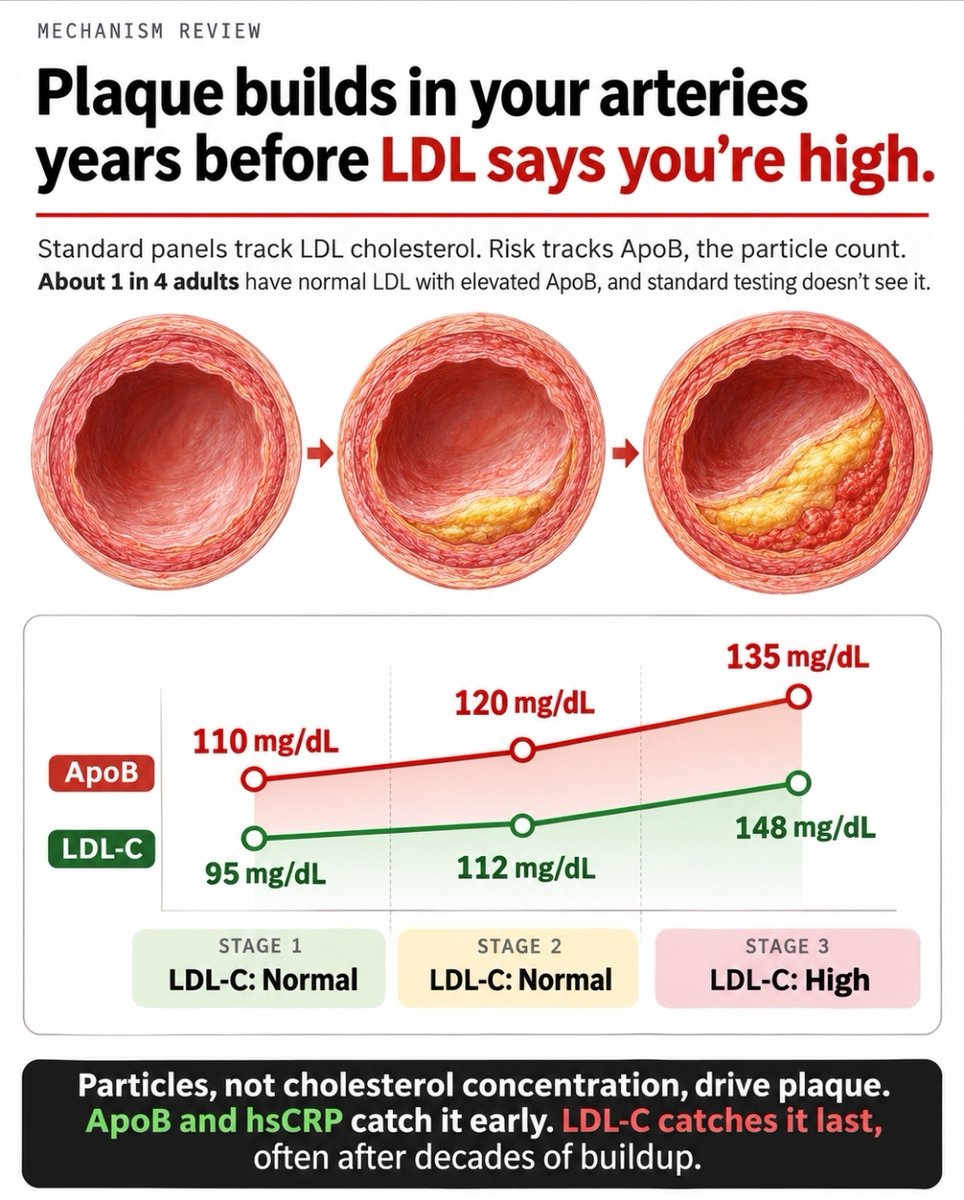
Your standard cholesterol panel measures how much cholesterol your LDL particles carry. What actually clogs arteries is the number of particles, and ApoB counts them directly, because each of those particles carries exactly one ApoB protein.
Two people can have the same LDL and very different particle counts. That mismatch shows up in about 1 in 4 adults, and more often with high triglycerides, insulin resistance or extra weight around the middle.
A pooled analysis of 12 studies covering 233,455 adults found that ApoB was the strongest predictor of heart attacks and strokes, and LDL was the weakest. Next time you get bloodwork, it's worth asking for ApoB, Lp(a) and hsCRP.
Most people think of collagen and vitamin C as two separate supplements, but inside your body they work as one system, and if you take away the vitamin C, the collagen stops working.
Collagen is made of three protein strands that twist together into a tight rope, and that twist is what gives your skin, tendons and joints their strength. The strands can't hold that shape on their own, though. Each one first needs a small chemical change, and your body can only make that change when vitamin C is around to help the enzyme that does the work. Without enough vitamin C, the strands never lock together properly.
The practical result is striking. In lab experiments with human collagen, strands made without that change fell apart at about 90 to 93 degrees Fahrenheit. When vitamin C was present and the enzyme could do its job, the collagen stayed stable up to about 104 degrees. Your body sits at about 98.6 degrees, which means that without enough vitamin C, the collagen you build comes apart at the temperature you live at.
That is what was really happening with scurvy. Sailors with scurvy were eating plenty of protein, but with no vitamin C they couldn't make collagen that held together, so their wounds reopened, their gums broke down and even old scars came apart. The cure turned out to be limes rather than more meat.
If you take collagen for your skin or joints, the vitamin C isn't an optional extra, because it's what allows your body to build anything with the collagen you eat. Most people who eat fruit and vegetables every day already get enough, so the people who should pay attention are those who rarely eat produce, smokers, and anyone relying on a collagen powder to do the job by itself.
To be fair about the evidence, the exact temperatures come from a lab system rather than measurements inside living people. The overall finding isn't in doubt, though, since this is well-established biochemistry.
References
Myllyharju, Ann Med, 2008
Booth & Uitto, Biochim Biophys Acta, 1981
Lamberg et al., J Biol Chem, 1996
Muscle rebuilds in about 3 months, while tendons and cartilage take about 1.5 years and bone over 2. Adding 40 g of whey a day for 2 weeks didn't speed up any of them, since connective tissue is still built from protein but rebuilds so slowly that load and time set the pace.
The glass of wine with dinner is the amount almost everyone treats as safe. For seven cancers, it is already enough to raise your risk.
A 2026 analysis in Nature Health pooled 843 studies using a conservative method designed to report the smallest effect the data can support. Across all ten cancers examined, risk rose with intake, and for seven of them it was already elevated below one standard drink a day: pharynx, colorectum, esophagus, breast, liver, pancreas, and prostate. There was no threshold below which the risk disappeared.
The magnitude is not the same for every cancer, and the graphic shows that honestly. The strongest signal is in the upper aerodigestive tract. Pharyngeal cancer carried by far the highest minimum excess risk in the analysis, with laryngeal cancer next, and the other aerodigestive sites following. Colorectal and breast cancer showed clear, consistent dose-response relationships of smaller size. Liver, pancreatic, and prostate cancer showed the smallest excess risk with wider uncertainty, but still no safe floor. The direction never reversed, and only the size changed.
This is where alcohol differs from most things people argue about. The same paper found genuinely mixed and weak evidence for several cardiometabolic and neurological outcomes, where low-to-moderate intake was associated with slightly lower risk that weakened or reversed at higher amounts. For cancer there was no such ambiguity. The senior author described the cancer evidence as consistent and unambiguous: risk rises at any level.
The practical point is not about heavy drinking. The cancer signal is already present at the amount most people consider harmless. A single daily drink is not a safe lane for cancer risk. It is the low end of a line that only goes up.
Dai et al., Nature Health, 2026
This is what happens to your body after you do the couch stretch:
· The low back relaxes
· Posture improves
· Glutes fire better
· The body feels less stiff
· Hip flexors relax after hours of sitting
One minute a side, 5 days a week, and your body will thank you.
🧈🥥 ¿Qué es peor para el hígado: la mantequilla clarificada, el aceite de coco o el aceite de palma?
Un estudio ha comparado sus efectos sobre la acumulación de grasa hepática, la inflamación y la resistencia a la insulina.
Los resultados son interesantes. 🧵👇