2/2
Symptoms did not simply increase risk/loss aversion or decision caution. Instead, anxiety and depression appeared to weaken value-to-evidence translation during choice. @cognoman5@MichaelLouisPl1
Preprint, not peer reviewed. Feedback welcome:
https://t.co/jQo3L7rqRP
1/2
New preprint: How do anxiety and depression alter decision-making?
Across behavioural and EEG samples, we combined hierarchical drift diffusion modelling with centroparietal positivity (CPP) to test where symptoms act in the decision process.
#ComputationalPsychiatry
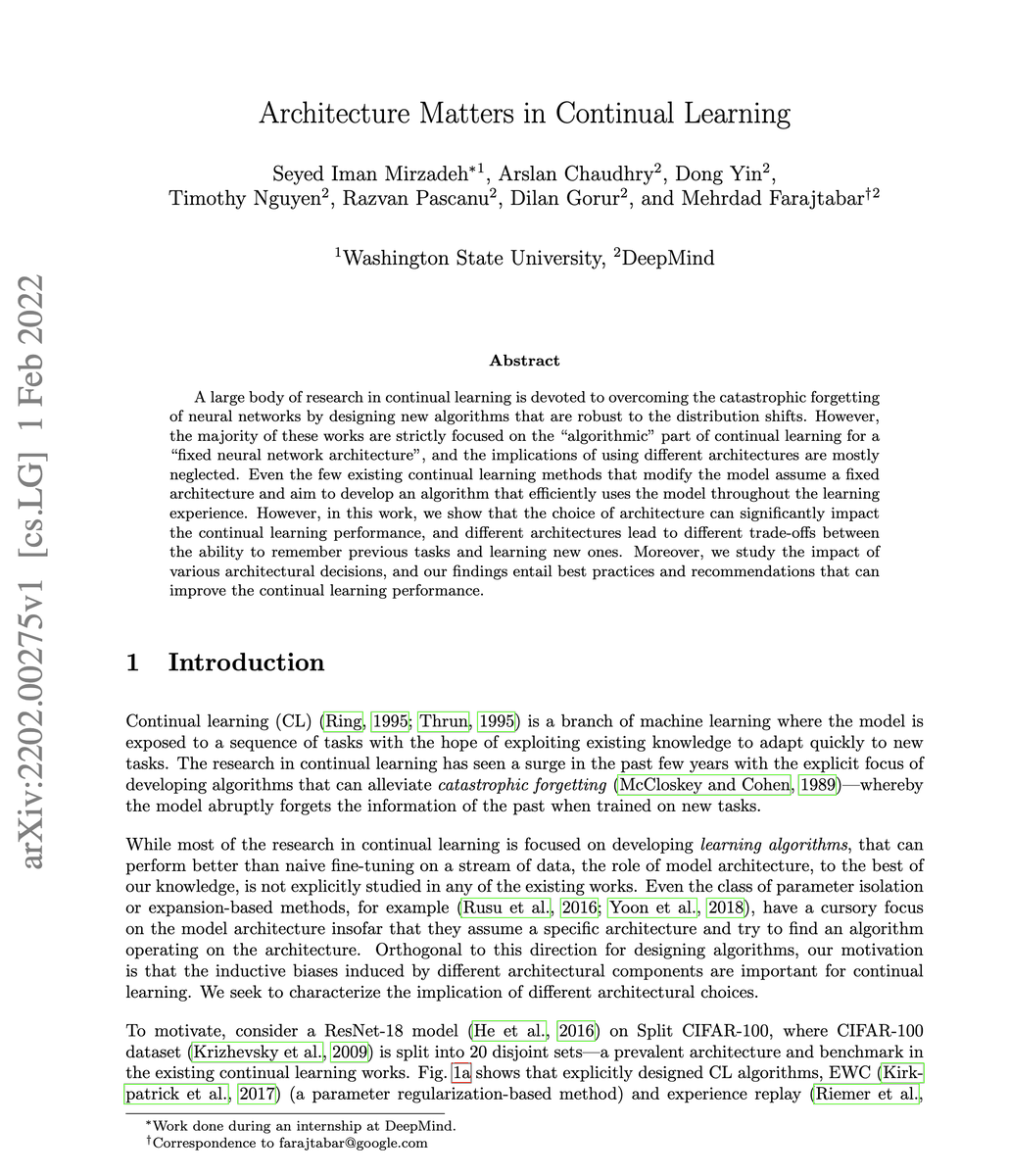
Amazing continual learning paper out of DeepMind 🚨
Most Continual Learning work assumes the backbone is fixed and the burden on the algorithm to fight catastrophic forgetting. This paper flips that assumption on its head and shows pretty convincingly that architecture choices matter just as much for the plasticity–stability trade-off.
A few takeaways that stood out to me:
Learning vs. retention is heavily architecture-dependent. ResNets and WideResNets are great at picking up new tasks, but they forget aggressively. On the other hand, simple CNNs and even ViTs are surprisingly good at retaining old knowledge, even if they learn new tasks more slowly.
Width beats depth. Making networks wider consistently reduces forgetting and improves average accuracy. Making them deeper often gives diminishing returns on learning while worsening forgetting.
Pooling is a hidden culprit: Global Average Pooling is a major driver of forgetting because it bottlenecks the final representation. Removing GAP or replacing it with smaller pooling layers significantly improves retention.
BatchNorm isn’t always helpful. It helps when task distributions are similar, but under large distribution shifts, BN can accelerate forgetting.
What I’d love to see next is this line of work pushed into the LLM regime (larger models, longer task sequences) so we can (1) benchmark continual learning methods more rigorously and (2) start designing architectures explicitly for continual learning, rather than inheriting them from static training.
Excited to see our Centaur project out in @Nature.
TL;DR: Centaur is a computational model that predicts and simulates human behavior for any experiment described in natural language.
In our new @CommsPsychol review, we explore how humans adjust learning to different types of uncertainty, why biases arise, and what this reveals about learning and psychiatric conditions.
📖 Read more: https://t.co/qs2VIn99TN
With @NassarLab & @haukeren
🚨 Funded PhD alert!
Apply by Feb 24th for a PhD with James Goulding, Evgeniya Lukinova (Nottingham) and myself (Birmingham) to work on consumer behavior, big data, machine learning, behavioral experiments, and eye-tracking: https://t.co/BbMBEWRNxr
Please share and RT!
We had a fantastic time at our first lab retreat at the North Sea Coast in Büsum! Besides catching up on our research projects, we discussed challenges in modeling, the future of our field and lab, and career opportunities in science. Thanks to all for this great experience! 🌅
🚨 New paper out! 🚨
Our latest paper with @SebastianGluth, @ErikStuchly and @arkadykonovalov, where we empirically show that people can learn others' social preference from observing their response time ALONE ⏱️ is finally published in @PLOSBiology! 🧵👇
https://t.co/JixrlqxFaH
🚨Open course materials🚨
Excited to share open materials (cc-by-sa) for a 1-week course on using open-source LLMs in social and behavioral science using the @huggingface ecosystem that @ZakASHussain and I finished today at #GSERM@HSGStGallen.
https://t.co/9OZQdUznrB
🚀 NEW PREPRINT ALERT🚀
I am beyond excited to finally announce that my first first-author paper is now available as a preprint: https://t.co/FxLusIXpan We show how hunger state affects the cognitive processes underlying dietary choice. 1/n
New publication @PNASNews: Frequent winners explain apparent skewness preferences
in experience-based decisions
https://t.co/fLJI0XOYcb
With @Mikhail_Spektor and @gael_lemens
Thread(1/7)>>>
🚨New paper alert🚨 „Losses loom larger than gains“, or do they? We find that decision context affects loss aversion, while its rank order across individuals is quite stable. Just published in JEP: General! https://t.co/3jzQ1jr5iM (open access: https://t.co/aZMMdLF9OF) (1/X)
🚨3-year postdoc position🚨
Work with us at @arc_mpib and @mpib_berlin on #NLP projects at the intersection of psychology, #AI, and scientometrics involving #LLMs and the large-scale analysis of publication records.
Thank you for sharing!
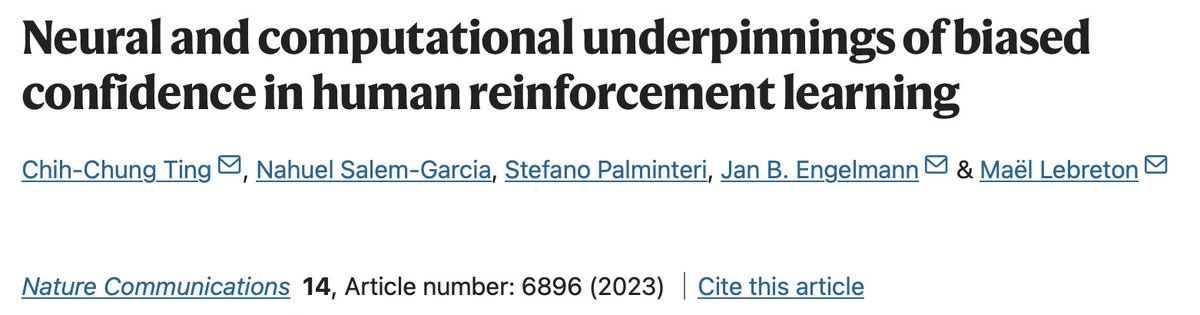
✅New paper (with @NahuelSalem , @StePalminteri , @jbengelmann and @mael_lebreton) is now available online https://t.co/oWHCV6I5NJ
This time, we investigated the role of the ventromedial prefrontal cortex (VMPFC) and dorsomedial prefrontal cortex (DMPFC) in confidence formation.
How deep is your … brain?
In our new @NatRevNeurosci paper, we propose the shallow brain hypothesis. We contest the prevailing view that inference in the brain is hierarchical and can be captured by deep learning algorithms.
with M Suzuki and C Pennartz
https://t.co/YkpkayRUL7
🚀 Fresh Preprint Alert! 🚀
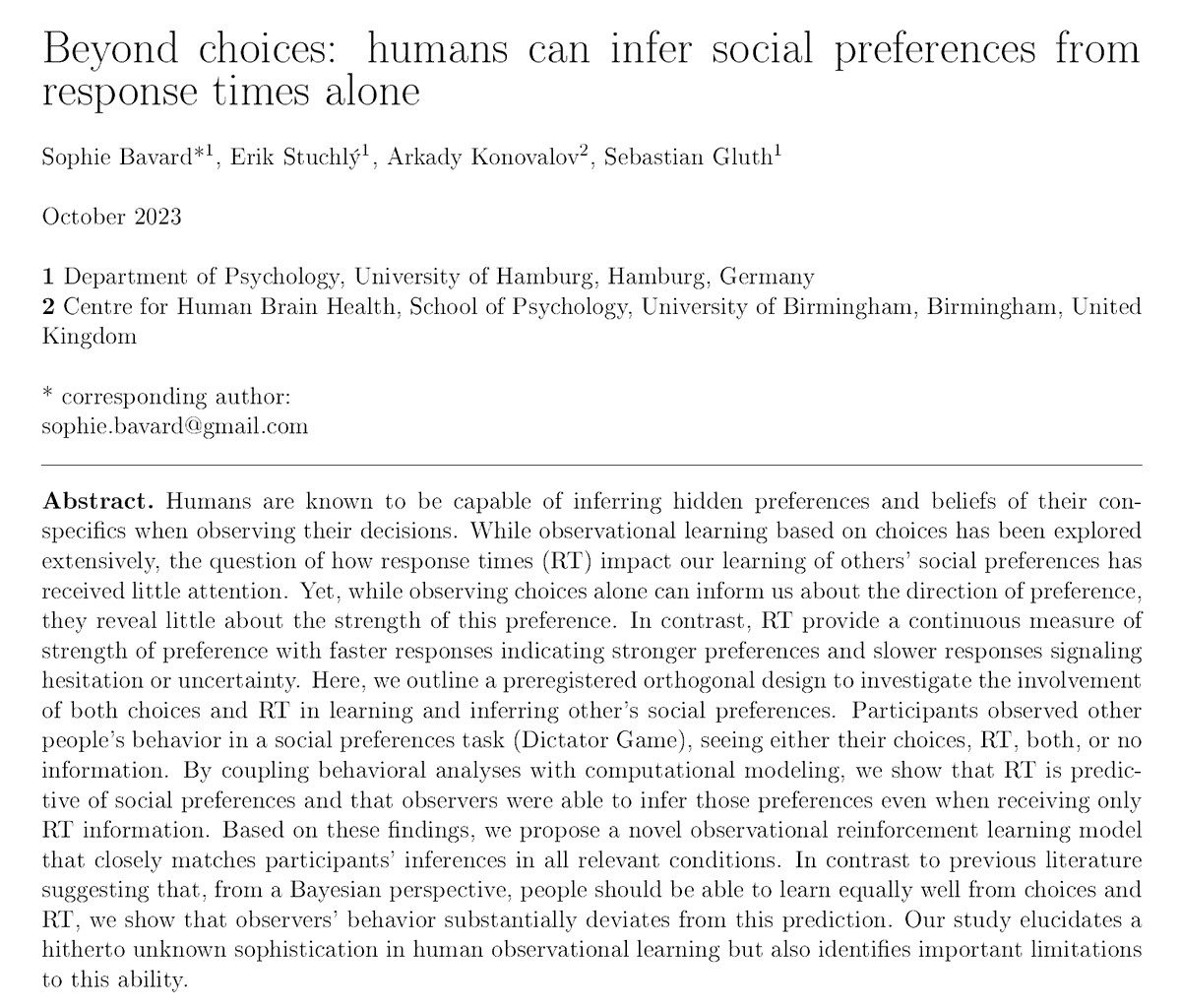
We (w/ @ErikStuchly, @arkadykonovalov & @SebastianGluth) are thrilled to share our work on the impact of response times (RT) on learning others' social preference 👥 main results below, but check out our preprint! 👇
https://t.co/8Kpop9YkHo
📢 We're hiring 📢
Join our lab at the @unihh in the beautiful Hamburg! Apply before October 22nd to join our project on multi-attribute decision-making 📅
Looking for a postdoc position? 👇
https://t.co/Du3GqRjEil
Looking for a PhD position? 👇
https://t.co/dMueJuK9hc