Playing Taboo with GPT-Live as a teammate. Note the fast back-and-forth action and simultaneous speaking and listening.
(Answers: "breaking point", "mixed signals", "hidden agenda", "blind spot", "chain reaction", "moral dilemma", "unfinished business")
Autonomous mode activated in four new cities! ✨ Starting today you’ll see our vehicles with no human at the wheel in Las Vegas—with Denver, San Diego, and Tampa to follow. Want to be one of the first to ride when we start serving these cities? Download the Waymo app and we’ll let you know when you’re in.
In the newsletter today, I wrote about our prediction markets episode, and one of the big ways the internet's changed in the last 10 years.
There are so many more avenues for people with domain expertise to make money, and much less reason to post free alpha online.
IS THE ECONOMIST ALWAYS WRONG?
Scandalously, in some circles @TheEconomist has a reputation as a contrarian indicator. This week we fessed up to getting a big call on oil prices from April wrong.
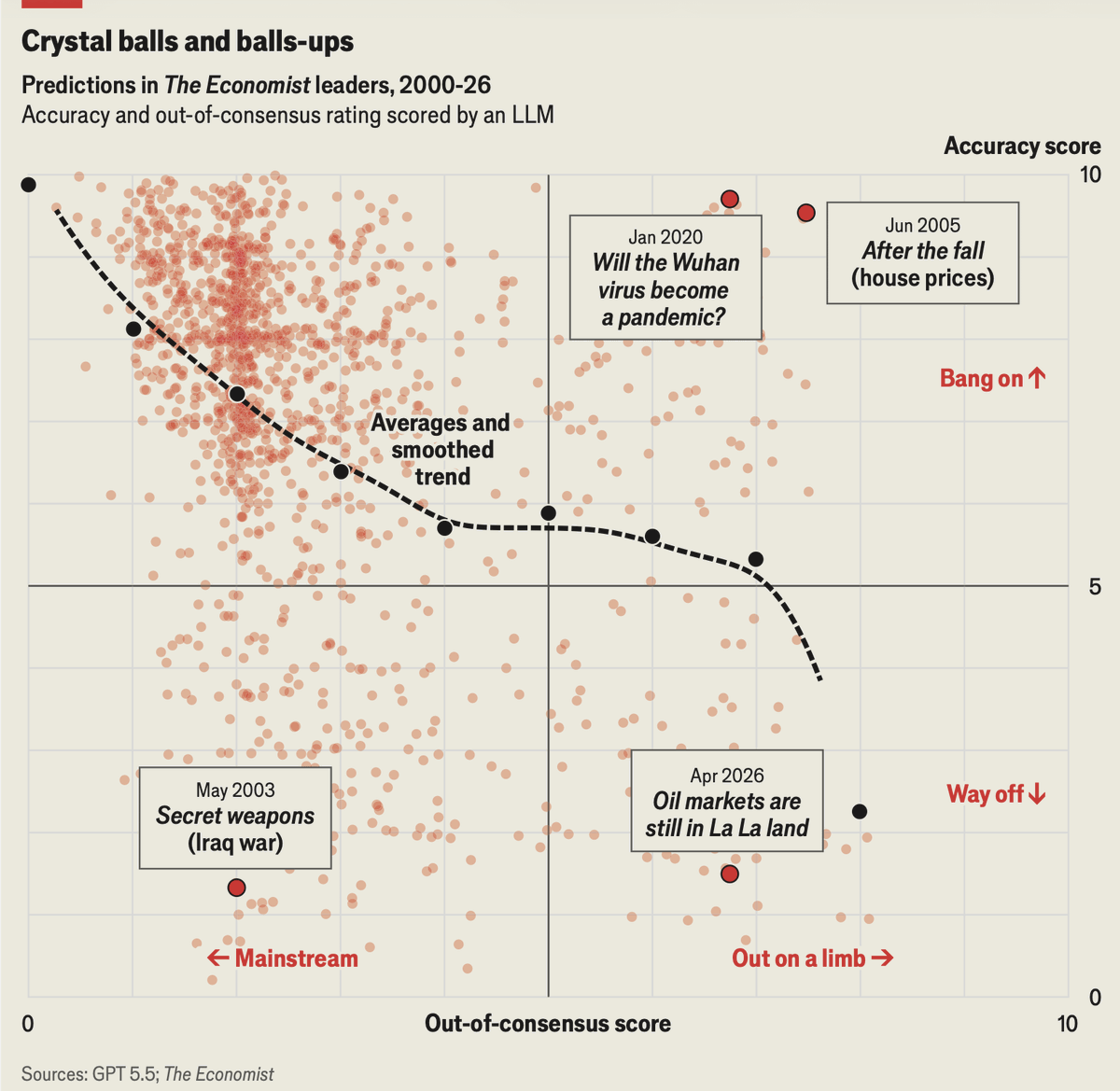
Obviously our goal is not perfectly-hedged (and perfectly boring) predictive accuracy: often it is to stimulate, provoke, and challenge. But I did want to test that wider allegation, so I ran a series of LLM scorers across our full leader database since 2000 (7,000 leaders in all.)
You can see the results in the chart below: each dot is one of the 1,400 leaders where we identified concrete and falsifiable predictions that were central to the argument. Higher = more accurate, further to the right = more contrarian.
We do well, unsurprisingly, when aligned with conventional wisdom. We often do worse when truly out on a limb. But actually, on average, we are a bit likelier to be right than wrong on our somewhat-out-of-consensus calls. All round, a respectable performance.
And as @ecurrnomics points out an accompanying leader, there is no shame at all in being beaten by the market: as good free-marketers we believe deeply in the aggregated wisdom of prices.
Take a look at my piece here, which includes a canter through our best and worst calls of the last quarter-century: https://t.co/WyKqangFrE
Crazy thing in this episode. When our guest started his career at Aldi, they hadn’t implemented barcodes yet. And employees were expected to memorize the price of every item in the store in order to maximize checkout aisle throughput.
The dura is the brain's armor: a membrane so tough that a surgeon normally cuts through it with a scalpel. For the first time in our clinical trials, we inserted the electrode threads of our implant straight through the dura and into the cortex, keeping the dura intact.
Here's how we did it 🧵
Here’s the video showing the moment the lights unexpectedly turned on during Rock ‘n’ Roller Coaster Starring The Muppets!
It was a really cool experience getting to ride it with the lights on!
The lights came on halfway through the ride, and then it stopped near the end. We were stuck there for about 15mins before cast members came to get us out. After that, we walked down the stairs toward the launch station and exited from there. This building is massive inside!
It was an incredible experience! It was actually cooler than Space Mountain with the lights on.
The thing that made Fable so impressive was its creative problem-solving and good judgement calls across long-running projects
You can see this when I had it make a self-aware Snake game. I gave it no design feedback, just "make it better"
Worth trying: https://t.co/KOIp52aGzg