The global aviation community was stunned. The Americans who built the plane were left speechless. Indian engineers & a fearless pilot had taken a foreign cargo plane, bolted a fighter engine to its roof & rewritten the rules of physics in the sky.
It is July 23, 1962. The jagged, barren wasteland of the Karakoram Range looks like the surface of the moon. In the valley below, a crude, unpaved strip of dirt & loose gravel sits frozen in the Karakoram Pass. This is Daulat Beg Oldie (DBO): the highest advanced landing ground on Earth.
Tensions with China are simmering to a boil. The Indian Army jawans stationed on this freezing frontier are completely cut off. They need men, they need ammunition & they need them yesterday. But conventional military wisdom says flying a massive, heavy transport plane into DBO is a suicide mission.
The air is too thin to create lift. The dirt strip is too short to stop.
The Western aviation world had already given its verdict: Impossible. They did not account for Indian ingenuity & they certainly did not account for Squadron Leader C.K.S. Raje.
On the tarmac at Jammu, a twin-boom Fairchild C-119G Packet transport plane affectionately known as the "Flying Boxcar" idles. But this is not a standard American-built cargo plane anymore. Perched precariously on top of its fuselage, like a rocket backpack, is a raw, unshielded British-designed Orpheus 701 jet engine, ripped straight out of a Folland Gnat fighter jet.
This mechanical chimera is the brainchild of Indian maintenance engineers & the fledgling GTRE. It is an unproven, terrifying gamble. If the jet engine fails/if its immense thrust rips the roof off the fuselage, the plane will disintegrate. Climbing into the cockpit is Squadron Leader Raje. Walking in right behind him are 32 battle-ready jawans loaded with full gear & Air Vice Marshal Erlic Pinto, the chief of Western Air Command, who refuses to let his men take a risk he will not take himself.
The props blur into motion. The piston engines roar. The modified Packet lifts off, heavily clawing its way toward the roof of the world. As Raje navigates the treacherous Himalayan peaks, the true nightmare begins. The air is so thin that the Packet’s twin piston engines begin to gasp for oxygen, losing power. The control columns vibrate violently. Below them, DBO appears, a tiny, dusty brown ribbon surrounded by lethal mountain walls.
There are no air traffic controllers, no radar, no paved runways. Just a strip of loose earth.
Raje throttles back. The massive plane drops like a stone through the thin air, bouncing violently as its tires slam into the gravel of DBO. Dust explodes around the fuselage. The brakes screech, fighting the loose rocks, throwing the passengers forward against their harnesses. Against all mathematical odds, they stop. The doors fly open. The icy Himalayan wind rushes in & 32 jawans step out onto the highest battlefield on earth.
But landing was only half the battle. The real terror is the takeoff. To get a heavy transport plane off the ground at 16700 feet, you need speed that the thin air physically denies you. The runway is too short. The mountain at the end of the strip is rushing closer by the second. Raje lines up the Packet. He pushes the piston engine throttles to the absolute wall. The plane starts rolling, but it is sluggish, heavy, dragging through the gravel.100 meters... 200 meters... the end of the strip is coming up at terrifying speed.
The plane is not lifting. It is a dead weight. Raje reaches for a custom-built switch on the panel. The Jet Toggle. He flips it. With a deafening, supersonic shriek that echoes across the Karakoram range, the Orpheus jet engine on the roof ignites. 20 kN of pure, unadulterated jet thrust punches the cargo plane from behind. A massive column of flame & jet wash erupts over the tail.
The Packet does not just accelerate, it rockets. The front wheel lifts off the gravel just as the runway runs out. The massive cargo plane claws, screams & blasts its way into the sky, clearing the jagged mountain peaks by a matter of yards. When Raje touched down back at base on July 23, 1962, he had not just completed a supply run. He had shattered a world record for the highest take-off & landing by a transport aircraft in aviation history.
@tehseenp Great job @tehseenp sir, request you raise this issue in the interest of common man in parliament as well, as apparently no politician is talking on this.
The #LPGshortage of #GasCylinders for Restaurants, Hotels & homes will hurt our economy, create job losses & inconvenience. The Hon'ble PM must push Hardeep Puri ji out of the Miinistry of Petroleum & Natural Gas not just metaphorically but physically for being this incompetent & arrogant!
Were you FU(K¡N sleeping so far? Screwed over the Service Industry which employees a large number of people & contributes heavily to our GDP growth. Shameless & pathetic and this is why Babus are a curse on India & we need to reduce the bureaucracy numbers.
#LPGShortage
This man who heals what doctors can't:
Jiddu Krishnamurti.
It's impossible to be psychologically trapped, stressed, or anxious after understanding his teachings.
Here's his 5-step approach to unlocking mental freedom:
Leading a secular government that Islamists detested, Hasina gave Bangladesh rapid economic growth. But powerful external forces were aligned against her. Her decision to award the Teesta project to India angered China. And, sadly, Biden went after her. https://t.co/9TyjjSQXZY
-#NASA's mind-boggling supercomputer model shows how carbon dioxide moves around planet
-Orange plumes erupt from Earth surface
-Over #India 420-460 PPM greenhouse gases seen
-See how #China not only threatens India militarily but CO2 drift from China to India adding to pollution
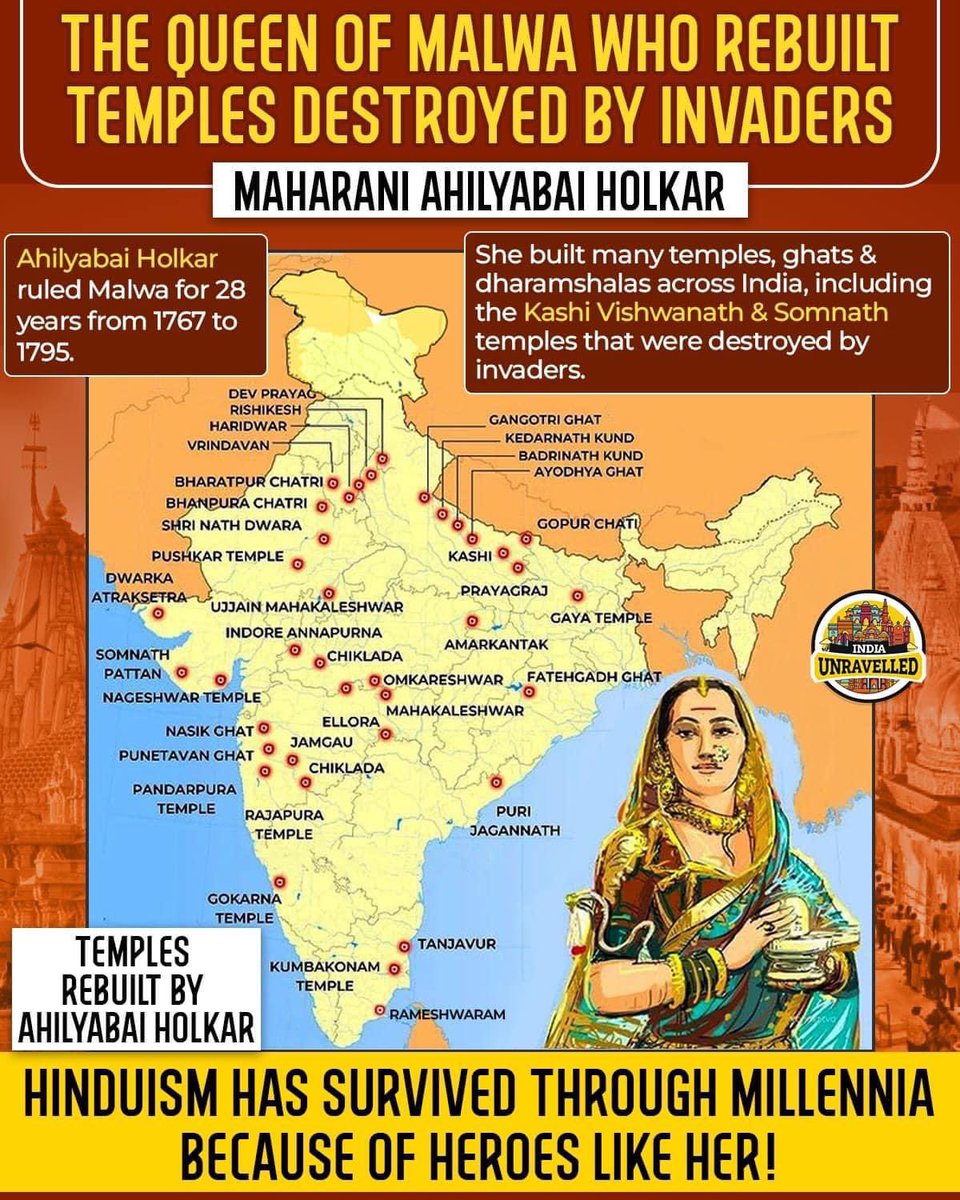
Remembering Maharani Ahilya Bai Holkar , the Holkar Queen of the Maratha ruled Malwa kingdom, India , on her birth anniversary on 31st May
The brave daughter of Bharat who was a torchbearer of Sanatana dharma with her renovation of hundreds of temples destroyed by the Mlechhas.
She was also a forerunner of the social reform movement, welfare of women and restoration of several ancient crafts of Bharat including the maheshwari weaving tradition.
Koti koti naman to her.
The Banking sector is considered the backbone of a nation’s economy. Recently, India’s banking sector achieved a significant milestone by recording its highest-ever net profit, crossing ₹ 3 lakh crores.
This is in stark contrast to the situation before 2014 when @INCIndia-led UPA government turned the banking sector into a cesspool of bad loans, vested interests, corruption and mismanagement.
The ‘seeds’ of the NPA crisis were sown during the @INCIndia -led UPA era through ‘Phone Banking’, when loans were given to undeserving businesses under pressure from UPA leaders and party functionaries.
Under the UPA, obtaining loans from banks often depended on powerful connections rather than a solid business proposition.
Banks were forced to neglect proper due diligence and risk assessment before sanctioning these loans.
This led to a massive increase in Non-Performing Assets (NPAs) and institutionalised grafts. Many banks hid and avoided reporting their bad loans by 'evergreening' or restructuring them.
Various measures by our Government and the RBI, such as the Asset Quality Review, disclosed hidden mountains of NPAs and ended the accounting tricks used to hide them.
Congress-era reckless and imprudent lending created the disgraceful legacy of the ‘Twin Balance Sheet’ problem, which we inherited in 2014.
This problem starved the nation of essential credit flow needed for development. Banks became reluctant to lend to new borrowers, especially MSMEs, the backbone of economic growth and job creation.
Credit growth slowed to a decade-low level. Banks also suffered huge losses and erosion of capital due to higher provisioning.
After banks began transparently disclosing their NPAs for loans lent before 2014, the gross NPAs of PSBs rose to a high of 14.6% in FY 2017-18.
Two former RBI Governors have openly exposed the level of decay in the system left by the UPA regime. Raghuram Rajan, who also participated in @RahulGandhi’s ‘Bharat Jodo Yatra’, described the NPA crisis during the UPA era as a “historic phenomenon of irrational exuberance.”
Similarly, former Governor Urjit Patel noted that the functioning of PSBs under the UPA suffered from “a perennial shortcoming on account of bureaucratic inertia and political meddling.”
The NPA crisis stifled the credit required to fund the dreams of crores of aspirational Indians who wanted to establish start-ups and expand small businesses.
The UPA chose to favour dynasts & cronies in Lutyens’ Delhi while leaving a large chunk of Indians in the lurch.
When the Modi government took charge, these cronies fled, fearing prosecution.
Those who now take credit for the nationalization of banks kept the nation’s poor and middle class unbanked for decades while their leaders and allies climbed the ladders of corruption.
(1/4)
Sahebs II - Our 1 hour documentary on the evil design of Congress, Marxists and Islamists - is STREAMING FREE on Prachyam OTT 🔥
No signups needed. Just visit the link and enjoy..
Watch Link https://t.co/5zjToJNHVJ
#Climate-smart #agriculture optimises food security, resilience, and mitigation goals in response to climate change, say Arkalgud Ramaprasad, R Gowrish, Vishal K Mehta. @T20org https://t.co/KnTS9GDhQ6
One of India Inc's biggest challenges towards its economic growth will be ensuring a good, steady and reliable pipeline of leaders! Everything else can be sourced "on demand" but leadership depth and breadth has to be systematically over time!
https://t.co/3l8SlKiRLB
Personal financial management is crucial life skill that young Indians must be taught as they enter job market.
It will help them navigate financial life effectively & prevent falling prey to dubious schemes, debt traps.
Urged @EduMinOfIndia to introduce in college curriculum.