Introducing GPT-5.5
A new class of intelligence for real work and powering agents, built to understand complex goals, use tools, check its work, and carry more tasks through to completion. It marks a new way of getting computer work done.
Now available in ChatGPT and Codex.
We are deeply saddened to learn of the loss of Prof Heisuke Hironaka on 18 March 2026, aged 94.
https://t.co/CWrrTp9M8q
May he rest in peace.💐
He was awarded the Fields Medal in 1970. @HarvardMath
📙"Complex Analytic Desingularization" (2018, Springer) https://t.co/c93Z3yf3UI
Congratulations to Charles H. Bennett (@IBMResearch) and Gilles Brassard ( @UMontreal) on receiving the 2025 ACM A.M. Turing Award!
🔗: https://t.co/UQ5C1K1kVT
How are mathematicians facing the wave of rapidly advancing AI-for-math capabilities?
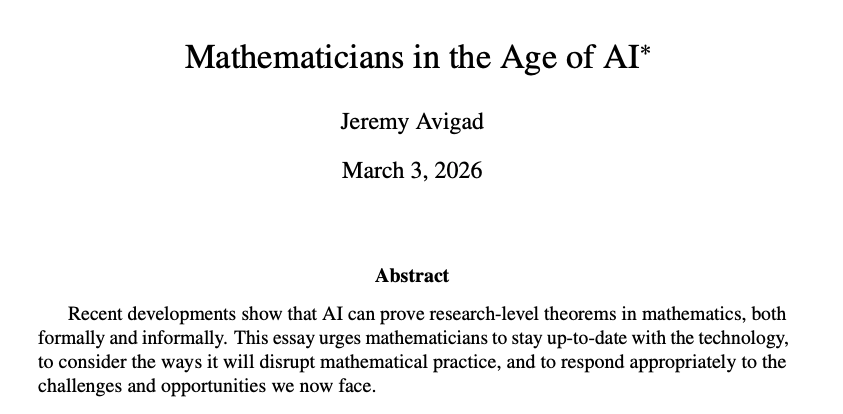
Jeremy Avigad (CMU prof and co-author on the original 2015 system description paper for Lean) just posted a paper with his thoughts in the wake of the Math, Inc. announcement on sphere packing.
https://t.co/vMpRguL2AE
There are a lot of interesting passages in here, including a bit of the back story of the Math, Inc. bomb drop and how it was initially received by the humans working on the formalization project.
But, as for how mathematics proceeds, here's the key last passage:
"We need to remember our strengths: mathematicians are problem solvers and theory builders extraordinaire. Rather than fight the use of AI in mathematics, we should own it. It is not enough to keep up with current events and design benchmarks for AI researchers; we need to play an active role in deploying the technology and molding it to our purposes. We also need to learn how to raise our students with the wisdom to use the new technologies appropriately, and we need to be careful that we still manage to impart core mathematical intuitions and understanding. Figuring out how to use AI effectively to achieve our mathematical goals won’t be easy, but mathematicians have always embraced challenges—indeed, the harder, the better. If we face AI head-on and stay true to our values, mathematics will thrive. We just need to show up and get to work."
The next few years should be a golden era for mathematics. For those of us working on the frontier, I hope we do well by our mathematician colleagues.
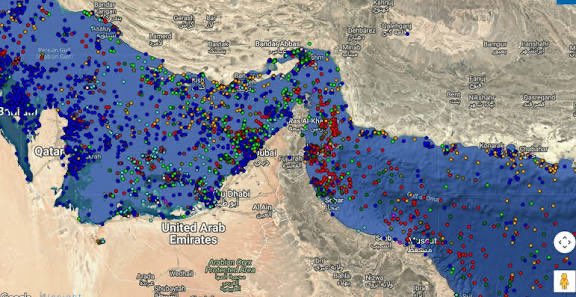
Twenty million barrels of oil passed through the Strait of Hormuz yesterday.
Today the number may be zero.
Not because Iran mined the water. Not because a tanker was hit. Because Lloyd’s of London picked up the phone.
War risk underwriters began canceling policies for strait transits hours after Operation Epic Fury launched. The Financial Times confirmed premiums surging 50 percent. Baseline war risk sits at 0.25 percent of hull value. For a hundred million dollar tanker that is 250,000 dollars per voyage. At peak escalation rates, one million per transit. Vessels linked to American or Israeli interests are becoming uninsurable entirely. No price. No policy. No passage.
The KHK Empress was loaded with Omani crude heading for Basra when it executed a U-turn mid-strait and redirected to India. The Eagle Veracruz halted at the western approach carrying two million barrels of Saudi crude bound for China. The Front Shanghai stopped off Sharjah with Iraqi crude destined for Rotterdam. Nippon Yusen ordered its entire fleet to avoid Hormuz. Greece told its merchant armada to reassess passage. Hapag-Lloyd suspended all transits.
None of them were fired upon. Every one of them got the same call.
More than fifty million years ago the Arabian plate collided with the Eurasian plate and compressed the Persian Gulf into a basin that drains through a single geological bottleneck twenty one miles wide. Twenty one percent of global petroleum. Twenty percent of all seaborne LNG. One fifth of industrial civilization’s energy supply forced through a tectonic accident narrower than the English Channel, bordered on one side by the country whose supreme leader was killed yesterday morning.
The USS Abraham Lincoln carries enough Tomahawks to sink every IRGC patrol boat in 48 hours. Operation Praying Mantis crippled Iran’s operational naval forces in eight hours in 1988. The Fifth Fleet has rehearsed this scenario for decades.
None of that matters. Aircraft carriers cannot force an underwriter to rewrite a policy. Tomahawks cannot lower a premium. The most powerful navy in human history cannot make a Lloyd’s syndicate decide that a VLCC transiting Iranian coastal waters represents an acceptable risk on a Saturday afternoon when missiles are landing in Dubai.
Goldman Sachs estimates Brent could peak at 110 dollars per barrel. JP Morgan projects 120 to 130. At those levels every airline bleeds cash. Every central bank watches three years of inflation fighting reignite overnight. Bypass pipelines from Saudi Arabia and the UAE handle roughly three million barrels. Hormuz handles twenty million. The math does not close.
Iran figured out something the Pentagon still has not.
You do not need to close a strait. You just need to make it uninsurable.
https://t.co/BrzGRrU3VW