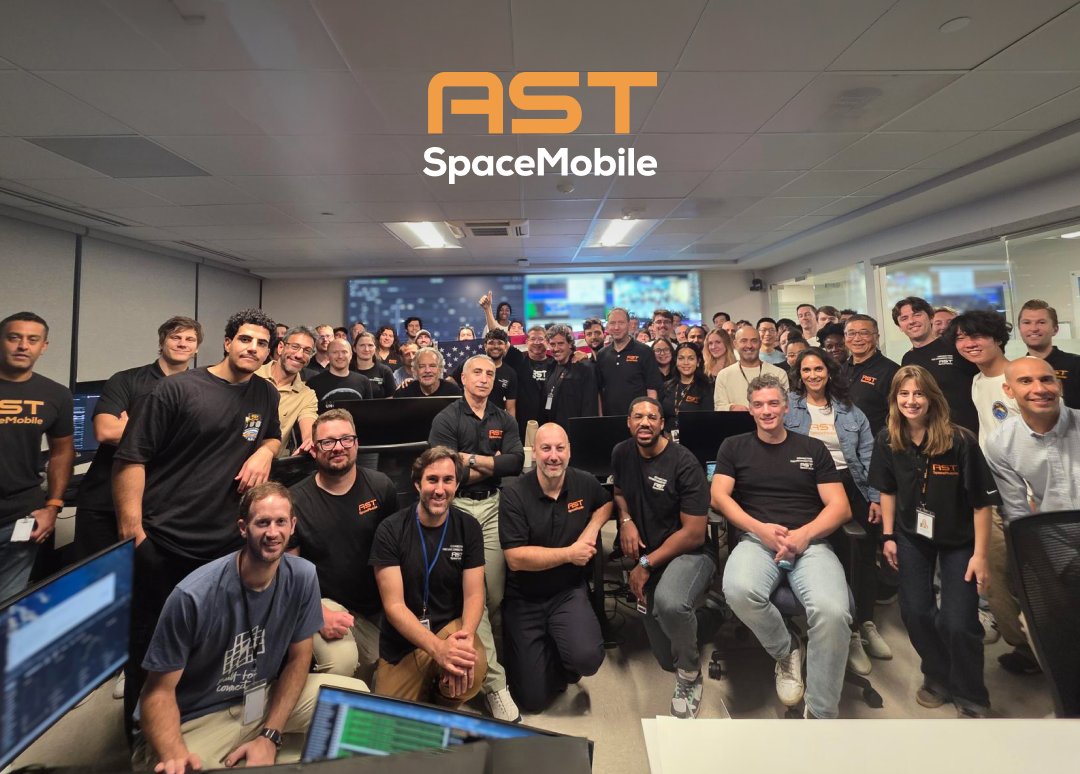
Advances with Field Experiments 2026 was simply amazing! So many people using the world as their lab to help make things just a little bit better.
Bravo!
PISA just dropped new test results. The headlines are unequivocal: "lowest OECD scores ever recorded"; "US at its worst mark in history." A year-plus of learning "lost." Then comes the usual hand-wringing about American kids falling behind other countries we presume we should beat.
I want to call a pause to this for just one moment and ask: what exactly does PISA measure? A few years back we published a paper that puts things into perspective: https://t.co/j1cqMznwdM
Surprise students with cash for right answers just before a PISA-style test begins and US scores jump substantially; Shanghai scores don't move. Same kids, same knowledge, different effort, different PISA percentile.
In this way, the paper shows that PISA scores bundle two things: what kids know and whether they feel like showing it on a test that counts for nothing in their lives. I suspect the same happened this year, and the fact that over 40% of US test-takers didn't even bother finishing the accompanying questionnaire is consistent with that hypothesis. That number was so high that the OECD flagged the US results for potential bias.
I am not saying that US education is fine. Indeed, quite the opposite, as we should be doing much, much more, beginning prenatally. I am just calling into question the received wisdom: "American kids know a year less than they did" and "American kids try less on tests that don't matter" are different diagnoses with very different treatments.
Execution in motion.
Across our Texas manufacturing facilities, more BlueBird satellites are moving through every stage of production as we build the world’s first space-based cellular broadband network accessible directly by everyday smartphones.
We invented a new way to design, manufacture and deploy large-scale space infrastructure: advanced lightweight composite structures, stackable architecture and repeatable production at a scale never before achieved for commercial communications satellites.
More BlueBirds. More capacity. More connectivity.
🇺🇸📶🌎📱
Build. Stack. Launch. Repeat.
#ASTSpaceMobile #Broadband #ConnectingtheUnconnected #BlueBirds
Successful launch… again!🚀🚀🚀🚀🚀🚀🚀🚀🚀🚀 🚀🚀 🚀
Our DC team in full comms with BlueBirds 11, 12, and 13 within minutes, and just confirmed full Nominal Operations.
BlueBirds 14, 15, and 16 to follow soon after, with production underway in Texas through spacecraft 42.
We now have ~20,000 sq ft of combined aperture hardware in Space! Bigger is better and we have the biggest!!!
Beta service around the corner! 🤠 🇺🇸🌎📶📱
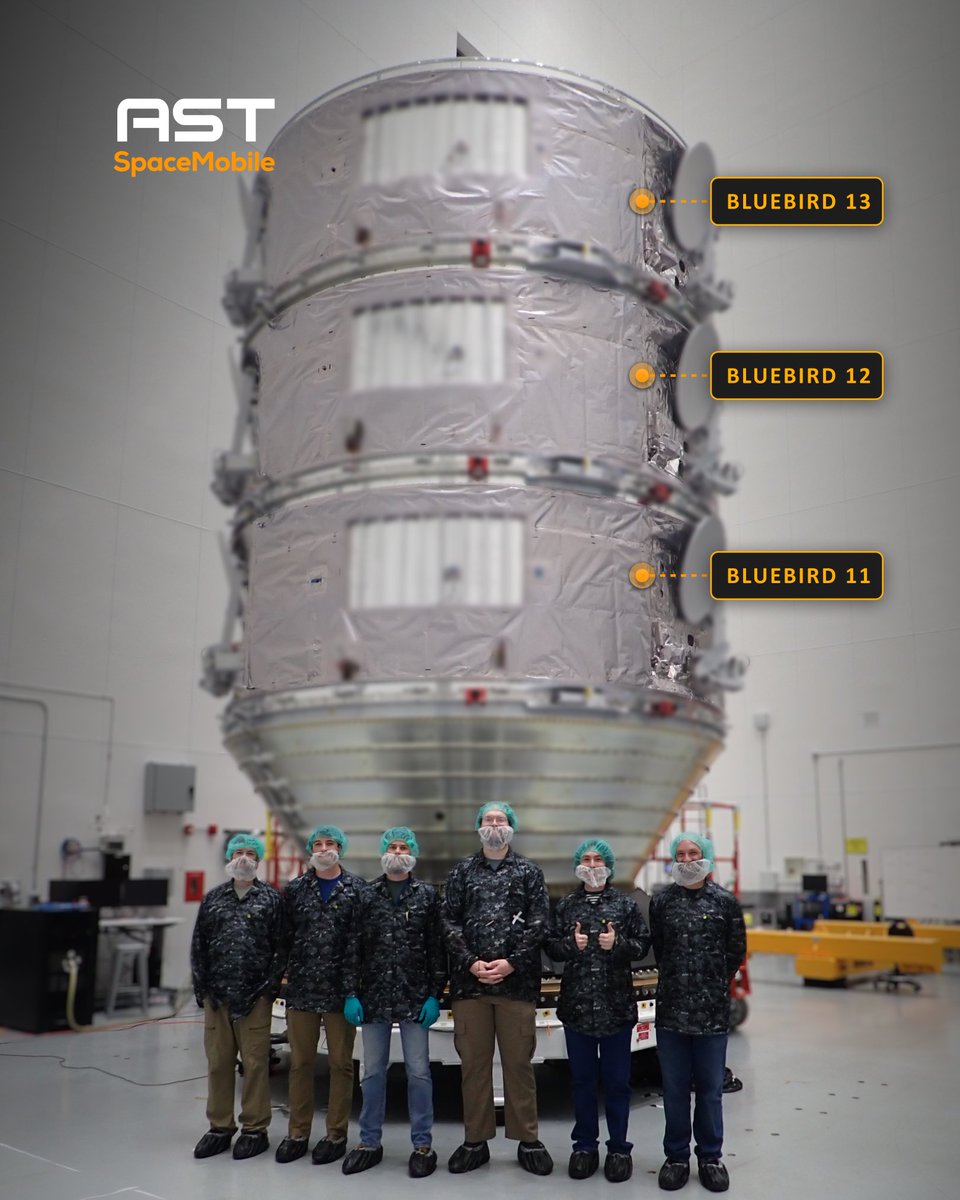
BlueBirds 11, 12, and 13 are stacked and getting ready for their August 5th orbital launch from Cape Canaveral Space Force Station in Florida.🚀🚀🚀🚀🚀🚀🚀🚀🚀🚀🚀🚀🚀
BlueBirds 14, 15, and 16 to follow right after.
Production advancing through BlueBird 42.
Built in Texas. Broadband from space. Designed to connect directly to everyday smartphones. 🇺🇸🌎📶📱
#ASTSpaceMobile #Broadband #ConnectingtheUnconnected #BlueBirds
I heard a story that I’ve never forgotten...
It's about an eagle raised by turkeys. Like his adopted family, the eagle scratched in the dirt, kept his eyes down, and lived small… because everything around him told him that’s all he was.
Until one day, he looked up and saw an eagle soaring.
There are too many people who live below their potential. That doesn’t have to be your story.
God made you new. But the old identity will keep trying to pull you back down. Old labels, old failures, old thinking, old identity. And before long, you find yourself living beneath what God created you for.
But here’s the truth:
You were not made to live in the dirt of your past.
God created you to be free, confident, and full of purpose.
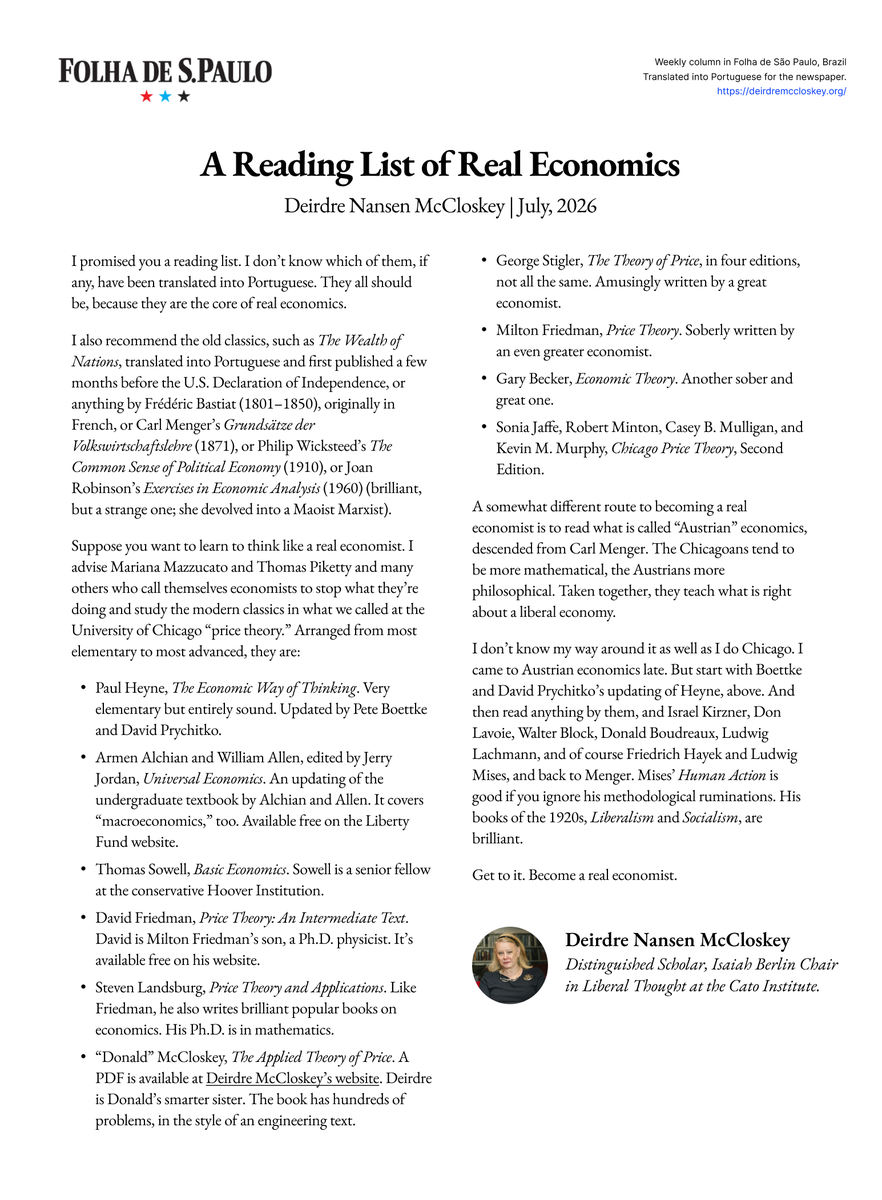
I promised you a reading list.
I recommend the old classics, such as The Wealth of Nations, first published a few months before the U.S. Declaration of Independence, or anything by Frédéric Bastiat (1801–1850), originally in French, or Carl Menger’s Grundsätze der Volkswirtschaftslehre (1871), or Philip Wicksteed’s The Common Sense of Political Economy (1910), or Joan Robinson’s Exercises in Economic Analysis (1960) (brilliant, but a strange one; she devolved into a Maoist Marxist).
Also, study the modern classics in what we called at the University of Chicago “price theory.” Below, I list them from most elementary to most advanced.
A somewhat different route to becoming a real economist is to read what is called “Austrian” economics, descended from Carl Menger.
The Chicagoans tend to be more mathematical, the Austrians more philosophical.
Taken together, they teach what is right about a liberal economy.
My latest column for @folha
Following launch, AST SpaceMobile has confirmed acquisition of signal for all 3 satellites. Over the coming weeks, they'll be fully unfolded. Meanwhile AST is already preparing the next 3 for shipment. These are expected to launch on another Falcon 9, possibly as early as July.
Grigori Perelman, mathematician who proved the Poincaré Conjecture and who refused to accept a Fields Medal and the $1,000,000 Clay Prize, spotted at a traffic signal.
Peak download speed 98.9 Mbps. From space. With our Block 1 satellites.
Direct to a standard smartphone over international waters. No modifications. No new hardware.
Next-generation satellites expected to nearly double these speeds!
Built in Texas. Space-based cellular broadband. Connecting everywhere. 🌎📶📱
#ASTSpaceMobile #Broadband #ConnectingtheUnconnected #BlueBirds
Announcement: Mid-June launch of three Bluebird satellites aboard a Falcon 9 rocket.🚀🚀🚀🚀🚀🚀🚀🚀🚀🚀
32 next-generation satellites at advanced stages of assembly to be ready for launch.
Network deployment with a launch every one to two months on average.
Space-based cellular broadband. Built in Texas.
🌎📶📱
#ASTSpaceMobile #Broadband #ConnectingtheUnconnected #BlueBirds
My travels have convinced me that we are now in the Age of Emboldenment.
How so? First, the good news. AI is having an effect that is often not discussed: it gives the underconfident a voice. People who once struggled to articulate what they knew deep in their minds but had a difficult time finding the words can now communicate with much more clarity and precision. Giving the once voiceless a voice is wonderful.
But there's a dark side to this emboldening. AI is also giving people an awkward and truly borrowed confidence. Some act as if consuming an idea is the same as understanding it. With every new prompt, the AI answers come fast and furious, and with such seductive fluency. The sand castle looks magnificent. Then the questioning starts, the tide comes in, and the sand castle disappears.
The differentiator here? Using AI as an assistant versus using AI as a steroid. Using AI to help hone your own ideas and write them more clearly, organize your thinking, or stress-test your argument? That strikes me as a force multiplier. It makes genuine expertise more powerful and more visible, and this helps us all learn more from others' ideas. AI as an assistant.
But, relying on AI to generate ideas that you do not actually understand yourself? That is the steroid at work. And, I am not saying this as an academic who romanticizes/rewards struggle for its own sake. I see the same within organizations, even where total output, not struggles, is crucial. The premise here is that the struggle and wrestling with an idea are creating the understanding. You cannot borrow it. You cannot shortcut it.
Making real change within organizations almost always requires some sort of verbal discussion and defense of a proposed action, policy, or idea. The person who has genuinely wrestled with a hard problem and the person who asked AI to wrestle for them are not the same. Just like steroids get detected, fake knowledge gets exposed. Always has. AI just accelerates both the inflation and the reckoning.
So, let me end with a prediction that complements what I wrote earlier: critical thinking and communication will soon become, by far, the most valued skills in the room (maybe they always have been in some rooms, but even more important now). Homogeneity is the reason why: everyone has access to the same AI. This means that the differentiator isn't who can generate the answer, it is who understands and can explain it.
The Age of Emboldenment is here. Make sure your confidence is built on bedrock, not sand.
Last call for those interested in joining my team and me in Buenos Aires for the Chicago School in Experimental Economics, November 4-8, 2026! There is no program fee, and financial assistance for accommodations is available.
This intensive one-week summer school is designed to deepen scholars' understanding of frontier experimental methods. Lessons will range from designing and conducting experiments to analyzing and interpreting data to writing up your findings. The curriculum draws from my new textbook, Experimental Economics: Theory and Practice.
The application deadline is April 30, 2026. Please apply here: https://t.co/8Aj3EtXqLM
Any questions, please contact Melissa De Vries at [email protected]
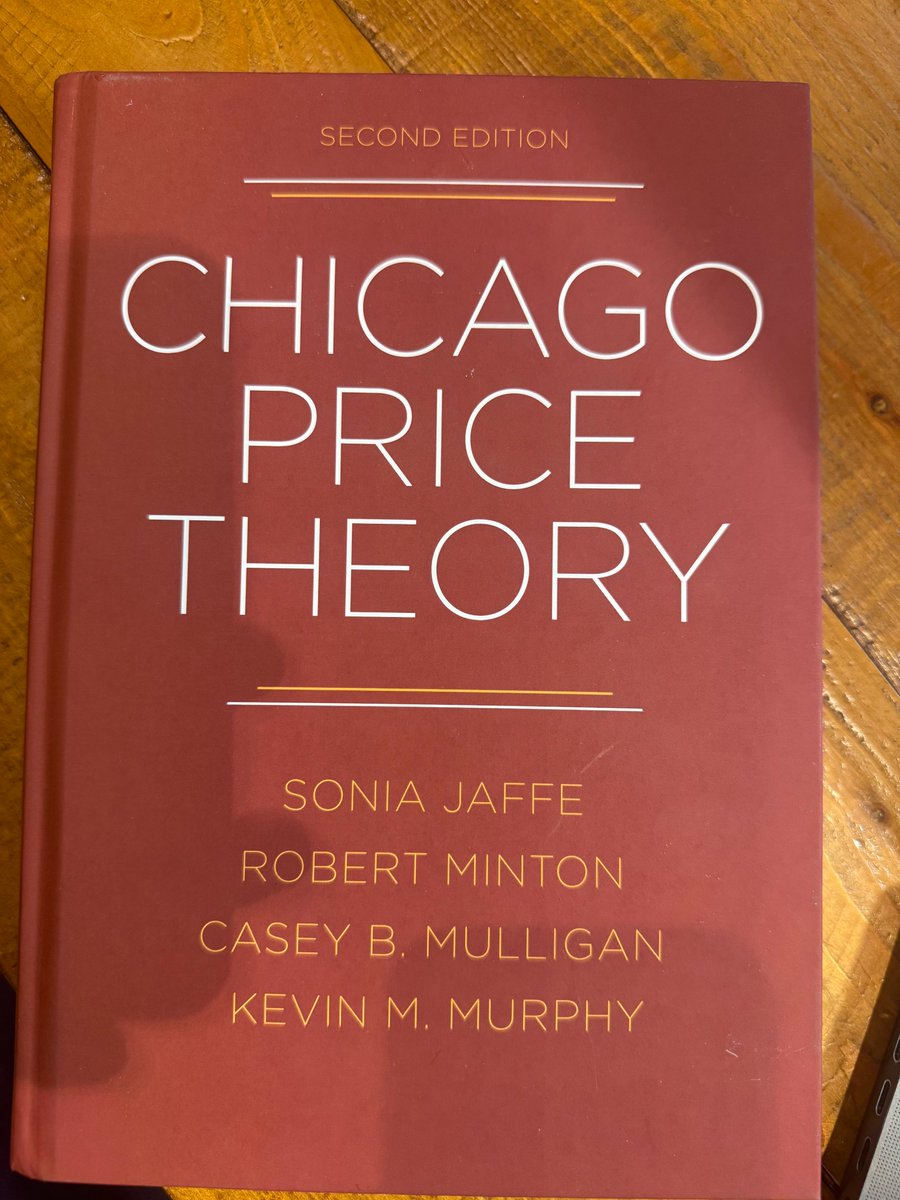
Just delivered at home.
More importantly, in a world with powerful LLMs, the relative importance of understanding economics (as opposed to being able to complete a proof) just went up considerably. An LLM can solve a fixed-point problem faster than most of us. What it cannot do is look at a policy proposal and see the second-order effect, the incidence shift, or the margin that adjusts. That is price theory. No amount of computation will give it to you.
Becker knew this fifty years ago: the power of economics was never in the math. The math was always the servant. The power was in thinking clearly about trade-offs, incentives, relative prices, and equilibrium. LLMs just made the servant very cheap. That makes the master more valuable, not less.
P.D. One still needs to know the math. I am only claiming its relative price changed!