I am proud to announce that today @cusp_ai has closed a $100M Series A fundraise, co-led by @NEA and @Temasek, with participation from @nvidia’s NVentures, @SamsungVentures and @Hyundai_Worldwide.
Google Summer of Code projects are available this year to improve molecular simulation in Molly.jl.
Feel free to ask me any questions.
https://t.co/s6BCfq7dTW
@FrankRHutter Hi Frank, there are some odd artifacts in the figure in this post (& the corresponding figure in the article) for the TabPFNv2 model predictions in the 5th and 6th columns. They look lower resolution than the others, with extra borders. Is there any reason for this? Thanks!
Presentation done at #EPDIC18! Really grateful for the opportunity to talk about a hobby project to actual proper crystallographers. Looking forward to enjoying the rest of the conference now.
En route to #EPDIC18 in sunny Padova! Looking forward to catching up with old friends and learning more about the state of the art for powder diffraction. I'll be giving a keynote about #GALLOP on Saturday afternoon during the MS05 session.
@YamilJColon@ejmaginn@NDCBE The abstract, supplementary info and github look really interesting! Unfortunately I don't have access to the article, would you be happy to send me a preprint link/copy? Thank you!
This is the most surprising and exciting result of my career: we were running simulations of NaCl with a neural network potential that implicitly accounts for the effect of the water, ie a continuum solvent model (trained on normal MD) when Junji noticed something strange: 1/n
@dwb_9 This was intended as (1) a proof of concept that a neural network can learn to predict these things and (2) a method of last resort should all of your sensible suggestions fail.
I was not suggesting it should replace the tried and tested methods already in use!
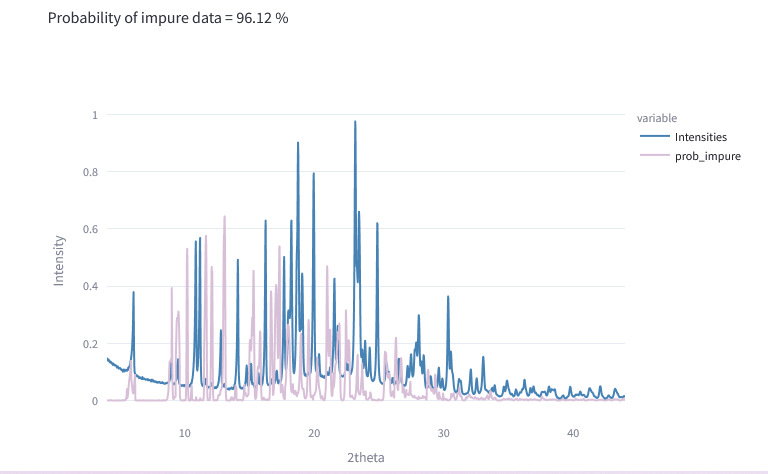
@xtalb@streamlit 😅 I optimised the the model more for laboratory data - I would guess the interpolation done for your data has produced features in the data that the model finds unusual. Sorry!
Got a PXRD dataset you can't index? Maybe it's due to the presence of impurities in the sample!
Check to see what a transfomer-based neural network trained to detect impurities thinks using this @streamlit app I wrote:
https://t.co/Fxspqglj6j
#xrd#pxrd#crystallography
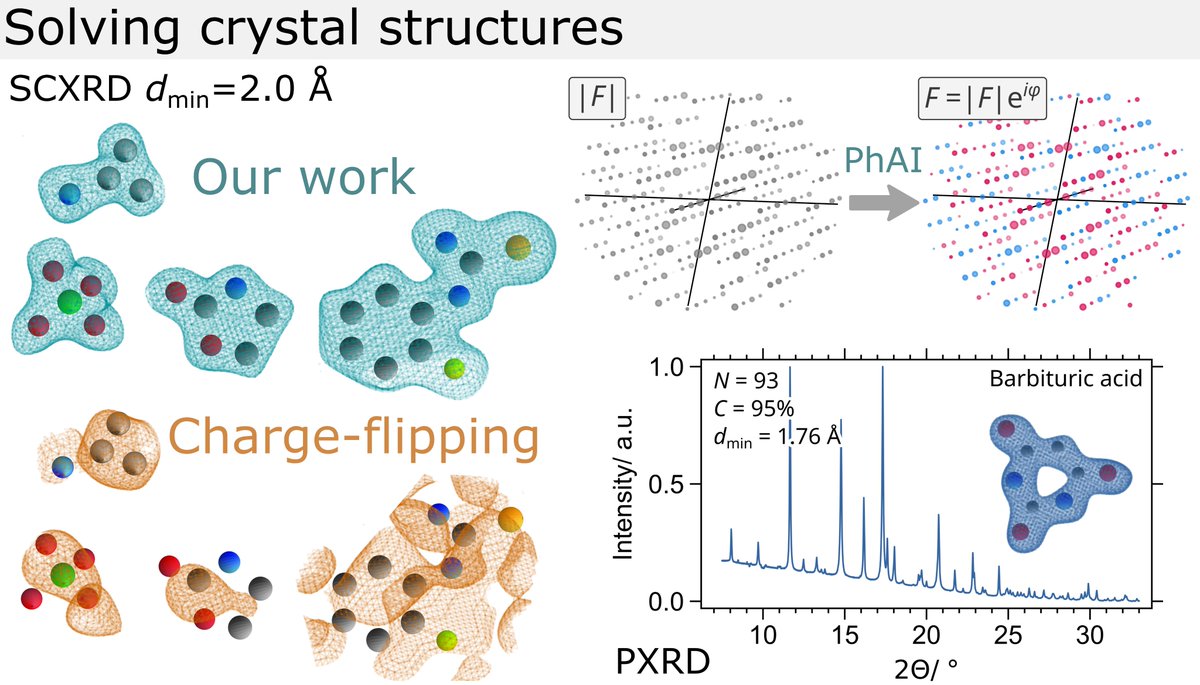
Imagine solving crystal structures from low-resolution SC- and PXRD data with a single click!? Our pilot study was designed for small unit cells and P21/c (+supergroups) only, but the results are striking! Preprint: https://t.co/1rbqIBswi5 @AndersSL@AndersOMadsen
Inside the Matrix: Use 3D to visualize matrix multiplication expressions, attention heads with real weights, and more. ⚡
Read our latest post on visualizing matrix multiplication, attention and beyond: https://t.co/8G2rAAccv8
We are excited to announce that we are gearing up to relaunch the PyData Southampton meetup in the very near future. In the meantime, if you'd be interested in speaking at one of our future meetups submit a talk proposal https://t.co/Einc3nMgBw
Migrated my blog from @fastdotai fastpages to @quarto_pub last night. A relatively smooth process and the new default template looks great! Look forward to trying some of the new features that quarto enables. It does however mean that all of the links I've posted are dead though.
#DASH users - ever encountered an issue with ill conditioning of the Pawley covariance matrix? Fear not! You can still solve the structure at that resolution using #GALLOP. More info here - https://t.co/uG9Yucb2N8
#pxrd#sdpd#diffraction#crystallography
🚨#Postdoc alert!🚨. We are looking for an enthusiastic young scientist (m/f) interested in #MOFs for the controlled release of active ingredients
Curiosity is a must-have skill, experience in SCXRD and XRPD is a plus!
Come and join us!
🛑Deadline: 23.11.2022
More info in DM.