Our reporter @ceboudreau has a scoop today: The White House has been sitting on an EO since last fall that would push FERC to require grid operators and utilities to identify where advanced transmission technologies like dynamic line rating and advanced reconductoring could be deployed instead of building new wires.
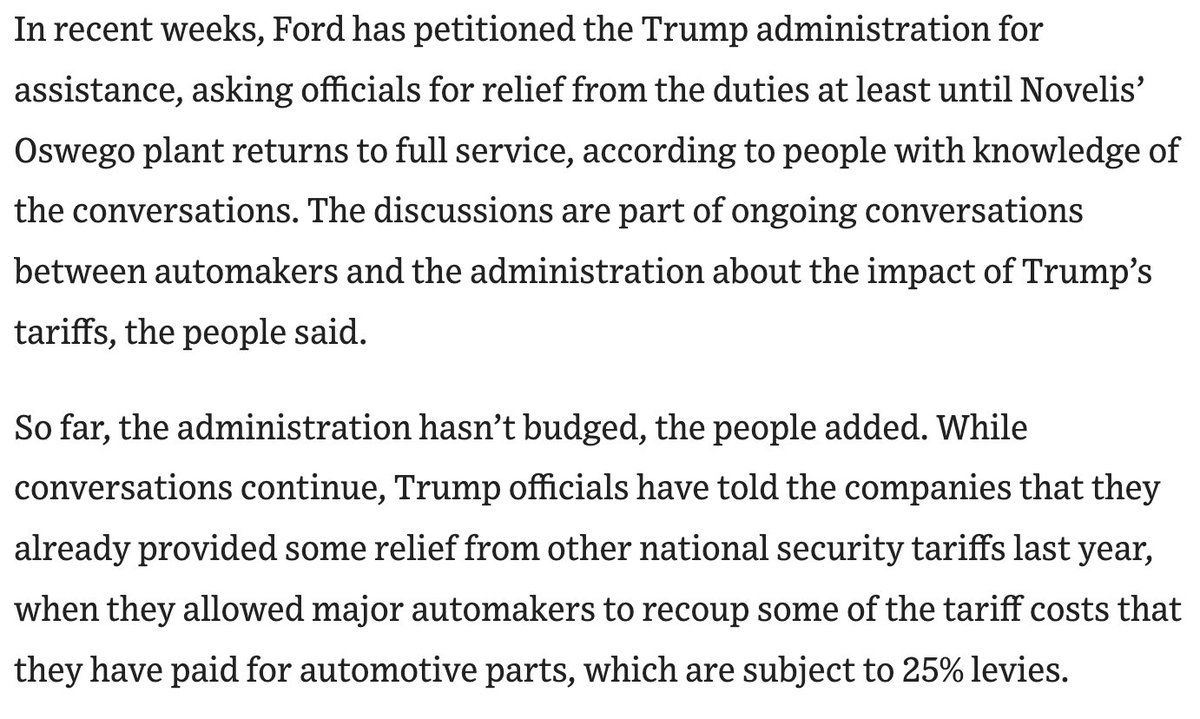
SCOOP: Ford has asked Trump admin for relief from 50% aluminum tariffs after fires at a New York aluminum facility took a key domestic supply of the metal for its F-150 offline.
Trump's team so far has said no.
w/ @bob_tita, @ryanfelton
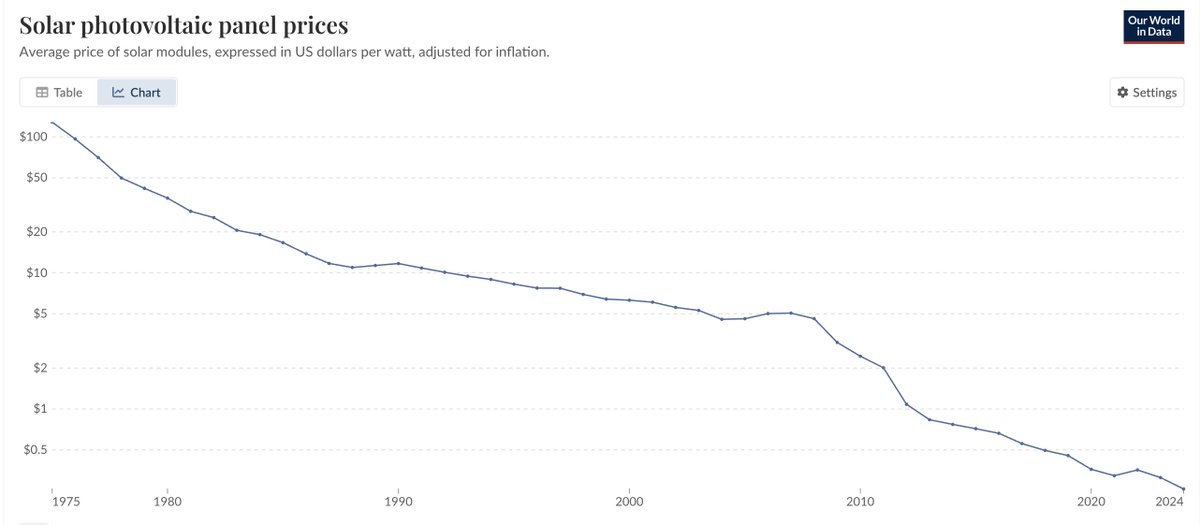
a barrel of oil can provide as much electricity as a 400W solar panel does annually.
a barrel of oil runs $92 and comes with a few minor logistical complications.
this year the solar panel should run less than $90; you can order online, ships in a week.
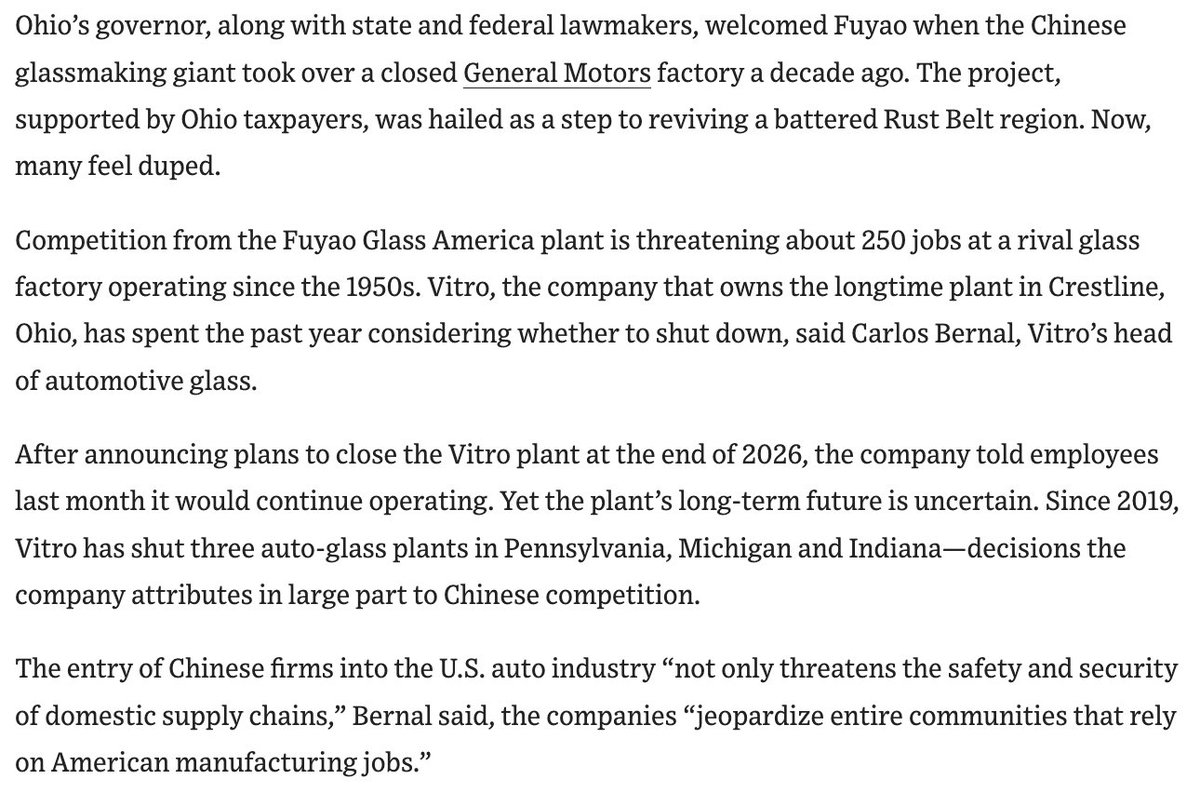
ICYMI: A Chinese auto glass plant in Ohio shows the risks when America’s biggest rival sets up shop.
Chinese glass giant Fuyao says it's just more efficient. Critics say it isn't playing fair, pointing to an ongoing human trafficking probe and national security risks:
Many data centers claim to use clean energy to power their operations. But in a report we published today, we found that’s increasingly not true.
Instead data centers are using natural gas—and doing so in very strange ways.
It can now take as long as 7 years to connect a data center to the power grid. Beginning about a year ago, developers began pursuing new power strategies.
Rather than wait, many data centers are now building their own power plants.
In what we believe is the most comprehensive analysis of this trend to date, we identified 46 data centers with a combined capacity of 56 GW that plan to build their own power "behind-the-meter."
That represents roughly 30% of all planned data center capacity in the United States, according to Cleanview's project tracker.
In the last year, this trend has gone from niche to mainstream. 90% of the projects we identified—representing approximately 50 GW—were announced in 2025 alone.
When we began this research, we were skeptical of many of these projects—as all analysts should be.
Data center developers often pursue multiple projects with the intention of only building one (the "phantom project" phenomenon). Turbine manufacturers have said lead times for their equipment now stretch as long as 5-7 years.
But we think much of this capacity is likely to come online soon.
What makes our report unique is that we didn't rely on press releases, which show what developers say they are going to build. Instead we tracked down actual equipment deals and permits showing site plans.
This revealed a very different—and surprising—story. Most of the press releases we found mentioned "all of the above" strategies that include renewables.
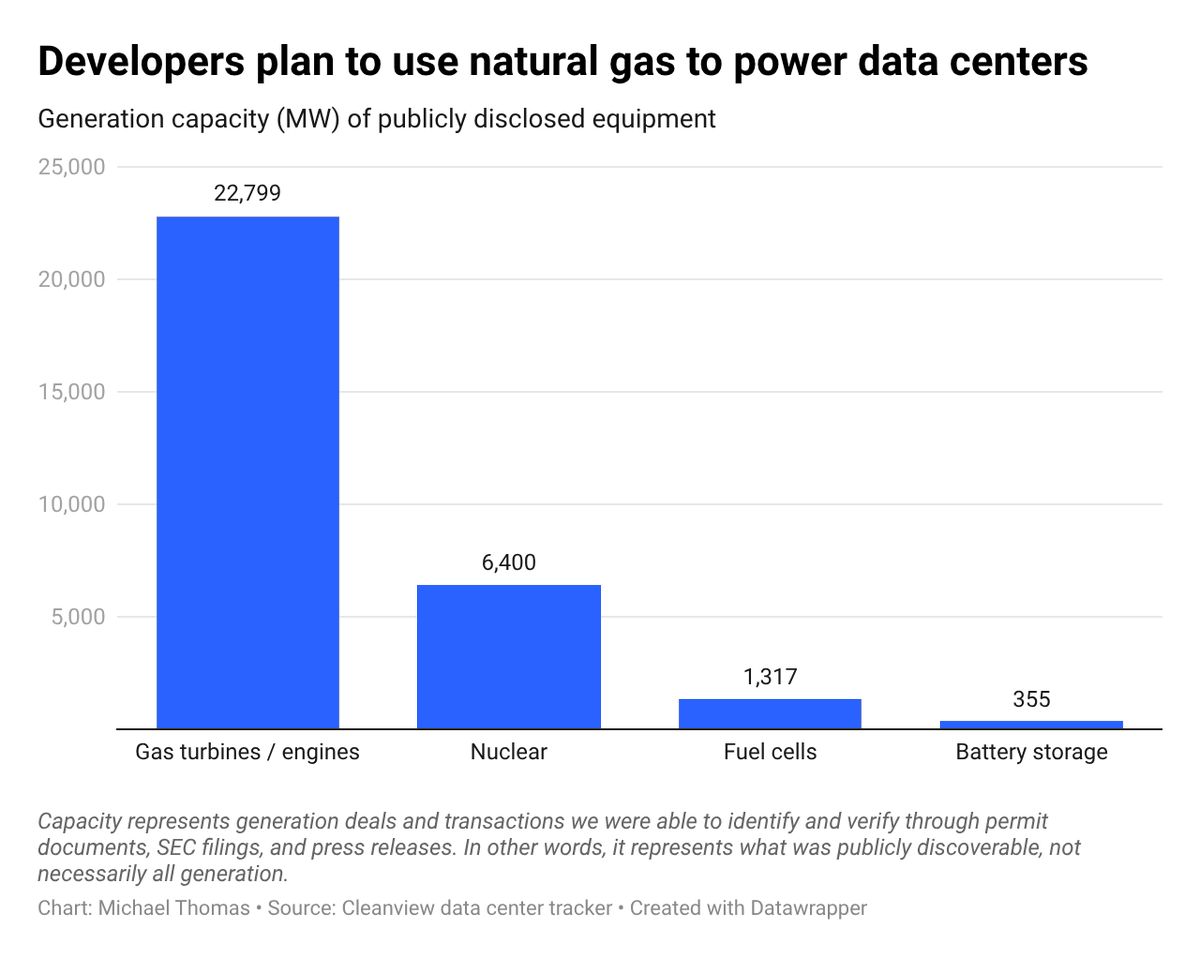
But ~75% of the generation equipment we could identify (23 GW) was natural gas-powered.
Data centers aren't planning to use your typical gas turbines either—hence why many are able to install them this year or next year.
Developers are instead turning to:
- Mobile gas generators strapped to semitrucks
- Aeroderivative turbines originally designed for aircraft and warships
- Reciprocating engines that ramp fast, but are less efficient
- Refurbished turbines acquired from industrial operations
We even came across a company that typically sells cruise ship engines that struck a deal to power a data center.
On the surface this makes no sense. These are less efficient technologies and the power will cost far more. But an AI data center can earn as much as $10-12 billion per GW. Getting online a few years early can result in a windfall.
I track data centers and power projects for a living and all of this shocked me. The public narrative is that data centers are waiting for grid connections and 5-7 year turbine backlogs.
But that narrative is lagging what is actually happening on the ground in rural counties across the country.
I'm planning to write much more about this. But in the meantime, you can head to Cleanview's website to get the full report.
Earlier this month, the Houston-area application portal for utility bill assistance crashed — because a record 100k people tried to apply for just 5,000 slots set aside for August & September.
For context, in the entirety of 2024, 44k people applied: https://t.co/wrsKNsEGn5
No way around it: California is starting to backslide on climate. And it’s (mostly) Gavin Newsom’s fault.
My column today looks at Newsom’s failures on rooftop solar, oil industry accountability, home electrification and more: https://t.co/YIl2Vy70Q1
On the air w/ @Thom_Hartmann talking about QCells in Dalton, GA. The largest solar panel manufacturing factory in the western hemisphere.
This is our earth shot moment to bring jobs back to the USA, save our planet and lead the next economy.
@SIRIUSXM@SierraClub
Solar energy is delivering power to thousands on the Navajo Nation⚡
With the help of @Qcells_NA and @ENERGY, Navajo Power Home is bringing electricity to many homes for the very first time. WATCH: https://t.co/f4vlLZjL1H
My fellow Democrats, I have decided not to accept the nomination and to focus all my energies on my duties as President for the remainder of my term. My very first decision as the party nominee in 2020 was to pick Kamala Harris as my Vice President. And it’s been the best decision I’ve made. Today I want to offer my full support and endorsement for Kamala to be the nominee of our party this year. Democrats — it’s time to come together and beat Trump. Let’s do this.
I heard someone say moderating this debate would be a hard job. It would if @cnn were practicing some journalism and challenging the candidates. They’re just directing traffic. Shameful.
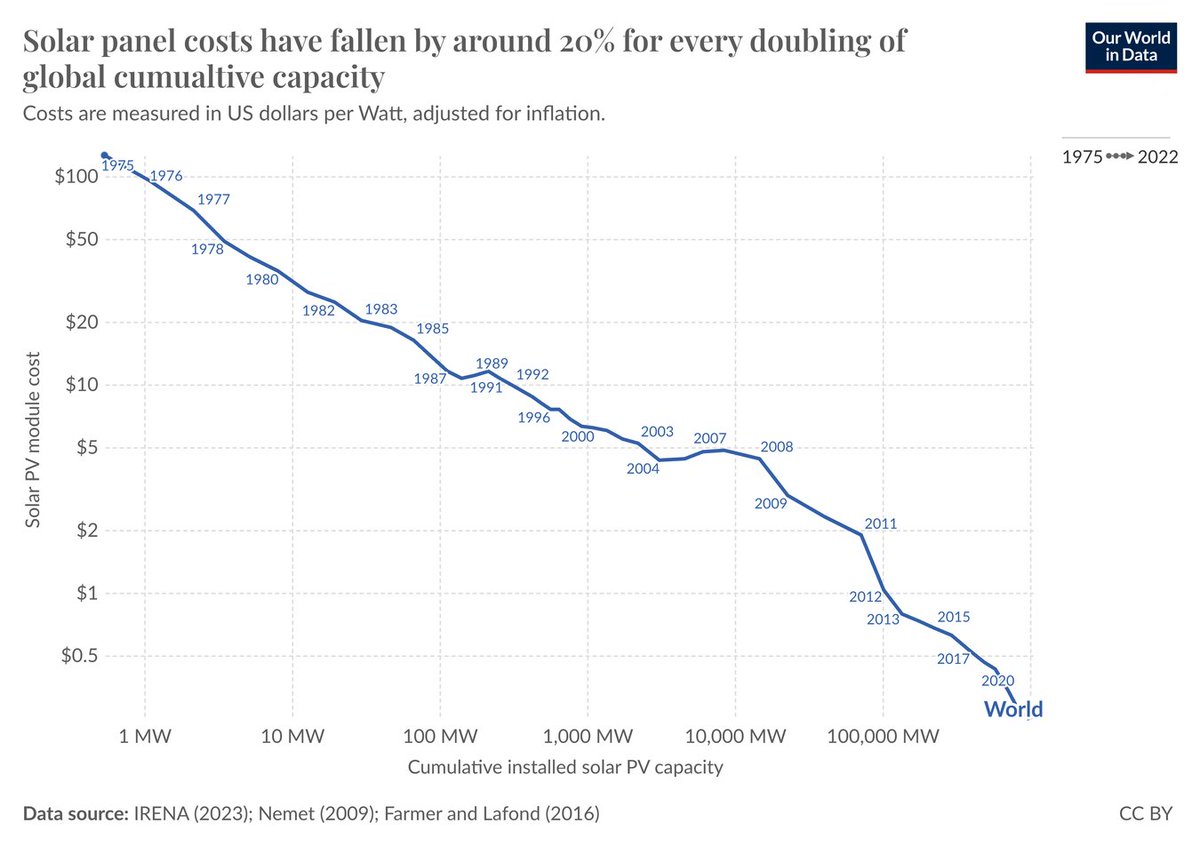
People often conflate cost of solar panels with cost of solar power. The panel is one part of the system, and advancements have caused a massive cost decline over time. In doing so, panels are an ever smaller % of total costs. Panels may be headed to zero but systems aren't. 1/3
It took @Qcells_NA two years to compile all the data to prove our products do less harm to people and the planet. Today, we can proudly say our panels made in Dalton, Georgia are among the most sustainably manufactured products on the U.S. market.
🚨Qcells’ residential & commercial solar panels, Q.TRON G2 and Q.PEAK DUO G11S, have met @GEC_org stringent sustainability criteria & are now @EPEAT registered products.
Together, we’re building a complete solar supply chain in America - made sustainably: https://t.co/igZHiurb47
EXCLUSIVE: Qcells has begun producing solar panels at its new Cartersville plant, a key step in the ramp up of the highly-anticipated Georgia factory, which has been billed as a game-changer for U.S. solar manufacturing. https://t.co/789EZ8RwHs
If you care about climate change, who should you vote for in the California Senate primary?
I talked with Barbara Lee, Katie Porter and Adam Schiff. Here are my takeaways, in my latest column for @latimes: https://t.co/FrTqxYLlhI
@SolarKellyP This is heartbreaking and a blow to onshoring the solar supply chain. It's bad for jobs, bad for our US manufacturing industry, and bad for the climate.