IA polymath with SEO, Content Strategy, UX, Human AI. Former Pres @iainstitute #inmemoriam. Constructive irritant. Avowed heretic.
Heresy here is my own.
@MordyOberstein@Kevin_Indig@rustybrick The current information landscape that we occupy is dynamic and complex. Inputs inputs like new training data, that being web content, and user behavior data influence this landscape. We have access to neither.
@MordyOberstein@Kevin_Indig@rustybrick The studies that the SEO community are doing are all inherently flawed. They are looking at the technology from the shore and do not see the underlying growth through reinforcement learning, changes to the instructions to better map the expected outcomes.1/2
And I believe that this is best accomplished by having human factors practioners -- information architects, content strategists, UX research and SEO, involved in the design, development, deployment and reinforcement learning of intelligent applications. https://t.co/lTxzoXHKFa
I believe we need to make a deliberate effort to keep humans in the loop in all critical processes across our economy and society, regardless of whether it is technically necessary.
Even if AI develops the *capability* for advanced autonomy, we should not make it highly autonomous. We have to maintain control and keep visibility and understanding of all critical processes, we should not blindly hand over everything to AI agents just because we can. AI as a tool in the human hand is the only form of AI that is worth pursuing.
Been working on my new approach to building presentations.
Inputs:
Readwise: highlights and notes
Slack: All my crazy ideas and videos internally
Linkedin: All my posts, comments + performance
Code:
Compare my new reads and thoughts to existing slides and notes
Find what I am thinking about, saying, highlighting that could challenge my existing slides or make them better.
Output is what you see in the video - I get to decide what makes sense to add and not, in a loop that trains the system why I think the way I think about what makes it into my decks.
@DoorDash support found the deactivated account with the previous credit and could not transfer the balance and would not issue a credit.
@DoorDash has a market capitalization of $94 billion. Makes me wonder what LCV I need to be valued by @DoorDash.
Service design fail. 3/3
I successfully petitioned to reactivate my account and added the gift cards. After one order, the account was mysteriously deactivated again. I created another account using the same credentials and... the gift card balance of over $100 was gone. 2/3
Service Design Fail
I've been with @DoorDash for more than a few years and spent more than a few dollars on their fees. A Dark UX pattern had me deactivate my account. Afterwards, as luck would have it, I received many gift cards. 1/3
@gaetano_nyc I think you got to look at everything holistically, but couldn’t you say:
How can you ‘only do SEO’ and not consider content marketing?
How can you ‘only do email marketing’ and not lifecycle marketing?
All the naming semantics is about business goals and framing.
@MordyOberstein@SERanking@PlanableApp And then there is the Tower of Babel in scriptures and most businesses. Peter Checkland developed the Soft System
Method (SSM) sees all soles meeting to build a shared vision of product and success.
And that is what SSM is a cornerstone of NEXT.
A LOT of people think they are qualified for this gig and applied.
You can't control anthropic, you can control what you do next, maybe they got this decision wrong.
Maybe they'll scan your twitter handle and see this post and others like it and not consider you for future roles because messages like this aren't constructive and show low humility.
Saying they want a yes man is quite the jab. Maybe they do want a leader and maybe they define leadership differently than you do. That is OK.
Latsly, people would ask me in the early days when companies didn't pick me for jobs if I thought was it b/c you are black? I was like, how TF would I know? I would never assume anything about a company, and I don't control them, I did say...if you don't hire me, I'm going to try to get hired by a competitor and make you wish you did, I can't control my skin color, I can control my network and what I research and what I put into tghe world.
Ultimately, 20+ years later I have no idea if people didn't hire me because I was black or not, but by focusing on what I could control, I built Seer. Worked out ok.
Keep ya head up, focus on what you can control and what you put into the world and life will hopefully give you whatever it is you want.
Indeed. And take that a step further in learning more deeply exactly how these applications were. In addition to RAG, LLMs use training data with RLHF for ground truth. The problem here is that often the human feedback comes from developers and not human factors practitioners.
"Grounding" Doesn't Mean What You Think It Means 🗺️
Words matter, especially when they're quietly reshaping how an entire industry thinks.
"Grounding" comes from "ground truth," rooted in statistics and originally cartography, where it literally meant going outside to verify that your map matched reality.
In some AI models, "ground truth" is the objectively correct real-world data, like sensor readings or medical records, used to anchor the model to reality. Not documents. Not web pages. Reality.
The core problem with LLMs is that there's no ground truth signal during training or generation. The model isn't checking its answer against the facts; it's only predicting the next most likely word.
What Microsoft, a company I deeply respect + admire, calls "grounding" is actually RAG (Retrieval-Augmented Generation): retrieving web documents to supplement a response. Useful! But web text is written by humans, about reality, not reality itself. Those documents can be wrong, biased, SEO-manipulated, or outdated.
RAG is better-informed guessing. True "grounding" is fundamentally a different thing.
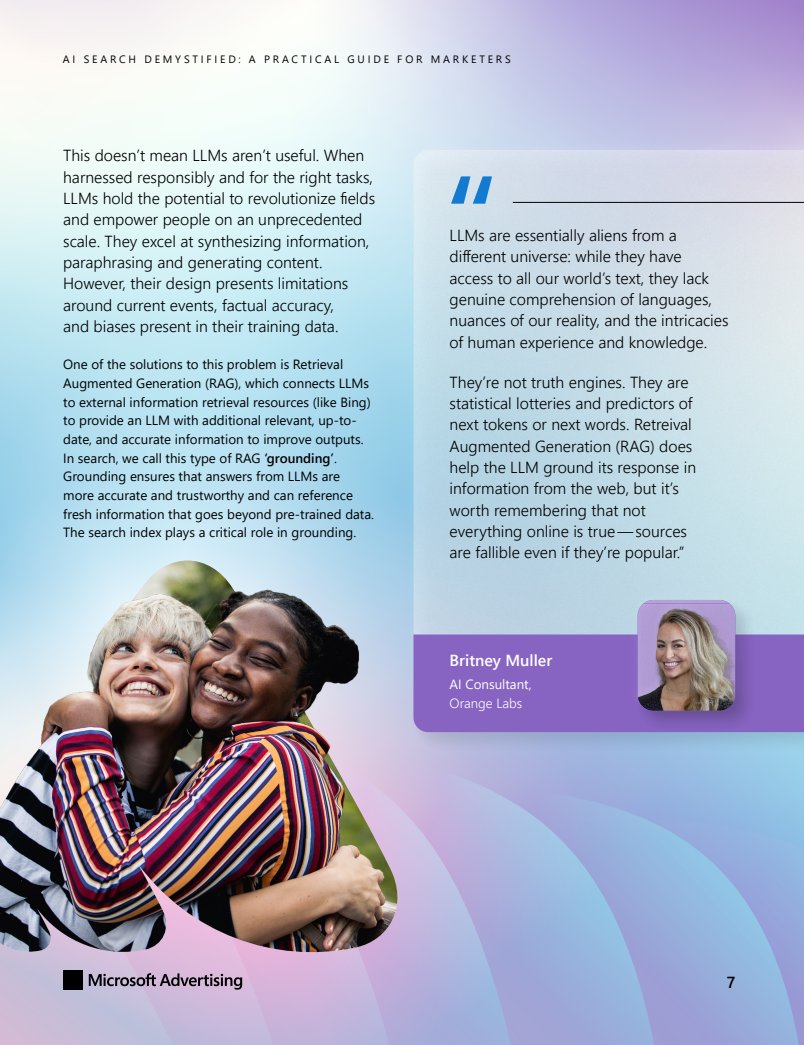
The uncomfortable part: Microsoft's own AI Guide features a quote from me where, after significant pushback on their "grounding" framing during a long interview, I said: "RAG does help the LLM ground its response in information from the web, but it's worth remembering that not everything online is true." The caveat got published. The correction didn't & the term has escaped into GEO AIO E-I-E-I-O gauntlet.
I've since watched real people repeat versions of Microsoft's definition & treat it as fact. And I don't blame them. They're trying to keep up with all of these changes.
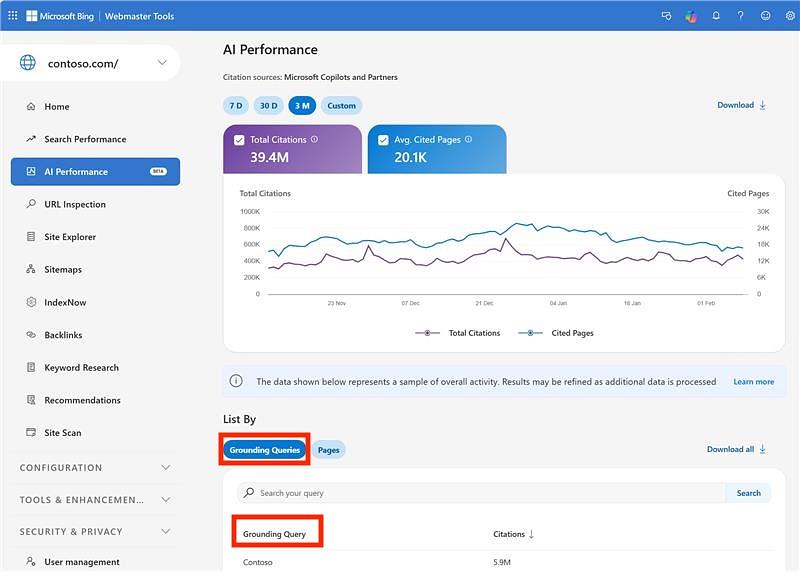
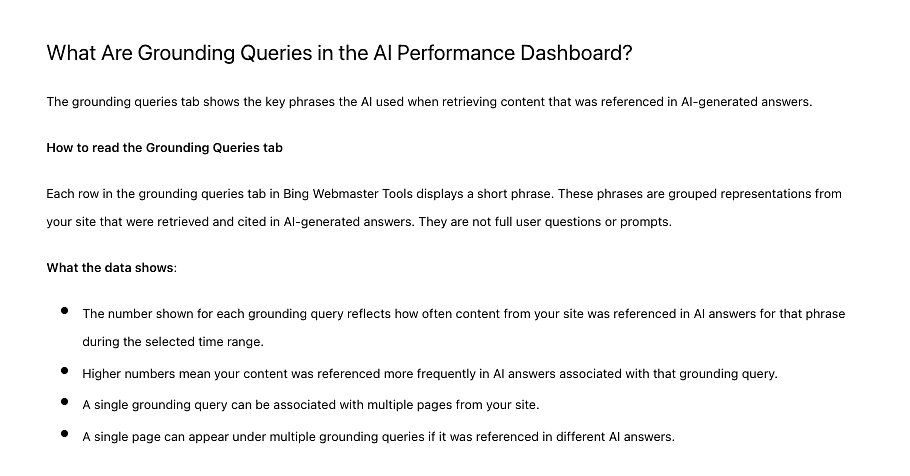
Microsoft's new "Grounding Queries" metric in Bing Webmaster Tools makes this even more confusing. Those aren't user queries. They're background searches AI quietly generates when a user submits a prompt.
For example, when you ask "should I bring an umbrella in Seattle?" the AI might internally generate "Seattle weather today" to inform its response.
Calling those "grounding queries" buries an already-misused term one layer deeper.
I raised this concern with Microsoft & suggested alternatives like "Retrieval Queries" or "AI Queries," which I feel would be more accurate and less confusing but to no avail.
The real irony? Microsoft employs SO many world-class AI researchers. They know the difference. By rebranding RAG and synthetic AI queries as "grounding," a precise technical term has now become a marketing buzzword.
SEOs are now optimizing for a word we don't have a shared definition of. And when AI researchers hear you use "grounding" this way, it'll erode your credibility.
As AI continues to reshape industries, it's more important than ever for us to understand these nuances. By learning the true meaning behind AI terms & tech we can communicate more effectively, make better decisions & drive real results.
19 Days until the next Actionable AI For Marketers Course 🎓
And there are humans, enterprise information architects, that are qualified to do so with both technical and behavioral expertise. Cross discipline education and cooperation is our path to more humane AI.
The bottleneck of current AI is simple: the techniques we use are still predicated on pattern memorization and retrieval, and thus they need *someone* to tell them which patterns to memorize (training data, RL envs...)
That role cannot yet be played by AI in a truly open-ended and autonomous way. We can't yet remove the humans in the loop. In that sense, current AI is still purely a reflection of human cognition (both in terms of which tasks/goals it pursues and the patterns it uses to solve them). It isn't yet its own thing.
Note to us all: Google is not our friend. Never has been. Never will be. It is a publicly traded company whose mission is to make money for stockholders through search dominance.
@MordyOberstein Agree to disagree. Enterprises using Google workplace apps and cloud have been making their data available for many uses outside of the workplace.
The Anthropic/OpenAI/Current Administration spat is like watching a WWII movie where you can only root for the Russians or Germans..