@vinibarbosabr@Dashpay Hi @DefuseSec, do you know if the $DASH devs asked about the vulnerability you discovered.
They implemented the Orchard pool on their chain.
I know it is open source and anyone can take and do whatever they want with the code.
@vinibarbosabr@Dashpay On May 29, 2026, Taylor Hornby discovered a critical counterfeiting vulnerability in Zcash’s Orchard pool.
Do $DASH integration includes that vulneravility?
https://t.co/Vfw3OcgjLR
@Batuzec@r4nk0X Based on the previous tweets, none paid direct with ZEC, there was a helper who received ZEC and this helper paid the business with another app (currency). We are so early.
@Johnny_DGB Hi, do you know if someone did something like this for $DGB already? That service helps accept payments on your Wordpress+Woocommerce, Shopify and your app using their API.
https://t.co/31rMe4Pu12
Hi @zooko !
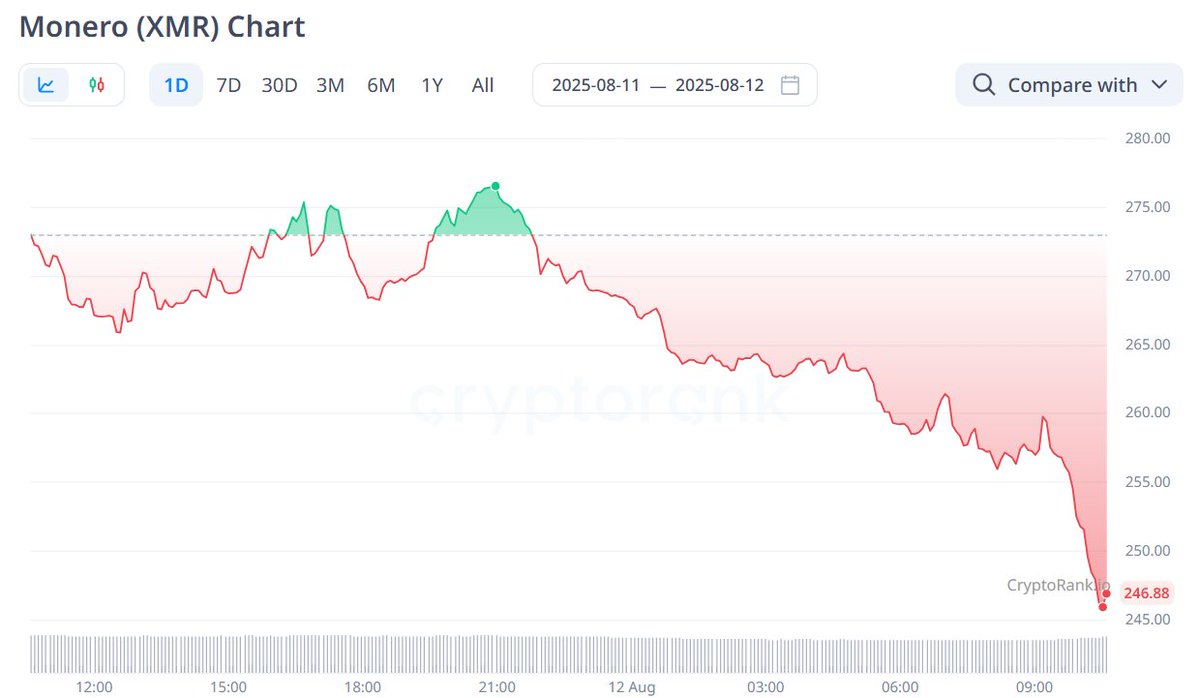
After seeing monero's drama, shall we worried about that 75% of ZEC being mine by one pool only?
drama: https://t.co/LfnuyO5Rbu
source: https://t.co/j7c9OfYF7e
51% Attack on Monero: Qubic Appears to Have Seized Control of the Network
According to the, @evilcos, founder of SlowMist, the mining pool Qubic has gained control over the majority of Monero's hash rate, enabling a large-scale blockchain reorganization. This kind of control allows for rewriting the network’s history, launching double-spend attacks, and censoring transactions.
Ledger’s CTO estimated that maintaining such an attack would cost around $75 million per day. Experts warn that this level of dominance poses a serious threat to the network's security.
Recent research suggests a quantum computer could derive a Bitcoin private key from its public key in as little as 9 minutes. $BTC block time is 10 minutes. This creates a real attack vector & DigiByte's 15-second blocks offer a natural defense. Let me explain.
First you need to understand how public keys and addresses actually work because most people conflate them.
When you create a wallet you generate a private key and a public key. Your wallet address is NOT your public key. Your address is a hash of your public key. Hashing is a one-way function. If someone only knows your address they cannot reverse-engineer your public key from it. A quantum computer can't do anything with just an address. It needs the actual public key.
So when is your public key exposed? When you spend. To prove you own the funds you must sign the transaction with your private key and include your full public key so the network can verify that signature. Before you spend your public key is hidden behind the address hash. The moment you broadcast a transaction your full public key is visible to every node on the network.
This is where the mempool matters. The mempool is the waiting room for unconfirmed transactions. When you hit send your transaction doesn't go straight into a block. It sits in the mempool waiting for a miner to include it. On Bitcoin that wait averages about 10 minutes and often much longer during high traffic.
Here is the attack. An attacker monitors the mempool. They see your unconfirmed transaction and grab your now-exposed public key. They feed it to a quantum computer which derives your private key in approximately 9 minutes. Your Bitcoin transaction still hasn't confirmed. The attacker now holds your private key. They create a new competing transaction that sends your funds to their own wallet with a higher fee. Miners select the higher-fee transaction. Your coins are stolen before your original transaction ever makes it into a block.
This works because there is a gap between when your public key becomes visible and when your transaction is safely confirmed. On Bitcoin that gap is about 10 minutes. The quantum crack takes 9. The attacker wins the race.
Both Bitcoin and DigiByte use the exact same cryptography — ECDSA on the secp256k1 curve. The quantum vulnerability in the math is identical. The difference is the confirmation window.
DigiByte confirms transactions in 15 seconds. The same attacker sees your transaction, grabs your public key, and starts their quantum computer. Fifteen seconds later your transaction is confirmed in a block. After 9 minutes when the quantum computer finally finishes, your transaction is already buried under roughly 36 confirmations. The attack window closed before it could be exploited.
Same cryptography. Same quantum threat. Completely different outcome because of block speed.
To be clear no blockchain is fully quantum-proof yet. Both Bitcoin and DigiByte will eventually need to adopt post-quantum signature schemes. But the most practical near-term quantum attack — intercepting exposed public keys in the mempool and racing to crack them before confirmation — does not work when blocks confirm in 15 seconds. The math simply isn't on the attacker's side.
We designed DigiByte in 2014 with 15-second blocks for fast payments. It turns out speed is also a security layer. Forty times faster than Bitcoin means forty times less exposure to quantum attacks on the mempool. 🤯🚀
$DGB
@Cardon_Saguaro@DGBDevs Would you accept items from unknown people into your luggage while traveling? What If you don't have choice and you are forced to carry it?
They know that if not forced it will fail.
@mctrivia's DigiAssets uses IPFS there is only 3 brave nodes: https://t.co/sqcMgooiL2
@coinbase A genuine response & explanation to the DigiByte community why you won’t list $DGB after 12 years.
DGB is more alive and thriving as a community than ever. Do you support community run decentralized blockchains? People just want clarity. Thanks
North Korean hackers planted 192 malicious packages on npm and PyPi targeting crypto devs with fake coding challenges. Supply chain attacks are the new normal. $DGB consensus has zero external package dependencies. C++ compiled from auditable source. No npm. No pip. No trojan.