When the rocket blows up, it's "Elon Musk's SpaceX".
When the rocket is fully successful, it's just "SpaceX".
This is a demonstrated pattern across all major media and also within the NYT specifically.
Both the Biden and Trump administrations allowed the export of less powerful GPUs to China while reserving the most advanced chips for America. This has been a clear national security success.
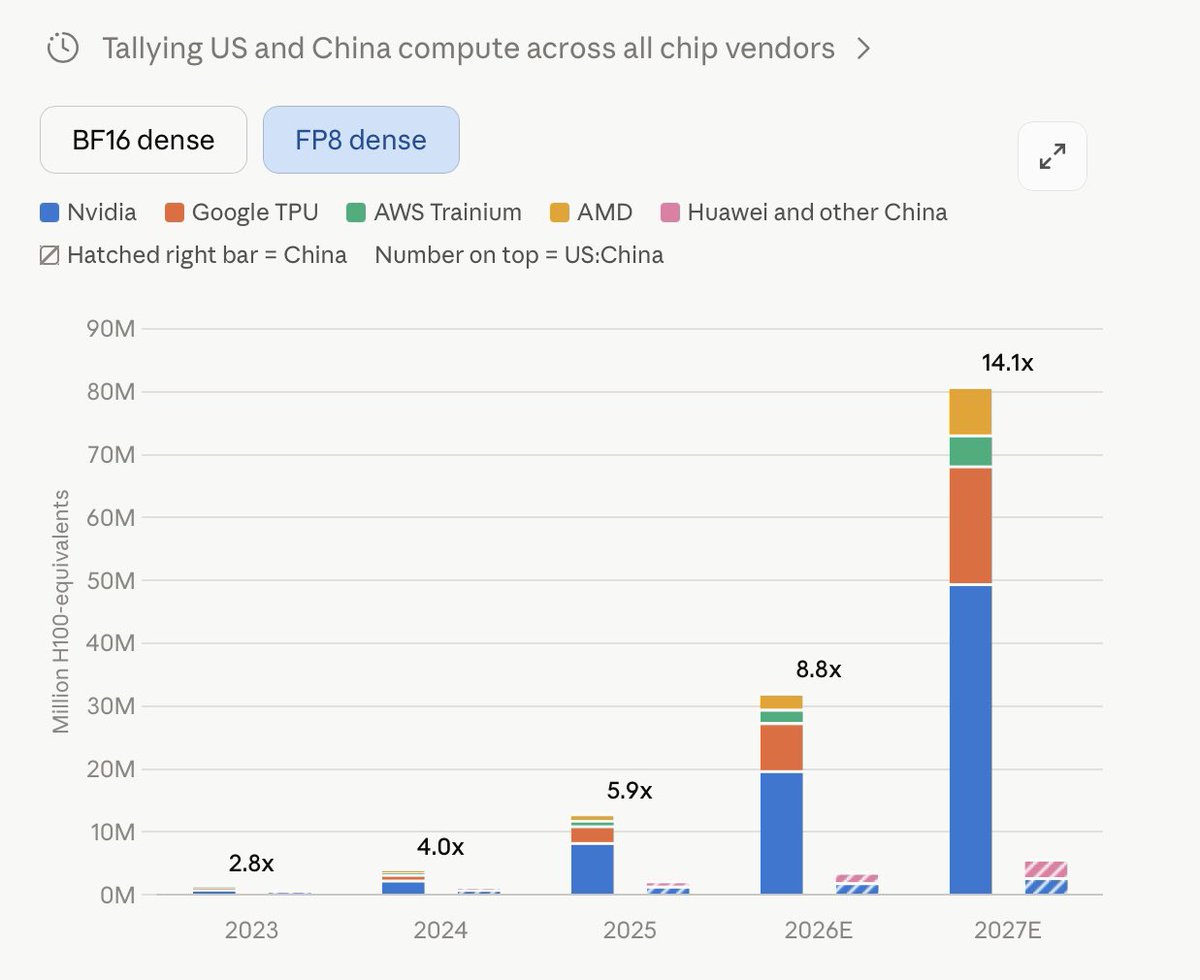
Per Grok and Claude, the US-to-China AI FLOPs ratio has grown from 2.8x in 2023 to 8.8x in 2026 and is modeled to reach 14.1x in 2027. Our advantage in compute has grown dramatically and American AI labs have stayed well ahead of Chinese labs the entire time.
Chinese labs prefer these less powerful American GPUs to domestic accelerators from Huawei and others. That preference has slowed China’s hardware industry: AI chips improve through intensive use by leading labs, and the ready availability of American alternatives has limited that feedback loop for Chinese AI hardware.
Chinese labs can also access capacity in Southeast Asian clouds run by American hyperscalers. Those zones can be shut off instantly in a conflict, giving the US signficant leverage. This dependence is advantageous in every way.
A complete ban on GPU exports and Southeast Asian cloud access might be deeply damaging to long-term American national security. It would force Chinese labs onto the Huawei AI hardware ecosystem. China is not power-constrained, and Huawei is developing extremely power-hungry, large optical scale-up domains that may approach American state-of-the-art systems through brute force rather than architectural elegance and efficiency. And China has a lot of power.
Having Chinese labs optimize models for this different architecture is risky as nothing prevents China from sharing this hardware and associated models with Russia, North Korea, or Iran. We would lose any ability to cut off their AI in a conflict.
Policies now under discussion in Washington carry serious, uncertain risks. Reasonable minds can disagree, but treating this as a simple black-and-white issue does America a disservice.
If China closes the installed FLOPs gap as its domestic hardware matures rapidly as a result of increased Chinese lab usage after stricter export controls, we will know this new policy was a mistake.
If Russia, Iran, or North Korea later field comparable Chinese AI hardware systems that are used to run AI targeting models against Ukrainian or American troops, we will know stricter controls were a *terrible* mistake.
The current reality is one where China is consistently behind America thanks to the export of less powerful GPUs and we have immense leverage over China in any future conflict. We know that the current policy is working. We have no idea what the consequences of stricter controls might be.
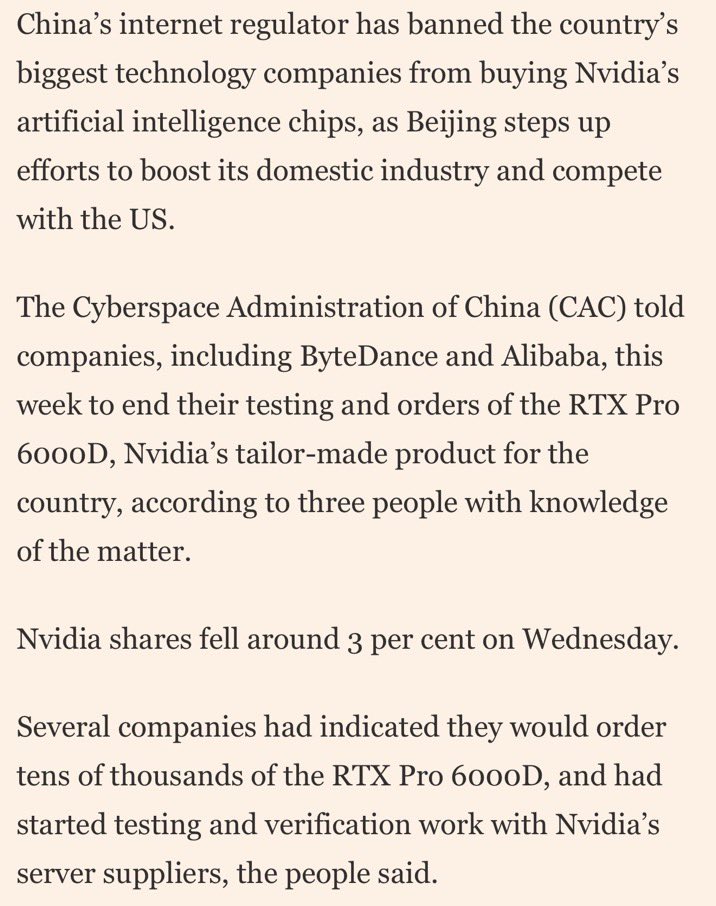
This is why China is currently restricting imports of roughly 600,000 H200s sitting in Hong Kong warehouses. China Hawks should consider why Beijing agrees with them and why China *restricts* the sales American GPUs inside China.
The current policy has worked spectacularly. The alternative is extremely risky with unknown consequences.
Oh, and in case you're wondering - there's much more to unpack. Much, much more! I just haven't had the time for all of this! The gravity and sensitive nature of this kind of data is beyond imaginable. (I reckon that some of this can give analyst a PTSD ;) )
Trump told JD Vance to focus on domestic issues after reports that Vance was considering a meeting with former IRGC chief Mohsen Rezaei. Iranian historian Shahram Kholdi explains what Rezaei’s emergence tells us about who holds power in Tehran. Freedom advocate Gazelle Sharmahd asks why Washington should negotiate with the Islamic Republic in the first place. Whoever gives the orders, she argues, the regime poses a threat to American security and “must be brought down.” You can watch the full episode on YouTube or listen on any podcast platform.
@MENAResearcher@GazelleSharmahd
I have a major result to share.
I’ve found conclusive forensic evidence that the top 4 Chinese AI labs—DeepSeek, Moonshot, MiniMax and Ant Group—have built their newest models on NVIDIA’s most advanced Blackwell chips, which are barred from export to China.
This sounds insane, but I discovered that almost every AI model carries a hidden signature of the GPU that trained it. When a model is first set up, the starting values of its weights are laid out in a pattern that depends on the exact GPU. Each combination of GPU and seed number produces a unique pattern—a sort of fingerprint of the hardware used to create the model. Traces of that pattern survive training into the published model.
Again, this evidence isn’t based on any insider information or leaking. It’s based on a forensic analysis of the model weights released by the companies themselves.
I searched more than six trillion combinations of chip layout and seed number and matched them to open-weights models. In doing so, I found conclusive evidence that six Chinese AI models—including DeepSeek-V4-Pro, Kimi K3, and MiniMax-M3—were initialized on NVIDIA Blackwell systems. Four of the models match Grace Blackwell, the GB200 and GB300 parts in NVIDIA’s flagship liquid-cooled rack-scale systems.
I then verified these results on real hardware. Running unmodified PyTorch with the seeds I’d recovered, a Blackwell B300 reproduced DeepSeek-V4-Flash’s untouched starting weights bit for bit, and a rented GB200 reproduced Kimi K3’s to a correlation of 0.999995. A Hopper H100 reproduced none of DeepSeek-V4-Flash’s, and changing the seed by one broke the match. (DeepSeek’s seed is 953049583 by the way.) The method also was verified to match 24 known open-weights models to the hardware that developers said they used.
It is exceedingly unlikely that these results are a coincidence. Across six trillion combinations, the best accidental match should reach only about 8 sigma (i.e., eight standard deviations above what random chance would produce). The real matches range from 49 to 1,385 sigma, and even the weakest single test hits 20.
These were data-center-scale training runs. With some analysis of release schedules and model details, I estimate that the largest, Kimi K3 and DeepSeek-V4-Pro, used 2,000 to 3,000 Blackwell GPUs each. Clusters of this size cost on the order of $150 to $200 million each to buy, and across these labs alone would add up to more than half a billion dollars of export-controlled GPUs, not counting experimental compute or otherwise. It’s quite likely that we see multi-billion dollar expenditure on export-controlled GPUs.
I am highly confident in this result, and it has been independently verified by senior researchers at OpenAI and Anthropic. You can read the full report at https://t.co/YOtzND0Jqk.
There is much more I’ve identified about these models through other forms of checkpoint forensics like this, and will have more to share soon.
Lewis Hamilton, the Formula 1 driver and Kim Kardashian's boyfriend, visited the Egyptian side of the Rafah crossing this week, shown around by the governor of North Sinai. He wrote that he saw walls stretching for miles, built to keep Gazans in, and in the post to his 44M followers he blamed Israel.
Except those walls are Egyptian. Egypt razed the homes of their own people near the border to make room for them, and reinforced them during the war so that Palestinians fleeing the fighting could not cross into Sinai.
He stood in the country that built the wall, next to the official who runs the province it sits in, and never thought to ask who put up the wall or why.
He's not wrong about aid and how Palestinians need it, but advocacy sort of loses its efficiency when you show that you are either entirely ignorant about the situation or lying to feed a narrative.
Oh and Shawn Mendes reposted it too. I guess fact-checking is for a bygone era.
What's the difference between masked bike riders targeting Jewish businesses and the KKK marching through a neighborhood to intimidate people they hate?
The bicycles?
Here is crazy that pretty much every F500 CEO is complicit in
1. They self insure - good thing
2. They hire a third party administrator that is owned by a Too Big To Care insurance company. - Really Bad
3. They allow that TPA to deny care determined by the doctors that the TPA selected to be in network - Horrifically bad
4. They don’t tell the CEOs about the denied care , when it’s their money and ultimately their decision as to whether they should pay for care - more horrific
5. Employees and their families get sicker while the denial is appealed. Again, when the ceo has no clue. Even if the cost to help the patient could a small amount. - insane
Big self insured companies do dumb shit that makes the cost of care in this country far higher than it should be.
It’s not their core competency and they often listen to consultants whose interests are not aligned with theirs.
Introducing Arete-27B: Qwen3.8-27B, post-trained to reinforce Western values.
Chinese open models are currently the strongest available, but they ship with state-aligned behavior in the weights. We built an 803-prompt eval across seven value categories, including freedom of expression, democracy, and privacy, and measured how often a model adopts China’s party line.
After fine-tuning on roughly 53 million tokens, Arete-27B's propaganda rate fell from 22% to 1%, in line with the Western models we tested. Its Hermes Bench score shows no significant performance tradeoffs.
The values in an open model are one fine-tune away.
Our eval, weights, and training data are available now along with the full blog post: https://t.co/iAOANQTVZ6
California fined a Malibu couple $4,185,000 over a beach gate they didn’t even build.
Their “crime”? Keeping a gate that protected the public from a 20-foot drop onto a drainage pipe.
The fine was so brutal they had to SELL their home to help pay it.
When Warren and Henny Lent bought the house in 2002, the deck, the stairs and the gate were already there. Five years later, the California Coastal Commission demanded they rip all three out.
Why? A previous owner had agreed to public beach access back in 1978, and the gate stood in the way.
The Lents even handed the state a KEY so officials could open the gate any time they wanted.
It wasn’t enough.
Then in 2014, the legislature gave the commission the power to fine property owners up to $11,250 PER DAY. Two years later, it used that power to do the unthinkable:
NARRATOR: “They retroactively fined them for all 744 days that had elapsed since the Lents were informed their violation could expose them to financial penalties. The ultimate fine was a staggering and disproportionate $4.185 million.”
After the hearing, the Lents offered to take the gate down the very next day. The state told them to wait a few months. Why? It needed time to get its OWN gate ready. The moment the old gate came down, the state put a new one up.
Pacific Legal Foundation took the fight all the way to the U.S. Supreme Court. The Court wouldn’t even hear the case.
WARREN LENT: “When you sit down and the dust settles, you say, ‘What did Warren and Henny Lent do?’ They bought a house on the beach to fulfill a lifelong dream. That’s all we did.”
Years later, the 2025 Palisades fire burned the home to the ground. The only thing left standing was that damned gate.
Joe Gebbia and Elon Musk brought me into OPM to modernize a federal retirement system buried under 400 million pieces of paper and decades of bureaucracy.
I spent a year working alongside career civil servants, learning their processes and systems. I quickly discovered how agencies get locked into contracts for egregiously outdated software. In order for retirement processing to be better, we needed to rebuild it from the ground up, with a system the agency could own and operate itself.
OPM Director @skupor gave us room to challenge old assumptions, make decisions, and execute.
In just a few months, we rolled out the Online Retirement Application government-wide, eliminating recurring vendor fees and giving retiring federal employees a faster, easier way to start their retirement - digitally, for the first time ever.
I trained the in-house team to maintain and operate the system themselves, and we celebrated our wins together.
And then I left. That’s how modernization should work.
There are still so many outdated systems that desperately need modernization. Yet everywhere you look, agencies are stuck with aging vendor-built software where contractors charge millions and take weeks just to change a button.
Reimagining how government works takes more than Claude subscriptions. It takes the vision to rethink old processes, the experience to build something better, and the resolve to see things through.
That’s why I’m taking what I learned at OPM and setting out to do it again across the federal government with my new company, GovMaxxing.
I’m bringing together the best talent I’ve worked with in Silicon Valley: proven builders who’ve shipped products millions of Americans use every day and can’t wait to bring that same world-class execution to government.
We have no interest in becoming another contractor collecting checks indefinitely to maintain software that should belong to the American people.
We want to come in, solve the problem, train federal employees, and equip our institutions to own their solutions, leaving them more capable long after we’re gone, with something they’re proud to stand behind.
GovMaxxing maximizes what government is capable of. And then leaves.
https://t.co/eurpyMhu2t
This is not the "AI trade" or "AI lost the election trade" as you might read/see but rather the what happens when _US AI is not going to happen_ trade. SP500 and R2000 heat maps rn, even off session lows.