Happy birthday to Marie Skłodowska Curie, who was born on this day in 1867.
Marie Curie was the first person to be awarded the Nobel Prize twice, and is still the only individual to receive the prize in two different science categories.
Find out more: https://t.co/C00oKYwxxL
Nature rejected her paper for not being original,
University of Pennsylvania (her employer) demoted her,
and yesterday Katalin Karikó won the Noble Prize in physiology.
In mid-2000s, Karikó and her Drew Weismann submitted their paper on mRNA (messenger Ribonucleic Acid) to Nature.
Nature desk rejected their paper for being "an incremental contribution" only. The paper was later published in another journal, Immunity.
Earlier in her career at the University of Pennsylvania, Karikó was demoted because her applications for grants kept getting rejected.
But Karikó persevered and kept on going.
In 2013, she joined BioNTech, a German company founded by two scientists, Uğur Şahin and Özlem Türeci. In 2018, BioNTech partnered with Pfizer to develop mRNA vaccines against the influenza virus.
When the COVID-19 hit the world, Karikó's research helped Pfizer to produce the first vaccine against the disease.
I don't know how the Nature editors who desk rejected Karikó's paper and the Penn administration who demoted her feel about Karikó Nobel Prize.
Takeaway: Many academics and scientists worry about getting published in "prestigious" journals. Instead of worrying about prestige, we should try to put our work out as quickly as possible like Karikó did.
Once you put your work out without caring about prestige, two good things happen:
1. Your work will lead to newer opportunities.
2. You will start getting feedback from the scholarly community, which you can use to iterate and improve.
Here's another interesting Nobel Prize story.
Peter Higgs, a British physicist, joined the University of Edinburgh in 1956. By 1964, Higgs has published his groundbreaking work about subatomic particles.
After 1964, Higgs published less than 10 papers.
When his department would ask him how many papers, he published in a given year, he would reply "None."
It happened so often that he stared feeling like an "embarrassment to the department."
The University of Edinburgh, however, never fired Higgs because in 1980 he had been nominated for the Nobel Prize.
Higgs retired in 1996 and stayed on as an emeritus professor at Edinburg.
In 2012, experiments conducted at the CERN laboratory confirmed Higgs work and the existence of Higgs Particle.
And in 2013, Higgs was awarded the Noble Prize in physics and the University of Edinburgh got rewarded for being patient.
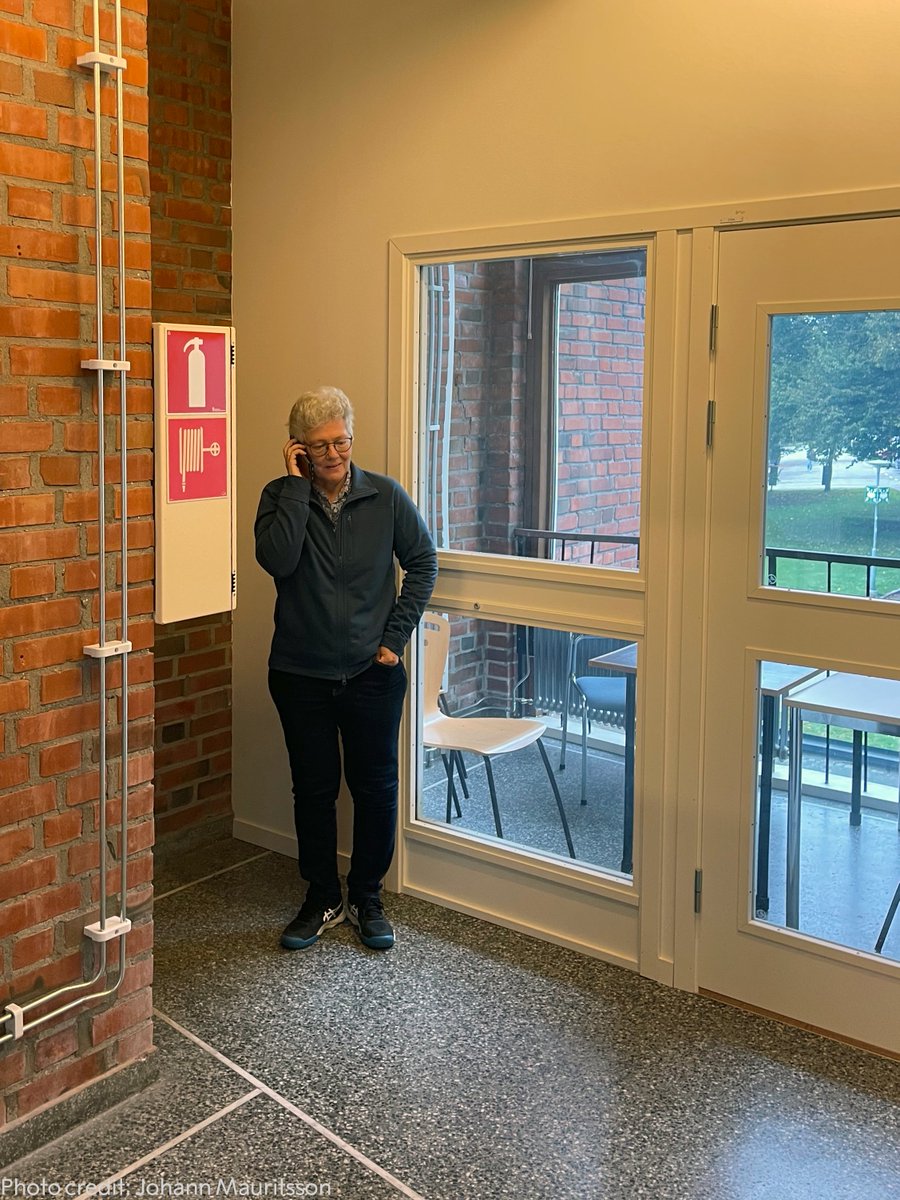
Dedicated teacher alert!
Not even the 2023 #NobelPrize in Physics could tear Anne L'Huillier from her students.
Our new physics laureate was busy teaching a class. During a scheduled break, she heard the news.
After the phone call, L'Huillier went right back to her students.
Congratulations to Katalin Karikó, laureate of the 2023 #NobelPrize in Physiology or Medicine, together with Drew Weissman, for the research that led to the development of the mRNA COVID vaccines.
Professor @kkariko also received the 2022 L’Oréal-UNESCO #ForWomenInScience International Award, proving once again that the world needs #WomenInScience.
Don't miss in this video her inspiring words on how fulfilling science is!
https://t.co/cvYplKNskU
“Ten years ago I was kicked out and forced to retire.”
Our new medicine laureate Katalin Karikó (@kkariko) told us how much it means to be awarded the Nobel Prize after a scientific career that has been full of challenges.
Ten years ago, Karikó was still doing all her experiments by hand but today she has been awarded the medicine prize for her research on mRNA, which led to the development of COVID-19 vaccines.
Listen now:
What a honor to evaluate a friend's work. I'm proud of you, Karina. Proud as a friend and as a evaluator. I wish you the most amazing things in your carrier.