At Harvard, a student thought A Clockwork Orange was written in “Old English” and used AI to “translate” it.
Others “view reading as an unnecessarily burdensome way of acquiring knowledge” and think professors who ask them to do it are “arbitrarily withholding information.”
Learning advanced math ahead of time is the greatest educational/career life hack.
When a student learns a lot of advanced math ahead of time, they unlock the opportunity to dig into a wide variety of specialized fields that are usually reserved for graduates with strong mathematical foundations.
This fast-tracks them towards discovering their passions, developing valuable skills in those domains, and making professional contributions early in their career, which ultimately leads to higher levels of career accomplishment.
I’m not exaggerating here -- this is actually backed up by research. On average, the faster you accelerate your learning, the sooner you get your career started, and the more you accomplish over the course of your career.
For instance, in a 40-year longitudinal study of thousands of mathematically precocious students, researchers Park, Lubinski, & Benbow (2013) concluded the following:
"The relationship between age at career onset and adult productivity, particularly in science, technology, engineering, and mathematics (STEM) fields, has been the focus of several researchers throughout the last century (Dennis, 1956; Lehman, 1946, 1953; Simonton, 1988, 1997; Zuckerman, 1977), and a consistent finding is that earlier career onset is related to greater productivity and accomplishments over the course of a career. All other things being equal, an earlier career start from [academic] acceleration will allow an individual to devote more time in early adulthood to creative production, and this will result in an increased level of accomplishment over the course of one's career.
...
[In this study] Mathematically precocious students who grade skipped were more likely to pursue advanced degrees and secure STEM accomplishments, reached these outcomes earlier, and accrued more citations and highly cited publications in STEM fields than their matched and retained intellectual peers."
“My mother had a biology/zoology class that ran late so I would sometimes attend the class with my mother, sitting on her lap, reading the text, and listening to the lectures. It was clear how my parents, the professors and students valued education, and that they were discovering and understanding things about the outdoors that I played in everyday. I liked the respect that the other students and professors gave my mother for being a good student, and that they tolerated me being in the class and sometimes explained things to me. The seriousness of learning was tempered with fun, so it was a wonderful place to be and opened up a whole new way of understanding the world as a child. I still spent a lot of time outside exploring nature but now tried to tie that to reason and a network of knowledge.”
- physics laureate George Smoot on his childhood memories with his mother who was a teacher.
#NobelPrize
The Cooper pair condensate is the Higgs condensate. In contrast to cooper pairs, it looks like it isn't composite but a fundamental field (but physicists actively look for signs of Higgs compositeness).
Yes, it does break down. At temperatures above the electroweak scale, around T∼100 GeV (a cosy 10^15 K), the Higgs expectation value goes to zero and electroweak symmetry is restored
3rd grader aces AP Calc BC, earning the equivalent of a full year of college calculus credit at most universities.
This is among the youngest publicly documented achievements of its kind.
For anyone wondering how a kid can learn six years' worth of math in one year -- really *learn* it, not just "cover" it:
Each circle represents a topic. The darker the circle, the stronger the student's knowledge.
Students systematically master prerequisite topics before approaching more advanced ones.
While pushing forward, they interleave across many learning paths to improve transfer.
They also systematically review previously learned content at optimal intervals to strengthen long-term retention.
What you're seeing is a student's math brain getting wired up under maximum-efficiency learning conditions.
(The animation below is just for one course, a smaller subset of the entire curriculum.)
For anyone wondering how a third-grader can complete six years' worth of math in a single year AND score a 5 on the AP Calculus exam.
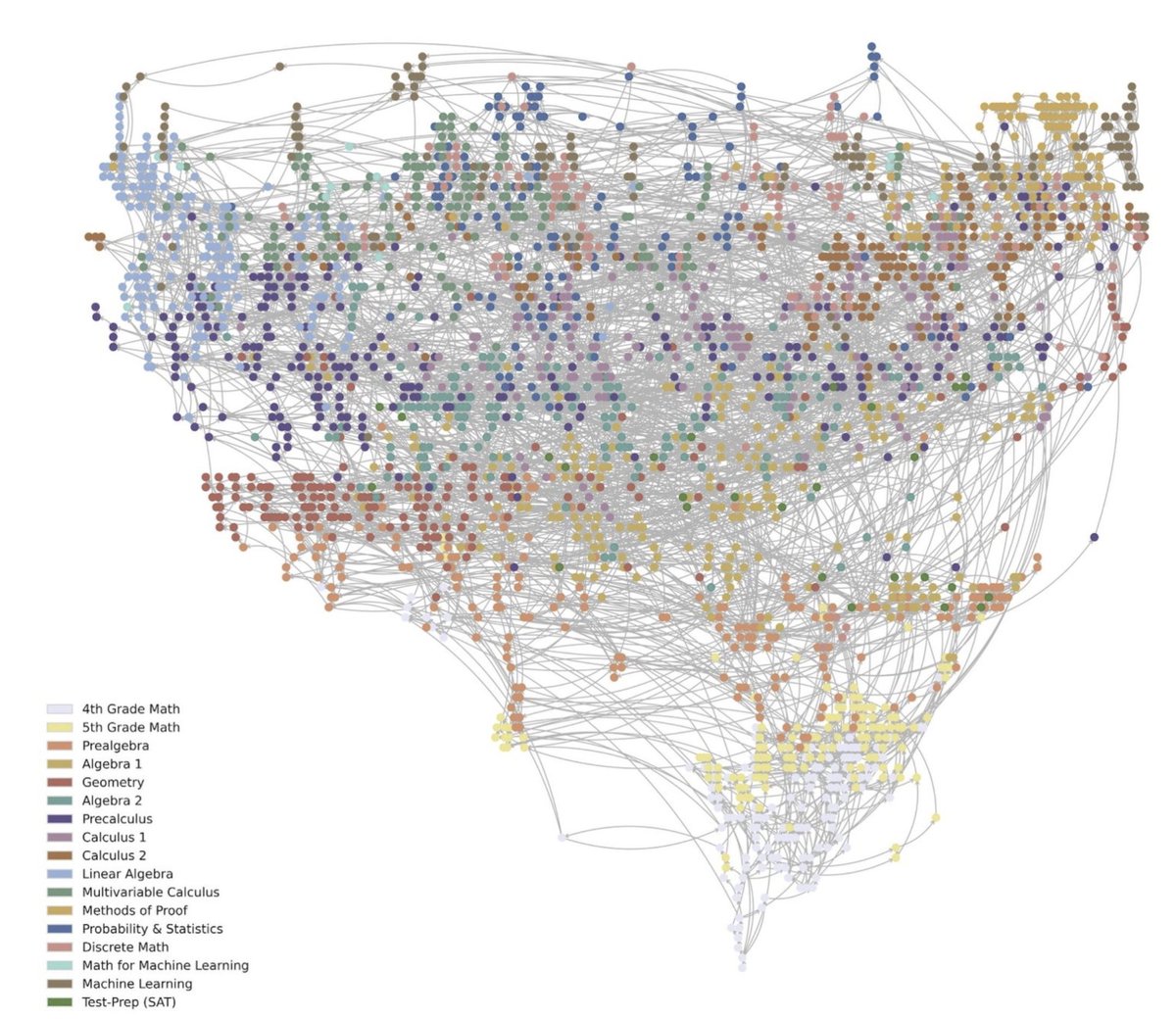
This knowledge graph spans 3,000 math topics, from 4th grade to the university level, providing the perfect basis for mastery learning.
Students can go as fast or far as they want! There are no restrictions whatsoever. The only requirement is that they must demonstrate mastery of each topic before moving on to the next.
Kids are capable of incredible things when given that kind of freedom and support.
Correct.
The neurochemistry discourse is biological determinism masquerading as science. Serotonin and cortisol are part of our biological hardware, but our actions are driven by the software of our ideas.
How to compress a grade level’s worth of learning much, much shorter than a year:
1. Identify what the student already knows
2. Overlay that on a knowledge graph to construct their personal knowledge profile
3. Teach only new topics for which they've mastered the prerequisites, their "knowledge frontier"
4. Each lesson cycles through minimum effective doses of explicitly guided instruction & active practice problems
5. Enforce mastery relentlessly: if you can't consistently solve problems correctly, then you don't move on to more advanced material that depends on it. You continue on parallel learning paths and come back to the halted one later.
6. Review previously learned material using spaced repetition & frequent broad-coverage closed-book timed quizzes
7. Review old stuff by learning new stuff -- i.e., knock out as much review as possible by learning new material that exercises those review topics as subskills.
A perfect example of @DavidDeutschOxf's fun criterion applied to game design.
I played countless hours of Age of Empires II and consider it a masterwork that has stood the test of time!
@AndrewCritchPhD Your reasoning tends toward positions that, if other people believed them, would be to your advantage. This is universal, unconscious, and does not require overt dishonesty.
A Wireheader's Apostasy
If you really understand philosophy of mind it is clear that David Pearce's quest to end suffering is misguided at a logical level and also at an ethical level.
Suffering is what negative feedback feels like from the inside.
You can't end suffering without ending negative feedback. There can't be a clever technical fix for this, because the suffering is the negative feedback in the same way that a rainbow is sunlight reflecting off water droplets.
You can't run a brain on "gradients of bliss" and have it feel blissful all the time but also produce the same distribution of outputs across all environments because feeling blissful occasionally serves a function and that function is not supposed to be on all the time - you become a wirehead.
Feeling slightly less blissful will simply not motivate you to move your hand off a burning hot plate the way the burn qualia will.
This is borne out empirically when you look at people born without pain receptors: they break all their bones, burn themselves, bite their own tongues off, and often die young.
People who take drugs stop doing normal-person things, they turn into zombies who just seek the drug and nothing else. Why? Because the drug is a massive, artificial superstimulus of all positive reward signals that your brain's reward architecture is not designed to handle. It drowns out the subtler reward signals you get from smelling a nice flower or having a social event with friends, so you stop doing those things. This is probably why homelessness and drug addiction go hand-in-hand - if you are homeless, it's hard to fix your life and get positive feedback from normal life stimuli, so you start taking drugs to feel something. But once you are on drugs, the reward of the drug is so much bigger than the reward you could get from a normal life activity that it's not that compelling to give up drugs for those activities.
It's also deeply immoral to try to turn off all negative feedback, because doing so will turn the world into a sh!thole. I would even include things like political correctness in this, as I think that is best thought of as a form of collective social wireheading.
It is actually a really good thing that sick people suffer terribly. It is good that death is often painful and frightening. It is good that romantic rejection stings and makes us feel bad about ourselves.
Why? Because if these negative events didn't come with negative qualia, we would not be motivated to avoid them.
To be a true transhumanist you must not ask to suffer less, you must ask to suffer more accurately, to be punished more when you fail to live up to your goals and to feel a sweeter reward when you do. And to be a true humanist you must embrace suffering as a force for good in the right circumstances.
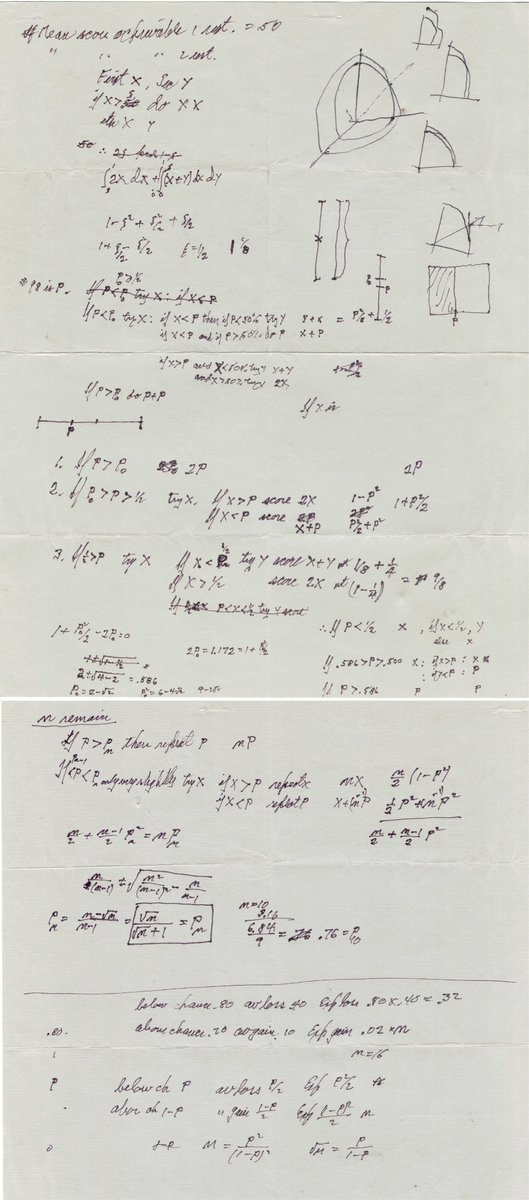
in the late 1970s, richard feynman was at a thai restaurant with his friend when he struggled deciding whether to order his favorite dish or try something new. he turned it into a math problem and solved it.
tldr, the optimal (and intuitive) policy is to try different options each night until encountering an option with a value that exceeded the threshold relative to how many chances you have left. the cutoff starts high and drops over time.
we see optimal stopping problems everywhere…finding parking, when to leave a job, deciding who to marry.
surely feynman’s math on this is elegant, but the interesting thing is that this optimal threshold is determined by what you believe is out there.
we spend so much time optimizing every decision, i think it’s worth reflecting on what kind of distribution we’ve assumed.
these r his handwritten notes btw
One of Niels Bohr's mantras was what we can call "relentless politeness". He was extremely polite, but he was "terrifyingly relentless" (in Heisenberg's words), not stopping for an instant before he satisfactorily resolved an argument and left no stone unturned. Science for Bohr was a forever dialogue, extending not just across race and nationality but past the lecture hall into walks, dinners, train trips and the halls of government. It seems like his formula is one we should all embrace. Always be polite and civil. But relentlessly so. All the way until the end.
My life has consisted in learning and forgetting and learning and forgetting and learning and forgetting statistical mechanics".
- Leonard Susskind
Maybe I shouldn't feel guilty for revising it again.