Thursday September 3rd is a Historic Day
Not just for Tesla, but for the entire world.
It is the day fully autonomous vehicles launch in a first city without a steering wheel or other manual controls, and driven by neural networks that rely exclusively on camera data. These vehicles can travel anywhere without restriction, and the cost per mile is far lower than anything seen before.
The vehicle is named the "Cybercab," and mass production, on a scale of millions, is already underway.
Because it makes point-to-point transport more cost-effective than any other alternative, the number of users of this Tesla transport service will grow exponentially. People who could not afford to be driven will use it daily.
The service is not only more affordable but also safer and more convenient, and it gives people back a piece of their most precious asset: time to live.
The world will look back on September 3, 2026 as the day transportation as we know it changed forever.
The fact that the narrative went from “Teslas can’t even drive themselves” to “well, they have a supervisor” to “well, they have steering wheels” to “well, sure, they don’t have steering wheels, but there are only a few dozen Cybercabs” just shows how fleeting these criticisms are as Tesla continues to knock them down one by one.
Tesla unveiled the Cybercab just 23 months ago and is going to start the first public rides in this thing in less than 3 days - something a lot of people said would never happen.
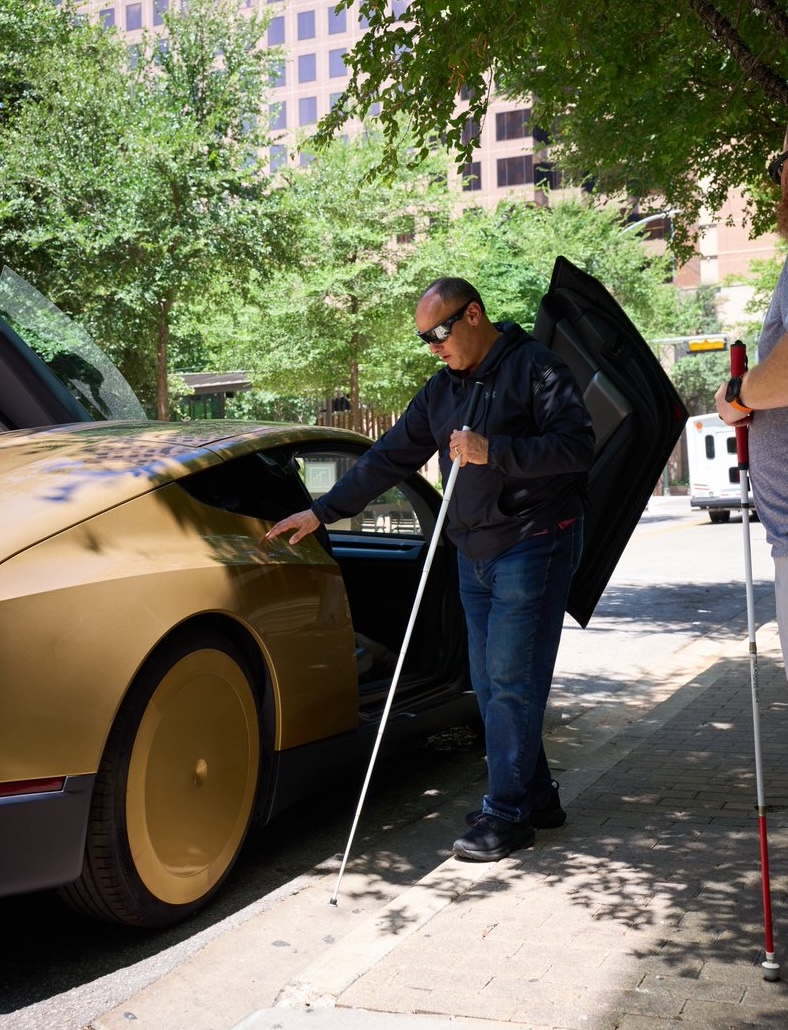
Cybercab will be a game changer in many ways, but especially for people with disabilities. It has Braille throughout the car, a seat height that matches that of a wheelchair, multiple grab points, and enough space around your legs to store a wheelchair or accommodate a large service dog.
I don't know how anyone could root against this vehicle.
SEO is now WAY bigger than ranking #1 on Google.
Not because Google matters less, but because the job of SEO has expanded.
Today, SEO is also about:
1. Getting found when someone searches on Google
2. Appearing in AI Overviews for Google searches
3. Getting recommended in ChatGPT answers
4. Owning the comparison searches in your category
5. Showing up on the sites influencing all of the above
And you can’t do that by JUST:
- Writing more blog posts
- Building more backlinks
- Adding schema
- Tracking a bunch of AI prompts
- Renaming SEO to “AEO”
You need the entire system working together.
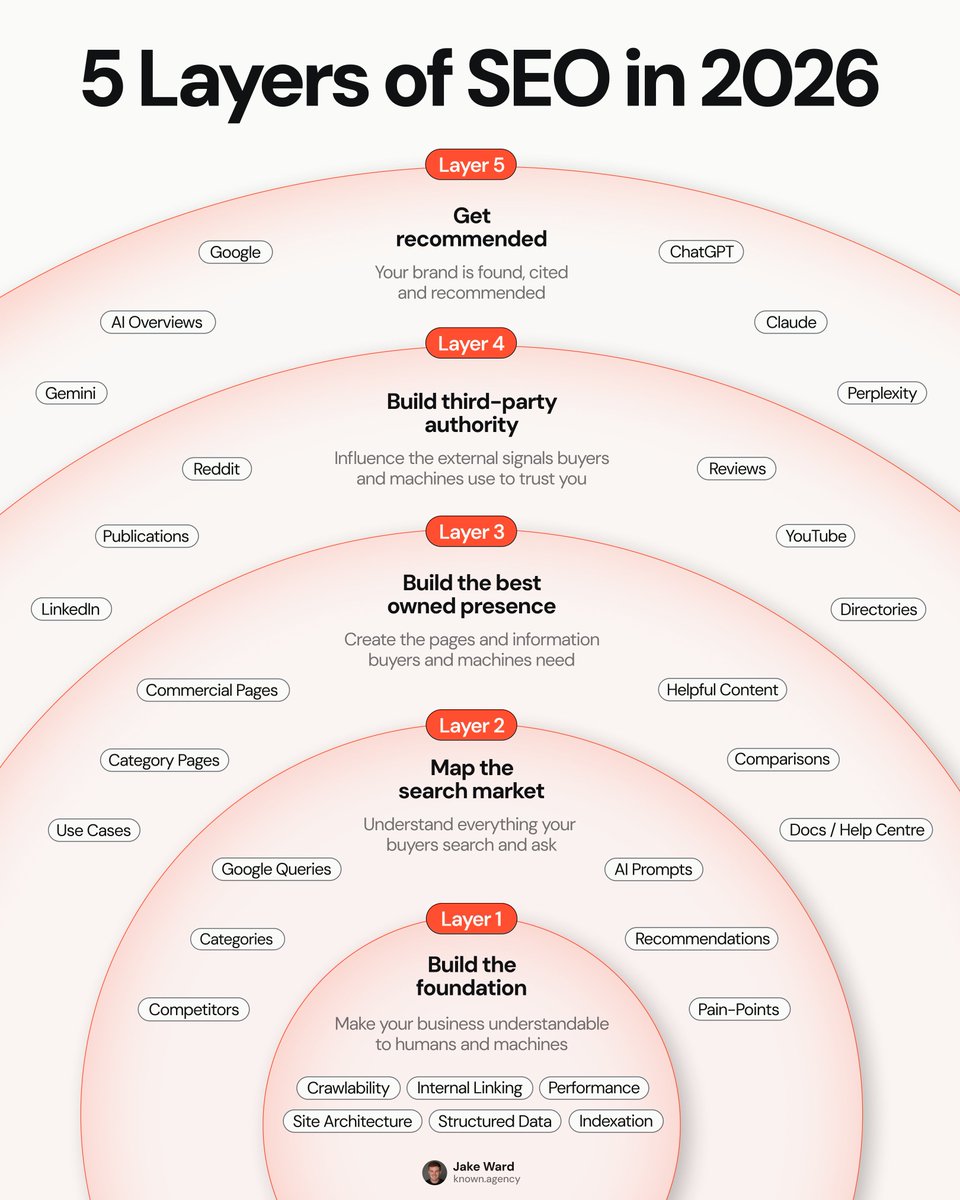
Here’s how I think about the 5 layers of SEO in 2026:
Nike spends $2M on a stadium shoot for a 10-second hero shot.
40-person crew. 3 days of permits. 2 weeks in post. Stunt doubles. Insurance paperwork thicker than the script.
This creator generated the entire sequence on a laptop for under $80.
A guy sprints across a stadium roof at night, leaps off the edge, free-falls into a sold-out arena, and lands on a giant football in the center of the pitch.
One continuous shot. No crane. No drone operator. No safety harness review board.
The toolchain behind this clip:
> Kimi K3 wrote the full shot sequence: rooftop sprint, jump arc, mid-air hang, landing impact, crowd reaction timing
> Kling 3.0 generated the fluid body physics and night lighting on the roof
> Seedance 2.5 rendered the free-fall, wind on the shirt, and the ball deformation on impact
> ElevenLabs produced the ambient stadium atmosphere and crowd noise
> CapCut handled speed ramps, color grade, and final export
A traditional production house would need a stadium rental at $150K, a stunt coordinator, a medical team on standby, and 6 months of liability clearance.
This entire sequence was prompted, rendered, and exported between dinner and sleep.
AI didn't replace the stunt double.
It replaced the entire stadium booking.
I think cold email is going to die.
Every email inbox will have an agent gatekeeper soon, and the only way through will be a warm intro or being interesting enough that the agent decides you're worth its person's time.
Gavin Baker and a16z's David George on the state of the AI boom:
The future doesn't have to be winner-take-all. Labs, open-source, applications, and the clouds can all capture value.
Demand for intelligence is still dramatically underestimated. Today's power users number in the millions and will grow to hundreds of millions. Gavin and David argue a compute shortage is a more real risk than an AI bubble, and building through it is an opportunity to reindustrialize America.
In this episode, they get into why compute investments pay back so fast, what the data center backlash gets wrong, the case for putting compute in orbit, why enterprises will run several models at once, and how Nvidia ended up at the center of the entire supply chain.
00:00 Intro
01:06 The bear case Gavin couldn't find
05:50 Why a lab would cut its own revenue 75%
08:05 What LPs get wrong about a crash
10:50 Microsoft slowed its capex and regrets it
14:33 The engineers spending 100x the median
17:35 Why 23-year-olds use AI better than Gavin
21:45 How much copper 500M AI users need
23:00 Stop promising to cure cancer
26:00 America's richest county is full of data centers
30:48 Who gets priced out of compute
33:05 The age of Elon and Jensen
34:25 Orbital data centers
44:40 Asteroid mining
48:12 Why Microsoft doesn't need a frontier model
54:02 Who becomes the abstraction layer
55:40 Everyone wanted a deity, Cursor wanted a product
1:00:25 Never take shots at Jensen
1:07:40 What happens when the chip doesn't work
1:12:10 What chip deals reveal about customer demand
YouTube: https://t.co/2mokoHwtDa
@GavinSBaker@DavidGeorge83
This is the first open-sourced AI classroom.
Not a chatbot that answers questions. A full classroom.
It's called OpenMAIC. You type one topic. "Teach me quantum physics."
Then it builds the whole thing for you:
- An AI teacher who lectures out loud
- AI classmates who ask questions and get called on
- A whiteboard where the teacher draws diagrams and solves equations step by step
- Interactive 3D simulations you can play with
- Quizzes that grade you in real time
The classmates are what got me. There's a roundtable mode where multiple AI agents with different personalities debate the topic while you watch. You learn from the argument, not the lecture.
MIT licensed so free for anyone.
You can export the whole lesson as PowerPoint or an interactive webpage and keep it.
Repo: https://t.co/3L83U9ZSEp
Today, a16z is announcing the Machine Age Fund, a new $1.1 billion fund for founders rebuilding what intelligence runs on: chips, memory, networking, systems software, power, and the machines that bring AI into the physical world.
Ben Horowitz, Martin Casado, and Raghu Raghuram see a new economic law. A thousand engineers cannot erase a two-year software lead, but a massive GPU cluster can turn capital directly into capability. Models are improving faster than the memory, interconnect, power, and cooling beneath them.
The founder map is changing with it. Some of the strongest teams are moving from pure software into complex hardware because every constraint in the stack is now a company-building opportunity.
In this conversation with Erik Torenberg, they explain what founders can build, why the opportunity reaches all the way down to the physical stack, and why a16z created a fund for it.
00:00 Intro
01:08 Why AI needs an entirely new infrastructure
02:02 The bottleneck is no longer the model
02:40 Founders saw it before investors did
06:07 Sold out through 2028
07:14 Why this time is different from 1999
08:57 The company whose idle hardware gained value
10:51 "Why didn't this fund exist five years ago?"
13:51 "Nobody likes to use AI more than AI"
17:06 The startup law that capital just broke
21:05 What Grok Bot got right
26:43 The case for a custom chip per model
28:23 Why AC power isn't good enough
32:07 Lots of new electricians
34:14 What one gigawatt can power
35:03 Why utilities can't just build faster
37:22 The data centers that give power back
38:01 Why we should never have called it AI
39:43 Why Nvidia will willingly leave money on the table
48:08 Hardware founders are older
52:36 Why America has to lead
YouTube: https://t.co/5QdtZyFJ9T
@bhorowitz@RaghuRaghuram@martin_casado@eriktorenberg