New essay up. The HALO Effect
- notes on the new“Hire and License Out” deals being done by AI companies, most recently Windsurf
- why they are not killing the social contract of SV
- what happens when your people are worth more than your company
- SAFEs for all things please
Software creates soft men
Soft men create hard times
Hard times create hard men
Hard men create hardware
Hardware creates good times
Good times creates software
Alcaraz beat Sinner played one of the greatest major finals in history.
As in 2008 Rafa/Fed Wimbledon finals great.
That Wimbledon final was an announcement that Rafa/Fed were next level above everyone else. Eventually, Novak joined them, and the three of them split nearly 70 major titles.
Sinner and Alcaraz are going to split the majority of majors the next decade plus (they have already won last six in a row) ... unless someone steps up. Currently, it is not evident who that someone else is.
I look forward to the documentary about this match.
Spaniard Carlos Alcaraz defends his #FrenchOpen title by winning one of the greatest #tennis matches ever played.
Rallies from two sets down and three championship points against him to defeat No 1 Jannik Sinner 4-6 6-7 (4) 6-4 7-6 (3) 7-6 [10-2]. His 5th major at age 22 and the longest French Open mens final at 5 hours and 29 minutes
Finished it with a forehand passing shot winner down the line. Met the moment and then the clay
He is 5-0 in major finals
"Bond investors are the economy's bond vigilantes. ... So if the fiscal and monetary authorities won’t regulate the economy, the bond investors will. The economy will be run by vigilantes in the credit markets.”
Ed Yardeni, 1983
“The European media, and numerous academics, keep up the increasingly implausible narrative that Ukraine can win the war only if the West maintains its support. But this is how people talk with no skin in the game... Ukraine needed brave supporters. It got cheerleaders instead.”
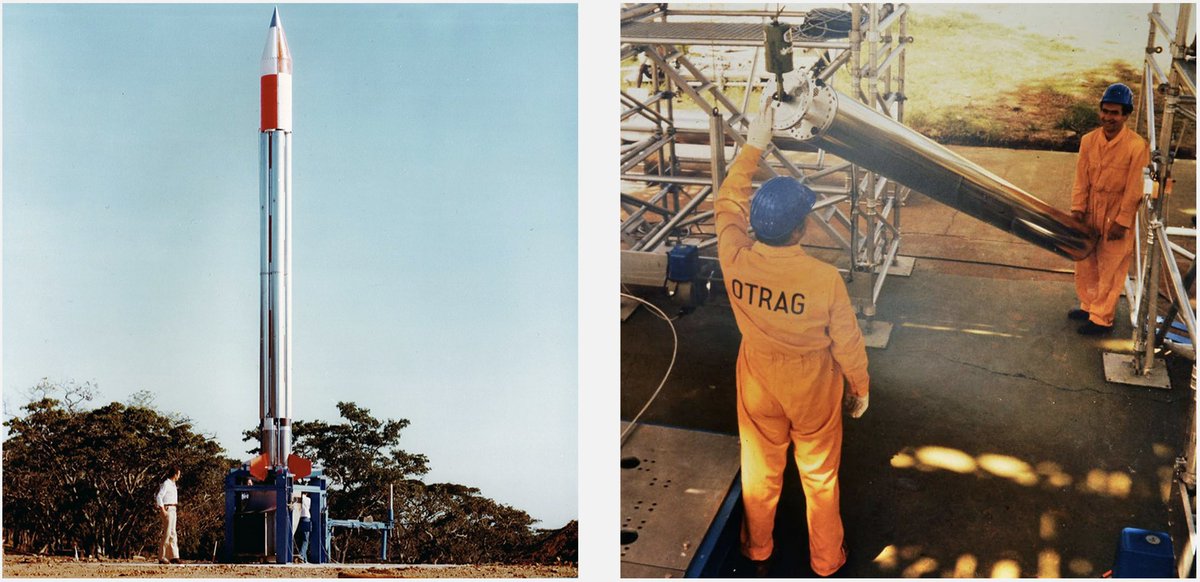
🚀 In 1977, while Elon Musk was still in kindergarten, a German engineer named Lutz Kayser launched the world's first private rocket from the jungles of Zaire.
He started what SpaceX finished three decades later following the same ideas of using innovative cost-cutting designs like bundled fuel tanks, off-the-shelf parts, and cheaper fuels.
With $400M (in today's money) raised from private investors, Kayser dreamed of becoming the "Southwest Airlines of Space." His rockets looked like bundles of aluminium pencils and earned the nickname "flying asparagus"—but they worked, reaching altitudes of 30+ kilometres.
But Cold War politics doomed OTRAG's vision. Deals with African dictators sparked international outrage, so Kayser's board fired him. His company shut down in 1987 and faded into obscurity. Today's booming private space industry owes much to this forgotten pioneer who dared to challenge government monopolies 30 years too soon. 🛰️
Super interesting blog post by @muellerfreitag!
https://t.co/Upv9cm3gsj
@DavidSacks Interesting perspective. Tim Wu explores similar themes in his book “The Master Switch” (2010).
@superwuster: What is your take on the proposal to auction off public spectrum?
Amazing perspective from the pad cameras — the chopsticks catch two 1' pins on the side of the rocket.
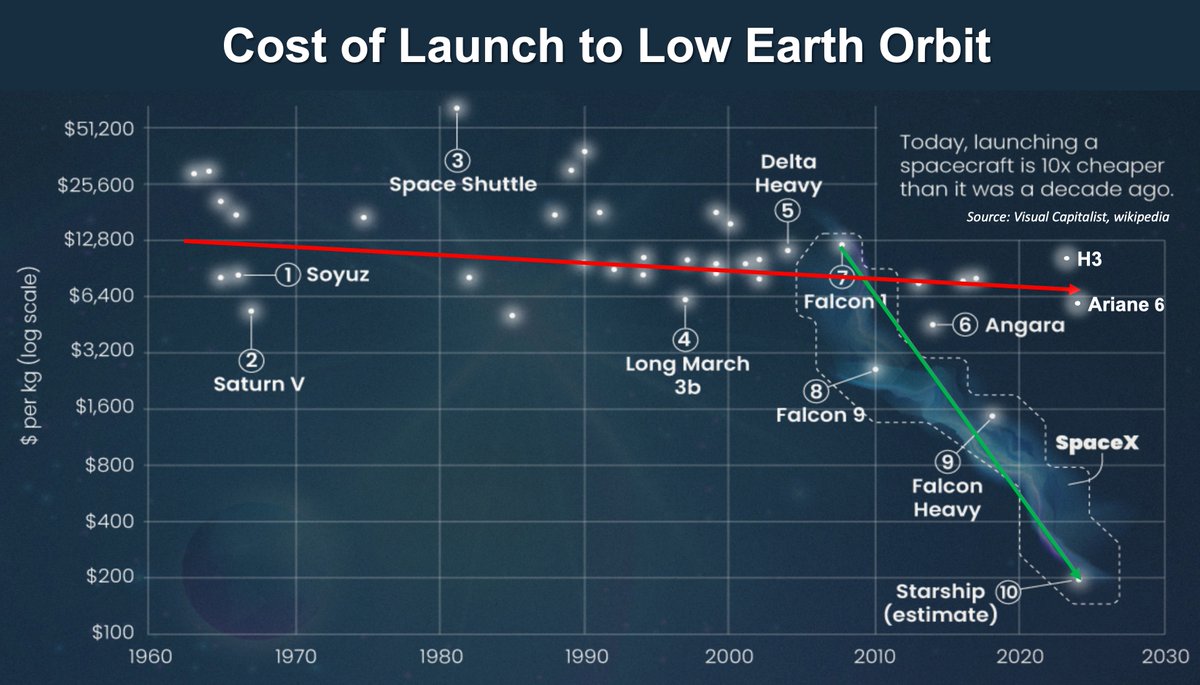
Full reusability is a game changer. While the industry is following the red line, SpaceX is on a different curve.
A straight line is an exponential on this semi-log graph.
Mario Draghi's new report on EU competitiveness doesn't mince words.
"Across different metrics, a wide gap in GDP has opened up between the EU and the US, driven mainly by a more pronounced slowdown in productivity growth in Europe. Europe’s households have paid the price in foregone living standards. On a per capita basis, real disposable income has grown almost twice as much in the US as in the EU since 2000."
"First – and most importantly – Europe must profoundly refocus its collective efforts on closing the innovation gap with the US and China, especially in advanced technologies. Europe is stuck in a static industrial structure with few new companies rising up to disrupt existing industries or develop new growth engines. In fact, there is no EU company with a market capitalisation over EUR 100 billion that has been set up from scratch in the last fifty years, while all six US companies with a valuation above EUR 1 trillion have been created in this period. This lack of dynamism is self-fulfilling."
"There are not enough academic institutions achieving top levels of excellence and the pipeline from innovation into commercialisation is weak. [...] However, while the EU boasts a strong university system on average, not enough universities and research institutions are at the top. Using volume of publications in top academic science journals as an indicative metric, the EU has only three research institutions ranked among the top 50 globally, whereas the US has 21 and China 15."
"Regulatory barriers to scaling up are particularly onerous in the tech sector, especially for young companies. Regulatory barriers constrain growth in several ways. First, complex and costly procedures across fragmented national systems discourage inventors from filing Intellectual Property Rights (IPRs), hindering young companies from leveraging the Single Market. Second, the EU’s regulatory stance towards tech companies hampers innovation: the EU now has around 100 tech-focused laws and over 270 regulators active in digital networks across all Member States. Many EU laws take a precautionary approach, dictating specific business practices ex ante to avert potential risks ex post. For example, the AI Act imposes additional regulatory requirements on general purpose AI models that exceed a pre-defined threshold of computational power – a threshold which some state-of-the-art models already exceed. Third, digital companies are deterred from doing business across the EU via subsidiaries, as they face heterogeneous requirements, a proliferation of regulatory agencies and “gold plating” of EU legislation by national authorities. Fourth, limitations on data storing and processing create high compliance costs and hinder the creation of large, integrated data sets for training AI models. This fragmentation puts EU companies at a disadvantage relative to the US, which relies on the private sector to build vast data sets, and China, which can leverage its central institutions for data aggregation. This problem is compounded by EU competition enforcement possibly inhibiting intra-industry cooperation. Finally, multiple different national rules in public procurement generate high ongoing costs for cloud providers. The net effect of this burden of regulation is that only larger companies – which are often non-EU based – have the financial capacity and incentive to bear the costs of complying. Young innovative tech companies may choose not to operate in the EU at all."
More: https://t.co/x1d1ApvG2Z.
@zebulgar “There are only two effective ways to deal with political and economic stagnation, preaches a popular Bulgarian joke—one is Terminal 1 and the other is Terminal 2 (of Sofia’s international airport).”
Ivan Krastev
@zebulgar What exactly is the bull case for Bulgaria?
The population has shrunk by 25% in the last 30 years. The UN predicts another 20% decline by 2050.
Bulgaria is the fastest-shrinking country in the world. 15 of the 20 fastest-shrinking nations are in eastern Europe or the Balkans.
@daveg To me, the ad primarily highlights the broader issue of societal atomization, where human interaction and traditional community bonds are increasingly mediated and replaced by impersonal smartphone apps. We prize efficiency over genuine human connection. This should concern us.




![christophclarey's tweet photo. Spaniard Carlos Alcaraz defends his #FrenchOpen title by winning one of the greatest #tennis matches ever played.
Rallies from two sets down and three championship points against him to defeat No 1 Jannik Sinner 4-6 6-7 (4) 6-4 7-6 (3) 7-6 [10-2]. His 5th major at age 22 and the longest French Open mens final at 5 hours and 29 minutes
Finished it with a forehand passing shot winner down the line. Met the moment and then the clay
He is 5-0 in major finals](https://pbs.twimg.com/media/Gs8Xy9_XoAAJLO1.png)