Dama munyi kira cewa wannan shugaban hukumar zaɓe ta INEC, na da mummunar manufa, yana da rashin adalci a cikin zuciyarsa musamman ga musulmi, amma yanzu gaskiya tana ta fitowa. - Dr. Bashir Aliyu Umar (Limamin masallacin Al-Furqan.)
Islam is not built on emotions or modern opinions; it is based on the Qur’an and the teachings of Prophet Muhammad ﷺ. The issue of blasphemy and its punishment is rooted in established Islamic jurisprudence and upheld by many classical scholars—not politics or personal feelings.
The Prophet ﷺ is a no-go area in Islam. His honor is sacred, and any insult towards him is treated with utmost seriousness in Islamic law. However, this is not for individuals or mob action—it is strictly the responsibility of a legitimate authority under proper legal process.
As for the claim that “, I am pretty sure that God could fight for himself". Islamically, Allah indeed needs no protection. But Muslims are commanded to love, honor, and defend the dignity of the Prophet ﷺ. Respecting him is part of faith, not because Allah is weak, but because it is a duty upon believers.
Islam is complete, and its laws are not subject to emotional arguments or external pressure.
CRESCENT SIGHTING REMINDER FOR SHAWWAL 1447!
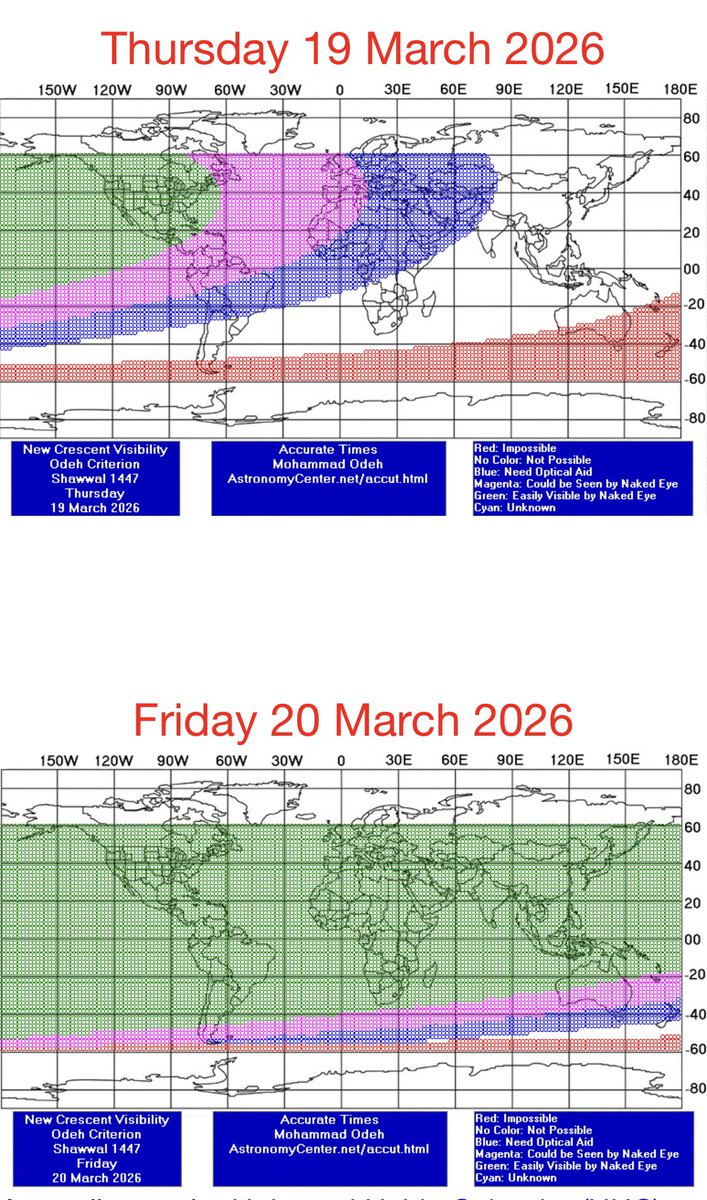
The conjunction of Shawwal 1447 crescent (New Moon) will occur InshaAllah on ( Thursday 19th March 2026) at 2:23am inshaAllah .
Sighting the new crescent on (Thursday 19th and Friday 20th March. Please note that the new moon conjunction will take place after sunset on March 18th/29th Ramadan , which is why there is no graph available for that evening. ) is shown in the graphs below using the program Accurate Times by Mohammad Odeh according to Odeh criterion.
Where:-
It is impossible to see the crescent from the areas located under red color because either the Moon on this day sets before the Sunset or conjunction occurs after Sunset.
The crescent is expected to be seen by optical aid only from the areas located under the blue color.
The crescent is expected to be seen by optical aid from areas located under magenta color. In these areas the crescent could be seen by naked eye if the atmospheric conditions are superb and the observer is experienced.
The crescent is expected to be easily visible by naked eye from areas located under green color.
The crescent cannot be seen from uncolored areas, even though it sets in these locations after Sunset and the conjunction occurs before Sunset, cos it’s not sufficiently illuminated.
Searching for the new Moon is an ACT OF IBADAH and a means of EARNING REWARD from Allah inshaAllah .
It is the SUNNAH of our beloved Prophet (ﷺ). The Sunnah is ‘sighting’ and not mere knowledge of the moon’s existence above the horizon.
Allahu a’alaam!!!
@moonsightingng
𝐈𝐧 𝟐𝟎𝟎𝟑, 𝐒𝐡𝐞𝐢𝐤𝐡 𝐉𝐚𝐟𝐚𝐫 𝐌𝐚𝐡𝐦𝐨𝐮𝐝 𝐀𝐝𝐚𝐦 )رحمه الله) 𝐬𝐩𝐨𝐤𝐞 𝐰𝐨𝐫𝐝𝐬 𝐭𝐡𝐚𝐭 𝐟𝐞𝐞𝐥 𝐚𝐬 𝐭𝐡𝐨𝐮𝐠𝐡 𝐭𝐡𝐞𝐲 𝐰𝐞𝐫𝐞 𝐬𝐚𝐢𝐝 𝐭𝐨𝐝𝐚𝐲.
He highlighted a reality many Muslims recognize, in Nigeria and around the world: we are often pushed into a constant state of defense. Accusations come one after another:
“Islam doesn’t give women rights.” “Islam is extreme.” “Islam is harsh.” And so we respond. We explain. We clarify. We defend.
But he warned that remaining perpetually on the defensive distracts us from a greater responsibility; to confidently and wisely invite others to Islam.
Islam is not defined merely as “peace,” as it is often reduced to in modern discourse. The word Islam means total submission to the will of Allah ﷻ; a complete and conscious surrender of one’s desires, actions, and life to the Creator. To say “I am Muslim” is to say: I submit fully to Allah. I do what He commands and refrain from what He forbids.
Sheikh Jafar (رحمه الله) also challenged a common narrative: the portrayal of Islam as inherently aggressive. He pointed to history — particularly the battles of Badr and Uhud — emphasizing that the early Muslim community faced persecution, expulsion, and armed pursuit. The Prophet ﷺ & his companions were forced from Makkah, migrated seeking peace, and were pursued to the outskirts of Madinah. The Battle of Badr itself took place near Madinah after hostile forces advanced toward them. His broader point was about perspective: history is often told by those who control the narrative. Yet global history is filled with devastating wars, colonization, and mass civilian casualties carried out by powerful nations — from Hiroshima and Nagasaki to Algeria, Iraq, Gaza & beyond, the Christian West has killed tens of millions of innocent Muslims, either during colonization or modern day imperialism. Still, Islam is frequently singled out as uniquely violent.
Whether one agrees with every framing or not, his message was clear: Muslims should not internalize narratives that constantly place them on trial. Instead, they should understand their faith deeply, represent it with integrity, and engage the world with confidence, knowledge, and wisdom. Nearly two decades later, his words still provoke reflection.
May Allah have mercy on him and grant us clarity, balance, and steadfastness.
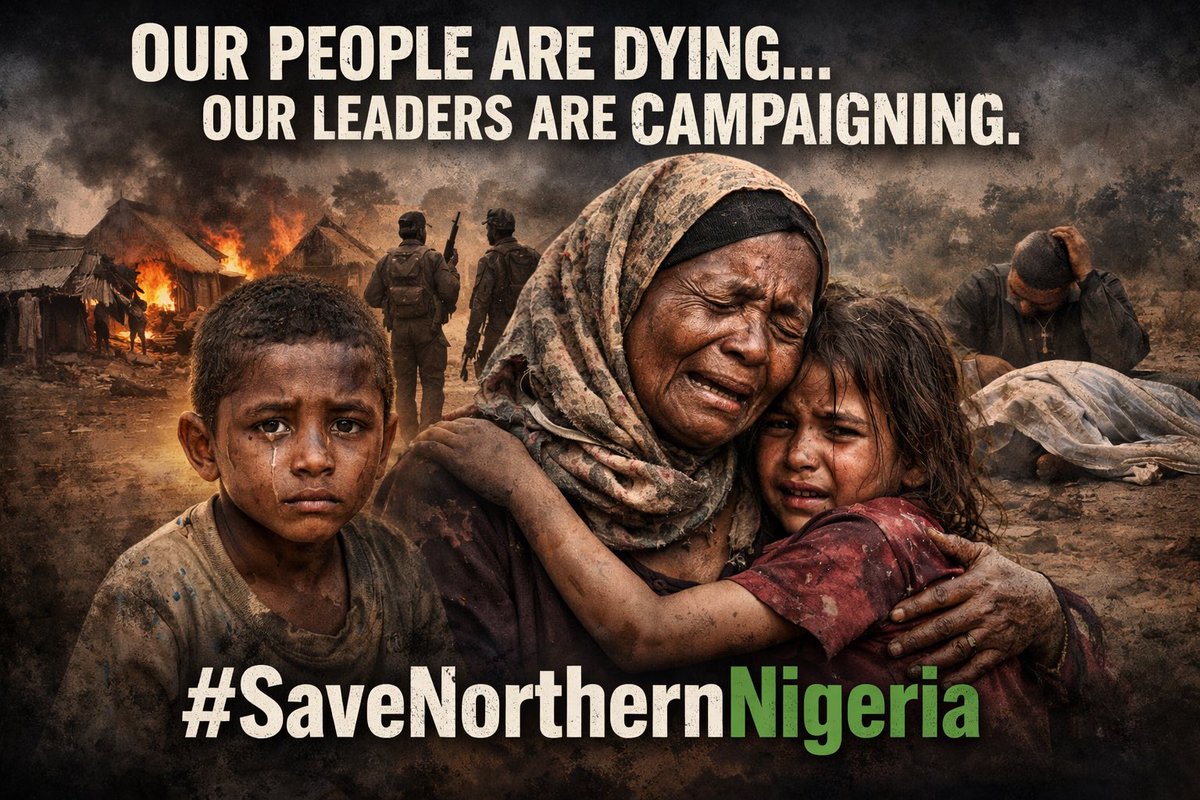
Bauchi is bleeding. Katsina is mourning. Kebbi is grieving. Zamfara is under siege.
Benue isn't safe. So is Plateau.
Families are being torn apart by bandits and terrorists.
Children are orphaned. Mothers are burying their sons.
Villages are burning.
Yet, the political class is already consumed with campaigns, alliances, and 2027 permutations.
What is the value of power if the people are not safe?
What is democracy without security?
What is leadership without responsibility?
Northern Nigeria cannot continue like this. We cannot normalize mass killings. We cannot normalize silence. We cannot normalize excuses.
Lives must matter more than elections.
History will remember who spoke up; and who stayed silent.
#SaveNorthernNigeria
Dear @JaafarSJaafar,
Everyone knows that you are not the best person to decide for anyone, especially for someone who is clearly more educated than you on matters of the world and matters of God, what such a person should or should not do. At best, what you have offered is nothing more than the loud opinion of a serial cynic who enjoys throwing stones without building anything.
Your position sounds less like thoughtful analysis and more like the familiar grumbling of someone who prefers noise to nuance. If your argument truly holds water, then it should have applied consistently in the past. When Pantami was appointed a Minister, he was publicly addressed & recognized as Sheikh, Dr, Professor, and Honorable Minister all at the same time. Your immature logic did not surface then. That appointment did not prevent him from continuing his scholarship, his preaching, or his intellectual contributions. In fact, he excelled. History has already recorded him as the best minister that ministry ever had, not because he abandoned faith, but because he carried competence, discipline, and clarity into public service. You seem comfortable suggesting that Nigeria would be better served by drunkards, morally bankrupt characters, and known thieves, so long as they fit your crude stereotype of what a politician should look like. If this is not your position, then kindly explain how a preacher automatically becomes unfit for leadership, while proven failures and criminals are repeatedly recycled and celebrated.
Your attempt at wit, including your choice of metaphors and your so called “sadakar yalla” comparison, comes across not as sharp satire but as playground mockery, and display of folly. It reads like the frustration of someone who wants to sound clever but ends up sounding petty. Reducing politics to theft, lies, and indecency only exposes how low your own expectations have become. If politics is indeed grimy, then people with values should be encouraged to enter it and clean it, not chased away by armchair commentators who profit from permanent outrage.
The idea that moral clarity cannot coexist with political leadership is one of the most destructive lies ever sold to Nigerians. It is this thinking that has kept terrible people in power and pushed capable, principled individuals to the sidelines. You speak as though corruption is a job requirement, when in truth it is a symptom of poor leadership and weak character.
It is hard not to notice that people like you appear more comfortable watching the country be ruled by disastrous characters than supporting anyone who threatens the status quo. This posture is even more troubling given that you are speaking from exile, far from the daily consequences of the failures you seem eager to normalize. Nigerians deserve better than recycled incompetence and fashionable cynicism; they deserve leaders with intellect, conscience, and courage, whether those leaders preach on a pulpit or speak from a podium.
DSS detains officer for rape, forced conversion of Muslim girl
The Department of State Services (DSS), has arrested one of its active personnel, Ifeanyi Onyewuenyi, for allegedly abducting, defiling, and forcefully converting a 16-year-old girl, Walida Abdulhadi, to Christianity.
In a statement issued on Friday, the DSS Director of Public Relations and Strategic Communications, Favour Dozie, said Ifeanyi Onyewuenyi is currently being investigated over the case and the outcome of the investigation will be made public.
For the last time, let me address some data boys who keep talking about a so called “House of Reps version” of the tax bill, as if its separate from that of Senate and the harmonised version, they are either ignorant of how this particular bill was passed or are deliberately misleading the public!
Yes, under normal circumstances, a bill is debated independently on the floors of the House of Representatives and the Senate. That is the standard legislative procedure that the data boys keep explaining. But the tax bill did not follow that route, precisely because of how sensitive, heated, and contentious it was.
In this case, the leadership of the National Assembly adopted an unusual but deliberate approach. 40 senators and 40 members of the House of Representatives were nominated, with each state represented by one senator and one rep member, minimum. These 80 lawmakers spent a full week at the Hilton Hotel, with logistics sponsored by FIRS, jointly harmonising the tax bill line by line.
At the end of that exercise, there were no parallel House or Senate versions. Both chambers were presented with the same single, harmonised tax bill. That identical document was laid before the House of Representatives and the Senate, debated, and passed by both chambers. This was the version transmitted to the president and subsequently assented to.
Traditionally, harmonisation comes after each chamber has passed its own version. That did not happen here. Lawmakers worked together from the outset to produce one unified bill, and that is what was approved. There is no “House version” separate from that of the Senate, in this case. It simply does not exist.
The real issue is that this harmonised version, the one passed by both chambers and signed by the president, is not what appeared in the gazetted copy made public. That gazetted version contains alterations that were never approved by the National Assembly.
On Thursday, 18 December 2025, after Hon. Abdulsamad Dasuki raised the alarm on the floor of the House. The speaker announced the setting up of a committee and gave it one week to report. On the surface, this sounded reasonable. In reality, it was a convenient way of pushing the issue under the carpet. The National Assembly proceeds on its end of year break tomorrow, Tuesday, with the committee’s report due next Thursday, which is after they've gone on break. By the time lawmakers reconvene in January, the tax law would already be in force, and the opportunity for meaningful legislative correction would have slipped away.
What is most telling is the silence from the presidency and from @taiwoyedele and his team. They have chosen not to address this issue at all, not because it is insignificant, but because they do not want to go on record. If no forgery occurred, setting the record straight should be straightforward. They have done so before on issues far less serious than this.
Sections 4 and 58 of the Constitution vest law-making power solely in the National Assembly. Any provision inserted, removed, or altered after passage is unconstitutional, void, unenforceable, and constitutes a clear breach of the separation of powers doctrine!
This issue will not be swept under the carpet, and no one will succeed in shutting people up!
Listen to Hon Falake on the harmonization issue!
HERE IS WHAT EVERY NIGERIAN NEEDS TO KNOW ABOUT THE TAX ALTERATIONS, THE LEGAL IMPLICATIONS, AND WHAT THEY MEAN FOR EVERY TAXPAYER
Nigeria’s 2025 tax laws were passed by the National Assembly. However, a month away from implementation, key provisions were discovered to be different from what the National Assembly approved.
These are substantive changes that expanded government powers, removed oversight, and altered the obligations of taxpayers.
In a democracy, what the National Assembly passes is what becomes law. When something different appears afterward, it raises serious legal and constitutional concerns.
One of the most significant changes is the introduction of arrest powers that were not approved by the National Assembly. What lawmakers agreed to was that tax authorities could investigate suspected tax violations. Investigation simply means checking records, reviewing documents, and asking questions. What appeared in the gazetted law goes much further. It allows tax authorities to cause the arrest of any person they merely suspect of a tax violation, using law-enforcement agencies.
This matters because investigating a tax issue and arresting someone are not the same thing. One is about sorting out paperwork and resolving compliance issues. The other is about taking away a person’s freedom. The altered law quietly allows that jump to happen before a court has even looked at the matter. That is a serious shift in power, and it was not part of what the National Assembly passed. Under the gazetted law, a tax issue can now lead to arrest and detention before a judge reviews the case.
Another major change is that tax authorities can now seize and sell movable property without first obtaining a High Court order. In Nigeria, courts exist to protect citizens from abuse and to ensure that property is not taken arbitrarily. Property rights require judicial oversight. By removing the need for court approval, the new law removes neutral control. When this is combined with the new arrest powers, it means a taxpayer can be arrested on suspicion and lose property without a judge approving either action.
Another troubling alteration is the removal of oversight by the National Assembly. In the version passed by NASS, the tax authority was required to submit quarterly & annual reports to the National Assembly and to appear before the NASS when summoned. These provisions were removed in the gazetted law. This means the National Assembly lost its ability to monitor a powerful agency, while the agency gained authority without accountability. Oversight is a core democratic safeguard. Removing it weakens checks and balances.
The alterations also quietly widened the tax net. Reporting requirements were changed from annual to quarterly, income thresholds were lowered, and the scope of who falls under federal tax administration was expanded. The effect is that more Nigerians and more businesses are pulled into the tax system, reporting becomes more frequent, and compliance burdens increase, especially for small businesses. Major policy shifts like this should be debated openly and transparently, not inserted quietly after passage.
Another significant change is that taxes in the oil and gas sector, must now be calculated and paid in U.S. dollars. Nigeria is already facing serious foreign-exchange pressure. Dollar-denominated taxes increase costs, create barriers, and place additional strain on businesses operating locally. This is not a minor technical adjustment. It is a substantive policy change with real economic consequences.
Access to justice has also been made more difficult. To challenge a tax decision, taxpayers are now required to deposit 20% of the disputed amount before they can go to court. For many Nigerians, this makes it impossible to challenge wrongful tax assessments. When access to justice depends on how much money someone has, rights become theoretical. A right that cannot be exercised is not a real right.
Omo, This pastor did an outstanding job explaining the new tax law in detail. With implementation starting in January, everyone needs to watch this video.... Part 1👇❤️
Nigeria’s painful silence and selective outrage that fuels division
By: Zagazola Makama
Three months ago, two Catholic priests Fr. John Igwebueze and Fr. Matthew Eya of the Catholic Diocese of Nsukka, Enugu State were brutally murdered by armed members of the proscribed IPOB/ESN group, widely referred to as “Unknown Gunmen.” Their killers did not hide. They claimed responsibility. There was no ambiguity, no attempt to shift blame, no opportunity to invoke the usual scapegoats. And yet, the country remained disturbingly quiet.
There were no trending hashtags, no loud condemnations from pulpits, no fiery commentaries from activists, and no international calls for inquiries. The Catholic Diocese of Nsukka buried the slain priests quietly without protest marches, vigils, or the global attention that similar tragedies have elicited in the past.
Even the Christian Association of Nigeria (CAN) has remained silent, offering no statement or call for international attention from Donald Trump or US Senator Ted Cruz since the attackers were not those they wanted to carry out the crimes. They are IPOB. During the burial, most media houses did not amplify the incident because it could not serve as fuel for the usual narratives.
International actors who regularly spotlight religion-related violence in Nigeria remained silent. There were no statements from groups in the United States or Europe. No congressional letters. No tweets from Christian lobby networks. No protests. Why? Because the attackers were not the preferred villains.
Bishop Wilfred Chikpa Anagbe of the Catholic Diocese of Makurdi who is one of the persons at the centre of the row between the United States (US) and Nigeria over alleged genocide against Christians in Nigeria, kept mum about this one.
This silence has once again exposed a painful reality in Nigeria’s narrative landscape: outrage often depends on who the perpetrator is, not on the value of the lives lost.
Ordinarily, the killing of Catholic clergy would spark national outrage. But this time, many of those who typically amplify such tragedies chose silence. The reason is painfully clear: since the perpetrators were not Fulani herdsmen the incident did not fit into the long-maintained narrative of “Christian genocide.”
Some clerics who routinely denounce attacks when they can be linked rightly or wrongly to Fulani herders avoided the subject. Until the burial, No high-profile Christian leaders issued statements.
In recent years, IPOB/ESN elements who are overwhelmingly Christians have carried out hundreds of assassinations, destroyed security formations, attacked civilians, extorted communities, and imposed illegal sit-at-home orders that have crippled the South East economy. Markets, transport systems, schools, farms, and small businesses have been devastated. Many families have been displaced. Yet, the loudest voices in Nigeria’s activist circles, civil society, and religious communities rarely connect these pains to IPOB terrorism. Even if it is glaringly that they committed the crime, they are often labelled as unknown gunmen.
In fact, a recent viral video showed IPOB elements attempting to stage-manage footage to implicate Fulani herders an intentional propaganda move to sustain their preferred narrative.
Meanwhile, evidence shows that extremists and criminals exist in every community Fulani, Igbo, Yoruba, Kanuri, Tiv, and others. While it is true that some Fulani-linked terrorists and bandit groups have committed horrific killings targeting Muslims, Christians, and people of other ethnic background, this does not justify labeling an entire ethnic group as violent. What Nigeria is witnessing today is not just violence it is a moral crisis.