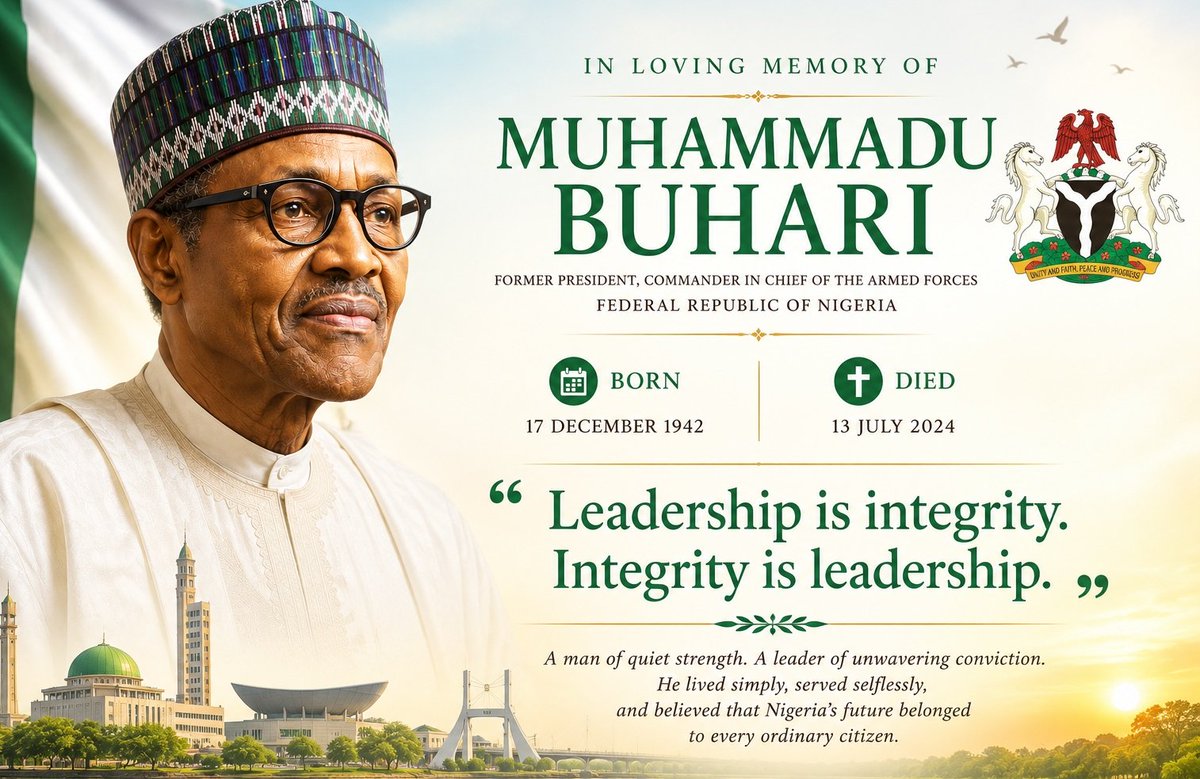
Muhammadu Buhari: A Year In Memory
One year has passed since the departure of President Muhammadu Buhari.
Generally, time has a way of softening passions, (perhaps not so much, in Nigeria). It lowers the volume of politics and allows character to emerge from beneath the noise of public debate. In that quieter space, it is worth reflecting on what may have been the defining feature of his life.
Muhammadu Buhari lived as though possessions did not define a man. They don’t. This is the philosophy of stoics, of which, I am one or still striving to perfect.
Whether one agreed with his politics or not, there was an unmistakable simplicity about him. He neither projected the flamboyance of office nor appeared captivated by the trappings of power. He seemed to believe that integrity was the true currency of leadership, that a leader's greatest asset was not wealth, eloquence, or popularity, but character.
I have summed up Buhari’s legacy as “Leadership is integrity. Integrity is leadership”.
Those words serve as the epitaph of a man who spent decades trying, in his own way, to live by them.
His presidency remains one of the most debated in Nigeria's history. Yet even many of his critics acknowledged what those closest to his philosophy always believed: that he genuinely cared about the ordinary Nigerian. His instincts were consistently shaped by concern for the common man rather than the privileged few.
It was this conviction that informed his reluctance to remove fuel subsidy for much of his administration. He understood its economic distortions and fiscal burden, yet he also understood the immediate hardship that its removal would impose on millions already living on the margins. His was a cautious approach, driven by the belief that economic reforms should not come at the expense of those least able to bear them.
The same philosophy was evident during the COVID-19 pandemic. Faced with an unprecedented global economic crisis, his administration turned to extraordinary financing measures, including increased borrowing from the Central Bank through Ways and Means advances, to sustain government operations and cushion the economy.
Those decisions continue to attract criticism, as they should in any healthy democracy. Yet they should also be viewed in their historical context. Around the world, governments adopted exceptional fiscal and monetary interventions to prevent economic collapse, preserve livelihoods, and support their citizens through an emergency unlike any seen in generations.
Nigeria, despite its vulnerabilities, avoided some of the worst humanitarian outcomes many had feared. That achievement did not erase the long-term economic challenges that followed, but it reflected a government striving to protect lives and livelihoods during an extraordinary crisis.
History is rarely kind to leaders in the immediacy of their time. It often takes distance to separate intention from outcome, and conviction from controversy.
Muhammadu Buhari will continue to be debated by historians, economists, and political scientists. His successes will be weighed against his shortcomings, and his policies scrutinised for generations to come. That is the proper work of history and historians will come from diverse camps, some will be fair, many will deliberately ignore context.
But beyond the debates stands the man himself:
-A man who believed that public office was a trust.
-A man who believed that personal simplicity mattered.
-A man who believed that government existed first for those with the least.
Whether history ultimately crowns or criticises him, few would dispute that he sought to live according to principles larger than personal comfort or material accumulation.
As I mark one year since his passing, perhaps the greatest tribute I can pay him is not merely to remember the offices he held, but to continue to be guided by Buharism-Leadership Integrity.
For nations are not transformed by wealth alone, they are transformed when integrity becomes the measure of leadership, and leadership becomes an act of service.
May Allah, in His infinite mercy, forgive his shortcomings, accept his good deeds, grant him Al-Jannah Firdaus, and comfort all who mourn him.
May his memory continue to inspire thoughtful reflection on duty, sacrifice, and the enduring truth that a person's worth is measured not by what they possess, but by the principles they leave behind.
Adieu, my Bubu. Thank you for your service.
BEST TIME FOR TAHAJJUD AND 10 GUIDES ON HOW TO PROPERLYOBSERVE IT. SAVE AND REPOST.
1: Wake up 40mins/1hr before fajr
2: Pray minimum of 2 raka'ahs
3: Recite the last 2 verses from surah Al baqra(amanar rasul)
4: Recite the 3 Quls(Ikhlas, Falaq, Nas)
5: Perform witr(1 raka'ah) after finishing your rounds of 2 or more raka'ahs.
6: Subhanallahi, Alhamdulillah, La'ilaha illallah, Allahu Akbar 33x
7: lahaula wala quwata illahbillah x100
8: Astagfirullah x100
9: Subhanallahi wabi handihi subhanallahil Azeem x100
10: Salatul Nabiy(as much as you can)
The best nights are Friday nights.
And ask Allah everything you want, mostly in your sujood. Because that's the closest you're to Allah.
With Ramadan now, the nights got even more special and scared.
Pray with calmness and focus. With the belief that Allah will answer your prayers.
May Allah answer all our prayers.
I share Islamic reminders every day. Follow me to not miss any update.
I extend my sincere gratitude to everyone who reached out, sent messages, reposted posts, likes, and the congratulatory posts.
I am deeply humbled by the overwhelming support I have received.
I encourage everyone to continue praying for our collective success and to envision a future where this achievement contributes to the development of our community and beyond.
Kind regards
Trust me, if Nigerian Christians have a bigger population than us in this country, they won't allow us pray even the least 5 daily prayers. This can never happen in the North. They didn't born the person's father that can try it.
You are not just a 'Human.'
In Arabic, Allah calls you Bashar.
But He also calls you Insan.
They refer to the same person. But they describe two completely different realities.
Since the past 24 hours that I made the tweet on child parenting solution, my DM has been buzzing. I checked them, and one thing was quite common to all: Parents who are not happy about their kid’s performance in school, and they have approached it the wrong way.
If you fall in this category, this post is for you.
Many of us use brutal force because expectations are too high, and the anger is just too much. The scholar Ibn al-Jawzi explained in his book Sayd al-Khatir that intellect is a Rizq (provision) from God, just like money or health.
He said some people are born with a wide vessel and others with a narrow one. If you try to force the water of a whole sea into a small cup, you will only spill the water and ruin the cup. This is what many of us are doing. We are trying to force a "doctor's brain" into a child whose cup was designed for something else.
By that, it causes a soul-crushing resentment in the child. Imam Al-Ghazali described this beautifully in Ihya’ Ulum al-Din. He warned parents about a state called “Al-Malal”, where a child builds resentment because they are pushed beyond their limit. Everyone wants the best for their child. No doubt. However, if you keep yelling at them for things they cannot grasp yet, you make them hate the very sight of a book. You are closing the door to their heart while trying to kick open the door to their mind.
Then what is the solution? It is simple.
Going forward, every parent should make efforts to start looking for the Fath (the opening) in their kids. What does this mean? This is the lane the Almighty has prepared for them. In our history, if a child is slow with grammar or math, the scholars don’t call them a failure. They move them to a trade, a craft or a service.
How then do you identify this Fath (Opening) in your child? Please pay close attention to me…
(1) The first phase is Observation. Ibn al-Qayyim mentioned a concept called Istid’ad (natural readiness) in his book titled: Tuhfat al-Mawdud. This means you want to watch/observe/look at the child when they think nobody is looking. This is your first tool. For the next two weeks, stop talking about school. Do not worry yourself about how they perform on their homework.
Instead, keep a "Strength Log." Every evening, write down one thing they did well that had nothing to do with a classroom. Did they fix a broken toy? Did they calm down a crying sibling? Did they organise their shoes? You are looking for their Istid’ad (natural readiness). If they are "book-slow" but "people-smart" or "hand-smart," that is where the key has been placed.
(2) Introduce “Project or Craft” early on. Ibn Khaldun, in his Muqaddimah, argued that projects/crafts are high forms of intelligence that build civilizations. He argued that some minds are designed to understand the physical world better than the abstract one.
Give them a "Project Day." Buy a basic tool kit, a sewing machine, or a coding starter kit. Give them a broken radio or a piece of furniture to fix. Delegate. Give them a real-world task that has a visible result. When a child who fails at math sees that they can build a table or bake a perfect loaf of bread, their internal shame starts to heal. They realize they are not stupid; they were just in the wrong room.
(3) Kill the Comparison Virus. Imam Al-Zarnuji, in his classic work Ta’lim al-Muta’allim, explained that a student should only study what fits their nature. He said that forcing a student into a field they have no taste for is a waste of their life and the teacher's time. When you compare your child to others, you are catching a virus that blinds you to their path. Always filter.
When family members start bragging about their kids' grades, you must be the shield. Tell them, "My child is mastering the art of (so so and so)." You are teaching your child that success is not a single ladder. There are many ladders to it. And if you do not value their ladder, they will stop climbing.
(4) Prioritize Character Building. Put more efforts to praise your kids for their good character. Always tell them you love them when they behave well or show good character. Character recognition helps the child build a good self-image, which translates into self-confidence and barrier-breaking for the child. Prioritise this.
(5) Don’t underestimate the power of your words. Always pray to God to grant them their opening. The scholars taught that the "opening" is a gift from Al-Fattah (The Opener). Supplicate.
In your Sujud or in your prayers, stop asking for them to be a doctor/engineer, and what have you. Ask for the door that was made for them to be opened. Ask Him to show you the Fath so you can stop pushing them against a closed wall.
Always remember, a parent who finds the "Fath (The Opening)" for their child has given them a gift better than a degree. You have given them a purpose. Start that journey NOW. It’s never too late…
Thank you for your attention.
Allah knows best.
If you are a Nigerian 🇳🇬, you don't need to bribe anybody to get police character report for immigration.
Go to this website:https://t.co/LokNxnbOg9
Fill out the form, then pay.
They will send you a form to do your thumbprint, and you will get the certificate in 1-2 weeks.
Confirmed!!
RT
I successfully revalidated my registration using the @inecnigeria portal.
The process is easy. Just click on the link https://t.co/hHgOwjbRsV and follow the prompts.
This is an important message that deserves all the attention. I kindly share it as widely as possible so it can reach the intended audience and ensure maximum awareness and impact.
You can now correct your NIN discrepancies by yourself using ur phone .
Guys please repost don't keep this vital information all to yourself 🙏
Millions of people need it
"Ina Masu Neman Admission, da Masu Neman Aure, da Masu Neman Sana'a , da Masu Neman Jari, to Ku dinga karanta wannan Ayar a duk Lokacin da kuke Fafutukar nema".