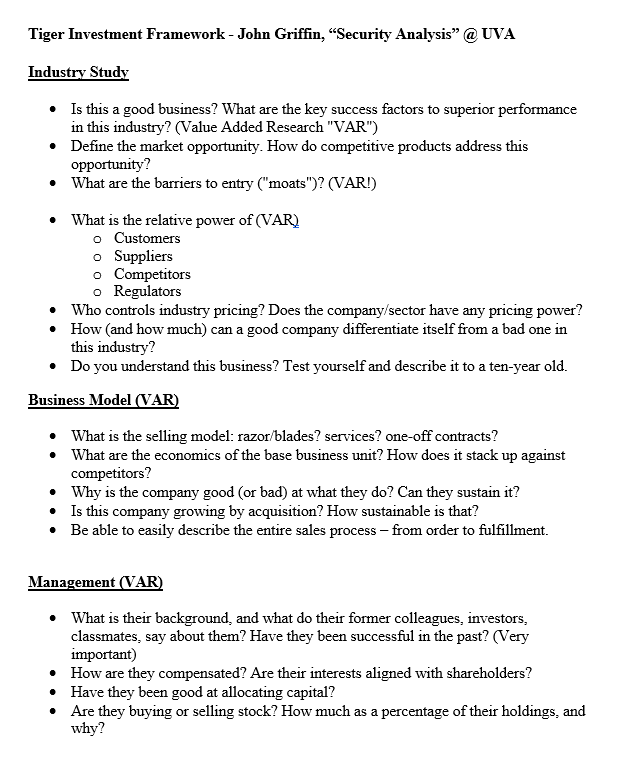
Dylan Patel says the memory shortage is not a normal cycle
"Memory capacity is only growing 20, 30% a year for the next three years. And yet, demand is doubling, is doubling...memory prices are going to keep soaring."
"Our point there was memory isn't a shortage, and this is not a short-term shortage. It's a shortage that's going to last years."
"Memory we've had the pricing go up like 4x and it's going to go up another 2x, 3x again, in addition to capacity growth. We talked about how KV cache was going to explode because of reasoning. And therefore memory was going to be the biggest winner."
"We're still not at 85, 90% gross margins for memory, but we'll get there. And then at some point from there, it'll also halve back down to like 70s or maybe even lower."
In my first "Pattern Recognition" piece 3 months ago I laid out 10 similarities i saw in $EVC at $3 (+300% since) and $APP at $70 in June 2024 (now $515).
In today's write up I lay out the 10 similarities i see today in $MRLN at $5 and $ASTS 3 years ago, at $5 (vs $89 today)
Mark Spitznagel - founder of Universa, the "black swan" fund Nassim Taleb advises - on the most counterintuitive idea in investing:
add a 3% sliver of crash insurance to a stock portfolio. give that insurance a 0% expected return - it makes nothing over time.
it still raises the portfolio's long-run compound return - by roughly what you'd get from putting that same 3% into an asset returning 20%+ a year.
how? by killing the deep drawdowns that quietly destroy compounding. but the insurance has to actually fire in a crash. one that only sometimes pays out is "like a parachute that only sometimes deploys - you're better off not wearing one."
most "safe havens" - gold, the dollar, hedge funds, even a Picasso - fail that test.
~13-min talk, free. the man who made ~4,000% in the 2020 crash, on what actually protects you ↓
Izzy Englander started Millennium with $35 million in 1989 - today it manages $84 billion - and has lost money in only one year out of 35
his only interview ever - how he built the most consistent hedge fund in history from a specialist desk on the floor of the American Stock Exchange
"in the land of the blind the one-eyed is king - the options market was in its infancy - and it just produced a lot of business"
"the primary piece is the ability to deliver what you say you're going to deliver - from there you need to control risk - risk becomes very very critical"
bookmark & watch the full conversation ↓
BETA-ARBITRAGE RETURNS AND STOCK MARKET BUBBLES
Beta arbitrage, or “betting against beta,” is a strategy that invests with leverage in low-beta stocks and hedges the resulting beta risk with a smaller short position in high-beta stocks. Andrea Frazzini and Lasse Heje Pedersen (2013) have written about this strategy extensively.
When beta arbitrage loses money is an interesting question. There are two main environments in which beta arbitrage produces losses. The first is when banking balance-sheet constraints become more binding and money gets unexpectedly “tighter.” In those situations, the stock market declines, and low-beta stocks decline more than their ex-ante betas would suggest.
The second loss scenario for beta arbitrage is a rapidly inflating stock market bubble. In a rapidly inflating stock market bubble, the market goes up, and the high-beta stocks go up even more than their ex-ante betas would suggest.
Why is that? As investors abandon present-value discipline, sideline investors rush in, and the market attains extreme overvaluation (bubble steps 4, 5, and 6), the bubble stocks begin driving the whole market. This bubble inflation, in turn, causes the bubble stocks’ returns to be high and their already high betas to increase further. The beta-arbitrage strategy that hedges non-bubble-stock longs with bubble-stock shorts loses money in this process.
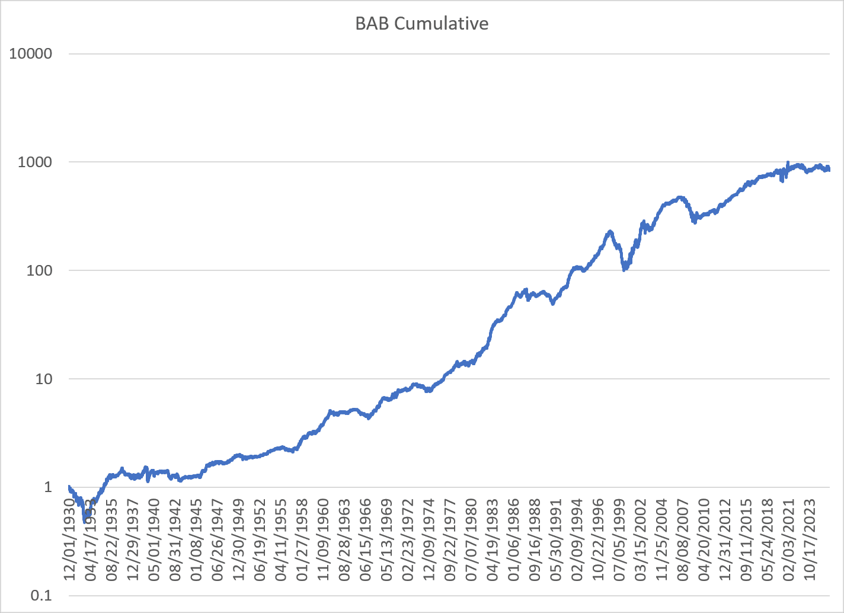
We can also invert the process. If the beta-arbitrage strategy has recently lost money in an up market, the probability of a bubble is higher, ceteris paribus. The graphs below from AQR’s site, augmented with some SPLV and SPHB ETF returns, show clearly how the beta-arbitrage, or BAB, strategy lost a ton of money during the late-1990s telecom-media-technology bubble.
So far, we are not seeing similar extreme beta-arbitrage losses in the current bull market, making it, in my subjective opinion, less likely that we are deep into bubble territory yet. (A caveat: I just half-assed the last couple of months of returns from ETFs. Better data will come with their next update.)
How refusing a sketchy trade cost David Tepper his Goldman Sachs partnership—and why he has zero regrets:
David Tepper's legendary career wasn't built on a flawless record—it was forged by ethical steel and the ability to take a punch. In a candid talk with students, the billionaire founder shared the raw truth about what it actually takes to survive and win in the markets.
David Tepper explained what actually builds your career in the markets. and it's definitely not a perfect track record...
https://t.co/Gbqxjf2Tpq
Three hedge fund founders managing a combined $120 billion - Steve Cohen - Dmitri Balyasny - Mike Rockefeller - sat down with the woman who told them the brutal truth about their own industry
what separates the funds that survive from the thousands that die - why the smartest people in the room eventually leave - and what LPs actually look for before writing a check
"peel back the curtain at a $30 billion fund - it's the same one or two people driving returns year after year - after a while you start questioning whether you're in the right room"
"you can forget about alpha if you cannot attract and retain a winning team - talent is everything"
"if you have people you have problems - pure and simple"
bookmark & watch the full conversation ↓
$ICE $CME $CBOE $MIAX
Could always be wrong of course but the prevailing sentiment that the moats of incumbent exchange operators are under siege right now from perps/offshore exchanges feels like one of the most ludicrously misplaced paranoias in recent memory. Recommend reading Q&A transcripts from the Piper Sandler Exchange conference if unconvinced of that.
Have been adding heavily to $MIAX which, as the OP notes, is now trading at an absurdly low multiple of EBIT and down ~40% over the last 5 weeks. Decline likely exacerbated by technical dynamics around pre IPO warrants being exercised. So we have technical selling + likely irrational fears resulting in an obscene multiple for a scaled and perpetual asset light tollbooth on endlessly growing trading activity. Smells like opportunity.
Have also added $ICE $CME $CBOE for a basket trade. Some of the best business in history are on fire sale while their fundamentals and network effects have never been stronger. DYODD
“Value investing with legends” is a great finance-specific podcast with a mix of celebrities and dedicated professionals. Here are some of my favorite episodes.
Kent Daniel: from physics to finance
https://t.co/gF4zywCWyd
Cliff Asness: quant investing, inefficiencies, being Cliff
https://t.co/SK0hGGKUHR
Nicolai Tangen: intuition, fundamental investing
https://t.co/YfTLwEAAxe
Michael Mauboussin: biases (and also learning from a master financial communicator)
https://t.co/ZKppJsGxok
When investors talk about the “grid replacement supercycle,” they’re usually referring to:
High-voltage transformers
Switchgear
Transmission conductors
Grid-enhancing technologies
Utility automation and monitoring systems
2nd derivative players like $RELL are interesting
$HMM.A 120m market cap, trading 6x EBITDA, 15% revenue growth and accelerating top line with exposure to AI/DC build out. Stock is up 40% in the last month.
This is just the start of the re-rate.
Key takeaway on revenue outlook:
✅ A $1.6-billion ARR line of sight within the next several years on just aircrafts like C‑130J and KC‑135 alone.
"$MRLN already has over 800 aircraft under contract across platforms like the C‑130J and KC‑135, implying roughly $3 million per tail in upfront integration and $2 million in annual recurring software revenue once fully ramped—a $1.6-billion ARR line of sight within the next several years on just these two aircraft alone."
Interview with Nebius Co-Founder Roman Chernin
Please like & share this video so that all $NBIS investors on X will see it! :)
If you prefer watching on YouTube: https://t.co/lGwhArC8MS
Timestamps:
00:00 - Why AI Infrastructure Is So Hard to Understand
00:24 - Market Fragmentation and What Actually Differentiates Providers
01:30 - Consolidation, Segmentation, and the Future AI Cloud Landscape
02:56 - What Analysts and VCs Still Get Wrong About AI Infrastructure
05:34 - Nebius Cloud: Product Readiness and Customer Proof Points
07:42 - Why Inference Workloads Are Exploding
09:11 - Training vs. Inference: How AI Models Actually Reach Production
10:10 - Why Inference Market Share May Concentrate Around a Few Winners
12:36 - Customer Use Cases: Coding, Enterprise AI, and Real-World Adoption
14:01 - Why Integrated Training and Inference Matter Strategically
16:01 - Building Scalable AI Infrastructure With High Utilization
18:24 - Token Factory: Inference as a Managed Service
20:24 - Revolut Case Study: AI-Driven Product Enhancements
22:56 - Token Factory Performance Optimization and Competitive Advantage
25:07 - Scale, Capacity, and Efficiency as Growth Drivers
28:36 - Why Inference Capacity Could Become the Next Major Bottleneck
30:10 - How Nebius Benchmarks Performance Across Providers
33:14 - The Future Size and Shape of the Inference Market
36:38 - Value-Based Pricing: Moving Beyond Cost per GPU Hour
40:55 - How Nebius Wins Deals: Quality, Performance, and Customer Experience
44:53 - Autonomous AI Platforms and the Rise of Agent-Based Models
47:28 - Tavily, Agentic Applications, and the Next Layer of the AI Stack
50:45 - Strategic Trade-Offs: Scaling, Product Roadmap, and Customer Relevance
55:40 - Final Thoughts: Adapting to the Next Shift in AI Workloads
@nebiusai@romanchernin
I first read this post on PTJ by @trengriffin more than a decade ago, and it's a great complement to the episode.
It's a collection of lessons and quotes, and remains one of the best summaries of how Paul approaches trading and what separates him from everyone else.
Well worth reading (or revisiting).
1/ "The secret to being successful from a trading perspective is to have an indefatigable and an undying and unquenchable thirst for information and knowledge."
2/ "Don't be a hero. Don't have an ego. Always question yourself and your ability. Don't ever feel that you are very good. The second you do, you are dead."
3/ "While I spend a significant amount of my time on analytics and collecting fundamental information, at the end of the day, I am a slave to the tape and proud of it."
4/ "I love trading macro. If trading is like chess, then macro is like three-dimensional chess. It is just hard to find a great macro trader. When trading macro, you never have a complete information set or information edge the way analysts can have when trading individual securities."
5/ "I really don't care about the mistake I made three seconds ago in the market. What I care about is what I am going to do from the next moment on. I try to avoid any emotional attachment to a market."
6/ "I am always thinking about losing money as opposed to making money. At the end of the day, the most important thing is how good are you at risk control."
7/ "I want the guy who is not giving to panic, who is not going to be overly emotionally involved, but who is going to hurt when he loses. When he wins, he's going to have quiet confidence. But when he loses, he's gotta hurt."
8/ "I've done really well on the short side. There's nothing more exciting than a bear market. But it's not a wonderful way for long-term health and happiness."
9/ "The sweet spot is when you find something with a compelling valuation that is also just beginning to move up. That's every investor's dream."
MUST MUST MUST MUST MUST MUST MUST MUST MUST MUST MUST MUST MUST MUST MUST MUST MUST MUST MUST MUST MUST MUST MUST MUST MUST MUST MUST MUST MUST MUST MUST WATCH