Devendra Fadnavis, Chief Minister of Maharashtra, today unveiled the official theme and logo of the World Hindu Congress 2026 in Mumbai. The World Hindu Congress 2026 (WHC 2026) will be held from 18 to 20 December 2026 in Mumbai and is organised by the World Hindu Foundation.
The World Hindu Congress 2026 is the fourth edition of this quadrennial global gathering, following the WHC held in New Delhi in 2014, Chicago in 2018 and Bangkok in 2023. It will bring together Hindu leaders, thinkers, entrepreneurs, activists and young people from across the world through seven concurrent thematic conferences on Economy, Education, Media, Politics, Women, Youth and Hindu Organisations, as well as strategic sessions on Bhasha, Samaj, Vishwakarma and Dharma. More than 4,000 delegates from over 60 countries are expected to participate.
(1/7)
🚨 Big news for India's chip ambitions! Andhra Pradesh's new Semiconductor & Display Fab Policy 4.0 is here.
- Up to 80% capital support for semiconductor fabs
- 100% match of the Centre's #ISMSemicon2.0 support
- A 5,000-acre Semiconductor Park at Tirupati
What it means for investors 🧵👇
With the coordinated efforts of JKP, Indian Army, CRPF and intelligence agencies, Lashkar's last known active local terrorist in the valley, Lateef Bhat, was neutralised in an operation in Kulgam in the early morning hours today. One of his terrorist associates, Umar Nisar, was also neutralised in Kulgam, the day before. The entire operation was marked by a very high level of synergy.
The nation salutes the brave Jawans of JKP, Army and CRPF and intelligence agencies.
In a class on the Indian economy for senior officers, someone asked: why did our savings rate fall during the last decade?
I showed a simple calculation. ₹100 invested in 2008–09 for five years, earning the repo rate, was worth just ₹82.70 in purchasing power by 2013–14. Inflation consistently exceeded the interest earned.
Interest rates below inflation impose a wealth tax on people holding rupee deposits and debt instruments. Their account balances grow, but what that money can buy shrinks.
Saving means sacrificing consumption today to provide for tomorrow. Unexpected inflation is an unauthorised tax on that sacrifice. Penalise savers this way, and saving becomes less attractive.
The consequence: our savings rate fell from 38% to 33% over those five years, weakening the domestic funding available for investment and growth. Savings stabilised only after 2014, when savers started earning positive real returns of around 1.5%.
We have now spent roughly a year with negative real policy rates. I hope we exit soon. If we persist, there is little reason to expect different long-term consequences.
Domestic savers are the backbone of our growth. FII and FDI supplement their savings. Our policies should be far more considerate towards those who sacrifice today to finance India’s tomorrow.
Understanding the forces shaping economies is essential to building a vision for the future.
We are delighted to welcome Shri @sanjeevsanyal , Member of the Economic Advisory Council to the Prime Minister (EAC-PM), to the World Hindu Economic Forum at World Hindu Congress 2026.
His participation adds an important voice to a global platform bringing together business leaders, economists and thinkers for meaningful dialogue and exchange.
We look forward to welcoming you to Mumbai this December.
📍 Jio World Convention Centre, Mumbai, Bharat
📅 18–20 December 2026
Register now: https://t.co/prD4vRFCWO
#WHC2026
[ World Hindu Congress 2026 | Hindu Conference in Mumbai | International Hindu Conference | Global Hindu Event | Hindu Events in Mumbai | Mumbai Events in December | International Conference 2026 | Shri Sanjeev Sanyal | EAC-PM Member | Economic Advisory Council to PM | World Hindu Economic Forum ]
~USA/India real exchange rate. Has basically gone nowhere for 35yrs. Even as India has been converging during this time with US incomes. A lot of the cobwebs are being cleared. INR now back in low-mid 90s. 80s beckon then 70s then 60s 50s 40s 30s etc. Give it a few years/decades.
Households’ out-of-pocket share of India’s health spending fell from 64.2% to 42.7%, while the government’s share rose from 28.6% to 43.5% between 2013–14 and 2023��24. A major achievement in protecting families from the financial burden of illness. This deserves far more attention (https://t.co/7oUWvxz07r).
I have studied the relationship between health expenditure and loan defaults in several projects. Across our studies, health shocks repeatedly emerge as the leading reason for default among poor borrowers, accounting for up to 50% in some samples.
My paper, “How Does a Health Insurance Program Covering 500 Million Poor Impact Credit Market Outcomes?”, published in Management Science (https://t.co/5N4cwYwrsH) in 2025, finds that Ayushman Bharat significantly reduced loan delinquency. Lower out-of-pocket medical expenses and a reduced need to maintain precautionary savings freed up money for repayment. The benefits of health insurance extend well beyond treatment.
My back-of-the-envelope calculations suggest that a rupee spent on Ayushman Bharat could generate around ₹3 in economic gains by preventing business failures and lost working days. I would place well-designed health spending among our highest-return public investments, perhaps next only to defence research.
Protection against medical bills could plausibly be an important contributor to the poverty reduction reported by the World Bank. One illness should not wipe out years of a family’s progress.
We do not celebrate such achievements enough. I hope the coming Budget gives healthcare the priority it deserves.
Yes. I am aware of this. That is why casteism is a problem of entire Hindu society and not to be blamed one caste. If there were Mahars who refused to eat with Mangs, there were also Mahars like Shri Ganesh Akaji Gawai who opposed Ambedkar and reservations and stood with Savarkar
#Opinion | The absence of "phone banking" today offers no institutional guarantee against its return. Stronger PSB balance sheets offer an opportunity to reform from a position of strength, writes @ananthng#BankingReform#EconomicReforms#PSBs
https://t.co/JYYmXyidGZ
In fact, @josyjosephkj should have known, particularly after writing this book, that Hindu Mahasabha leaders faced the wrath of the Government of Dominion India for advocating the cause of Akhand Bharat in the years immediately following Independence.
It is also worth examining the Hindu Mahasabha’s proposed Free Hindustan Constitution. Its stated framework was strikingly different from the usual caricature: no special concessions to minorities, but equally, no privileges or advantages for the majority. Equal citizenship, rather than communal appeasement or majoritarian privilege, was the principle it professed.
And let us get the chronology right. Sir Syed Ahmad Khan, the founder of the Aligarh movement, articulated the idea of Hindus and Muslims as distinct political communities decades before Savarkar was even born. The intellectual genealogy of the Two-Nation Theory cannot simply be rewritten to begin with Savarkar.
It is therefore unfortunate that someone writing on this subject appears to have missed the most elementary distinctions between who proposed what, when, and in what political context.
@iyuvrajpokharna is absolutely right on one crucial point: Savarkar envisaged Hindus and Muslims as two distinct nations, but did not advocate their territorial separation. His conception was of two nations inhabiting the same country. One may disagree with that political vision, but one cannot honestly conflate it with the demand for Partition.
And, for that matter, even Jawaharlal Nehru acknowledged the profound differences between Hindu and Islamic religious traditions, particularly their contrasting approaches to proselytisation and accommodation of other faiths.
History deserves better than convenient chronology, selective quotations and ideological shorthand. If we are going to debate the origins of the Two-Nation Theory, let us at least begin with the historical record.
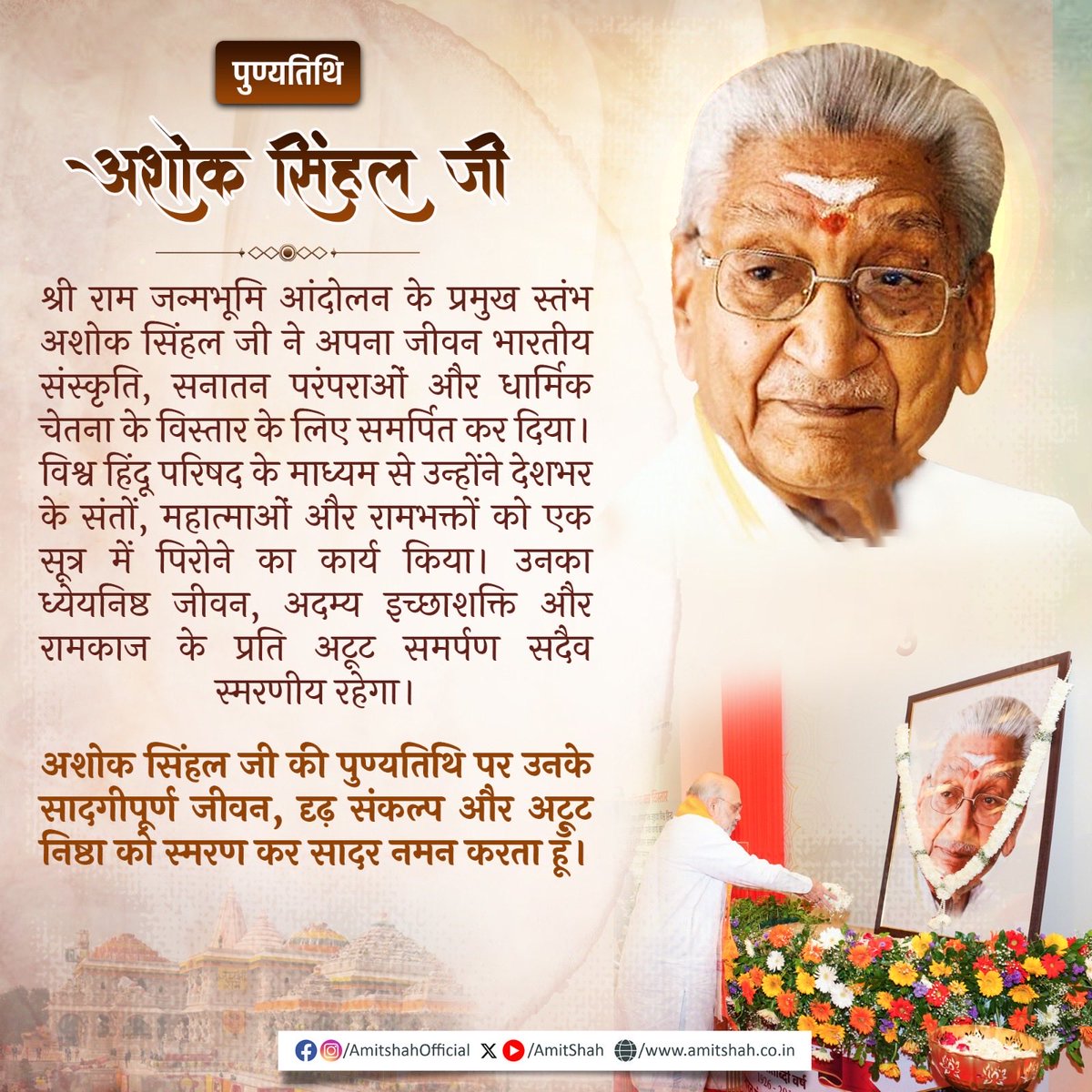
श्री राम जन्मभूमि आंदोलन के प्रमुख स्तंभ अशोक सिंहल जी ने अपना जीवन भारतीय संस्कृति, सनातन परंपराओं और धार्मिक चेतना के विस्तार के लिए समर्पित कर दिया। विश्व हिंदू परिषद के माध्यम से उन्होंन�� देशभर के संतों, महात्माओं और रामभक्तों को एक सूत्र में पिरोने का कार्य किया। उनका ध्येयनिष्ठ जीवन, अदम्य इच्छाशक्ति और रामकाज के प्रति अटूट समर्पण सदैव स्मरणीय रहेगा।
अशोक सिंहल जी की पुण्यतिथि पर उनके सादगीपूर्ण जीवन, दृढ़ संकल्प और अटूट निष्ठा को स्मरण कर सादर न��न करता हूँ।
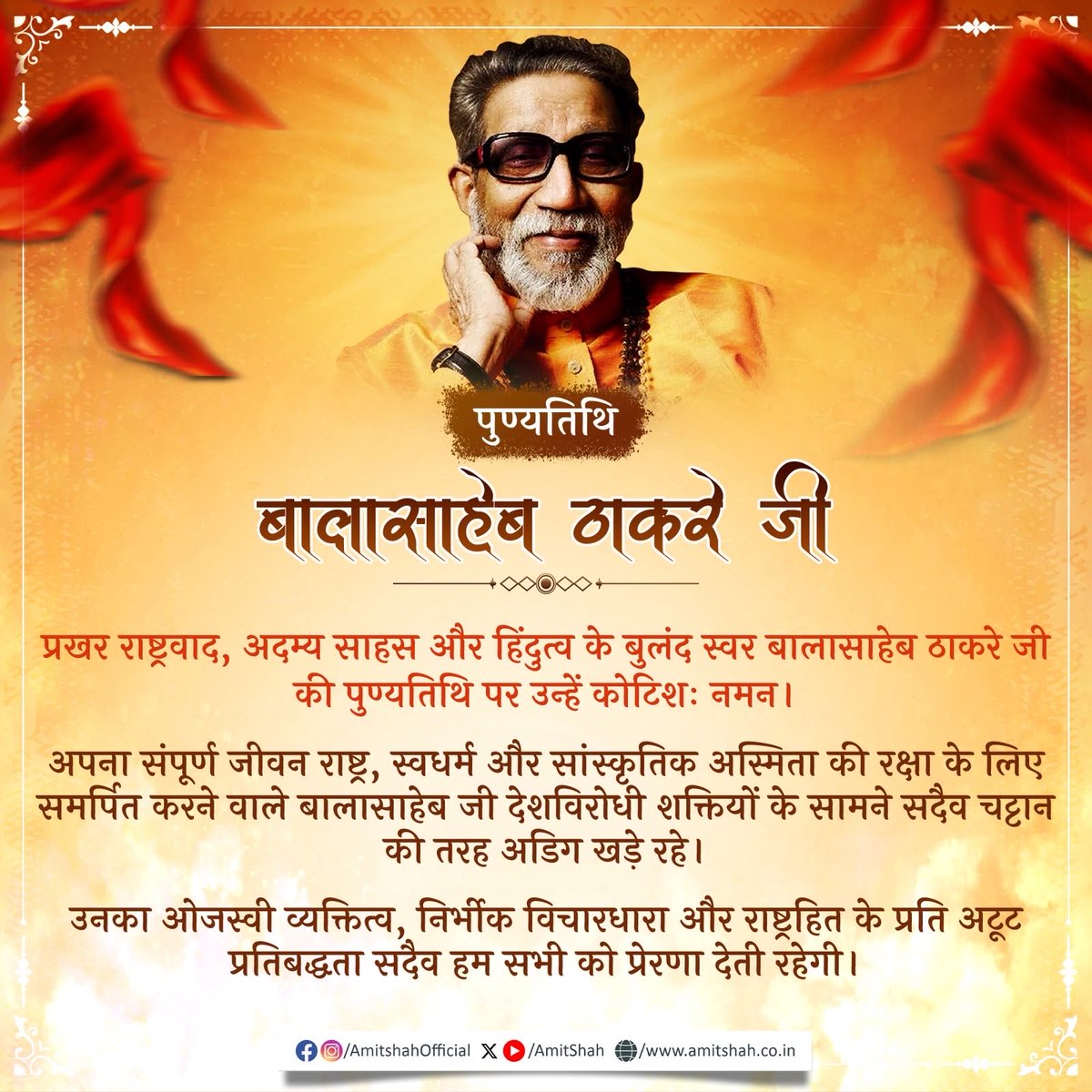
प्रखर राष्ट्रवाद, अदम्य साहस और हिंदुत्व के बुलंद स्वर बालासाहेब ठाकरे जी की पुण्यतिथि पर उन्हें कोटिशः नमन।
अपना संपूर्ण जीवन राष्ट्र, स्वधर्म और सांस्कृतिक अस्मिता की रक्षा के लिए समर्पित करने वाले ब���लासाहेब जी देशविरोधी शक्तियों के सामने सदैव चट्टान की तरह अडिग खड़े रहे।
उनका ओजस्वी व्यक्तित्व, निर्भीक विचारधारा और राष्ट्रहित के प्रति अटूट प्रतिबद्धता सदैव हम सभी को प्रेरणा देती रहेगी।
प्रखर राष्ट्रवाद, अदम्य साहस आणि हिंदुत्वाचा बुलंद आवाज असलेले बाळासाहेब ठाकरे जी यांच्या पुण्यतिथीनिमित्त त्यांना कोटी-कोटी वंदन.
आपले संपूर्ण जीवन राष्ट्र, स्वधर्म आणि सांस्कृतिक अस्मित��च्या रक्षणासाठी समर्पित करणारे बाळासाहेब जी देशविरोधी शक्तींसमोर सदैव अढळ उभे राहिले.
त्यांचे ओजस्वी व्यक्तिमत्त्व, निर्भीक विचारधारा आणि राष्ट्रहिताप्रती असलेली अतूट कटिबद्धता आपल्या सर्वांना सदैव प्रेरणा देत राहील.
Honouring a great leader whose fearless leadership, powerful voice and unwavering commitment to Maharashtra’s pride remain etched in the hearts of millions, HinduHruday Samrat Balasaheb Thackeray, on his SmrutiDin...
मराठी अस्मिता व हिंदुत्वाचे पुरस्कर्ते, वंदनीय शिवसेनाप्रमुख, हिंदूहृदयसम्राट 'बाळासाहेब ठाकरे' यांना स्मृतिदिनी भावपूर्ण आदरांजली...
#हिंदूहृदयसम्राट #बाळासाहेब_ठाकरे #BalaSahebThackeray #Maharashtra
THE ECONOMIST’S CURSE STRIKES AGAIN?
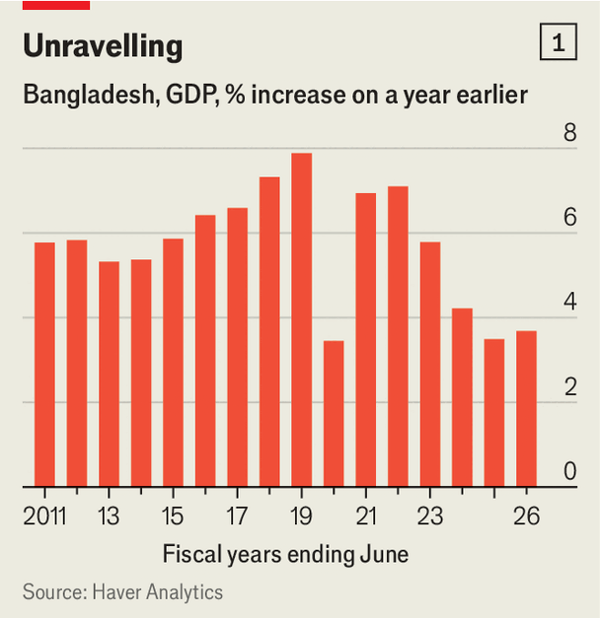
The very publication that crowned Bangladesh its Country of the Year in 2021 ( or whatever it means) is now documenting an economy staring at a devastating crisis.
Bangladesh heading for economic meltdown as banking system is on brink of collapse
GDP growth forecast has slumped to 3.7%, against the 6.5% growth typical before the political upheaval.
Poverty is expected to rise for the third consecutive year in 2026.
Private credit growth has collapsed to 4.5%, a 33-year low.
33% of bank loans are now non-performing (India’s comparable NPL ratio: 1.7%)
Banking sector capital adequacy: NEGATIVE 3.8%.
$6.2 billion already injected into banks as emergency support.
Recapitalisation needs estimated at 10% of GDP.
Government tax revenues are paltry 7% of GDP.
A credit-starved economy, rising poverty, weak public finances and a crippled financial system are now feeding into one another.
Bangladesh is no longer a development superstar
https://t.co/tbjMdyfEWU