Institute of Biological and Medical Imaging (IBMI) @HelmholtzMunich & Chair of Biological Imaging (CBI) @TU_Muenchen (TUM) - Head: Prof. Vasilis @ntziachristos
The #MunichImaging science management team provides comprehensive administrative support to our researchers, giving them room to focus their full creative potential on developing the imaging and sensing technology of tomorrow.
🔍 We now seek a highly qualified and motivated Science Manager (f/m/d) to support our ongoing third-party projects and the preparation of new grant applications.
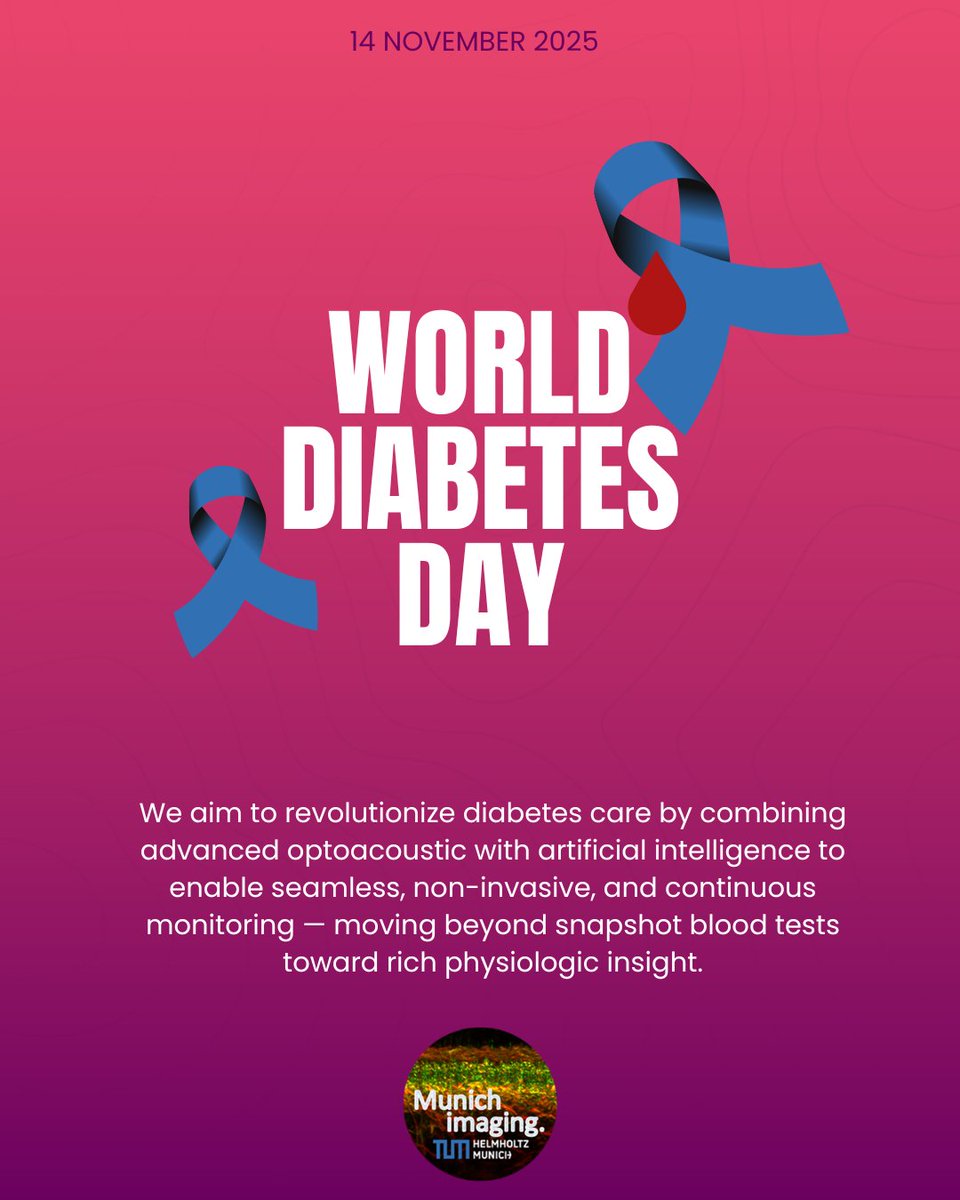
We’re pushing the boundaries of #diabetes care.
🚀 Advancing data-driven diabetes research by combining #optoacoustic#imaging and #sensing with multi-omics data and AI to uncover the molecular and physiological mechanisms underlying the disease.
#WorldDiabetesDay#WDD2025
👉 @OPTOMICS2020 combines optoacoustic imaging phenotypes with multi-omics data (genomics, proteomics, metabolomics) and AI to build a digital-twin model for early detection, prevention and treatment of type 2 diabetes.
Starker Andrang bei der FORSCHA 2025 🚀
👉https://t.co/Mdd1ZX1kwh
🔬 Auch dieses Jahr war die Mitmach-Messe “FORSCHA – Münchner Wissenschaftstage” in München ein voller Erfolg. Besucherinnen und Besucher jeden Alters konnten die Welt der Wissenschaft und Forschung hautnah entdecken.
#HelmholtzMunich war auf der FORSCHA vertreten und zeigte gemeinsam mit unterschiedlichen Instituten und Einrichtungen ein vielfältiges Programm.
🔍 Für Kinder gab es interaktive Angebote, dazu Informationsangebote zu Diabetes inklusive Risikotest von diabinfo sowie spielerische Aktivitäten des Kinder-Gesundheits-Portals clever.gesund. Das Bioengineering Center bot Experimente und Demonstrationen, während ein interdisziplinäres Team des Environmental Health Centers kindgerecht Lungenfunktion, Umweltfaktoren und wissenschaftliche Methoden erklärte.
@forscha@MunichImaging
#FORSCHA2025 #FORSCHA #Wissenschaftskommunikation #diabinfo #clevergesund #Bioengineering #EnvironmentalHealth
#Diabetes affects millions worldwide. 🌍
At the Helmholtz Diabetes Center, we connect basic research with clinical studies to shape the future of precision diabetes care.
Our mission: Understand. Prevent. Treat. 🔵
#WorldDiabetesDay2025
One-Hour Blood Glucose Level: A New Chance to Preventing Type 2 Diabetes🩸
👉https://t.co/k6xrxEgIbx
A simple blood glucose measurement taken one hour after a glucose tolerance test can reveal crucial metabolic changes – even before prediabetes develops.
A team from #HelmholtzMunich, the University of Tübingen, and the German Center for Diabetes Research (DZD), has shown that the 1-hour glucose value (1h-PG) is a sensitive early #biomarker for type 2 diabetes risk – enabling earlier and more targeted prevention.
💡Current prediabetes criteria are missing about one in five individuals who later develop diabetes. Measuring the 1-hour post-load glucose value allows clinicians to detect early metabolic changes long before standard markers become abnormal – opening a new window for prevention.
🔬In a nine-month lifestyle intervention, participants with elevated 1-hour glucose levels who achieved weight loss and reduced liver fat showed marked improvements in insulin sensitivity and beta-cell function – restoring metabolism to levels seen in healthy individuals. Over the long term, their risk of developing type 2 diabetes decreased by 80%.
🔗To the original publication: https://t.co/xqoGLvj5iD
@Dr_Birkenfeld@DiabResearch@uni_tue@nyuniversity@helmholtz_diabc
#DiabetesResearch #Prevention #Typ2Diabetes
#WorldDiabetesDay#WeFightDiabetes💪
This World Diabetes Day stands for raising awareness for the millions of people with diabetes worldwide who face daily challenges at work due to diabetes-related stigma and discrimination.
🩵 At #HelmholtzMunich, researchers from different scientific backgrounds are closely connected to find new innovative approaches to prevent, treat, and ultimately cure #diabetes and #obesity through cutting-edge research – driving #PersonalizedPrevention and innovative #therapies for a better #DiabetesLife!
💬 “Our successes in diabetes research at Helmholtz Munich are driven by strong synergies with other disciplines – including artificial intelligence, structural biology, and bioengineering.”
– Prof. Stephan Herzig, Department Head of the Helmholtz Diabetes Center, Helmholtz Munich
🌟 Get inspiring insights into our diabetes research:
👉https://t.co/44YdhoThWh
📽️ Watch Prof. Stephan Herzig on the successes and synergies in diabetes research at Helmholtz Munich in this video!⬇️
@IntDiabetesFed@DiabResearch@helmholtz_de@bioeg_de
#type1diabetes #type2diabetes #WDD2026 #AWorldWithout1
At the meeting of the Int. Soc. on Oxygen Transport to Tissue (@isott2025) in Thessaloniki/ Gr, hear the plenary by @munichimaging director Vasilis @ntziachristos on “#Optoacoustic imaging of #oxygen transport in tissues.”
25 Aug 2025, 8:30-9:30 am (Greek)
https://t.co/h0sb4XvPWH
New Endoscopy Technology Enhances Early Detection of Esophageal Cancer 🔬
👉Read more: https://t.co/6wetAxQPde
A research team from #HelmholtzMunich, the @TU_Muenchen, and the Medizinische Universität Wien has developed a dual imaging technique – O2E – that significantly improves early detection of esophageal cancer.
This capsule-based technology combines optical coherence tomography with optoacoustic imaging, producing high-resolution, 360° 3D scans of tissue microstructure and vasculature. The result: early-stage lesions, previously invisible to conventional methods, can now be detected with remarkable precision.
🗨️ “Our dual imaging system uncovers critical features of early cancer lesions, including microscopic structural changes beneath the mucosal surface and subtle microvascular alterations within the cancerous tissue, that previous methods were unable to detect.”
– Prof. Vasilis Ntziachristos
💡 This innovation could mark a turning point in esophageal cancer diagnostics – enabling faster, more accurate, and less invasive detection that benefits both patients and healthcare systems.
The next phase of the project – funded under the EU’s EIC Pathfinder program (#ESOHISTO) – will focus on clinical translation and the integration of confocal endo-microscopy for even higher-resolution, real-time analysis.
🔗 To the original publication: https://t.co/ofalfwIaLO
@ntziachristos@MunichImaging
#BiomedicalImaging #CancerResearch #Endoscopy #O2E #PrecisionMedicine #EICPathfinder
NIRF-IVUS can highlight key pathobiological
markers of #atherosclerosis beyond standalone IVUS at clinical imaging speeds, further supporting the clinical #translation of the #NIRFIVUS technology.
@dzhk_germany
https://t.co/Lg5o1msCNq
NIRF-IVUS can highlight key pathobiological
markers of #atherosclerosis beyond standalone IVUS at clinical imaging speeds, further supporting the clinical #translation of the #NIRFIVUS technology.
@dzhk_germany
https://t.co/Lg5o1mtaCY