Businesses are driven by self-interest. Yet in pursuing it, they build infrastructure, hire workers, and support universities and technical colleges to secure skilled talent. If growth opportunities exist, they seize them aggressively. The “investment boycott” narrative is makes no sense.
I hold no candle for Musk but what I really cannot abide anymore is the sort of rich person, often but not always paid by the public, who always thinks there’s something more important than growth and jobs.
South Africans are so inured to our staggering level of unemployment that we simply cannot see the world historical scale of it. It is more or less unprecedented globally, outside of war zones. Ever.
Public policy-making involves tradeoffs. Given our mind-blowing level of unemployment, there are very, very few things that make risking more growth a good idea. Very few. Starlink is not one of them.
Yes, there are security considerations to take care of, and we should take care of them. But for Pete’s sake, can we just, for once, work backwards from the real problem here?
Redi Tlhabi just dropped a piece calling @Starlink a “national security threat” to South Africa… and warning us not to sell our democracy to @elonmusk . But she “forgot” to mention her piece is hosted on Phillip van Niekerk’s Substack, the same guy who’s A PAID CONSULTANT FOR MTN.
MTN has every incentive to slow-walk Starlink while pushing its own satellite plays. Transparency matters when lecturing about “democracy” and foreign influence.
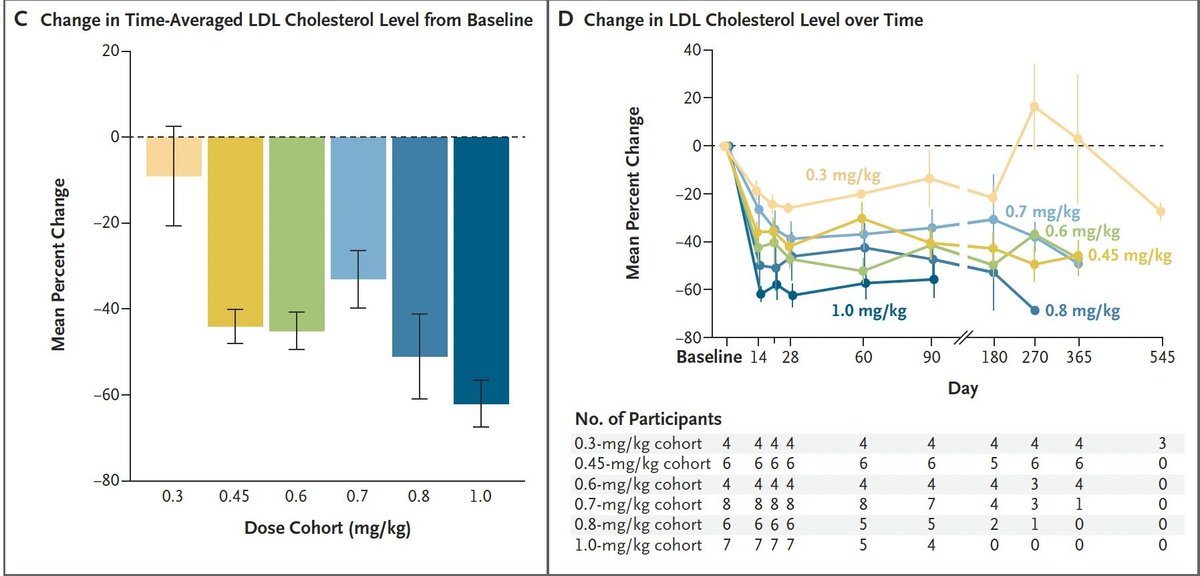
Eli Lilly has done it.
They've gone and made what seems to be a powerful, permanent gene therapy for LDL cholesterol.
That means they'll be able to effectively prevent most heart disease with a single infusion!
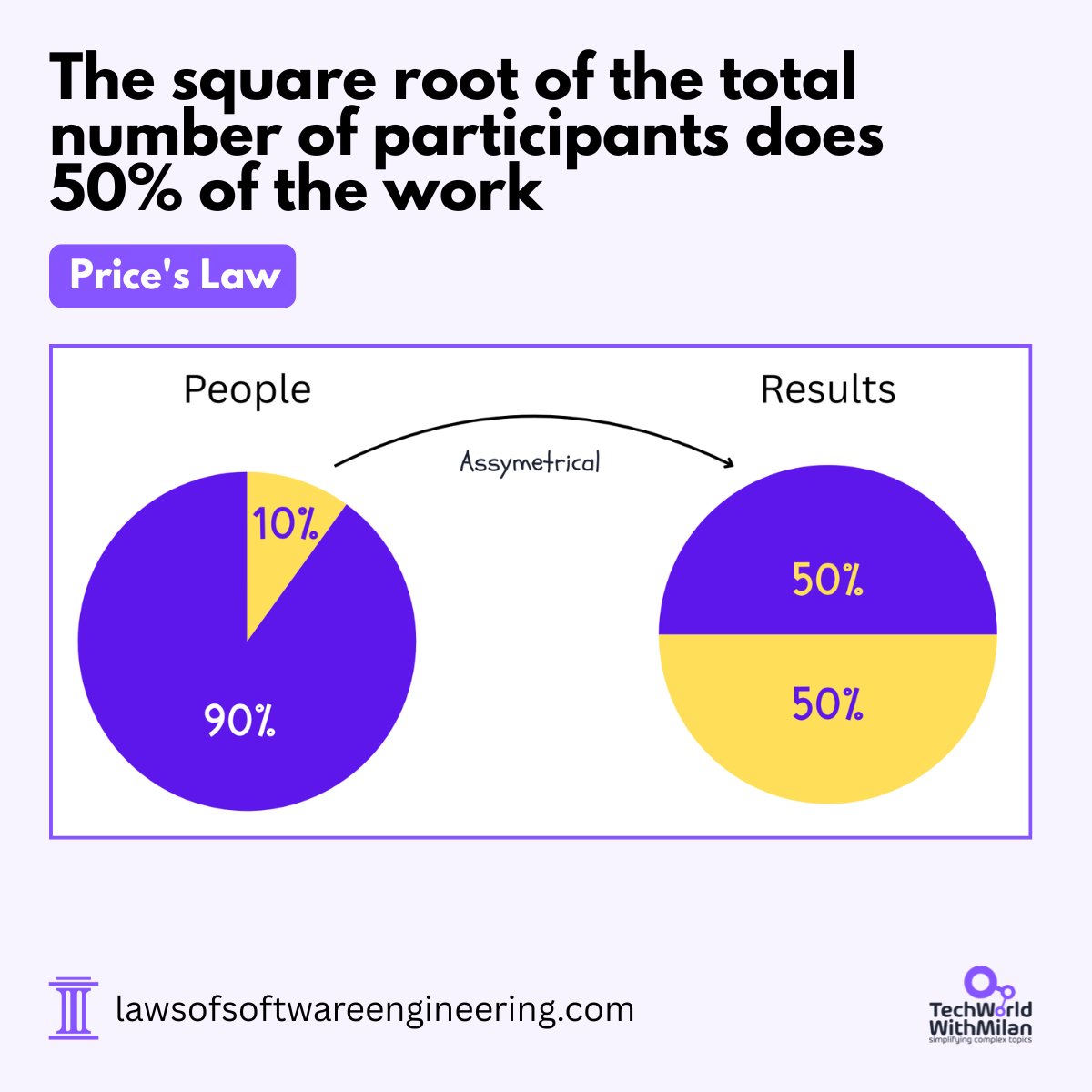
𝗪𝗵𝘆 𝗛𝗮𝗹𝗳 𝗬𝗼𝘂𝗿 𝗧𝗲𝗮𝗺'𝘀 𝗢𝘂𝘁𝗽𝘂𝘁 𝗖𝗼𝗺𝗲𝘀 𝗙𝗿𝗼𝗺 𝗮 𝗛𝗮𝗻����𝗳𝘂𝗹 𝗼𝗳 𝗣𝗲𝗼𝗽𝗹𝗲
In an engineering org of 100 people, about 10 of them produce half the output. Of 400, it's 20. Of 10,000, it's 100.
This is Price's Law:
"The square root of the number of people in a group does 50% of the work."
Derek de Solla Price observed it in scientific publishing in the 1960s. The most prolific authors weren't a bit more productive than average. They were dramatically more, and the gap widened as the group grew.
In software, you can see it too:
A GitHub project with 30 contributors. About 5 of them (√30 ≈ 5) wrote half the meaningful code. The rest shipped patches, docs, and one-time fixes.
A product team of 16. Four engineers consistently solve the hardest problems and shape the architecture. The others handle maintenance, smaller features, and the day-to-day.
The most public test of this law was on Twitter in late 2022. About 7,500 employees. Price's Law would predict a core of around 87. Musk took over, cut staff roughly in half, and the platform kept running. The basic functions are held.
But the law only predicts who produces visible output. It says nothing about resilience. Twitter cut redundancy in SRE, security, and content moderation. Some laid-off engineers were asked to come back. Critical skills had been cut. Output continued. The buffer underneath it was gone.
This is the part most people get wrong. Price's Law is not a layoff plan, nor is it an argument that most of your team is dead weight. The 87 produces visible output. The 7,413 hold the system up.
What the law actually says:
Adding people doesn't double output. The math doesn't work that way. Going from 100 engineers to 400 doesn't move the core from 10 to 40. It moves it from 10 to 20.
If your top contributors leave, you lose more than the headcount suggests. Replacing one of the √N takes longer and costs more than replacing an average hire.
Hiring quality matters more than hiring quantity. One excellent engineer outperforming three average ones is normal. Engineering throughput tracks hiring bar more than headcount.
Retention of the core √N is strategic, not HR. They burn out the same as everyone else, often faster, because they take on the hardest work. Losing one of them is a much bigger event than it looks on paper.
The real implication of Price's Law isn't who matters. Its output is wildly uneven, and the org chart almost never reflects this. Knowing where the work actually comes from is the first step to not losing it by accident.
@unherd Hi there. Despite numerous interactions with the @unherd support team since raising this issue, I continue to be bounced from pillar to post and am now simply being ghosted. Any assistance that can be provided will be much appreciated.
@unherd three e-mails sent to [email protected] regarding an order placed on the 16th of March for two decks of UnHerd Playing cards. Absolute Crickets since then. Is this a real company or a sham? Looking forward to a response this decade.
Also don’t remember. But it’s been living rent free in my head ever since. Puts a very important truth that you intuit when building companies in a very accessible form.
Elon Musk avait dit un truc qui m'avait marqué sur l'allocation de ressources. En substance : passé un certain niveau de richesse, l'argent n'est plus de la consommation, c'est de l'allocation de capital.
Cette phrase change tout.
L'économie, dans le fond, c'est juste un problème d'allocation. Tu as des ressources finies et des usages infinis. Qui décide où va quoi ?
Imagine une cour de récré. 100 enfants, des paquets de cartes Pokémon distribués au hasard. Tu laisses faire. Très vite, un ordre émerge. Les bons joueurs accumulent les cartes rares, les collectionneurs trient, les négociateurs trouvent des deals. Personne n'a planifié. Et pourtant chaque carte finit dans les mains de celui qui en tire le plus de valeur. Le système maximise le bonheur total de la cour. C'est ça, la main invisible.
Maintenant fais entrer la maîtresse. Elle trouve ça injuste. Léo a 50 cartes, Tom en a 3. Elle confisque, redistribue, impose l'égalité. Trois effets immédiats. Les bons joueurs arrêtent de jouer, à quoi bon. Les mauvais n'ont plus de raison de progresser, ils auront leur part. Les échanges s'effondrent. La cour est égale, et morte. Elle a maximisé l'égalité, elle a détruit le bonheur.
Le problème de la maîtresse, c'est qu'elle ne peut pas avoir l'information que la cour avait collectivement. C'est le problème du calcul économique de Mises, formulé en 1920. L'URSS a essayé de le résoudre pendant 70 ans avec le Gosplan. Résultat : pénuries, queues, effondrement. Pas parce que les Soviétiques étaient bêtes, parce que le problème est mathématiquement insoluble en mode centralisé.
Quand Musk a 200 milliards, il ne les consomme pas, il les alloue. SpaceX, Starlink, Neuralink, xAI. Chaque dollar est un pari sur le futur. Et lui a un track record. PayPal, Tesla, SpaceX. Il a démontré qu'il sait identifier des problèmes immenses et y allouer des ressources avec un rendement spectaculaire.
L'État aussi a un track record. Hôpitaux qui s'effondrent, éducation qui décline, dette qui explose, services publics qui se dégradent malgré des budgets en hausse constante. Le marché identifie les bons allocateurs, la politique identifie les bons communicants.
Le profit n'est pas une finalité, c'est un signal. Il dit : tu as alloué des ressources rares vers un usage que les gens valorisent suffisamment pour payer. Plus le profit est gros, plus la création de valeur est grande. Quand Starlink est rentable, ça veut dire que des millions de gens dans des zones rurales ont enfin internet. Quand un ministère est en déficit, ça veut dire qu'il consomme plus qu'il ne produit. L'un crée, l'autre détruit, et on appelle ça redistribution.
Dans nos sociétés il y a deux catégories d'acteurs. Les entrepreneurs et les bureaucrates. L'entrepreneur prend un risque personnel pour identifier un problème, mobiliser des ressources, créer une solution. S'il se trompe il perd. S'il a raison, ses clients gagnent, ses employés gagnent, ses fournisseurs gagnent, l'État collecte des impôts. Il est la cellule de base du progrès humain.
Le bureaucrate ne prend aucun risque personnel. Son salaire est garanti. Au mieux il maintient une rente existante. Au pire il la détruit par excès de réglementation, mauvaise allocation forcée, incitations perverses qui découragent ceux qui produisent. Mais dans aucun cas il ne crée.
Regarde les 50 dernières années. iPhone, internet civil, SpaceX, Tesla, Google, Amazon, Stripe, mRNA, ChatGPT. Toutes des inventions privées, portées par des entrepreneurs, financées par du capital risque. Pas un seul ministère n'a inventé quoi que ce soit qui ait changé ta vie au quotidien.
La France est devenue le laboratoire mondial de la dérive bureaucratique. 57% du PIB en dépenses publiques, record absolu. Une administration tentaculaire, une fiscalité qui pénalise la création de richesse. Résultat : décrochage face aux États-Unis, à l'Allemagne, à la Suisse. Fuite des cerveaux. Désindustrialisation. Dette qui explose.
Et le pire c'est que la mauvaise allocation s'auto-renforce. Plus l'État prélève, moins les entrepreneurs créent. Moins ils créent, moins il y a de base fiscale. Plus l'État s'endette et taxe. Boucle de rétroaction négative parfaite. La maîtresse pense qu'elle aide, et chaque année la cour produit moins.
Dans nos sociétés, ce sont les entrepreneurs, toujours, qui font avancer la civilisation. Les bureaucrates au mieux maintiennent une rente, au pire la détruisent. Aucune société n'a jamais progressé en taxant ses créateurs pour subventionner ses gestionnaires.
La question n'est jamais qui a combien. C'est qui alloue le mieux la prochaine unité de ressource pour maximiser le futur de l'humanité. La réponse depuis 200 ans n'a jamais changé. Ce ne sont pas les fonctionnaires.
THIS NEWS WAS NOT FIT TO PRINT
Yesterday’s @nytimes piece was intellectually defunct. It bothered me so much that I thought I’d write a detailed dissection of everything that’s wrong with it.
First, we should acknowledge @danprimack's reasonable analysis: he observes that no statement of fact in the article is false, but it’s also nothing new and nothing nefarious.
But his analysis forgives the four pieces of journalistic malpractice on display:
1. People have short attention spans, and journalists have a duty of care *not* to imply things that aren’t there. This care is not exercised.
2. In fact, the writers do the opposite — the phrasing intentionally twists the facts to suit the narrative.
3. Articles should educate readers on technical topics with nuance (Special Government Employees, private market divestitures). Here we see the opposite: the arcaneness is used to mislead the public.
4. Throughout the piece — and in fact, the headline and subheading — the article insidiously implies wrongdoing that appears clearly false.
I say that with confidence because none of the facts in the article substantiate the headline. If you have 3,000 words (backed up by months of work from 5 journalists) to prove something… but then you don’t prove it… then it means you can’t back up your accusations.
DISCLAIMERS
I’ve met @DavidSacks a handful of times, when Craft invested in a company I founded. We are an inconsequential position to Craft (<0.1% AUM) and I am not particularly beholden to Craft or him. My company is not trying to raise money. No one asked me to write this. I write this because the journalistic malfeasance bothers me. I’m a registered independent and have routinely criticized both the Trump and Biden administrations.
Okay, now on to everything that's wrong with the NYT article.
OUT THE GATE, SWINGING WITH ALLEGATIONS
>> [David Sacks] had convened top government officials and Silicon Valley executives for a forum on the booming business of artificial intelligence. […] Almost everyone in the high-powered audience — which included the chief executives of the chip makers Nvidia and AMD, as well as Mr. Sacks’s tech friends, colleagues and business partners — was poised to profit from Mr. Trump’s directives.
So…
— the AI + Crypto czar actually knows people / has worked with other people in AI + Crypto
— the campaign that ran on the promise of being tech-friendly convened a forum to deliver on the promise
Got it.
>> Since January, Mr. Sacks, 53, has occupied one of the most advantageous moonlighting roles in the federal government, influencing policy for Silicon Valley in Washington while simultaneously working in Silicon Valley as an investor.
This is the very definition of how a Special Government Employee role is supposed to operate.
1. SGEs allow the government to access highly specialized skills or domain knowledge without the need for long-term or full-time hiring.
2. SGEs are still subject to ethics laws, but some conflict-of-interest rules are relaxed given their limited duties.
3. SGEs on advisory committees can participate in matters of general applicability even if their employer is part of the affected industry.
If the NYT has an issue with the rules of the role, they should take it up with Congress.
>> Mr. Sacks has recommended A.I. policies that have sometimes run counter to national security recommendations, alarming some of his White House colleagues and raising questions about his priorities.
Mr. Sacks is not the national security advisor. He’s the AI advisor. His job is to recommend AI policies, and it’s the administration’s job to decide what is the best path across all factors.
Also — any competent official who has *never* caused concern is probably not very good at what they do. Real policy is bold.
>> Mr. Sacks has positioned himself to personally benefit. He has 708 tech investments, including at least 449 stakes in companies with ties to artificial intelligence that could be aided directly or indirectly by his policies, according to a New York Times analysis of his financial disclosures.
Note the tense: “Mr. Sacks has positioned himself,” implying that he has *taken actions* to *benefit*. In fact, he has provably taken several actions to *reduce* his benefit.
You’re probably asking “why is that benefit not zero?” Fair question — this has to do with how private markets work (an area I have some expertise in). We will talk about his incomplete divestiture below.
In the meantime, this statement can be boiled down to “we appointed someone who has an incredible track record in the areas he’s been asked to provide advice.” That… seems like a good thing.
>> His public filings designate 438 of his tech investments as software or hardware companies, even though the firms promote themselves as A.I. enterprises, offer A.I. services or have A.I. in their names, The Times found.
This is probably the worst offender in an overall shoddy article.
“AI” is not an industry category. Go look at SIC codes, or the S&P industry categories, and tell me where “AI” appears as a classification. AI is an underlying technology. Almost every software company today is repositioning itself to be an AI company. It makes complete sense that the terms are converging.
The New York Times has a comments section on articles. Should we start referring to them as a social media company?
Just like the comments section on the NYT is a way to enhance the core value prop (media and publishing), AI is a way to augment the core value proposition of software or hardware.
>> Mr. Sacks has raised the profile of his weekly podcast, “All-In,” through his government role, and expanded its business. [...] No event better illustrates Mr. Sacks’s ethical complexities and how his intertwined interests have come together than the July A.I. summit. Mr. Sacks initially planned for the forum to be hosted by “All-In,” which he leads with other tech investors. “All-In” asked potential sponsors to each pay it $1 million for access to a private reception and other events at the summit “bringing together President Donald Trump and leading A.I. innovators,” according to a proposal viewed by The Times. […] The plan so worried some officials that Susie Wiles, the White House chief of staff, intervened to prevent “All-In” from serving as the sole host of the forum, two people with knowledge of the episode said.
When reading this, I thought this was a serious concern if true. It’s certainly worthy of questioning and clarification. But Sacks’ (PR + legal) rebuttal certainly provides that clarification:
— The sponsorships were solely to defray event costs
— Susie Wiles' intervention was precautionary, not reactive to misconduct
— There was no financial gain for Sacks or All-In; the event operated at a loss
— The hypothetical private reception was a non-profit endeavor which didn’t materialize
Nevertheless, this might be one of the only reasonable concerns raised by that article. I would still argue that if this were the standard, no public figure could ever hold government office because it “raises their profile.” Reasonable minds can disagree, though.
>> Steve Bannon, a former adviser to Mr. Trump and a critic of Silicon Valley billionaires, said Mr. Sacks was a quintessential example of ethical conflicts in an administration where “the tech bros are out of control.” “They are leading the White House down the road to perdition with this ascendant technocratic oligarchy,” he said.
Oh, NOW you’re buddy-buddy with Bannon? “The enemy of my new enemy is my friend,” eh?
Bannon is clearly annoyed that his race-focused agenda has been overruled by a more techno-optimistic one. I think this is a huge step in the right direction by the administration.
APPARENTLY WE’RE NOT OVER THE WHOLE “BE ASHAMED OF SUCCESS” THING
>> Mr. Sacks stands out as a special government employee because of his hundreds of investments in tech companies, which can benefit from policies that he influences. […] His public ethics filings, which are based on self-reported information, do not disclose the value of those remaining stakes in crypto and A.I.-related companies. They also omit when he sold assets he said he would divest, making it difficult to determine whether his government service has netted him profits. […] Mr. Sacks has complied with special government employee rules and the Office of Government Ethics determined that he should sell investments in certain types of A.I. companies but not others, she said.
Remember: “SGEs are still subject to ethics laws, but some conflict-of-interest rules are relaxed given their limited duties.”
This is a judgment call for the OGE to make, which appears to be exactly what happened. I’m not an expert in OGE disclosure forms, but a quick review indicates that these are in-keeping with requirements for an SGE. If this is improper, I assume the NYT would have said so, plainly.
>> At a White House dinner for tech executives in September, Mr. Sacks said he was grateful to work in both technology and government. It was “a great honor to have a foot in each one of these worlds,” he said.
OK. This just describes how an SGE works: one foot in their industry, and one foot in government. The industry expertise *is the point*.
>> After eBay bought PayPal for $1.5 billion in 2002, [David Sacks, Peter Thiel, and Elon Musk] invested in one another. [...] In 2017, Mr. Sacks began Craft Ventures, a firm that has invested in hundreds of start-ups, including some owned by his friends. He also started the “All-In” podcast three years later with friends and fellow investors Jason Calacanis, Chamath Palihapitiya and David Friedberg.
This boils down to: David Sacks likes working with his friends, and his friends like working with him. This is stated in an accusatory fashion, but this is actually Just How Things Work when you like your friends and colleagues.
>> Last year, Mr. Sacks hosted a $12 million fund-raiser for Mr. Trump at his San Francisco mansion. The dinner made an impression on the presidential candidate. “I love David’s house,” Mr. Trump said on “All-In” two weeks later. “What a house.”
Mr. Trump has also been known to say that Mar-a-Lago has the most “beautiful piece of chocolate cake.” Are we going to get an NYT feature on that too?
>> Mr. Sacks opened the door of the White House to Silicon Valley leaders. Among the most prominent visitors was Jensen Huang, Nvidia’s chief executive. Mr. Sacks and Mr. Huang, who had not met before Mr. Sacks joined the administration, forged a tight bond this spring. [...] And spreading Nvidia’s technology would expand the A.I. industry, aiding the A.I. investments owned by Mr. Sacks and his friends.
Nvidia is the most valuable company in the United States and the world. They are a cornerstone of the most important technological revolution of our lifetimes — and a matter of critical national security.
I’m pretty sure Jensen Huang would be able to get an audience without David Sacks’ intervention.
Along the way, the AI czar advocated for the AI industry.
I'm curious: is it also considered wrongdoing when a teachers’ union meets with the President to advance their views on education policy?
>> In White House meetings, Mr. Sacks echoed Mr. Huang’s ideas that the best way to beat China would be to flood the world with American technology. Mr. Sacks worked to eliminate Biden-era restrictions on Nvidia and other American chip companies’ sales to foreign countries. […] Mr. Sacks flew to the Middle East in May and struck a deal to send 500,000 American A.I. chips — mostly from Nvidia — to the United Arab Emirates. The large number alarmed some White House officials, who feared that China, an ally of the Emirates, would gain access to the technology, these people said. […] Mr. Sacks trumpeted the Emirati deal on “All-In” in May. “I would define winning as the whole world consolidates around the American A.I.” companies, he said. […] In the White House, Mr. Sacks promoted the idea that the ban inadvertently helped China by diverting chip sales to Huawei, a Chinese rival to Nvidia, four people familiar with the discussions said. […] In July, Mr. Sacks and Mr. Huang took their argument to an Oval Office meeting with Mr. Trump. Before the meeting ended, Mr. Trump cleared Nvidia to sell its chips to China.
Look, I think it's fair to have a diametrically opposite policy perspective. Geopolitics is complex!
But again: David Sacks is the AI advisor. If you have a problem with this foreign policy, that’s a valid policy decision to litigate with President Trump or Secretary Rubio.
Sacks’ spokeswoman specifically clarified that none of his holdings benefited. I don’t know what else one can reasonably ask for, here.
TO DIVEST, OR NOT TO DIVEST
>> The White House has praised Mr. Sacks, saying he minimized his financial conflicts of interest. The ethics waivers that Mr. Sacks received said he and Craft Ventures had sold more than $200 million in crypto positions, including investments in Bitcoin, and were divesting stakes in A.I.-related companies including Meta, Amazon and xAI. Mr. Sacks had started or completed sales of “over 99 percent” of his “holdings in companies that could potentially raise a conflict of interest concern,” the White House said. […] What is clear is that Mr. Sacks, directly or through Craft, has retained 20 crypto and 449 A.I.-related investments, according to the Times analysis.
For an “elite” newspaper, this is either hilariously ignorant or willfully ignorant.
These are not public market positions that you can simply sell. A co-GP cannot leave without borderline-blowing-up the firm.
I don't know the specifics, but here are the entanglements one can infer from the context:
1. Every VC firm has a share of the fund that the General Partners are putting in themselves. For a firm with several billion dollars in AUM, a typical GP’s commit would be eight figures (easily). Marked to market, we are probably talking about >$100M in holdings. It's hard to find buyers for this sort of position, and when they're sold, it's usually at a 10-40% discount.
2. David Sacks is no doubt a key person at the firm. You can’t simply “divest” without massive governance, legal, financial, and operational implications for Craft — not just David Sacks but all the other people who work there.
3. He has dozens of angel investments and LP positions from before he started Craft Ventures. These tickets are probably smaller, but there will be a TON of them. Imagine trying to sell a $200K position in a Series B company. There is essentially no secondary market for a position like this.
4. There is no way to put this stuff in a blind trust! it's not like he can forget all the companies he's invested in.
The fact that David Sacks has hundreds of direct + indirect positions makes him uniquely qualified to serve this role. But that very qualification cannot become a handcuff.
You can disagree with his worldview; but treating him as a Bond villain whose every action is a cash grab is unserious. People with hundreds of pre-existing, illiquid positions cannot magically divest from their entire life’s work, nor should we pretend that every policy preference is secretly a personal payday.
>> Mr. Sacks has stakes in defense tech start-ups such as Anduril […] Anduril announced a $159 million contract with the U.S. Army to build a new type of night vision goggles with A.I. Shannon Prior, an Anduril spokeswoman, said that the company had a relationship with the Army before the A.I. Action Plan and that it received the contract because its founder, Palmer Luckey, is “the world’s best virtual reality headset designer.” Ms. Hoffman said it was an “obvious idea” to include the military use of A.I. in the policy plan.
If I were the recipient of these questions, I would have been a lot less patient.
>> This spring, Mr. Sacks also backed a bill called the GENIUS Act to regulate stablecoins […] Mr. Sacks promoted the legislation on CNBC and worked to advance it through Congress. […] One of Craft’s crypto investments is BitGo, a company that works with issuers of stablecoins. […] In September, BitGo filed for an initial public offering. Craft owns 7.8 percent of the company, according to financial filings, which would be worth more than $130 million at BitGo’s 2023 valuation.
I feel like I’m beating a dead horse here.
— The AI & Crypto czar advocated for pro-AI and crypto policies.
— He divested positions according to proper filings and ethics reviews.
— SGEs on advisory committees can participate in matters of general applicability even if their employer is part of the affected industry.
>> BitGo declined to comment. Ms. Hoffman said the GENIUS Act’s passage “contained no specific benefit for BitGo.”
I believe this is called “general applicability”.
>> Since Mr. Sacks joined the White House, A.I. companies have continued to announce new investments from Craft. […] The funding was secured before Mr. Sacks joined the administration, said Mac Liu, Vultron’s chief executive. […] Mr. Sacks had left corporate boards before joining the Trump administration, but stayed on Glue’s because “it was allowed,” Ms. Hoffman said. The funding was completed last year, she said. Glue did not respond to a request for comment.
I’m trying really hard not to use all caps here.
** Deep breath **
Why are we talking about financings that happened before he joined the administration?
Nice try with the clever use of “continued to *announce* new investments.” Because it would be false to claim Craft made these investments since. But by citing these examples anyway, it makes it seem like Craft is making conflicting investments.
But wait! Even if they did! Craft *doesn’t have to shut down the entire damned firm*! They’re allowed to keep operating! And David Sacks is allowed to maintain those stakes!
>> Mr. Sacks’s government work has boosted the profile of the [All-in] podcast, which is downloaded six million times a month. Its annual conference in Los Angeles generated roughly $21 million in ticket sales this year, up from $15 million last year, based on its $7,500 ticket price and public attendance estimates. In June, the podcast introduced a $1,200 “All-In”-branded tequila. Mr. Sacks has forgone A.I. and crypto-related revenues, such as from sponsorships, but can share in sales from tequila and event tickets, Ms. Hoffman said.
What are we even talking about here.
Is David Sacks the tequila czar?
No?
Cool. Let’s move on.
>> Mr. Sacks’s personal business and policy work came together at the July A.I. event in Washington, which he tapped “All-In” to host. [… literally a repeat of the ostensible conflict from earlier in the article]
Ha. I missed this during the first read, but it’s nearly a word-for-word rehash.
I guess when you’re filling a 3,000-word nothingburger column that talks in circles, you can repeat (baseless) allegations without people noticing.
>> In the keynote speech, Mr. Trump described Mr. Sacks as “great” before signing executive orders to speed the building of data centers and exports of A.I. systems. Then he handed Mr. Sacks the presidential pen.
You mean… one of the *hundreds* of pens Presidents give away every year?! Gasp! Say it ain’t so! Are we worried that David Sacks might sell it on eBay to enrich himself?!
This entire article presumes that rich people only care about money. David Sacks has a *lot* of money. He’s allowed to have opinions and philosophy too. You can disagree with those ideologies… without painting him as a cartoon capitalist in a bowler hat twirling his mustache.
———
Imagine a local newspaper that wrote:
Headline: “Local Surgeon Endangers Patients With Sharpened Scalpel Use.”
And then in the body of the article, you learn:
– the surgeon used the right scalpel, the way surgeons always do
– the hospital’s chief of surgery supervised the surgery
��� “some staff expressed concern because it was touch and go”
– the surgery was successful and the patient was healthy
Every sentence in the body is technically true. It would also be outrageous to imagine a respected outlet publishing anything like it. Yet… the NYT writes something like this, routinely.
I don’t know why we’ve all collectively decided we’re okay with this from (what is ostensibly) the leading American publication.
We deserve better.
The anatomy of a software migration of non-trivial complexity, broken down by time/effort:
- code: ~10%
- comprehensive testing: ~20%
- operations: ~30%
- client coordination + whittling away the long tail: ~40%
@GergelyOrosz The very rare AWS outage probably costs many (most?) companies less than what it’d cost to implement multi-region support and failovers.
The cost of building, provisioning, testing, debugging, maintaining etc can be several of orders of magnitude higher.
The cancer of corruption has metastasised at ANC-led Gauteng Department of Health. Close to R20bn has been stolen from the Department in the last 10 years. The scale of this theft makes former President Jacob Zuma look like a clumsy shoplifter. https://t.co/bCHwXbFGzm
"@JMilei has brought monthly inflation down from 13% to 2%. The economy is now growing at an annual rate of 7%. Investors no longer shun Argentine bonds and stocks—indeed, they were among the best investments you could have made over the past two years. After a brief upward jump, the poverty rate has fallen from 42%, when Milei was elected, to 31%" 2/5