URGENT #RDC#Rwanda: Le Trésor américain a imposé ce mercredi 25 juin de nouvelles sanctions contre un réseau rwandais impliqué dans le trafic illicite de minerais en provenance de l'est de la #RDC.
Dans le viseur de Washington : la raffinerie Gasabo Gold Refinery LTD, basée à Kigali, accusée d'avoir servi de plaque tournante pour l'écoulement de l'or extrait des zones contrôlées par l'AFC/M23 au Sud-Kivu.
Selon le Trésor, au moins 60 kg d'or, représentant des millions de dollars, auraient transité de l'est du Congo vers Gasabo Gold au début de l'année 2026, sous escorte des Forces de défense rwandaises.
Le président de la raffinerie, Jean Malic Kalima, son directeur général Bosco Kayobotsi, ainsi que trois sociétés minières rwandaises contrôlées par Kalima ont également été sanctionnés.
Le secrétaire au Trésor Scott Bessent a averti : « Les États-Unis ne permettront pas à des groupes hors-la-loi de profiter du commerce illicite de minerais et de déstabiliser la région. »
La surpopulation, la promiscuité et les conditions de vie précaires dans les prisons congolaises créent un environnement particulièrement propice à la propagation des maladies infectieuses.
En pleine épidémie d'#Ebola, la prévention est donc essentielle pour empêcher la propagation de la maladie dans les lieux de détention.
Cette semaine, notre équipe a soutenu les efforts de prévention à la prison centrale de Beni en mettant à disposition des dispositifs de lavage des mains, en organisant des séances de sensibilisation auprès du personnel pénitentiaire et des femmes détenues, et en affichant du matériel d'information sur Ebola.
Des mesures de prévention ont également été mises en place par l'administration pénitentiaire, notamment la limitation des visites familiales afin de réduire les risques d'introduction du virus.
Une prison n'est jamais complètement isolée du monde extérieur. Les personnes qui y vivent, y travaillent ou y rendent visite font toutes partie de la même communauté. C'est pourquoi prévenir une épidémie dans un lieu de détention contribue à protéger bien au-delà de ses murs.
One man lies on the ground. Another is trampling on him.
This is what happens when some people confuse power with the right to dominate.
You can beat an activist, but you cannot crush a people’s aspirations for freedom, justice, and democracy.
History is full of regimes that believed themselves invincible. None of them were.
The dignity of the Congolese people cannot be trampled upon.
#NoToViolence #DRC #Democracy #Justice #FreeCongo @azizfall9@MutebaMPascal1@congofriends@AfricansRising@asmbaraza@MutemiWaKiama@Hayami_Minato
I am not a constitutional lawyer, nor do I claim the authority of one. However, after reading Karl Marx in The Eighteenth Brumaire of Louis Bonaparte and Critique of the Gotha Programme; Vladimir Lenin in State and Revolution; Samir Amin in The Implosion of Contemporary Capitalism and Eurocentrism; Antonio Gramsci in Selections from the Prison Notebooks; and Nicos Poulantzas in State, Power, Socialism, I find myself astonished by the enthusiasm with which many have celebrated Professor Ngondankoy's @NgondankoyG arguments without first subjecting them to a rigorous Marxist analysis and a dialectical examination of the nature of the State itself.
Legal science cannot be reduced to the interpretation of constitutional provisions alone; it also requires an understanding of power relations, social interests, and the concrete role played by the State within a given society.
The debate is not about the abstract capacity of the people to exercise their sovereignty. No serious constitutional scholar disputes that the people are the original holders of constituent power. The real question is whether those who currently control state power can instrumentalize popular sovereignty in order to circumvent the constitutional limits imposed upon their own authority.
The fundamental flaw in Professor @NgondankoyG Ngondankoy's reasoning lies in his conflation of the people as the historical subject of original constituent power with state institutions that exercise constituted powers strictly defined and limited by the existing Constitution.
In modern constitutional theory, original constituent power indeed belongs to the people. However, as long as a Constitution remains in force, the President, Parliament, and all public institutions exercise only constituted powers. They cannot invoke the people as a pretext to free themselves from the constitutional constraints that govern their mandate.
From a Marxist perspective, the State is not a neutral entity floating above society. As argued by Karl Marx, Friedrich Engels, Vladimir Lenin, Antonio Gramsci and later developed by Nicos Poulantzas, the State is the institutional condensation of existing social and class relations. When a government seeks to alter the fundamental rules of the political order during a period of contested legitimacy, the issue ceases to be merely legal; it becomes profoundly political: who controls the state apparatus, and in whose interests is that power being exercised?
The constant invocation of "popular sovereignty" becomes highly questionable when it originates from elites who already control the institutions, public resources, and decision-making mechanisms of the State. One cannot claim to act in the name of the people while simultaneously weakening the constitutional safeguards designed to prevent the concentration and abuse of power.
A Constitution is not merely an expression of popular sovereignty; it is also a mechanism for limiting state power. Ignoring this distinction transforms the referendum from an instrument of democratic participation into a tool for legitimizing the political ambitions of those already in power.
The central question therefore remains unanswered: are the people genuinely being called upon to exercise their sovereignty freely, or are we witnessing an attempt by constituted power to present itself as constituent power in order to redefine the rules of the political game to its own advantage?
This is where the real scientific debate should be focused. Rather than celebrating arguments as definitive truths, we should subject them to a rigorous dialectical and constitutional critique capable of distinguishing genuine popular sovereignty from its political appropriation by the State. @azizfall9@congofriends@RFIAfrique@AfricansRising@ProudSocialist@PatrickMbeko@DSESANGA@HDIAKIESE@KatangaCynthia@StanysBujakera@MartinFayulu@milaindfayulu@MutemiWaKiama@MutebaMPascal1
🧵 #RDC | #USA | Ils fuyaient la violence en Colombie, avaient cherché refuge aux États-Unis. Ils se retrouvent aujourd’hui bloqués à Kinshasa, déportés par l’administration Trump vers un pays qu’ils ne connaissaient pas. Thread.
What has the US actually done for the Congolese people?
The Congo is not a buffet. Its resources belong to its people — not to Trump's business circle, not to the corrupt Tshisekedi leadership bleeding the Congo dry.
Stop bankrolling tyranny. Stop robbing the Congolese and supporting those who kill US.
We WILL return to Congo. Not because you told us to — but because we never stopped belonging to it. 🇨🇩
RDC_Quotidien_Mines_Pétrole_Environnement_07.04.2026
· RDC : Judith Sumwina lance un plan stratégique pour sécuriser l’or artisanal. https://t.co/7EMPUVMzZw
· Mali, Côte d’Ivoire, RDC... gagnants et perdants de l’exploration minière en Afrique (2025). https://t.co/pG8tV8CVcu
· RDC : les Chinois Zijin et CMOC se positionnent sur un corridor d’exportation concurrent de Lobito. https://t.co/TpP6VCHnes
· Kamoa-Kakula : une puissance minière entre promesses économiques et défis de durabilité en RDC. https://t.co/51C5hJtYAP
· Sud-Kivu : massacre de creuseurs à Karhembo, l’or au cœur de la violence. https://t.co/rp3nfCGzzS
· Secteur minier en RDC : la précarité des exploitants artisanaux au cœur d'un café politique à Kinshasa. https://t.co/iWGdvKOvIm
· RDC : Jean-Jacques Purusi relance le débat sur une guerre liée aux minerais. https://t.co/NS8QW1HEWL
· Déguerpissement forcé des habitants de Mukumbi au Lualaba. https://t.co/H0jbpgY3xr
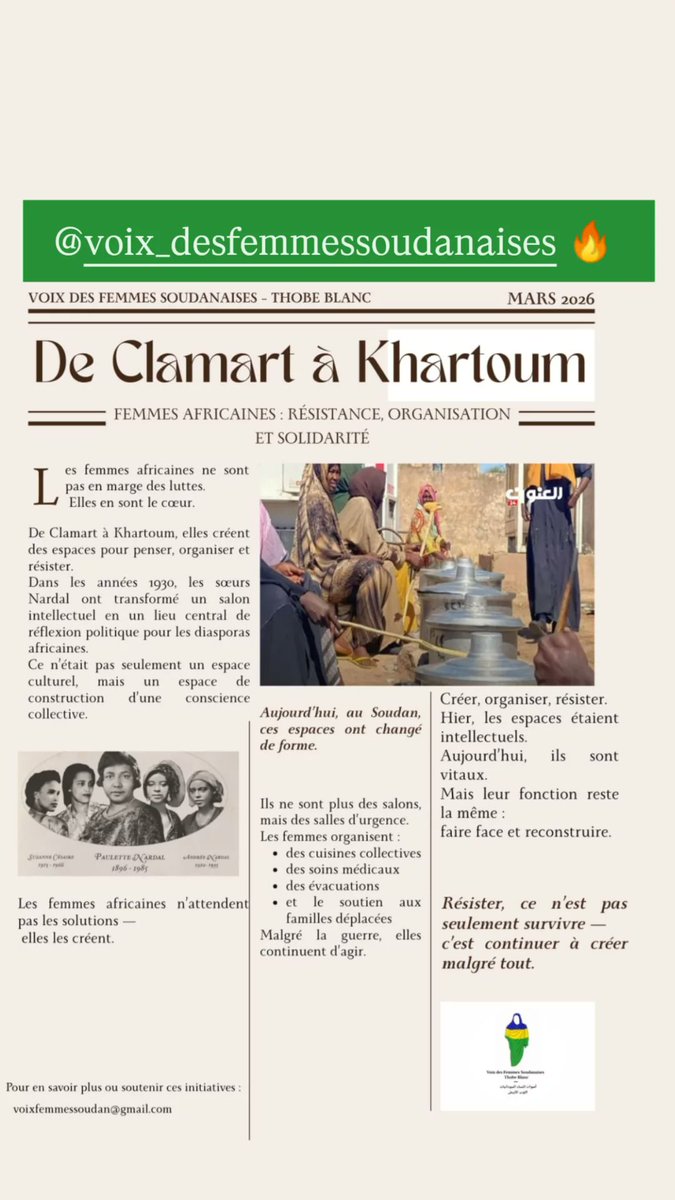
"Les femmes africaines ne sont pas en marge des luttes. Elles en sont le coeur. Les femmes africaines n'attendent pas les solutions - elles les créent."
@voixfemmes3 🔥
La guerre dans l’Est du Congo a-t-elle des impacts sur la santé mentale des Congolais ?
Ce mercredi, la camarade Prunoel Kaketa nous aidera à mieux comprendre les effets psychologiques des conflits et à promouvoir le bien-être de nos communautés.
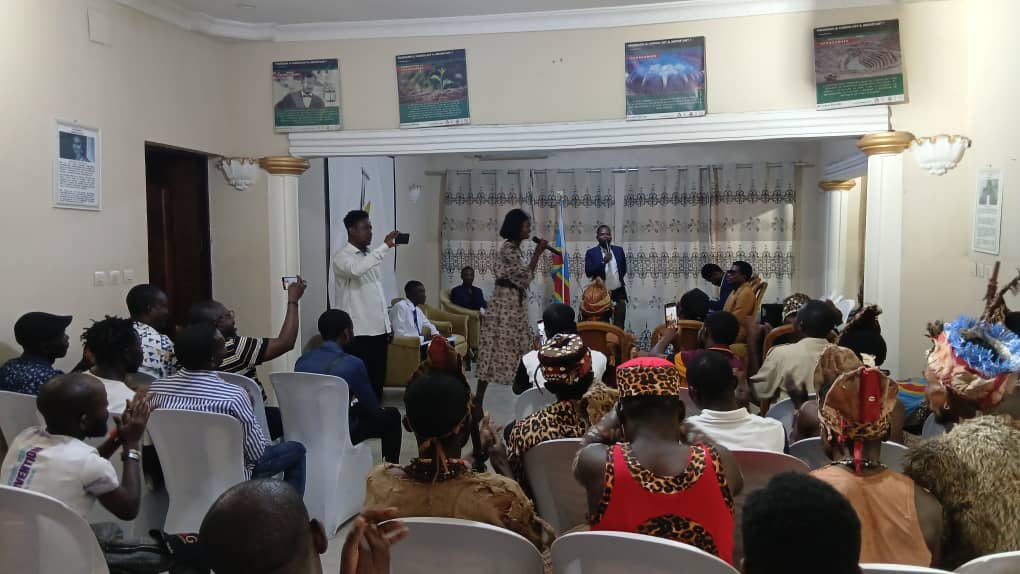
Ce samedi 17 au @ccandreeblouin, je parlerai du « r��le de l'éducation politique du peuple congolais ». Mon intervention sera basée sur l'héritage de Lumumba.
Bienvenue à tous !
@tresorkanda2
À la #CANMaroc2025, Lumumba a fait son retour sur nos écrans. À travers ces images, c’est toute une histoire de résistance, de dignité et de souveraineté qui ressurgit et qui doit être enseignée partout.
Bienvenue chez nous ce samedi à 13h00 !
Si demain matin nous nous réveillons et que Tshisekedi a été kidnappé puis exfiltré hors du pays, que ferons-nous ? Quelle lecture, spécifiquement congolaise, faisons-nous de ce qui se passe au #Venezuela ?
RDV au @ccandreeblouin ce mercredi afterwork. Welcome!
✊🏿 Bonne année 2026 !
Le CCAB souhaite une année de paix et de justice pour le Congo, l’Afrique et les peuples en lutte.
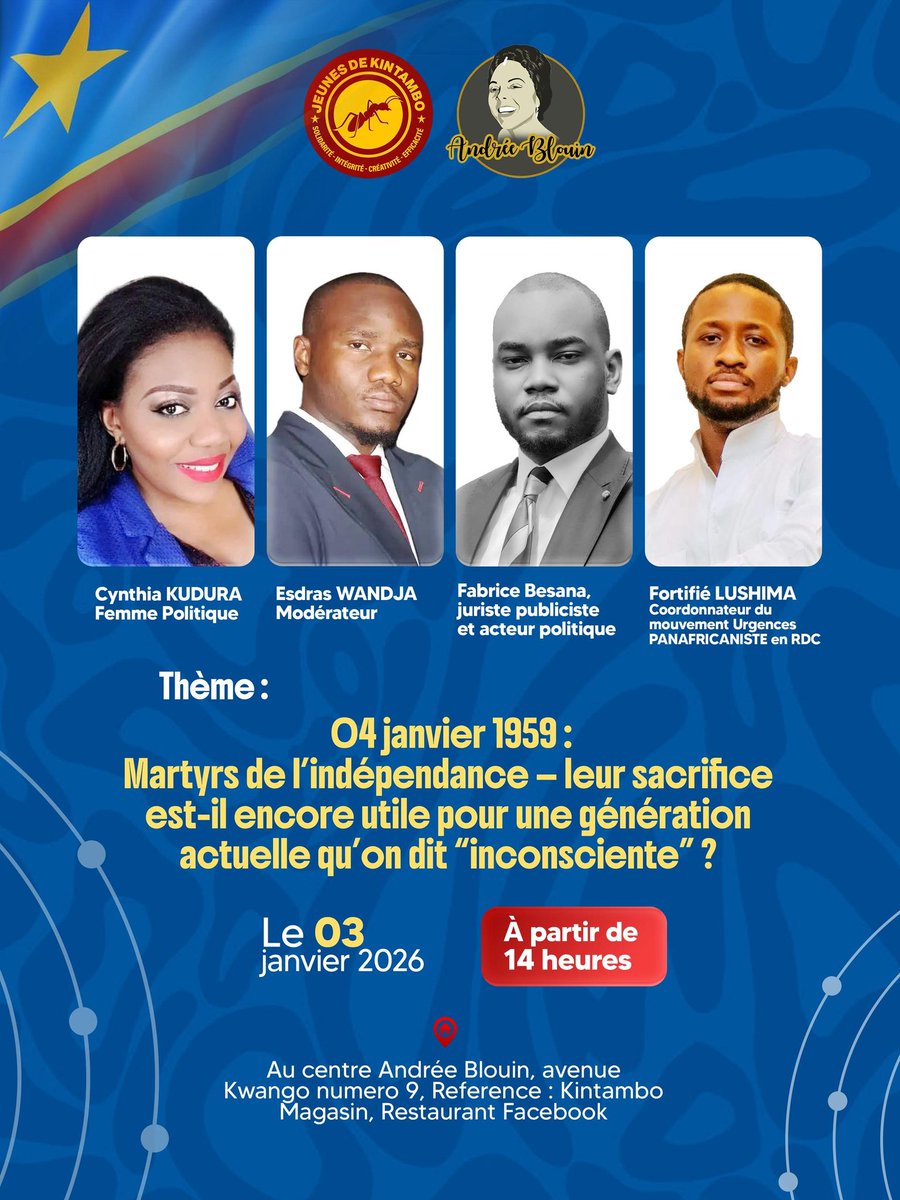
Samedi 3 janv. 2026 à 14h
Hommage aux martyrs de l’indépendance du Congo, avec les Jeunes de Kintambo.
Honorer les martyrs, c’est poursuivre le combat.
Andrée Blouin aurait eu 104 ans hier.
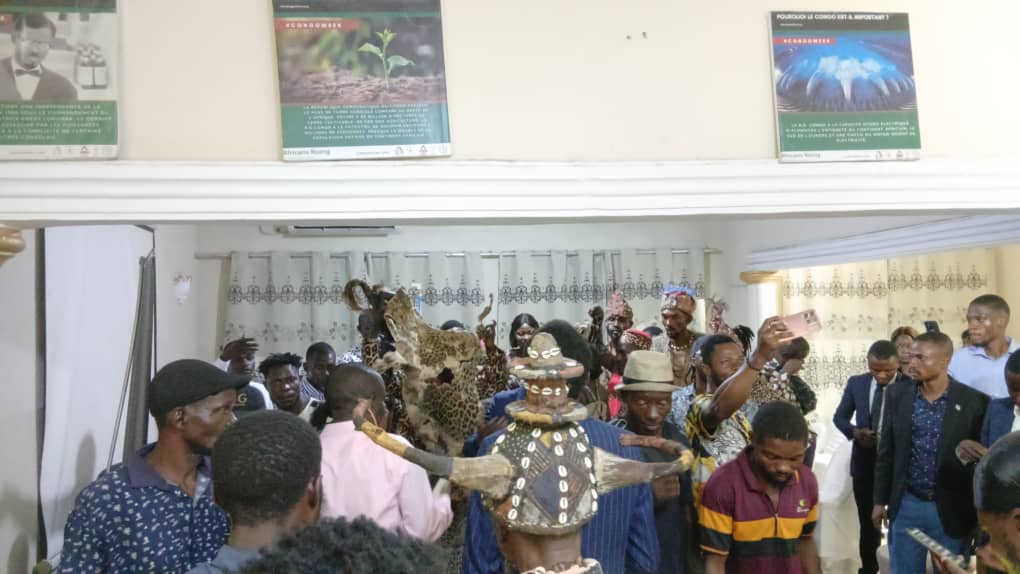
Pour honorer son héritage révolutionnaire, nous avons partagé un moment fort avec la communauté Yaka.
À ce soir pour une discussion ouverte sur la voix des marginalisés après Andrée Blouin, avec Joyeux Ngoma.
#AndréeBlouin#Panafricanisme
@ngama_obed Good job, my dear Obed!
The world should not turn against truth and human values because of technological advances. We must raise awareness among internet users for a dignified and rational use.