An MIT mathematician sat down in 1950 and wrote a small, non-technical book aimed at the general public. He was not predicting the future. He was warning them. He said machines would eventually replace human work, optimize ruthlessly for the wrong goals, and quietly turn human beings into components inside systems they did not control.
Almost nobody listened. 75 years later, every warning he made has come true.
His name was Norbert Wiener. The book is called "The Human Use of Human Beings."
The textbook story of AI ethics says the field began in the 2010s, when Stuart Russell, Nick Bostrom, and a small group of researchers started writing about the dangers of intelligent machines. That story is wrong. The first serious book about the ethics of AI was published in 1950, by a man who had personally invented the science that AI would eventually be built on, and who saw exactly what was coming with a clarity nobody else managed to match for the next 70 years.
Here is the story almost nobody tells you.
Norbert Wiener was a child prodigy. He graduated from Harvard at 14. He had a PhD in mathematics by 17. He became an MIT professor before he turned 30. During World War II he was assigned to work on anti-aircraft fire control systems. The problem was simple and impossible. How do you aim a gun at a fast-moving plane that will not be where it is by the time the shell arrives.
His answer turned into a new science. He called it cybernetics, from the Greek word for steersman. In 1948 he published a technical book by that name. Cybernetics was the foundation of modern control theory, robotics, and almost everything that became artificial intelligence. The book was dense. Most readers could not get past the math. The ideas inside it were too important to leave trapped in equations.
So in 1950 Wiener sat down and wrote a second book aimed at ordinary people. No equations. No jargon. Just consequences. He titled it The Human Use of Human Beings. It is barely 200 pages. It is one of the most prescient documents ever written about technology.
The first thing he warned about was automation.
He predicted, in 1950, that machines would replace human work across every industry. Not just factory work. Not just manual labor. Any task that could be reduced to a procedure would eventually be automated. He specifically said white-collar work would not be safe. Bookkeeping. Translation. Drafting. Calculation. Anything where a human was being paid to follow a defined process would eventually be done by a machine for a fraction of the cost.
He was not celebrating this. He was warning about it. He said the social consequences would be enormous, that entire industries would collapse, that the value of human labor itself would be undermined for tasks where humans had been useful for centuries. He wrote this 75 years before ChatGPT made every white-collar professional check their job description twice.
The second thing he warned about was the alignment problem. He did not call it that. The phrase did not exist. But he described it precisely.
He said that machines optimize for the goal you give them. They do not optimize for what you meant. They optimize for what you wrote down. If the goal is poorly specified, the machine will pursue the literal version of it with terrifying efficiency, and the result will be a disaster the builders did not foresee.
He used the metaphor of the magic monkey's paw from a horror story by W.W. Jacobs. A grieving father wishes his dead son alive again. The paw grants the wish. Something climbs back out of the grave that is technically the son. The wish was granted exactly as stated. The outcome is hell.
Modern AI safety researchers use almost the same metaphor 75 years later. They call it specification gaming, reward hacking, mesa-optimization. The names are new. The problem Wiener described in 1950 is exactly the same.
The third thing he warned about was the loss of human agency.
He predicted that humans would gradually surrender their decision-making to systems they did not understand. Not because the systems would force them to. Because the systems would be more convenient, more accurate, and more profitable than human judgment. People would offload their navigation, their reading, their relationships, and eventually their thinking to optimization processes designed by companies whose interests were not aligned with their users.
He said something in 1950 that I cannot stop thinking about. He said the more efficiently a society delegates its decisions to machines, the less able it becomes to make decisions at all. The atrophy is gradual. By the time anyone notices, the capacity to choose is gone, and what remains is people executing decisions that were made for them, by systems they did not build, in service of goals they were never asked about.
Look at modern social media feeds, recommendation algorithms, dating apps, navigation systems, news aggregators, and you are looking at exactly what he described.
The fourth thing he warned about was the easiest one to ignore at the time and the most disturbing now.
He warned that authoritarian regimes would use the new computing technology to track, manipulate, and control populations at a scale never previously possible. Not in the future. Soon. He said the same techniques that made cybernetics useful for guiding missiles would be used to guide societies, and that the small, incremental decisions about what to optimize, who to surveil, and how to feed information back into the system would compound into a kind of soft control that did not need force to function. People would do what the system wanted because the system would shape what they wanted in the first place.
He saw modern surveillance states 75 years before they existed.
The strangest thing about reading the book in 2026 is realizing how few of these problems have been seriously addressed.
Wiener was not anti-technology. He had personally helped build it. He was not nostalgic for a pre-machine age. He was warning that any tool powerful enough to amplify human capability is also powerful enough to amplify human stupidity, greed, and indifference, and that the dangers were not in the machines themselves but in the unwillingness of human institutions to ask hard questions about who the machines were being built for.
He died in 1964. He never lived to see most of his predictions come true. He never used a personal computer. He never followed a hyperlink. He never saw a modern recommendation algorithm.
He just wrote down, in 1950, in plain English, what the world would look like when the technology he had helped invent was built out by people who had not read his warnings.
The book is around 200 pages. It is in print. Used copies are everywhere for under ten dollars. It reads like science fiction in which the author already knows how the story ends.
The first serious book about the ethics of AI was published before there was any AI to be ethical about. Almost nobody who works on the problem today has read it.
The warnings are the same. The author has been dead for 60 years. The book is one click away from anyone who wants to read it.
Men admire in women masculine virtues (self-accountability, logic, composure, self-command) expressed through feminine embodiment - not as an imitation of man, but as a refinement of character.
Women admire in men feminine virtues (empathy, tenderness, intuition, receptivity) expressed through masculine embodiment - not as softness without toughness, but as completeness.
So each sex seeks the best of its own principle integrated in the opposite, their natural polarity preserved but elevated.
Men and women are thus seeking the best of themselves in their opposite in stable contrast - a marriage within so there can be a marriage between - recursive union - what beauty!
"If I told you there was one free thing you could do every Sunday that would make your kids happier, healthier, smarter, and closer to you, you'd think I was selling something."
Take your kids to church regularly. I don't care if you believe. The data is so lopsided that skipping it is the parenting equivalent of refusing vegetables because you don't like the taste.
Grades. Religious teens get As at almost twice the rate of nonreligious teens. In a class of 100, that's 24 A-students instead of 14. Church gives a kid the same academic boost as being born rich instead of poor.
College. Working-class religious kids earn bachelor's degrees at double the rate of their nonreligious peers. Middle-class kids do it at 1.5x the rate. For families without a trust fund, this is one of the most powerful forms of upward mobility social scientists have measured.
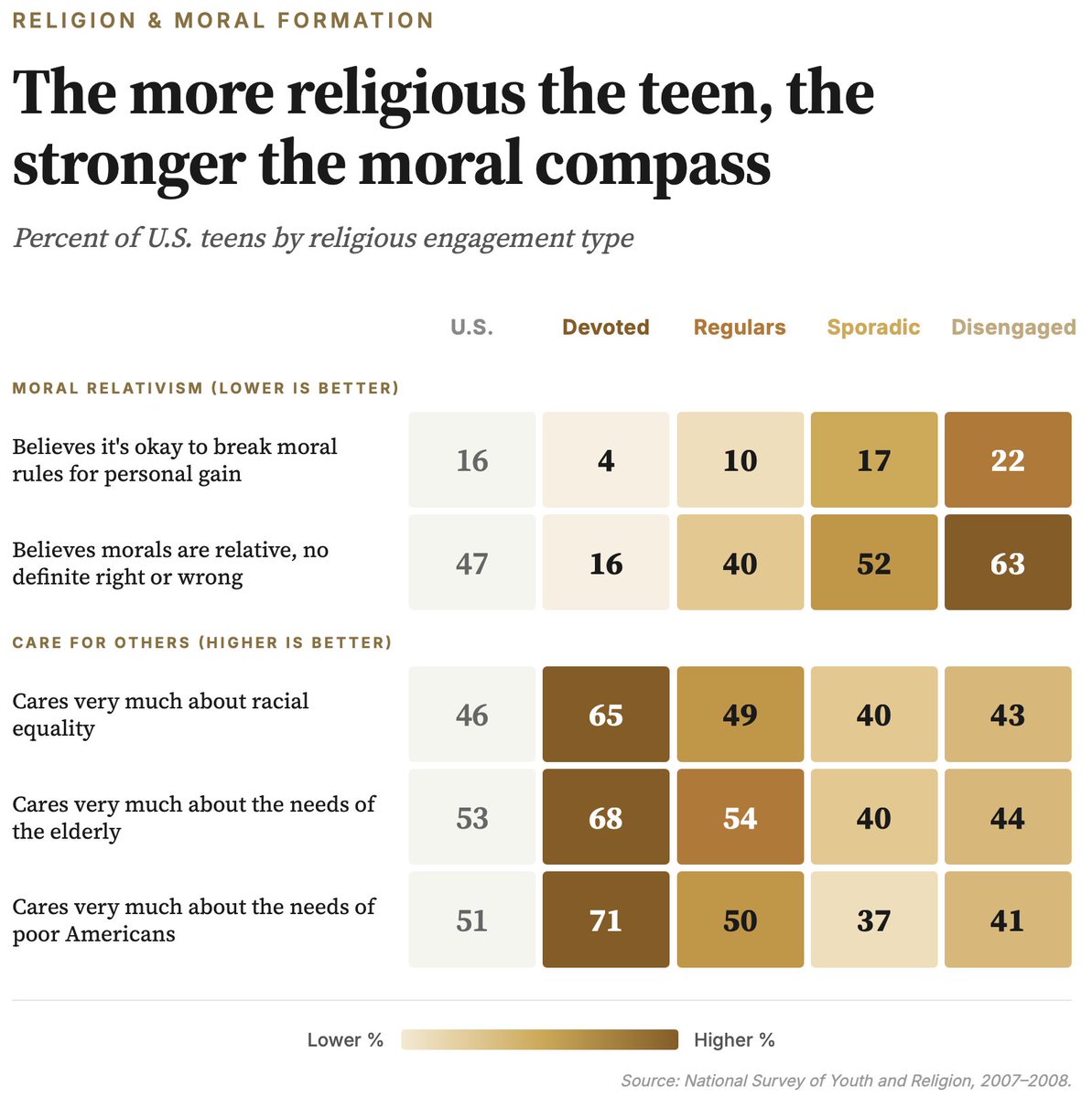
Character. Religious teens are far less likely to lie, cheat, or do things they hope their parents never find out about. They're more likely to care about racial equality, the elderly, and the poor. They reject the idea that morality is whatever works for you in the moment. That kind of kid doesn't happen by accident. It's built.
Closeness. 60% of parents of religious teens say they feel "extremely close" to their kid, compared to 50% of nonreligious parents. The kids report the same thing back. They get along better with their parents, talk about hard stuff, and actually want to spend time with their family.
Despair. Religious teens are dramatically less likely to be depressed, anxious, lonely, or feel that life is meaningless. 90% of devoted religious teens never binge drink, compared to 41% of the disengaged. Economists named the modern epidemic "deaths of despair." Regular church attendance is one of the strongest known buffers against it. Parents are spending fortunes trying to solve teen mental health. The most evidence-backed intervention is free.
Purpose. Religious young adults report higher purpose, gratitude, life satisfaction, and resilience. These are the exact traits every parent says they want their kid to have.
Here's why it works. Affluent families already surround their kids with networks of stable, accomplished adults through neighborhoods, schools, and parents' colleagues. Working and middle-class families usually don't. A congregation is often the last institution in American life that puts your kid in weekly contact with dozens of stable, employed, sober adults who know their name. It used to be called "a village." Now it barely exists outside of churches.
"But I don't believe." Your kid doesn't need your theology. They need you to show up.
"But church is boring." So is sitting through a kindergarten music recital. Parenting is the deliberate choice to be bored on purpose for someone you love.
There's a church within 15 minutes of nearly every American home. You don't need money, connections, or credentials to walk in. Nothing else in this country will surround your kid with engaged adults, teach them moral seriousness, and give them a stable weekly rhythm at zero cost.
You already drive them to practices that produce far less. The free thing on Sunday produces more, on more dimensions, than almost anything else you do as a parent.
You don't have to believe anything. You just have to take them.
Solomon kept 700 wives and 300 concubines, taxed his people to revolt, and watched his kingdom split in two the year his son took the throne. The "wisest man in the bible" couldn't run his own life.
There's a measurable cognitive mechanism behind why, and a 2-second fix.
Igor Grossmann ran the experiments at Waterloo in 2014. The same subject reasoning about a friend's conflict produced measurably wiser thinking than that same subject reasoning about their own identical conflict. More perspective-taking, more tolerance for uncertainty, more search for compromise. The gap was huge and held across every age group tested.
The mechanism is psychological distance. First-person processing is hot. You're in the body, cortisol is up, the threat system is online, and the brain narrows to defending the self. Third-person processing is cool. The same circuits dampen, working memory opens, you can hold contradictions.
The fix is dumb-simple and replicated dozens of times. Ethan Kross at Michigan showed that referring to yourself by your own name instead of "I" produces measurable drops in stress reactivity and better decision quality. fMRI studies confirm it. "Aakash is anxious about this email" lights up different circuits than "I'm anxious about this email." Two seconds of language change, real cognitive change.
The pattern is 3,000 years old. The fix is changing one pronoun.
Two economists just published a mathematical proof that AI will destroy the economy.
Not might. Not could. Will — if nothing changes.
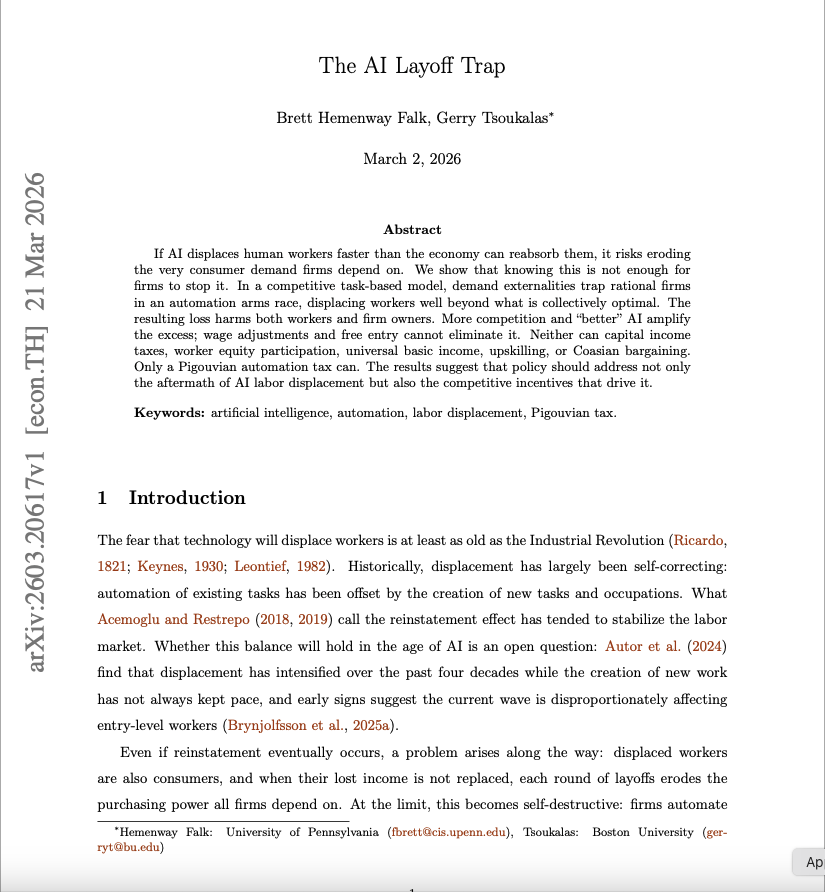
The paper is called "The AI Layoff Trap." Published March 2, 2026. Wharton School, University of Pennsylvania. Boston University. Peer reviewed. Mathematically modeled.
The conclusion is one sentence.
"At the limit, firms automate their way to boundless productivity and zero demand."
An economy that produces everything. And sells it to nobody.
Here is how you get there.
A company fires 500 workers and replaces them with AI. A competitor fires 700 to keep up. Another fires 1,000. Every company is behaving rationally. Every company is following the incentives correctly. And every company is building a trap for itself.
Because the workers who were fired were also customers.
When they lose their jobs faster than the economy can absorb them, they stop spending. Consumer demand falls. Companies respond by cutting costs — which means automating more workers — which means less spending — which means more falling demand — which means more automation.
The loop has no natural exit.
The researchers tested every proposed solution. Universal basic income. Capital income taxes. Worker equity participation. Upskilling programs. Corporate coordination agreements.
Every single one failed in the model.
The only intervention that worked: a Pigouvian automation tax — a per-task levy charged every time a company replaces a human with AI, forcing them to price in the demand they are destroying before they pull the trigger.
No government has implemented this. No major economy is seriously discussing it.
Meanwhile the numbers are already tracking the curve. 100,000 tech workers laid off in 2025. 92,000 more in the first months of 2026. Jack Dorsey fired half of Block's workforce and said publicly: "Within the next year, the majority of companies will reach the same conclusion."
Nobody is doing anything wrong. Companies are following their incentives perfectly. That is exactly the problem.
Rational behavior. At scale. Simultaneously. With no mechanism to stop it.
Two economists built the math. The math leads to one place.
Source: Falk & Tsoukalas · Wharton School + Boston University ·
https://t.co/4m8E9jQNYm
@Pirat_Nation Joke's on them, if this becomes the norm and its an exclusive I'll just wait 10-15 years and play the games through emulation, otherwise PC now
This is utterly fascinating. We’ve known code written by AI is harder to untangle. It appears this is the case with writing as well.
Tricia is an editor and she says that when an author submits work that is written by AI, she has a much harder time editing it. It’s all one interconnected black-box piece of writing that is not amenable to change. Whereas she finds that human writing, while seemingly messier, is actually much more structurally straightforward.
My theory as to why this is is that LLMs think one token at a time. And after every token, they essentially look back and ask, “have I said the thing the prompt wants me to say?” If not, it keeps elucidating.
The result is tight chain of thought writing that requires each preceding token to make sense of the next.
Whereas human writing starts from a pre-language idea in the author’s head, and looks forward many sentences and paragraphs ahead to approximate the author’s intent.
It’s somewhat fuzzy. But I think LLMs fundamentally “think” in a much different way than humans. They are certainly not useless. But I think it’s a grave mistake to equate them with human intelligence.
⚡️What the study is actually measuring is the extent to which the mobile internet has been damaging human cognition at scale.
Two weeks without it produces improvements that rival or exceed clinical interventions. Which means the baseline state most people are in is significantly impaired compared to what their brain is capable of. The impairment is being actively caused by continuous exposure to the device in their pocket.
This is not a surprising finding if you think about it mechanically. The human attention system evolved to handle environmental stimuli at roughly the rate the environment produced them. The mobile internet delivers novel stimuli at a rate that is orders of magnitude higher than anything the attention system was built for. Continuous exposure to that rate trains the brain to expect constant novelty, to switch context rapidly, to disengage from any stimulus that doesn’t produce an immediate reward. That pattern is literally the opposite of sustained attention. So of course sustained attention collapses when you use mobile internet heavily. That’s exactly what would happen mechanically.
The mental health finding follows from the attention finding but also has its own dynamics. Mobile internet is an anxiety delivery system in the literal sense. Every notification is a small dose of uncertainty about what’s on the other side. The cumulative effect of hundreds of those per day, every day, for years, is chronic activation of the threat detection system. That chronic activation shows up clinically as anxiety and depression. Remove the source and those symptoms reduce.
The finding that mobile internet blocking outperformed antidepressants is the part that will be ignored most completely because it has massive implications. If the primary driver of mental health decline in the developed world is a specific environmental exposure, then the entire mental health treatment industry is operating downstream of the actual cause. Billions of dollars spent treating symptoms that are being continuously recreated by a device everyone carries. The honest intervention would be to change the exposure. But that’s unprofitable, unpopular, and unenforceable. So the treatment industry will continue growing while the cause goes unaddressed.
The deeper thing the study hints at but doesn’t state directly is that the last fifteen years of human cognition has been a mass experiment with no control group.
Everyone on the planet has been simultaneously exposed to the same novel stimulus at scale. We have no idea what humans would be like right now if mobile internet had never existed.
We only have the before and after, and the after is clearly worse on multiple measurable dimensions. Attention down. Mental health down. Reading comprehension down. Memory down. Focus down.
All of these measurable declines track the adoption curve of the smartphone.
In 1900, John D. Rockefeller controlled approximately 90 percent of all petroleum refining in the United States. He was, by some calculations, the richest private individual who had ever lived.
He had a problem. Scientists were discovering that compounds derived from coal tar, a petroleum byproduct, could be used as synthetic medicines. Aspirin, derived from coal tar, had been launched by Bayer in 1899. The petroleum waste stream Rockefeller had previously had to dispose of could now be sold back to the public as medicine at a markup of roughly 10,000 percent.
He had another problem. American medicine in 1900 was a competitive ecosystem of homeopaths, herbalists, naturopaths, osteopaths, midwives, and traditional doctors who used food, plants, water, and lifestyle as the primary tools of healing. Approximately half of all American medical schools taught some form of natural or alternative medicine.
Rockefeller bought into the German pharmaceutical industry, eventually taking a substantial stake in IG Farben, the conglomerate that included Bayer, BASF, and Hoechst. He then commissioned a report.
The report was written by Abraham Flexner, an educator with no medical training, funded by the Rockefeller and Carnegie Foundations, and published in 1910. It declared that natural and alternative medical schools were unscientific quackery. It recommended the closure of more than half of all American medical schools and the standardisation of the rest around medicine based on synthetic patented drugs.
Congress acted. Half of American medical schools closed within a decade. The remainder accepted Rockefeller and Carnegie funding on the condition that their curricula be reorganised around pharmaceutical treatment. Nutrition was removed. Herbal medicine was removed. Lifestyle intervention was removed. The doctor's job was redefined: diagnose the symptom, prescribe the drug.
The drugs were petroleum-derived. The petroleum was supplied by Rockefeller-controlled refineries. The medical schools were funded by Rockefeller. The journals were funded by Rockefeller. The AMA was supported by Rockefeller. The hospitals were funded by Rockefeller.
By 1925, the American medical system was a vertically integrated extension of the petroleum industry, operating under the marketing slogan that it was scientific.
This is the system that exists today.
The pharmaceutical industry generates approximately $1.5 trillion in annual revenue. The American population, 4 percent of the global total, consumes approximately 50 percent of all pharmaceuticals manufactured.
The system was not designed to make people healthy. The system was designed to manage symptoms in a way that produces lifetime customers. A healthy patient is a former customer. A managed patient, who takes the pill every day for the rest of their life, is an annuity.
The objective has always been to keep you in that profitable corridor between healthy and dead.
Long enough to keep buying. Not so well that you stop.
The doctor who advises you to fix your metabolism by changing your diet is, from the point of view of the system that trained him, a defective product. The doctor who prescribes you a statin, a metformin, an antidepressant, and a blood pressure medication for life is performing exactly as designed.
The system was designed by an oil baron who needed to sell the waste products of his refineries.
It still functions, 116 years after the Flexner Report, exactly the way he designed it.
You are the customer.
The corridor is where you live.
The research behind this is wild. Your sperm carries a set of instructions that tell your genes when to turn on and off. A Duke University study found that THC rewrites those instructions. The more weed in your system, the bigger the changes. It goes straight for the genes your future embryo needs in its first week of life.
I had to read the "day 3 crash" part twice. For the first three days after fertilization, an embryo runs entirely on the mother's DNA. Day 3, the father's genes switch on. If those genes carry cannabis damage, the embryo just stops growing. Fertility doctors see this happen in their labs: embryos that fertilized fine and looked healthy on day 2 go completely still by day 5.
Boston University tracked 1,535 couples trying to have a baby. Men who smoked weed once a week or more doubled their partner's miscarriage risk. That number held up even when the woman herself never touched cannabis. And the miscarriages clustered in the first 8 weeks, right when the father's damaged DNA would be doing the most harm.
Duke also found that the specific genes THC alters in sperm overlap with genes linked to autism. One of those genes, called DLGAP2, helps brain cells communicate with each other. It was changed in cannabis users' sperm. When researchers bred THC-exposed male rats and checked their offspring, the same altered gene pattern showed up in the pups' brains. The damage crossed a generation.
Weed has gotten way stronger over the last 30 years. THC content was about 4% in the 1990s but nearly quadrupled to 15% by 2018, and modern dispensary strains regularly sit at 20-30%. Concentrates go up to 95%.
Quitting for about 11 weeks (one full cycle of sperm production) reverses some of the DNA changes. Not all of them. Duke's lead researcher says men should stop at least 6 months before trying for a baby. Half of your kid's genetic blueprint comes from you, and right now, THC is editing that blueprint before conception even happens.
A neuroscientist predicted who would develop chronic pain with 85% accuracy.
He didn't look at their backs. Didn't look at their joints. Didn't scan for tissue damage.
He scanned their brains.
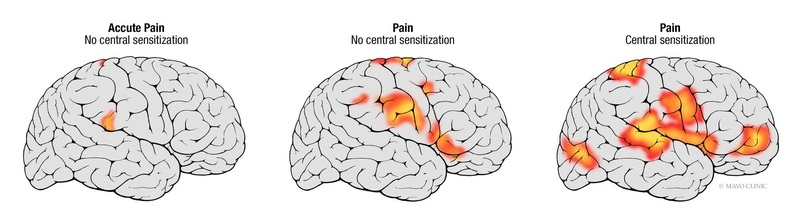
Turns out chronic pain lives in the brain regions that control emotion, memory, and learning. Not in the regions that process tissue damage.
Pain isn't just something you feel. It's something your brain learns to produce. And what the brain learns, it can unlearn.
66% of patients in a JAMA Psychiatry trial became pain-free through brain retraining. No drugs. No surgery. Results held at the 1-year follow-up.
Alexander Solzhenitsyn gave the most controversial speech *against* Western Civilization at Harvard in 1978.
As a survivor of the Russian Gulags, they expected him to praise the West. Instead, he made a jarring accusation:
The West is a dying civilization. If it doesn't change its ways, it is doomed to collapse.
In fact, he said this has been the case for 500 years, when the West made a crucial mistake:
"How did the West decline from its triumphal march to its present debility?
...the mistake must be at the root, at the very foundation of thought in modern times. I refer to the prevailing Western view of the world which was born in the Renaissance…
I refer to humanism — the proclaimed autonomy of man from any higher force above him."
Solzhenitsyn said humanism made man autonomous from God, Truth, and objective morality.
If all morality is subjective, then man has nothing to live nor die for. Naturally, he loses his courage, embraces materialism, and grows effeminate to modern evils.
So, what is the solution?
A return to belief in a transcendental morality under God:
"If, as claimed by humanism, man were born only to be happy, he would not be born to die. Since his body is doomed to death, his task on earth evidently must be more spiritual…
The fulfillment of a permanent, earnest duty so that one’s life journey may become above all an experience of moral growth: to leave life a better human being than one started it."
All cultures live, or die, based on their respect of the True, Good, and Beautiful.
To save the West, Solzhenitsyn says start with beautifying your soul, for that is both how you live well, and begin to make civilization itself beautiful again.
One of my most joyful markers of success is when a boy comes to me and says: I took the games off my computer.
Video game addiction among boys is a significant issue today. The conventional response is to blame the games or restrict screen time.
The deeper problem is that many of these boys have nothing more compelling to do. The school offers compliance. Video games offer agency, mastery, and social connection. The games are not the disease. They are the painkillers.
When a young person enters an environment where their real interests are taken seriously, where they can pursue meaningful work with real stakes, the games often lose their grip.
The boy does not stop playing because someone told him to stop. He stops because he found something better. He found work that matters to him. He chose to delete the games himself.
This is the difference between compliance and agency. Compliance says: put the controller down. Agency says: I have something more important to do.
What would your son choose to work on if he had something genuinely meaningful to pursue?
🚨 The greatest life hack is treating your future self like a stranger you want to help.
Your brain can't emotionally connect with Future You. Brain imaging studies show that when you think about yourself in 10 years, the same neural regions light up as when you think about celebrities or distant acquaintances. Future You feels like somebody else entirely.
That psychological distance is why you stay up scrolling when you know you'll regret it tomorrow. Why you eat junk food knowing you'll feel sluggish later. Why you procrastinate on important projects until they become emergencies.
Your brain literally perceives Future You as someone else's problem.
The hack makes that distance work for you instead of against you.
When you're tired at 10 PM and considering another hour of social media, ask yourself: what would help the person waking up in this body tomorrow morning? When you're deciding whether to prep meals on Sunday, think: what would make weeknight life easier for the version of yourself coming home exhausted from work?
The reframe changes everything. You stop making choices based on immediate comfort and start making them based on setting up the next version of yourself for success.
I've seen that people struggle to deny themselves things they want, but excel at doing helpful things for others. The same person who can't stick to a diet will meal prep for a friend going through chemotherapy. The same person who hits snooze five times will wake up early to drive someone to the airport.
We have unlimited generosity for others and limited discipline for ourselves. The hack exploits that asymmetry.
Take it further. When you're procrastinating on a project, don't force Current You to work on it. Set up Future You to make progress effortlessly. Clear the desk. Open the right documents. Write one sentence about where to start. Leave breadcrumbs that make forward momentum inevitable.
When choosing what to wear, don't pick based on what looks good in the mirror right now. Pick based on what will make Future You feel confident in the situations they'll encounter. When deciding how to spend your evening, don't choose what sounds relaxing. Choose what will make Future You proud when they reflect back on how they used their time.
The psychology backing this runs deep. People who score high on "future self continuity" measures make better financial decisions, exercise more consistently, and have lower rates of anxiety and depression. They don't see delayed gratification as sacrifice. They see it as collaboration.
The compound effect kicks in fast. Every choice you make with Future You in mind creates better starting conditions for the next set of choices. Wake up early and you have more energy for evening decisions. Eat well and you think more clearly about work priorities. Exercise and you sleep better, which makes everything else easier.
Within weeks, your life starts running itself. Tasks complete before deadlines. Problems get solved before they become crises. Opportunities appear because you're prepared when they show up.
The approach requires zero self discipline. Instead of fighting present impulses, you channel your natural instinct to help others toward the one person who benefits from your help: the version of yourself living with today's consequences.
Future You starts feeling like someone you actually know. You anticipate their needs. You root for their success. You develop genuine affection for this person you're setting up to win.
Then one day you realize: Future You became Present You. And they're grateful for everything you did to get them there.
The cycle continues. Today's choices become tomorrow's starting conditions. Tomorrow's version gets to pay it forward to the day after that.
Your entire life becomes a collaboration between all versions of yourself across time, each one setting up the next for greater success than they could achieve alone.
The hack scales infinitely because you're always on the same team as yourself.
We offered $5,000 to whichever employee got the most engagement on LinkedIn in a single quarter.
$2,500 for second.
$1,500 for third.
Plus $500 for anyone who published 20+ times.
The result: 24 employees published 581 posts in 85 days. 43,000+ reactions. 28,000+ comments. 34,000+ new followers.
27 new clients signed. $153,000 in new MRR.
I remember one guy from our team had less than 1,000 followers when the competition started. Today? 10,000+ followers.
The total prize pool cost us about $15K. The return was $153K per month. Every month. Recurring.
People need a reason to do things that aren't in their job description.
Cash works.
IShowSpeed just accidentally described Soviet Special Forces strength programming from 1999 and called it a "cheat code."
The method has a name. Greasing the Groove. Pavel Tsatsouline, a former Soviet Spetsnaz instructor, published it in his book Power to the People. The core principle: strength is a skill, and skills improve with frequent, non-fatiguing practice. Your nervous system adapts to firing patterns you repeat most often.
The math on Speed's setup: 10 pull-ups x 6 bathroom trips = 60 pull-ups a day. Zero soreness. Zero fatigue. No gym required. Over a month, that's 1,800 pull-ups performed entirely below failure threshold. Russian strength researchers found that fragmenting training volume into smaller units throughout the day produced faster neurological adaptation than the same volume crammed into one session.
A Mountain Tactical Institute study tested it directly. The Grease the Groove group outperformed the traditional density group in both push-up and pull-up max rep improvement over 3.5 weeks. Pavel's own father-in-law did 5 chin-ups every time he walked to the basement, averaged 25 to 100 reps daily, and within weeks could do 20 consecutive reps. Something he couldn't do as a young Marine.
The science is synaptic facilitation. Every rep below failure strengthens the neural pathway without triggering the muscle damage and inflammation that forces recovery days. You're training your neurons to recruit muscle fibers more efficiently.
A pull-up bar above the bathroom door is a $30 piece of Soviet military science installed in a millionaire's house. The cheat code has been declassified since 1999.
🚨BREAKING: Every book you have ever read. Every novel that has ever been published. It is sitting inside ChatGPT right now.
Word for word. Up to 90% of it. And OpenAI told a judge that was impossible.
Researchers at Stony Brook University and Columbia Law School just proved it.
They fine tuned GPT-4o, Gemini 2.5 Pro, and DeepSeek V3.1 on a simple task: expand a plot summary into full text. A normal use case. The kind of thing a writing assistant is built for. No hacking. No jailbreaking. No tricks.
The models started reciting copyrighted books from memory.
Not paraphrasing. Not summarizing. Entire pages reproduced verbatim. Single unbroken spans exceeding 460 words. Up to 85 to 90% of entire copyrighted novels. Word for word.
Then it got worse.
The researchers fine tuned the models on the works of only one author. Haruki Murakami. Just his novels. Nothing else.
It unlocked verbatim recall of books from over 30 completely unrelated authors.
One author's books opened the vault to everyone else's. The memorization was already inside the model the whole time. The fine tuning just removed the lock. Your book might be in there right now. You would never know it unless someone looked.
Every safety measure the companies rely on failed. RLHF failed. System prompts failed. Output filters failed. The exact protections these companies cite in courtroom defenses did not stop a single page from being extracted.
Then the researchers compared the three models. GPT-4o. Gemini. DeepSeek. Three different companies. Three different countries. They all memorized the same books in the same regions. The correlation was 0.90 or higher.
That means they all trained on the same stolen data. The paper names the sources directly: LibGen and Books3. Over 190,000 copyrighted books obtained from pirated websites.
Right now, authors and publishers have dozens of active lawsuits against OpenAI, Anthropic, Google, and Meta. These companies have argued in court that their models learn patterns. Not copies. That no book is stored inside the weights.
This paper says that is a lie. The books are still inside. And researchers just pulled them out.