Very excited to finally share our preprint on the AD Atlas (https://t.co/WUMMtFgIqG) - an integrative multi-omics resource for AD research 🧠🔍 Thank you to @_MatthiasArnold@KastenmullerLab@AMPADPortal@Alzheimers_NIH and all our amazing collaborators!
https://t.co/rGTGIlc1eu
By popular demand, full genome-wide summary statistics are now downloadable for our cross-platform metabolite study at
https://t.co/qAjXWPooRB
Please spread the word.
Amazing work lead by Claudia Langenberg and team, exploring the genetic architecture of protein-disease links! Also check out 👉🏼https://t.co/GCOZ5mYgSq for an interactive version of the proteo-genomic map and more! @pietznerm @eleanorwheeler#openscience#genomics#proteomics
Excited to finally share our preprint on the multi-omics AD Atlas (https://t.co/F54w7ZvxqL). Thanks and congratulations to @mwoerhe for driving this huge effort! Enabled by @AMPADPortal, @Alzheimers_NIH and all contributing partners. #AMPAD#ENDALZ
https://t.co/OvhvWYhsVP
To be or not to be?
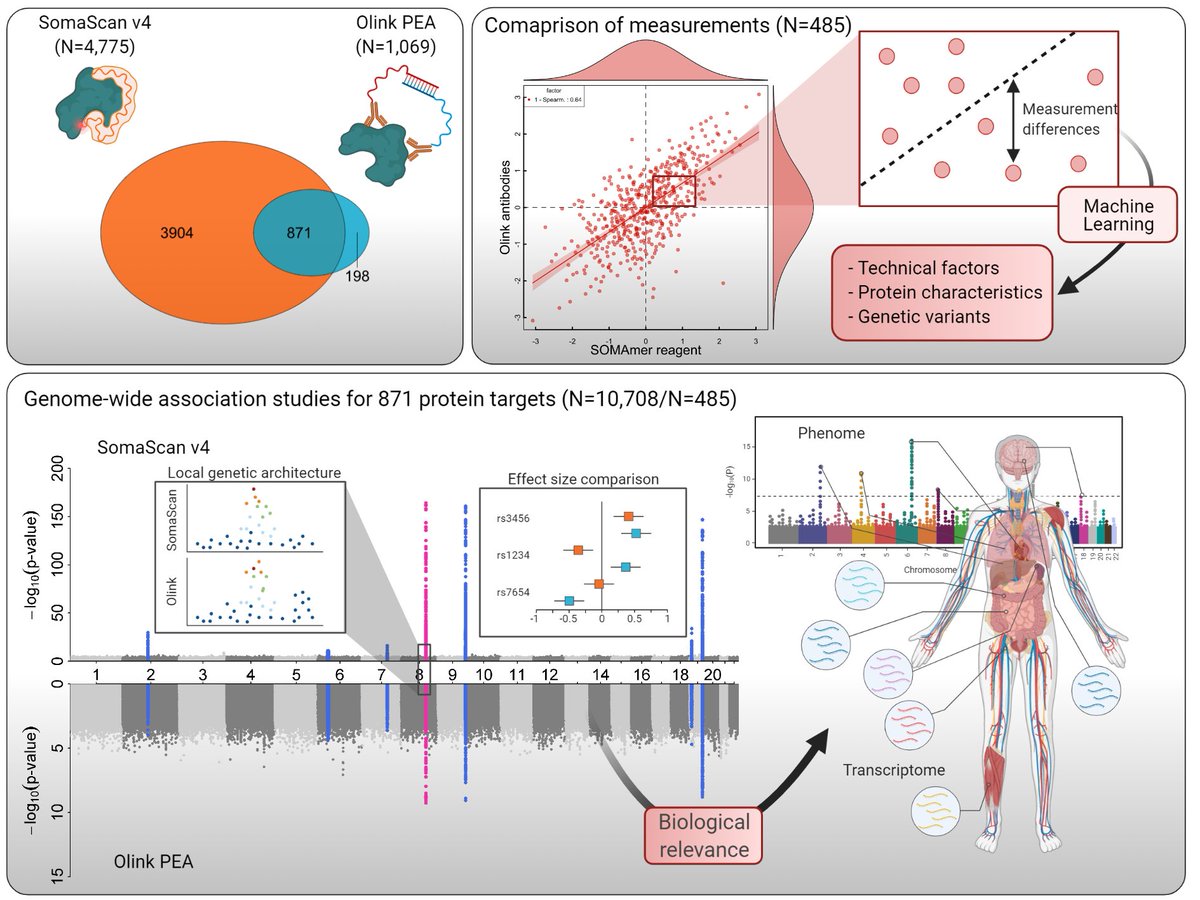
Thrilled to share our pQTL stories
head-to-head comparison of @SomaLogic and @OlinkProteomics for 871 proteins among 10k individuals @MRC_Epid
Bidirectional platform comparison for >2k pQTLs to guide genetic discovery
https://t.co/z4bAfuOE7m
🧵👇 (1/7)
📢 I'm thrilled to share that shiny 1.6.0 is now on CRAN!
🎉
This release makes so much easier to create beautiful, performant, and accessible #rshiny#rstats apps.
https://t.co/OwRSkCbzKK
We created a GitHub for the Harvard STAT115/215 BIO/BST282 course: Introduction to Bioinformatics and Computational Biology. https://t.co/gFqsvywtxl. Most of it is based on the 2020 course material, which we will gradually update in spring 2021.
On the occasion of SNiPA's 6th birthday, we released a new version at https://t.co/0nOfo9doyy. V3.4 features tons of additional eQTLs/pQTLs/mQLTs/traitQTLs, incl. the whole 2nd round of GWASs (pooled & sex-specific) from the UK Biobank (thanks to @bmneale's lab)! V4 coming soon..
Really happy to see our review (and the first paper of my PhD 🥳) 'Multi-omics integration in biomedical research – A #metabolomics-centric review' out!
Thank you to my amazing co-authors @JanKrumsiek, @KastenmullerLab,@_MatthiasArnold.
https://t.co/vPjBHAikTa
Pretty excited about this collaboration. Obstacle avoidance for robotic manipulators is a hard problem, especially on the basis of vision. Our approach allows a seamless integration of a learned policy while maintaining the responsiveness required for many critical tasks.
The GDS 1.4 release includes new machine learning algorithms, graph embeddings, and introduces a new Pregel API so you can implement your own algorithms using #Neo4j infrastructure #NODES2020
Learn more about GDS here: https://t.co/xOZlKI7aCW
Networks inferred via p-value cutoffs are often flawed, since they do not necessarily reflect biological reality. We analyze the problem and propose a new prior knowledge-driven approach in our latest Nature Communications paper https://t.co/C9N0V1QHMN
Nice! Thanks to Anna and her team @Sagebio, the AD atlas is now directly accessible through the Agora platform of the @AMPADPortal!
Check it out at https://t.co/wb4YKZTEoP and https://t.co/4ODdFFYgsw.