Out of everything posted about FSD v15 so far, one line from @elonmusk deserves way more attention than it's getting: "This is real-time AI video generation (no gaming engine!) using just half of one AI4 TRIP accelerator. Let that sink in …" 🔥
Half of one accelerator is the part worth sitting with. Once you see the numbers behind it, Reality View stops looking like a fancy new screen and starts looking like one of the most impressive things Tesla has ever shipped.
🎬 THE SCREEN IS NOW GENERATED LIVE
For years, FSD's screen worked like a video game. Software took a list of what the car detected and dropped stock 3D models in the right spots: a gray car here, a lane line there.
Reality View tosses that playbook out the window. The car's AI now generates the video itself, frame after frame, as you drive, with no game engine anywhere in the loop.
Better yet, the picture comes from the same end-to-end model that's doing the driving. That's the single neural network that turns camera video into steering and braking, and now it paints your screen, too.
⚙️ WHAT A TRIP ACTUALLY IS
The standard AI4 computer carries two self-driving chips, and each chip packs three custom neural processors Tesla calls TRIP accelerators. That's six in all.
And that's where Reality View gets made: right on the self-driving computer, instead of the infotainment chip that runs your maps and music.
Each TRIP is basically an arena packed with tiny calculators, all cranking through the multiply-and-add math that neural networks run on. Teardowns count 9,216 of them per TRIP, lined up in a 96-by-96 grid and firing 2.2 billion times a second.
Each calculator handles two operations per tick, so one TRIP works out to 9,216 × 2 × 2.2 billion, or roughly 40 trillion operations every second.
Half of one comes to about 20 trillion, roughly a twelfth of the whole computer's neural muscle.
📏 WHY THAT NUMBER IS RIDICULOUS
Twenty trillion operations per second sounds enormous, until you see what else runs on that kind of budget.
The Neural Engine inside Apple's iPhone 15 Pro is rated at 35 trillion operations per second. So on paper, the slice of compute painting Reality View has less raw AI muscle than the AI chip in a 2023 phone.
Companies don't all count these numbers the same way, so it's a ballpark, but it shows just how little compute this is.
At the other end of the scale sits Nvidia's H100, one of the data-center workhorses powering today's AI boom. It's rated at about 1,979 trillion 8-bit operations per second in its standard mode, the same kind of math a TRIP runs, which puts half a TRIP at roughly 1% of one H100.
That gap matters because AI video is one of the toughest jobs in AI. Many AI video generators still take minutes to produce a single clip, as the researchers behind the real-time system MotionStream point out.
Even MotionStream, built specifically for speed, streams roughly 17 to 29 frames per second at 480p, and about 10 at 720p, while eating up an entire H100.
Meanwhile, Tesla is streaming a live, photorealistic view of the real road on roughly 1% of that chip's rated power, inside a moving car.
In other words, Reality View runs on less compute than a phone's AI chip, inside a computer whose main job is driving.
There's a fair asterisk here. Those research models dream up whole scenes from a prompt or a single image, while Tesla's renderer starts with a driving brain that already knows exactly what's around the car. Tesla also hasn't shared the view's resolution or frame rate.
And even on the most generous estimates of AI4's power, half a TRIP still works out to only about 2% of one H100.
Either way, live generated video on a sliver of a car computer would have sounded like science fiction not long ago.
🔍 HOW IT CAN BE THIS CHEAP
Tesla hasn't spelled out how it works, but it has left plenty of breadcrumbs.
FSD's network has been building its own 3D picture of the world for a while now, something Tesla showed off at the ICCV conference in October 2025. That picture includes 3D Gaussians, millions of soft little blobs of color that can rebuild a scene you can view from any angle.
Tesla also built its own Gaussian splatting system that can rebuild a scene from the car's cameras in a fraction of a second.
Reality View streams its picture from a virtual camera that can sit anywhere above the car, and showing a scene from an angle no real camera has is exactly what those 3D blobs are great at.
Even Elon seems to like that theory: he called a description of Reality View as a neural, Gaussian-splat digital twin "pretty accurate", and it lines up with every other clue.
If that's the trick, the hard part is done before the screen ever needs a picture. The driving brain understands the scene, and the visualization just paints what it already knows.
That would explain the other shocker. Reality View swapped every separate signal behind the old screen for one end-to-end visualization, and it still uses less compute than the bare-bones 2020 visualization did.
🚗 WHY TESLA CARES SO MUCH
v15 is Tesla's large model, built to squeeze every ounce of performance out of HW4. On a chip working that hard, a screen that costs half of one TRIP leaves nearly everything else for the driving.
And it's a flex, too. The AI4 computer costs about $650 by Elon's own figure, and that same box now drives the car and paints live video of the world at the same time.
This is only the start. Elon says Tesla vehicles will share traffic knowledge and combine it with Grok's real-time 𝕏 feed, even giving you a heads-up about what's happening at your destination.
A view this cheap to generate is the perfect canvas for that kind of shared knowledge.
Elon asked everyone to let that sink in, and the math earns it: half of one accelerator in a $650 computer is painting the real world live while FSD drives.
T3 Code for WoW v0.3.0 is out.
Pick your model and reasoning level from inside the game, follow-ups steer a working thread, and it runs in more places, including ARM now!
Thanks to @zcuric@mwolson@0xFitz for contributions to this release
Many of you don't understand how serious this is, so let me break it down.
In computer science there is a famous kind of puzzle called 3-SAT. You are given a long list of yes-or-no switches and a set of rules about how they must be arranged, and you have to find a combination that satisfies every rule. The obvious way to solve it is to try every combination, but each new switch doubles the number of possibilities, so a puzzle with a few hundred switches would take longer than the age of the universe to brute force.
For decades, the smartest people in the field found clever tricks that made this a little faster, but every trick still hit the same wall: the time required kept exploding as the puzzle grew.
About 25 years ago, two computer scientists, Russell Impagliazzo and Ramamohan Paturi, working with Francis Zane, turned that wall into a formal idea.
They proposed the Exponential Time Hypothesis, which says this explosion is not a failure of human cleverness but a law of nature. No algorithm, however brilliant, will ever solve 3-SAT without the time blowing up exponentially. Nobody could prove it, but almost everyone believed it, and it became one of the foundations of modern computer science.
Researchers used it as a measuring stick. If you could show that solving some other problem quickly would also crack 3-SAT quickly, you had shown that problem was hopelessly hard too. Hundreds of papers, across scheduling, graphs, logic and much more, rest on this one assumption.
Now an internal AI model at OpenAI claims to have broken it. It says it found an algorithm that solves these puzzles meaningfully faster than the hypothesis allows, and it has checked the proof in a computer verification system called Lean.
And here is the remarkable part: the very people who proposed the hypothesis, Impagliazzo and Paturi, along with MIT's Ryan Williams, are now leading the public review of whether a machine has disproved their own idea.
So what happens next? If the disproof holds, a large part of theoretical computer science has to be revisited.
Every result that said "this problem cannot be solved faster, assuming ETH" loses its foundation, and researchers will have to work out which of those walls were real and which were simply where we stopped looking. It does not mean everything becomes easy. The new algorithm is still slow in absolute terms and this is not the famous P versus NP problem being solved.
But it means our map of what is possible was wrong in a place we were very confident about, and it was an AI that redrew it. If the disproof fails, the hypothesis survives and the field breathes out, but we will still have watched an AI produce serious, checkable work on one of the deepest questions in the discipline, closely enough that the founders of the idea had to take it seriously. Either way, something has shifted.
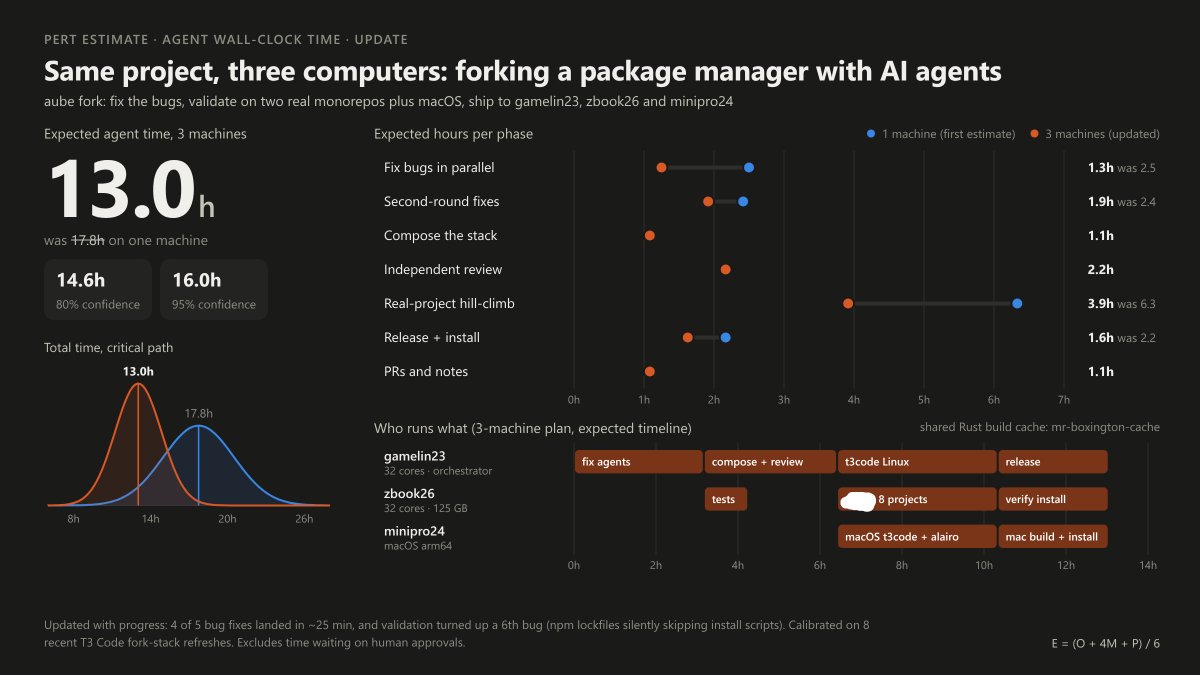
After seeing what @theo is doing for rust and tsc-rs, I’m curious about whether Opus can hill-climb efficiently on aube to get it compatible enough with pnpm 12 to build t3 code, and have aubeshim use it to finally replace all of {npm,pnpm,bun,yarn} on my system
Introducing tsrs: a Rust port of the TypeScript compiler 🦀
We are not forking TypeScript!
◆ In close collaborating with the TypeScript team
◆ Up to 8x faster than TS 7.0 & ~70% less memory
◆ Runs in WASM, so it works in your browser & on Workers
◆ Soon part of the Oxc toolchain
npx tsrs
https://t.co/qmmxF3YnQy
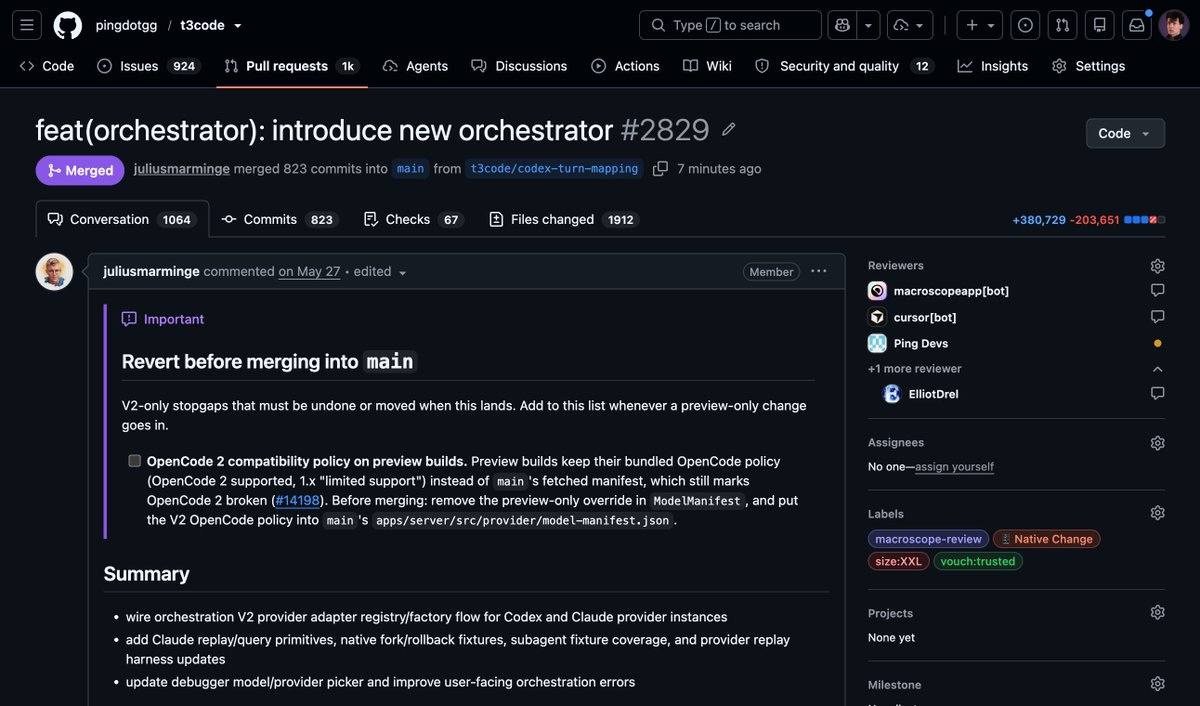
Orchestration in T3 Code v0.1.0 lets Claude, Codex, OpenCode, and Pi subagents work together in one thread. Here's what the latest @t3dotcodes release does and which parts I worked on:
https://t.co/sE5w4mA0NK
Orchestrator V2 is now out on the stable channel in @t3dotcodes! We also thought it was time we drop the Alpha branding, so we call this release 0.1.0 Beta.
Mobile store builds are also updated. Versions 2.0.0 are available to everyone on both App Store and the Play Store!
@dhh I'd love to see these available in the built-in package repository: docker-credential-pass-bin, helium-browser-bin (with Widevine enabled), k3s-bin, piavpn-bin, teams-for-linux-bin, zen-browser-bin. And maybe a ttf-ms-win11-* variant for games if licensing allows for it.
One of the more rewarding parts of working on aubeshim is being able to get aube working in projects that aren't using it at the moment, and identifying 28 different problems with repro cases that helped them get fixed.
aube has a very nice workflow where I can file discussions for a maintainer's agent to look at, and has been one of the easiest projects to contribute to.
https://t.co/NLUoDNiycX