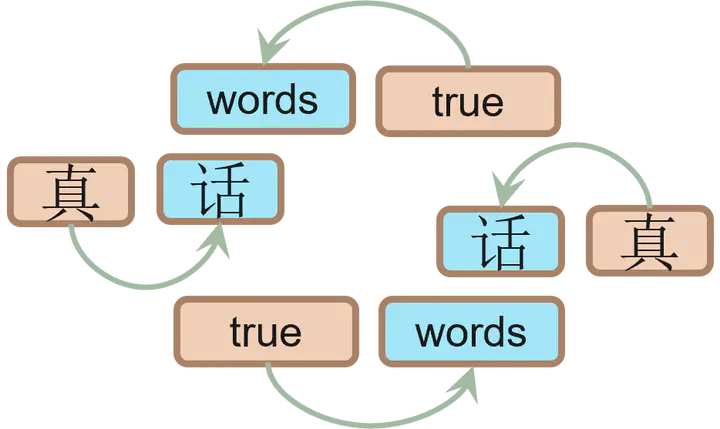
Ever tried to say the same words at the same time as someone else? In a Mandarin joint-reading study, speakers were surprisingly good at matching each other’s speaking pace—even when they normally spoke at different speeds.
@Tongrongtian@ThomasTalhelm But maybe there are costs to 被 over 把 if you need to abandon an agent-first interpretation (which many have proposed as a universal processing heuristic). It's an interesting possibility!
@Tongrongtian@ThomasTalhelm I think the P200 effect here is about the task demands in the experiment -- if we reversed the task to patient selection instead, I suspect we may get the effect in the opposite direction for 被 vs 把
The synergy of cognitive, affective, and sociocultural individual differences plays a crucial role in determining L2 Chinese speech performance.
#L2Chinese#L2speaking#IndividualDifference#Synergy
https://t.co/nJefJ7epOs
https://t.co/HCTJSvePM8
I have learned so much from this project and now dream about hungry apples with sharp teeth. Stay tuned for more results from Mandarin-English bilinguals!
Our brain data showed that implausible role reversal sentences like "child BA apple eats" elicited larger N400 amplitudes. We interpret this effect in relation to the extended Argument Dependency Model (eADM) and the Bag of Arguments model.
We further recommend that characterizing language-specific cue-weighting patterns requires considering interactions beyond a linear ranking of cue strength, alongside individual differences
Preprint from my PhD work about argument structure processing in Mandarin verb-final sentences! Take a look to find out how semantics and syntax compete to shape comprehension
https://t.co/aC6ntcJtp2
Our findings suggest that real-time argument assignment requires different brain activity for different languages, with an N400 response to Mandarin role reversals, in contrast to previous semantic P600 reports
come read about why Mandarin adjectives may be challenging for second language learners, with some extra juicy content on individual differences in N400 and P600 paterns!
https://t.co/nX4vIZn9lc
Happy to announce the preprint of the first paper from my PhD work! We used EEG to look at one of the coolest word classes--the adjective--and how native and non-native Mandarin processing was impacted by word order
https://t.co/nX4vIZn9lc
in our work, we replicated the English results and found a similar pattern for Mandarin native speakers. Butttt Mandarin non-native speakers showed a different pattern!😮😮😮