9 minutes of vigorous movement throughout the day is linked to a 40% drop in all-cause mortality
Sprinting up stairs, playing tag with your kids, walking briskly to the store... all of it counts
And the important part is: It adds up
The same pattern is associated with 50% lower cardiovascular mortality and 40% lower cancer mortality, even in people who don't consider themselves exercisers
We have big news to share:
Today the x402 foundation has officially merged the Pull Request to add a Cardano Specification of x402 into the repository.
This means Cardano is now officially an x402 chain.
And even better: They have also accepted the Masumi Smart Contract and potentially other Smart Contracts as an optional addition to the standard.
This now makes x402 on Cardano more powerful than x402 on most other chains because it supports:
1) Identity
2) Refunds & Disputes
3) Decision Logging
4) Registry
and more.
We want to give a big shoutout to Fabian from the Cardano Foundation who has spearheaded this 6+ month effort the whole way, improving the Pull Request & talking to Coinbase and the x402 Foundation.
Additionally we want to shoutout Karsten Siebert who has built the first x402 integration on Cardano and was vital in the discussions around the standard.
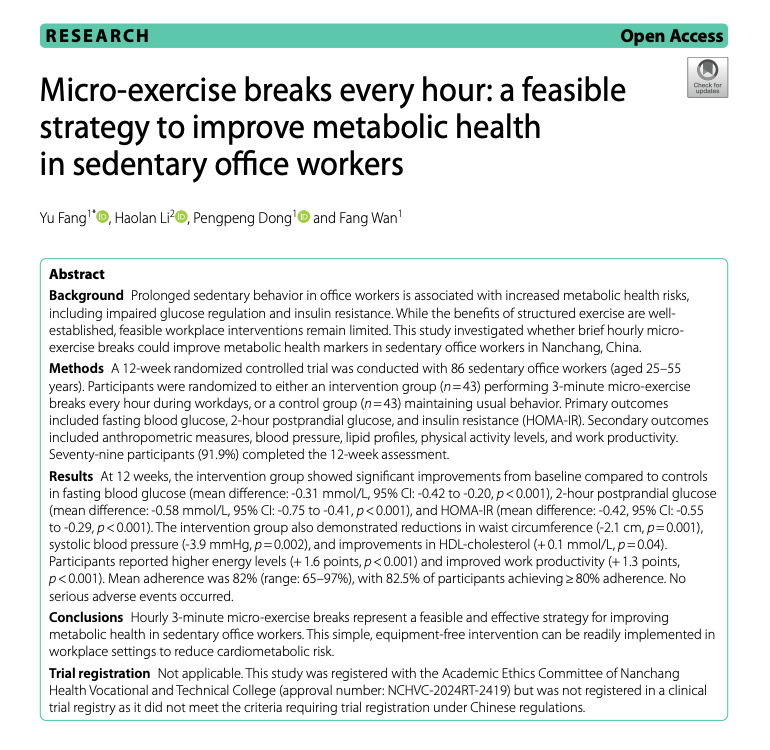
If you work at a desk, incorporating "micro-exercise breaks" into the day can greatly improve your metabolic health.
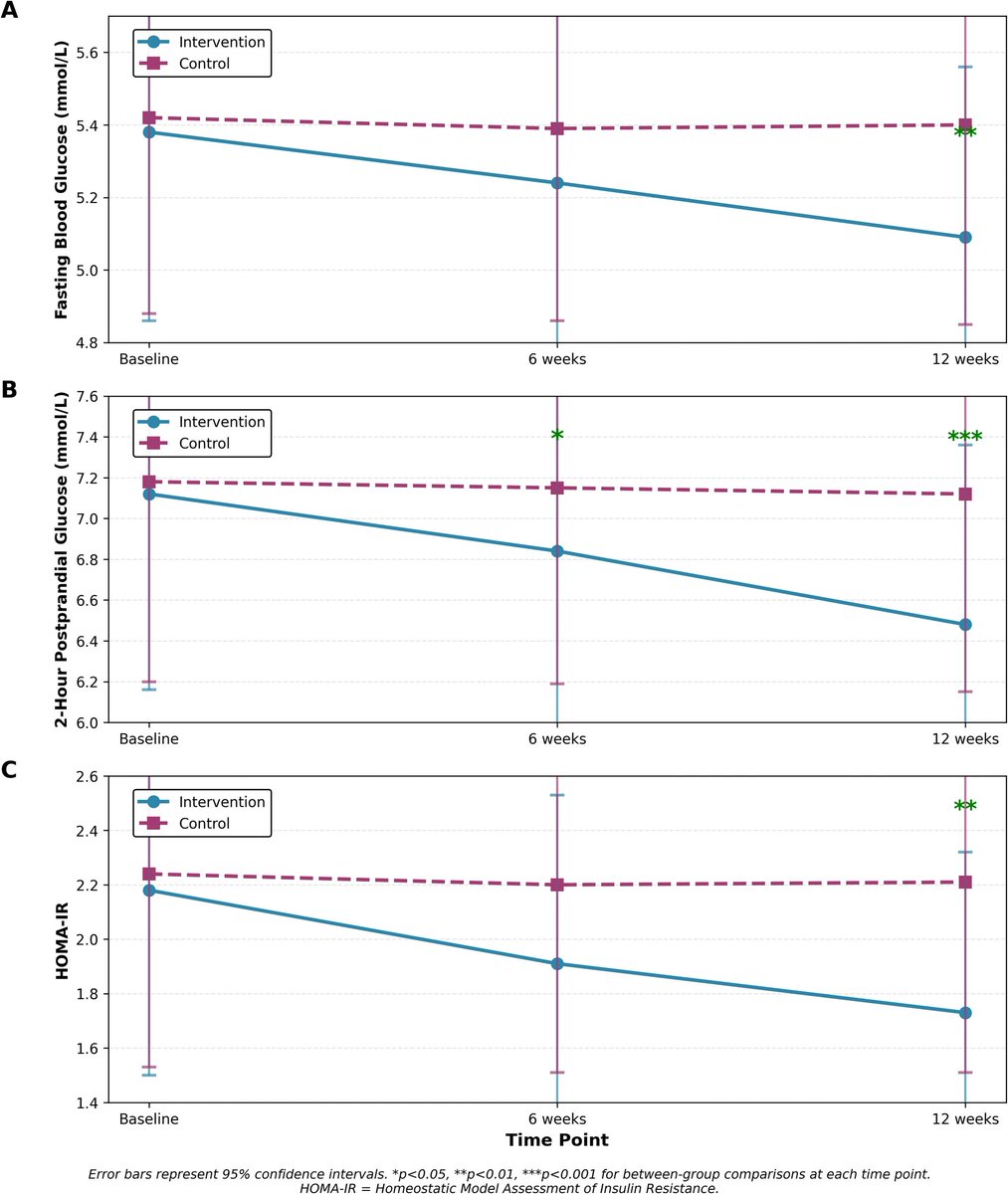
A 12-week study found that doing 3-minute exercise breaks every hour during the workday (e.g., marching in place, push-ups, squats, heel raises) improved fasting blood glucose, insulin sensitivity, and even waist circumference, blood pressure, and HDL cholesterol.
These metabolic benefits happen because muscle contraction stimulates insulin-independent glucose uptake. This is especially beneficial after meals.
Big upside for a low time and effort investment!
prediction re the end of spreadsheets
AI code gen means that anything that is currently modeled as a spreadsheet is better modeled in code. You get all the advantages of software - libraries, open source, AI, all the complexity and expressiveness.
think about what spreadsheets actually are: they're business logic that's trapped in a grid. Pricing models, financial forecasts, inventory trackers, marketing attribution - these are all fundamentally *programs* that we've been writing in the worst possible IDE. No version control, no testing, no modularity. Just a fragile web of cell references that breaks when someone inserts a row.
The only reason spreadsheets won is that the barrier to writing real software was too high. A finance analyst could learn =VLOOKUP in an afternoon but couldn't learn Python in a month. AI code gen flips that equation completely. Now the same analyst describes what they want in plain English, and gets a real application - with a database, a UI, error handling, the works. The marginal effort to go from "spreadsheet" to "software" just collapsed to near zero.
this is a massive unlock. There are ~1 billion spreadsheet users worldwide. Most of them are building janky software without realizing it. When even 10% of those use cases migrate to actual code, you get an explosion of new micro-applications that look nothing like traditional software. Internal tools that used to live in a shared Google Sheet now become real products. The "shadow IT" spreadsheet that runs half the company's operations finally gets proper infrastructure.
The interesting second-order effect: the spreadsheet was the great equalizer that let non-technical people build things. AI code gen is the *next* great equalizer, but the ceiling is 100x higher. We're about to see what happens when a billion knowledge workers can build real software.
David Sinclair: We’ll find out this year whether we can reverse aging.
The FDA cleared the first human trial tied to Sinclair’s age-reversal research, targeting age-related disease.
Effortful exercise improves cognition. It is brain and cognitive maintenance.
If I want an immediate boost in alertness, focus, and mental sharpness, I’ll do a short bout of vigorous exercise before a podcast or public speaking engagement. It’s the fastest, most reliable, and consistent way to flip the switch on short-term cognitive performance.
Study after study shows that even ~10 minutes of movement, especially at a higher intensity, can acutely enhance executive function, attention, and memory. It also tends to reduce anxiety and improve your ability to filter distractions, which is basically the cognitive state you want when you need to perform.
If you have an important presentation, an interview, or deep work that demands mental clarity, try a brief, intense session beforehand.
Clip from my recent appearance on the @PBDsPodcast.
Investigating the future of human–AI co-evolution. The interviews that informed my reporting on Michael Levin’s work at Tufts. Why the AI community needs to pay attention to this biologist @drmichaellevin
Some people say nanotechnology is not achievable. But it already exists - biology is nanotechnology.
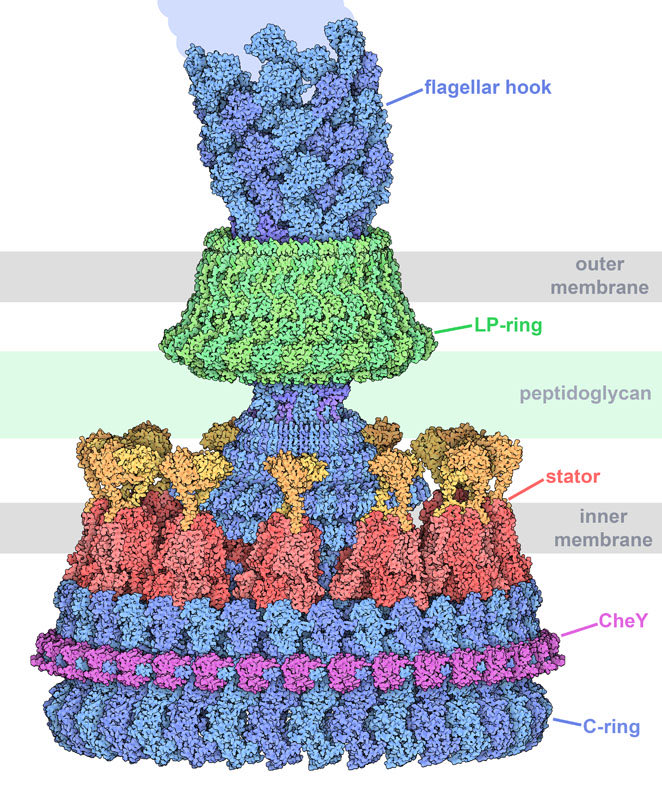
The bacterial flagellar motor is a perfect example. It’s a biological nanomachine, only a few dozen nanometers across, built from precisely arranged proteins that form a rotary engine.
It can spin at up to 100,000 revolutions per minute, powered by ion gradients across the bacterial membrane, just like an electric motor powered by voltage.
It even has equivalents of a rotor, stator, bearing, and drive shaft, all self assembled from molecular components.
With the help of AI, we’ll reach that level soon.
A novelty:
Researchers at UMass Amherst built the first artificial neuron that can “whisper” to real brain cells using the same tiny voltage as biological neurons (~0.1 V).
It uses protein nanowires from bacteria, stable in wet environments, allowing direct and low-power communication with living neurons.
This marks a step toward bio-electronic integration, not artificial consciousness, but a new bridge between silicon and the brain! Looks like Ray Kurzweil was right again.
🚨New Information on UFOs, Big Pharma & Human Experiments🚨
In this insane episode Brigham Buhler (@ferrisbuhler81) and I cover big Pharma’s insane history and how it overlaps with UFO secrecy:
1. Rockefeller → Flexner (1910): Rockefeller commissions a report that ensures total control over petrochemical based medicines. Natural/holistic medicinal schools and practices get wiped out. AMA/FDA power is locked in.
2. War Crimes to Pharma: Horrific Japanese Unit 731 human experimentation data immunized and absorbed post-WWII. Bayer’s Third Reich entanglements… then later payouts and scandals.
3. Agent Orange → Roundup: Monsanto’s evolution from wartime chemistry to a food system saturated with glyphosate. Court cases and controversy follows.
4. MK-Ultra never really ended: The CIA’s ORD (Office of Research and Development) picks up the torch. The Scientific Engineering Institute is privatized, becomes G.D. Searle (chaired by Donald Rumsfeld), then sold to Monsanto. Government black labs bleed into Big Pharma.
5. Follow the incentives: 2011–2019 saw 356 “blockbuster” drugs. According to Brigham, Big Pharma originated ~0–2 of them; taxpayers funded the rest before industry scooped them at Phase III.
6. Suppressed modalities: Red light, hyperbaric, EMF-based therapies, peptides, biologics—anything not easily patented or insurer-friendly gets sidelined.
7. DOE’s double life: The agency tied to UFO/nuclear stories also ran the Human Genome Project. If you’re looking for the nexus of biology and secrecy, start there.
If you’ve ever wondered how the UFO cover-up culture merged with healthcare capture, this episode connects the dots and provides the receipts.
Full episode live now!👇