"If the years of your life were interchangeable, then, yes, it might make sense to maximize your earnings early in life and spend that money on experiences in your old age. But the years of your life aren't interchangeable, and I would argue that your earliest years of adulthood are your most valuable.
You have your youth. You have optionality. You lack responsibilities. The world is, quite literally, yours for the taking. And do you realize how little money it takes to enjoy yourself in your twenties?
Given the time sensitivity of your youth, the worst mistake the twenty-something can make is spending their first decade of adulthood optimizing for money over everything just to realize, ten years too late, the nonfinancial costs of the memories not made along the way.
You have so much time to make money, but you have so little time to be young."
https://t.co/4IzhYuSgoU
Cavemen: hey wanna go grunting and stomping at the lake
Grug: no, Grug wants to draw caribou on cavern wall. Grug conveys tender feelings this way
Cavemen: (laughing) ok lol later man
(Archeologist thousands of years later) wow whoever drew this probably had no feelings at all
@stoopid_bich@casual_humanoid@BDoma@birch_js Their internal organization is nonsense. Highly secretive, so even minor things need to go high up the chain then back down to reach an adjacent team… yet high up execs have way too many direct reports… so effectively teams just waste time and money pounding sand.
Humans tried to tame horses 5,500 years ago. It didn't work. Those horses eventually went feral, and we had to start over 1,300 years later with a different bloodline.
A group in Kazakhstan called the Botai kept horses for milk and meat around 3500 BCE. A 2021 Nature study read the DNA of 273 ancient horses and proved every horse alive today comes from a different population entirely. The successful domestication happened 4,200 years ago near the Volga and Don rivers. Those horses spread across Asia and Europe in 500 years, wiping out every other horse bloodline.
Two tiny changes in horse DNA made it work. One mutation appeared about 5,000 years ago and made horses less jumpy. The other came 4,200 years ago and gave horses backs strong enough to carry a grown person; before that, they were the size of ponies. This is why chariots came first as the main use of horses, and regular horseback riding only became common centuries later.
Before rideable horses reached the Middle East, the Sumerians made their own by crossbreeding domesticated donkeys with wild onagers, a wild Asian cousin of the donkey. Onagers can hit 43 mph and hold 31 mph for hours, with more endurance than any modern racehorse. But they bite, kick, and can't be trained. So Sumerians made a hybrid called a kunga, which kept the speed and dropped the temper. A kunga cost 40 times a donkey. It couldn't breed, so every generation had to be made fresh. These pulled the war wagons shown on the Standard of Ur, a Sumerian mosaic from 2500 BCE. It's the first known case of humans creating a new animal.
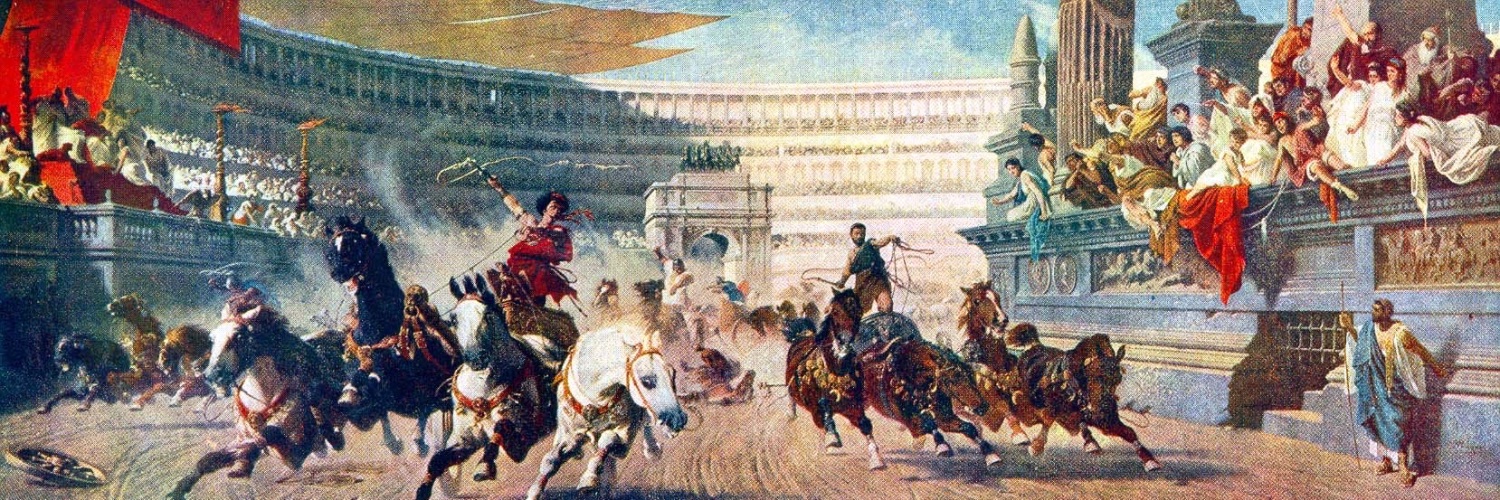
Zebras are the longest-running failure. Romans raced them in chariots during the emperor Caracalla's reign, around 200 AD. The Dutch tried in the 1700s. Walter Rothschild even drove a zebra carriage up to Buckingham Palace in the 1890s to prove the point. Germans gave it a shot in colonial East Africa. None of it worked. Zebras dodge lassos with a quick ducking reflex, have no hierarchy you can slot into, and have spent millions of years evolving alongside lions. A single kick can break a lion's jaw.
Jared Diamond ran the math on this. Out of roughly 148 large mammal species humans could have tamed, only 14 ever worked. The animal has to pass six separate tests: eat flexibly, grow fast, breed in a pen, stay calm, not spook easily, and follow a pack order. Miss one and the whole thing collapses.
The earliest confirmed horse riders were the Yamnaya, a nomadic steppe people from north of the Black Sea. They left behind skeletons showing the specific hip damage and healed fall injuries you see in modern riders. Out of 156 adult skeletons studied, only 24 had the pattern. Even inside a horse-riding culture, most people still walked.
Illustrations by C. F. Payne (2025-2026)
Payne depicts cows in the silhouette of US states, creating unique renderings that display a comical portrayal of what would otherwise be a straightforward animal portrait.
In 2010, a 20m long modern reconstruction of a Phoenician ship from 600 BC was used to circumnavigate Africa.
An account of the ancient circumnavigation of Africa is mentioned in Herodotus.
Thinking about doing an in-depth video on Kaluza-Klein, showing how the U(1) of electromagnetism can be thought of in terms of an extra, compactified, spatial dimension.
Long story short, general relativity in five dimensions naturally splits into gravity and electromagnetism in the 3+1 dimensions we’re familiar with.
While this model is simplified and thus doesn’t describe the real world, it explains why the idea of extra spatial dimensions, which I’m personally allergic to, is intriguing and must be taken seriously.
Would you be interested in this video?
(If not, what topic would you prefer?)
Make no mistake: post-Mythos, the United States has a licensing regime for AI. It’s just informal, with no consistent rules or firm boundaries on state power or public transparency. Cobalt mining in the Congo is vastly more institutionalized than frontier AI licensing in the US.