Coming off of psychiatric drugs after being on them for 25 years was one of the most brutal things I’ve ever had to do in my life, and I did it with little to no support.
I had the doctors treating me telling me my adverse reactions to the drugs were signs of my “mental illness” and that my withdrawal symptoms were signs that I needed the drugs.
I had friends and family be incredibly harsh with me, telling me I was being non-compliant and they believed if I didn’t like what a doctor told me I’d just stop doing what they recommended. (What I know now is that I knew deep down the drugs were harming me). I had a lot of people walk away from me, all while I was deeply suffering with withdrawal, intense akathisia, cognitive dissonance and total nervous system and brain fry.
Imagine going through what we know now is real—adverse side effects and withdrawal symptoms and everyone around you is giving you the side eye and turning their backs on you. Imagine a system using your pain and suffering against you for decades to diagnose and imprison you and then when you’re trying to crawl out of it, your support system throws you right back into the pit of being crazy, unstable and smearing you.
It was brutal.
But I survived.
I’m ten years off of all psych drugs and the relationship that I made during that time that was the most essential was the one I made with myself.
No more gaslighting, overriding my intuition or fawning just to avoid disappointing people or afraid of them not liking me.
It took the strength of an army and i cultivated that strength inside myself with my connection to God.
Most didn’t believe me or walked away from me—that’s ok, because I proved them all wrong and proved my resiliency to the only person that mattered—me.
If you’re in this place, the only thing I can tell you is to dig deep and keep going.
Richard Horton, editor-in-chief of The Lancet, concluded that medical journals had “devolved into information-laundering operations for the pharmaceutical industry.”
This statement comes from his March 2004 New York Review of Books essay “The Dawn of McScience.” He described how companies sponsor meetings, pay speakers, have communications firms turn the talks into articles (often with minimal or no peer review), and then pay publishers large sums to run them as journal supplements. The result, he argued, is marketing dressed up as science that seeds the literature with weaker evidence used to promote products.
Around the same period, in written and oral evidence to the UK House of Commons Health Select Committee (2004–2005), Horton described the journal–industry relationship as “somewhere between symbiotic and parasitic,” noting that it had swung too far toward the parasitic side. He highlighted financial pressures (e.g., companies promising large reprint orders if a favorable paper is published, or threatening to pull papers if criticism is not softened) and listed roughly 10 distorting practices, including:
• Manipulation or selective reporting of findings
• Bias toward positive results in industry-sponsored studies
• Hiding negative or adverse data
• Ghostwriting
• Lightly peer-reviewed supplements used for marketing
• Undisclosed conflicts of interest
He stated that commercial sponsorship of research and its intrusion into academia represented “one of the gravest threats to the independent evaluation of new medicines—indeed to the notion of an independent science base,” and that the for-profit motive of the sector clashes with public-health values and independent scientific research.
In a 2013 Lancet piece (“Falling out with pharma”), Horton withdrew the journal’s support from industry-linked guidance on doctor–pharma collaboration, saying the document’s claims did not match the evidence on company behavior regarding transparency, medical education, and prescribing influence.
His better-known 2015 editorial (“Offline: What is medicine’s 5 sigma?”) was broader—arguing that “much of the scientific literature, perhaps half, may simply be untrue” due to small samples, invalid analyses, tiny effects, and “flagrant conflicts of interest”—but conflicts of interest (often industry-related) were explicitly part of that critique.
These statements reflect Horton’s long-standing concerns about industry influence on the medical evidence base rather than a single one-off finding.
When the body is at its weakest, supplying no strength, but only betrayal and even torment - is precisely when the soul can grow stronger than ever before.
How many people are overweight and suffering metabolic dysfunction because of prescription drugs? Combine that with processed foods and low activity, and that’s 3 strikes against your health
“Roam through the streets of Jerusalem, look around and take careful note; search through the public squares. If you can find even one person who acts justly and seeks the truth, I will pardon this city.”
Jeremiah 5:1
i am 42 years old.
i spend my days trapped in my childhood bedroom, burning alive from severe #akathisia. my elderly mother takes care of me.
i used to manage a bank. i used to implement advertising campaigns. i was building a life.
now, my only job is surviving the next minutes of chemical torture.
medicine and psychiatry didn't just take my health. it deleted my adulthood.
#prescribedharm #benzowithdrawal #medicalgaslighting
I don't agree with everything RFK Jr says but I think the mainstream media owe him an apology on this account. I have had many patients say that they found coming off antidepressants harder than coming off heroin. And now there is large-scale data to back up those anecdotes.
This of course is distinct from addiction. The pre-requisite for withdrawal is physical dependence which is a predictable physiological response that is the consequence of adaptation to a drug. Physical dependence does not involve compulsion, craving, etc.
Opioids cause addiction because of their reinforcing euphoria which antidepressants do not do. But they are both cause physical dependence and evidently comparable levels of withdrawal for the higher risk antidepressants.
"Anyone selling you anything better than ‘highly imperfect’ in the realm of mental healthcare is a fool or a grifter."
Excellent piece by Awais about our need for humility when faced with the complexity of human suffering.
Big Short investor Steve Eisman says the AI labs know they have no moats and are manufacturing a crisis to get regulation that hands them a duopoly
"I think this is all nonsense."
[ You think it's all nonsense? ]
"All nonsense. I think that there's something else completely going on here. ... What I think is happening is that token maxing is over. The open weight models are taking big market share. I think these companies are very nervous. They realize that there are no moats around their business whatsoever, and they're trying to manufacture a crisis that will create regulation, and that they think they can then manipulate to create the moats, to create the duopoly that they want."
[ Wow. ]
"That's what I think is going on."
"Honestly, I think this whole Terminator thing is garbage. That's for sure."
Let that sink in. Akathisia is the worst condition imaginable, and the only way to get it is via a doctor and prescribed medication. Isn't that the true definition of insane?
Major release!
=--=--=--=--=
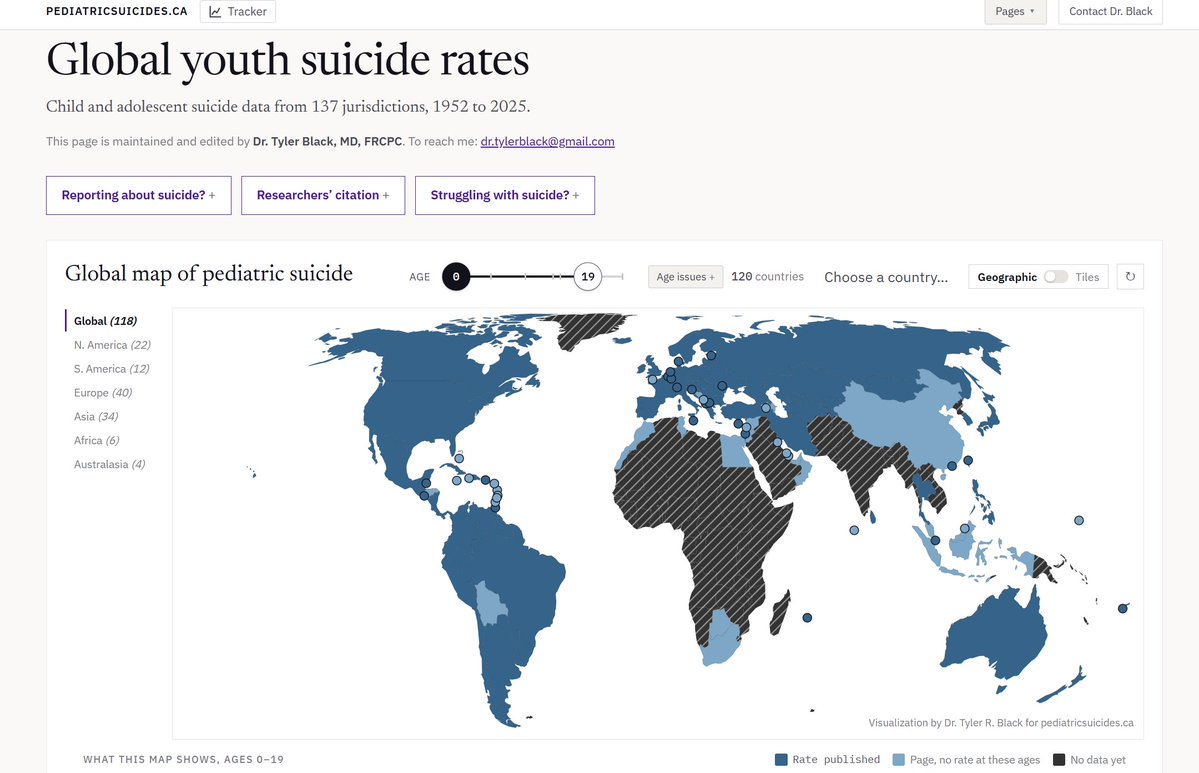
I have compiled the worlds largest database of pediatric suicide information, consisting of 137 countries, from 1952-2025. In total, 27.64 BILLION person-years of data are represented.
/1
I resigned from Anthropic today. I spent the last three years doing pretraining research at both OpenAI and Anthropic. Neither company is acting responsibly. They are racing straight to self-improving superintelligence and gambling with our lives. More thoughts below.
Coercive Practices in Psychiatry Are Being Systematically Underreported, Study Suggests
By Richard Sears
A global survey of mental-health professionals reveals substantial gaps between the use, recognition and reporting of coercive practices.
https://t.co/6dujyZBdSA
Correct, I ultimately said no and fortunately that was respected (though I wasn’t entirely sure if they were going to for a little while). My belief was my best chance to recover was to give my body more time to rest without further chemical or physical disruption. It was hell but I made it.
Technically maybe. But I was in the psych hospital on a 5150 (my only hospitalization for anything ever), so they had me in a vulnerable spot. It was pretty pressured, and I was clearly doing very badly…hadn’t slept in a week, lots of physical symptoms. My now ex-wife also was pushing me to do it, and my release was dependent on the on-duty hospital psychiatrist.
The most nefarious act I have ever seen in psychiatry was done to a psychiatric nurse. She was a union shop steward. She had organized a rally and was planning a nurse strike for more pay. She worked on the ward that I was an intern psychologist on. I said goodbye to her on a Friday and when I came to work on the Monday, she had become a patient on the ward that she worked on. She was put on an extremely high dose of the antipsychotic Haldol. It has terrible side effects like akathisia, a restless, agitated feeling and it can cause hallucinations (it's listed as a side effect).
She was transferred that same morning to another hospital. The strike of the nurses did not happen.
Later that day I saw the Head of Psychiatry walking with the CEO of the Hospital he had an unmistakable smirk on his face.