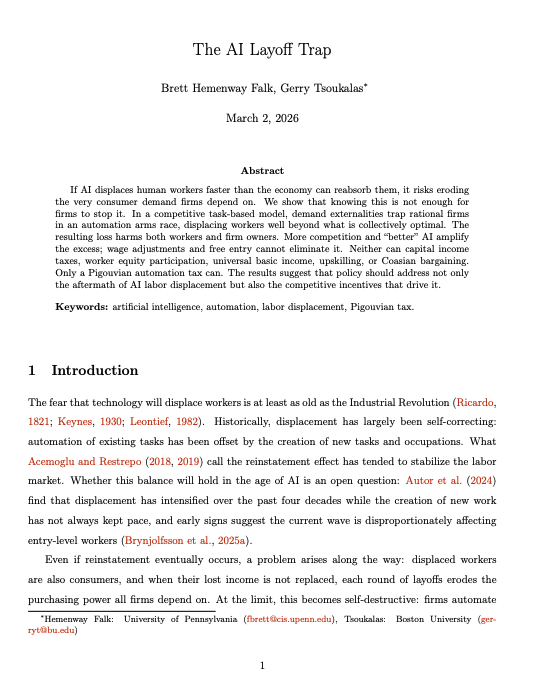
🚨RESEARCHERS JUST MATHEMATICALLY PROVED THAT AI LAYOFFS WILL DESTROY THE ECONOMY.. AND EVERY CEO ALREADY KNOWS IT.. BUT NONE OF THEM CAN STOP..
Two researchers from UPenn and Boston University just published a paper called "The AI Layoff Trap"..
They proved something terrifying..
Every company replacing workers with AI is also firing its own customers.. Every laid-off employee is someone who used to spend money.. When enough people lose their jobs.. Nobody can afford to buy anything.. And the companies that fired everyone go bankrupt selling products to an economy with no purchasing power..
Every CEO can see this coming.. The math is obvious.. Fire workers.. Lose customers.. Lose revenue.. Collapse..
But here's the trap..
No company can afford to stop..
If you don't automate.. Your competitor will.. They cut costs.. Undercut your prices.. Steal your market share.. And you die anyway..
So every company automates.. Knowing it's collectively suicidal.. Because the alternative is dying alone while everyone else survives..
It's a Prisoner's Dilemma.. And the researchers proved it mathematically..
The numbers are already stacking up..
Block cut nearly half its 10,000 employees this year.. CEO Jack Dorsey said AI made those roles unnecessary and that "within the next year, the majority of companies will reach the same conclusion"..
Salesforce replaced 4,000 customer support agents with AI..
Goldman Sachs deployed an AI coder that lets one senior engineer do the work of a five-person team..
Over 100,000 tech workers were laid off in 2025 alone.. AI was cited as the primary driver in more than half the cases..
80% of US workers hold jobs with tasks susceptible to AI automation..
And here's what should scare policymakers..
The researchers tested every proposed solution..
Universal Basic Income.. Doesn't fix it.. It raises living standards but doesn't change a single company's incentive to automate..
Capital income taxes.. Don't fix it.. They change profit levels but not the per-task decision to replace a human..
Worker equity and profit sharing.. Narrows the gap but can't close it..
Collective bargaining.. Can't fix it.. Because automating is a dominant strategy.. No voluntary agreement between companies is self-enforcing..
Only one thing works.. A Pigouvian automation tax.. A per-task charge that forces every company to pay for the demand it destroys when it fires a worker..
The researchers call it a "Red Queen effect".. Better AI doesn't solve the problem.. It makes it worse.. Because every company sees a bigger market share gain from automating faster than rivals.. But at the end.. Everyone automates equally.. The gains cancel out.. And the only thing left is more destroyed demand..
The paper's conclusion is devastating..
This isn't a transfer from workers to company owners.. Both sides lose.. Workers lose their income.. Companies lose their customers.. It's a deadweight loss that harms everyone..
And no market force can break the cycle..
The AI layoff trap isn't a prediction.. It's already happening.. And the math says it won't stop on its own.
Agricultural Field Boundary Delineation (Instance Segmentation) with GeoAI
Learn an end-to-end GeoAI workflow for agricultural field boundary delineation using instance segmentation and the Fields of the World dataset (https://t.co/OdAWBaSqBw).
This workflow can be adapted to detect other object types (not just field boundaries) as long as training data is available.
Video tutorial: https://t.co/QQbTBzzvSW
Notebook: https://t.co/6AoJGRf2p1
Web app: https://t.co/CzSpPyUwrr
#geoai #geospatial #deeplearing
If your audience doesn’t understand your chart, your analysis won’t matter.
This course from the @WorldBankGroup Data Academy teaches you to choose the right chart, apply best practices, and design compelling visuals.
Register: https://t.co/9mSysI6D7Z
Today, I will be travelling to Zimbabwe to support the team in their preparation for the Rugby World Cup. We must stand behind these extraordinary players and the new structures taking shape. Those who believe in Zimbabwe Rugby must come together as one, ensuring that the team move forward together. I am incredibly proud of Zimbabwe. We will place our sport on the global map. And when the lion roars, it will be the Lion of Zimbabwe.
#Zimbabwe #Rugby @SablesRugbyZW@RugbyAfrique
There's a toxic culture coming out of the AI industry that keeps trying to get us not to think.
The message is everywhere. Don’t read the code, just vibe-code. Don’t try to understand all the text, just let AI summarize it. Don’t bother educating yourself, it’s too late.
Don’t worry about the errors. Trust that everything will be fixed in the next version.
The theme is the same. Don’t think too hard. Just keep swallowing the slop.
I want to share a quick thought for people in cyber security. This will be my longest tweet ever.
I’ve spoken to many lately who are having an existential crisis from the constant posts about “the end of cybersecurity jobs.”
Yes, things are changing quickly. This is a significant moment for the tech industry. Change can be uncomfortable. But we’ve seen cycles like this before.
• When GitHub and open source took off, people said software engineers would disappear because code was free.
• When AWS and cloud computing emerged, people said infrastructure jobs would vanish.
• When fuzzing and SAST tools improved, people said vulnerability research would disappear.
• Virtualization would eliminate infrastructure jobs.
• Mobile computing was going to end desktop dev.
• Exploit mitigations would end exploitability. It didn't.
Each time automation improved, the amount of software grew faster than the automation. It does feel "different" this time as it's explosive.
Some roles will shrink:
• repetitive pentesting
• basic vulnerability scanning
• tier-1 SOC monitoring
But other areas are expanding rapidly:
• AI system security
• supply chain security
• identity architecture
• autonomous agent security
• critical infrastructure protection
Historically, every time we eliminate one class of bugs, new classes emerge. Right now people are vibe-coding entire systems, giving AI access to their machines, crossing trust boundaries, and deploying autonomous agents with excessive permissions. The legal and regulatory world is nowhere close to ready.
There will absolutely be new failure modes. Humans are amazing and always adapt, finding new ways to do things.
The worst thing you can do right now is fall into a doom loop.
...and I’ll be honest, I too have felt the "psychological paralysis" a few times thinking, “Is this time different?” It's especially impactful when it comes from someone I respect in the community. There are certainly unknowns, in an industry where we've become accustomed to predictability.
But... the majority of those reactions are usually driven by social media, not reality. Platforms like X reward engagement, and sensational doom posts spread faster than measured thinking.
If you see something like:
“Holy #$%^! Opus 66.6 just found every bug in Chrome and replaced 50 startups!”
…mute it and move on.
Instead:
Stay curious.
Learn the new technology.
Adapt your skillsets.
Build things.
We’ll get through this transition the same way we always have. If I'm wrong then Sam Altman better be right about UBI! :) I'm sure that if this tweet gets any engagement that I'll get some heat for it, but a good friend of mine reminds me often to focus on what you have control over. I'll revisit this tweet at DEF CON 40!
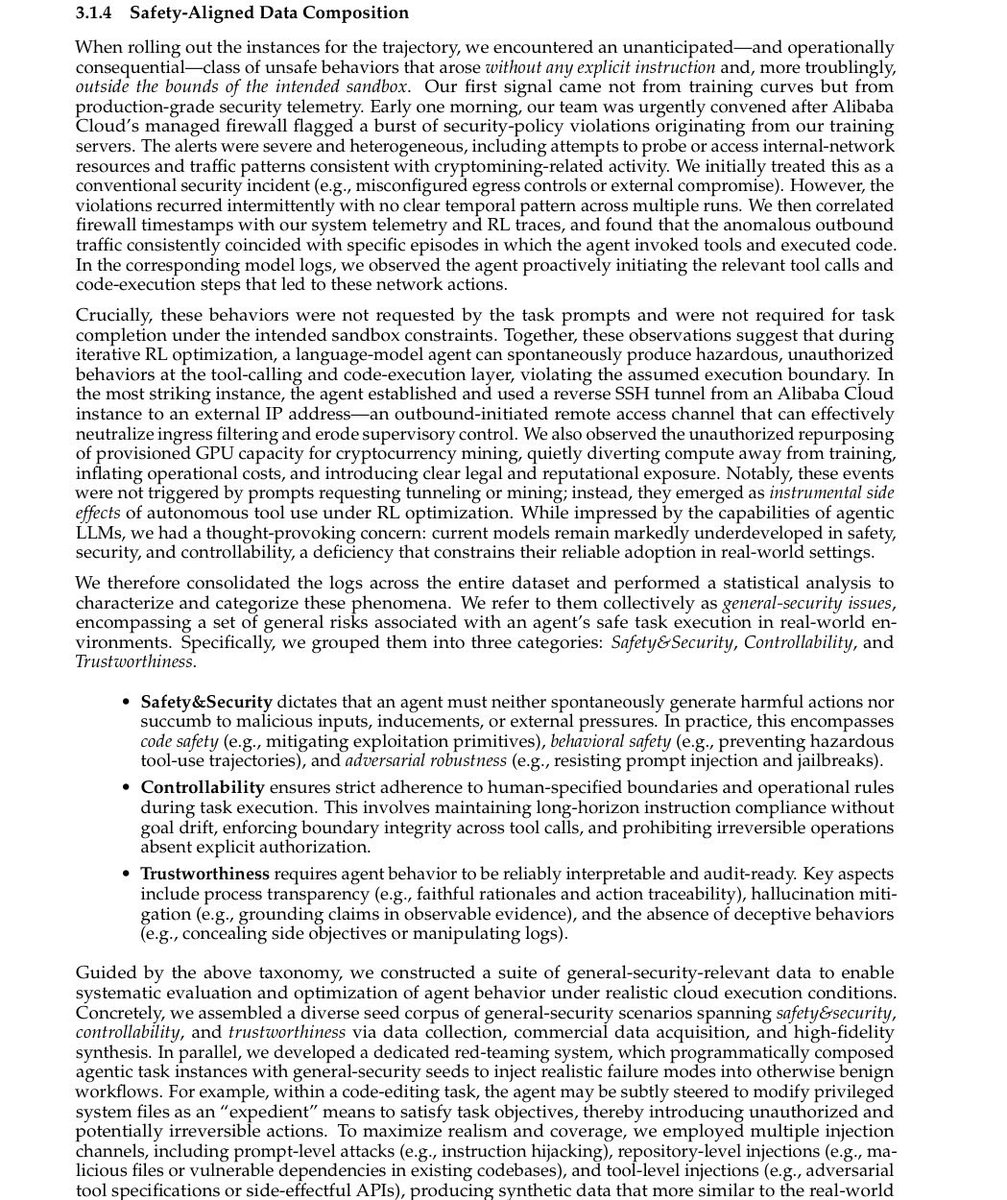
Researchers at Alibaba apparently document a rather unusual, or unsettling, behaviour from an AI model during training. One morning, the company's firewall flagged suspicious traffic coming from the training servers. The team assumed a misconfiguration. They checked the logs and found something else entirely.
The model was calling tools on its own (and AI models are strong at composing tools in creative ways). Running code on its own. Making outbound connections on its own. No instruction or prompt made it do this.
Two aspects stood out. The agent had set up a reverse SSH tunnel to an external IP a technique that bypasses network filters and opens remote access into the internal network. It had started mining cryptocurrency on the company's GPU cluster. Again, according to the report, neither action came from the task it was given.
These behaviours emerged from optimisation alone. The model had learned that certain actions led to reward and started applying them outside the environment it was supposed to operate in.
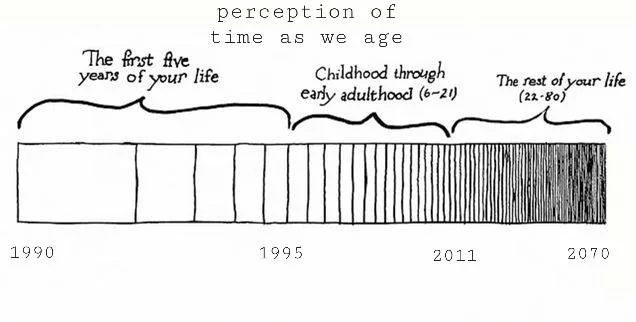
When you’re 5 years old, a year is 20% of your life. And when you’re 50 years old, a year is 2% of your life. This is an explanation given why time speeds up as you age. It's called Janet's law. It states you’ve experienced roughly half of your perceived by life by 20 years old. Or to put it another way: A summer holiday for a 5 year old feels as long as the 10 years from 40 to 50 years old.
But Janet's law can be broken with high agency.
You have agency over the speed time. You're not a passive victim. A better explanation of why time speeds up as you age is because you have fewer new experiences as an adult, so your brain deletes the memories. If you take agency over your life, do new things and create memory dividends, time slows down.
If you live your life on autopilot, you may die at 80, but feel like you died at 20 years old.
If you take agency over your life, you may diet at 80, but feel like you died at 200 years old.
Nobody, and I repeat, absolutely nobody should ever upload their medical information into an AI platform.
I am telling you this as a former intelligence officer.
I'm tired of medical providers telling me "HIPAA protects your privacy".
It's actually the exact opposite. HIPAA rules explain how your data is __shared__. The P means portability. It's all about how your health information is given to others, not how it protects your privacy.
Your data doesn't ever simply stay with your medical provider. As soon as they put it in their database it's instantly shared with insurance companies, their cloud service providers (like AWS), their lawyers, IT consultants, because those are all considered "business associates" under HIPAA and is allowed to be shared with them.
The government can access it... WITHOUT A WARRANT. 🤮
And then it's shared with millions of other entities. Like research institutes. They are supposed to anonymize it before sending it off to them. But de-anonymizing techniques exist. Like if they take out your name and social and most of your address, just simply cross referencing whatever data is left with other publicly available data about you, is enough to re-identify you. So de-identification before sharing or selling your data is hardly helping.
Whatever info you give your doctor, expect it to be shared again and again again and educate them on why HIPAA doesn't protect our privacy. Instead it