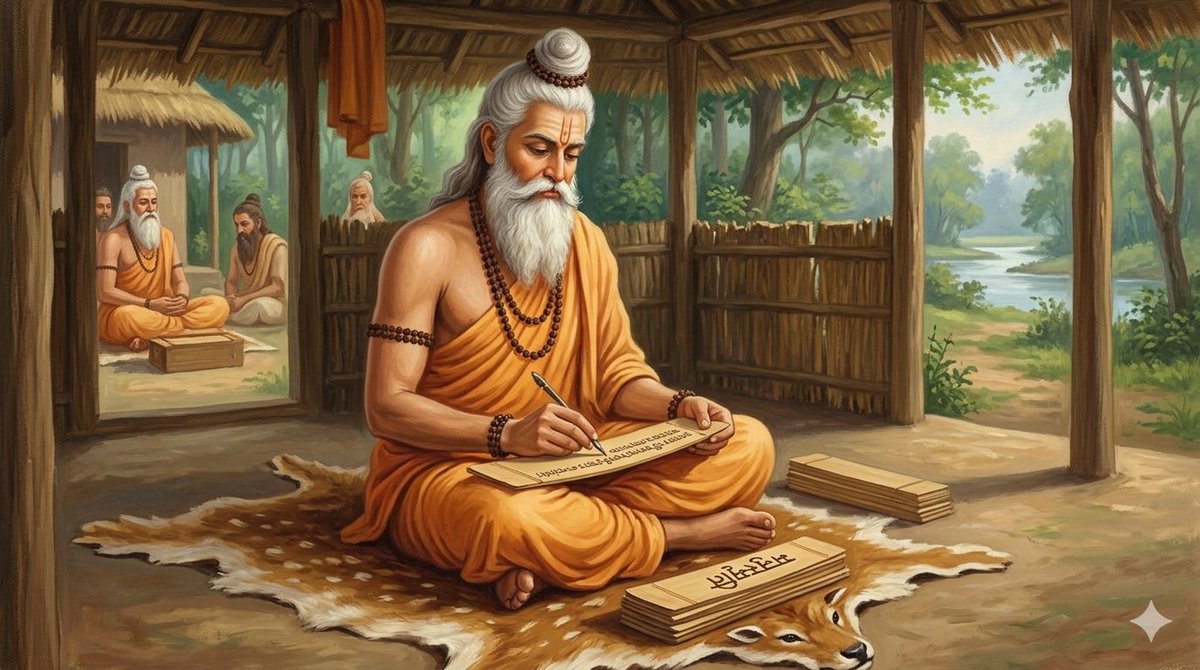
🧵 Kampaṉ: Introduction to Irāmāvatāram, the Tamil Rāmāyaṇa
From the Caṅkam period anthologies and idylls, it took twelve hundred years to separate the Kuṟuntokai from the Irāmāvatāram. In that interval, Tamil land produced the Tirukkuṟaḷ, the twin epics Cilappatikāram and Maṇimēkalai, the devotional outpourings of the Śaiva Nāyaṉārs and Vaiṣṇava Āḻvārs, and the prosodic refinements of the Yāpparuṅkalakkārikai.
None of them abandoned the Caṅkam apparatus. They modulated it, layered it, recombined it, but the tiṇai system, uḷḷuṟai uvamam (உள்ளுறை உவமம்), the choreography of nature-detail and emotional content, persisted as the deep grammar of the language's literary imagination.
By Kampaṉ's century, Vaiṣṇava devotion had filled the mullai landscape with Tirumāl's pasture-fields and the kuṟiñci mountains with his lover-god temperament. The descriptions of Sītā as a kuṟiñci heroine, of Daśaratha's Ayōttiyā as a fertile marutam capital, of the Daṇḍaka forest as a pālai country darkening into hostility, these are not Kampaṉ's inventions. They are Kampaṉ's placements of his characters into landscapes that the Tamil ear already knew how to read.
Kampaṉ, writing in Tamil, has inherited a poetic system in which landscape is feeling, and he used it. Vālmīki had to describe his characters' interiors, while Kampaṉ just let the karu-poruḷ (கருப்பொருள்) of tiṇai system describe them for him.
This will be an active thread with more stanzas from Irāmāvatāram with details, Kampaṉ's Rāmāyaṇa!
The question of when, where, and how the chicken became a domestic animal, and what role the Indus Valley played in that story, is not addressed in Vedic literature until a later period.
For most of the twentieth century, it was believed that the chicken/rooster was first domesticated in the Indus Valley around 2500–2100 BCE.
This view rests largely on Frederick Zeuner's A History of Domesticated Animals (1963) and on the original excavation reports from Mohenjo-daro and Harappa.
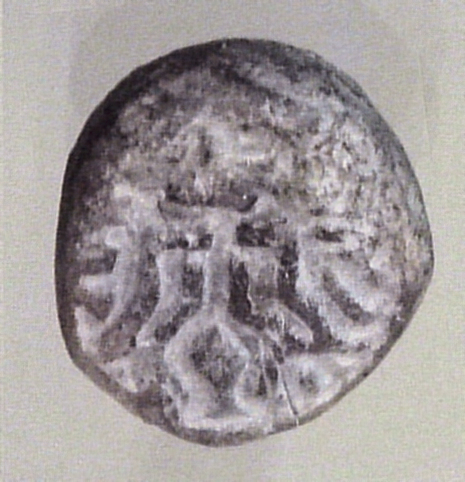
The supporting evidence consisted of a small number of bird bones from Harappa and Mohenjo-daro, plus an incomplete hen figurine from Mohenjo-daro. An intriguing interpretation by the epigraphist Iravatham Mahadevan, based on a Mohenjo-daro seal, speculated that the city's ancient name could have been Kukkuṭārma, the city of the cockerel.
Some seals from the Indus Valley Civilization (IVC) depict bird-like figures, and scholars have long argued that cockfighting and ritual fowl-keeping were Indus practices.
Bengali, Odia, Assamese, and Maithili Brahmin communities are famously fond of fish, but historically considered chicken and eggs taboo. The same pattern shows up among many Kashmiri Pandits and some other northern Brahmin communities.
So this doesn't seem like a vegetarian thing but a chicken-specific thing.
🧵Question of Chicken Taboo
Ṛgveda mentions many birds, śyena (eagle), mayūra (peacock), various waterfowl, the partridge (tittiri), and so on, but the domestic fowl is absent.
Many animal names that become prominent in the later Yajurveda and Atharvaveda are śārdūla (tiger), khaḍga (rhinoceros), kūrma (tortoise), nakula (mongoose), jāhakā (hedgehog), and śalyaka (porcupine), among others, appear only in those later strata.
The chicken/rooster is part of this same pattern of late emergence - it was not a Ṛgvedic bird.
Things begin to change, starting with the Atharvaveda, which mentions a wider range of village animals than the Ṛgveda, and references to the rooster whose dawn-crow had obvious magical associations begin to appear, though sparsely.
Interestingly, the Egyptian sky cow goddess, Nut, Hathor (and related earlier Mehet-Weret) is shown with 5-pointed star signs all over her body.
https://t.co/5VqLTo2OY7
https://t.co/AIGxbOmnqZ
https://t.co/xt2f17aJFK
https://t.co/sJ8akGqiVk
https://t.co/KkPPtRf3nI
The 5-pointed star sign found on the bodies and garments of Egyptian deities like the sky goddess Nut and the cosmic mother Hathor is called a Seba (hieroglyph: 𓇼)
The Book of the Heavenly Cow: Found in the tombs of New Kingdom pharaohs (such as Tutankhamun, Seti I, and Ramesses III), this sacred text features a famous full-page vignette of the divine cow Mehet-Weret (a manifestation of Hathor/Nut). Her body is propped up by the air god Shu and flanked by Heh deities, and her entire flank is patterned with rows of crisp, 5-pointed Seba stars.
Later on, the star signs on the sky cow changes to terfoil design. Tutankhamun's Funerary Ritual Couch: Among the treasures emerging from Tutankhamun's tomb was a gilded wood ritual couch shaped like the Hathor cow. The sides and body of the gilded cow are inlaid with dark, stylized spots and geometric trefoil patterns specifically meant to mirror the constellation maps and Seba motifs found on temple ceilings.
https://t.co/2L27ELeS5x
https://t.co/1bLv53fqZx
The trefoils on the sky cow shown on Tutankhamun's Funerary Ritual couch is derived from Mesopotamia where trefoil design on sky cows and those with male head are found 1500 years earlier. These statues are decorated with lapis lazuli stone of Afghanistan in Mesopotamia which Harappans of Meluhha gave the gemstone as well as a symbol of the god of Death to Sumerians.
There is Sasanian silver plate with Bel/Bilva trefoils on a leopard, and Bodhi fig tree sharp-tipped leaves. Both trees are not native to ANE. seems to represent ancient 5000 years of contact between IVC and ANE. will explain the Goddess symbolism associated.
The trefoil design found on sky-cows link the three ancient Bronze age civilizations: Harappan, Mesopotamia and Egypt. Trefoil design comes from the leaf shape of Vilvam/Bael tree which has a Dravidian etymology (Tamil veLLil, viLaa, veLavu (> beLavu in Kannada). Ref.: A. Parpola, Deciphering the Indus script. Sumeria got the trefoil designs associated with god of Death from Harappans. There are Linga base stones with trefoil design and also sky-cow bodies. There is a small Linga excavated at Kalibangan. M. S. Vats excavated a large Linga in front of which there is Swastika brick structure at Harappa. In South India, Megalithic tombs are made in Swastika shape. All these show clearly the Linga (phallic) worship from Harappan times is associated with the god of death, the Pole Star inside of a crocodile (Draconis). Rgveda tells about people worshipping Linga (Sisnadeva). Vilva/bael leaves are the most important part of Linga worship in Hinduism (e.g., Kashi, Madurai, Ramesvaram) even today.
Further research on trefoil design, vilva leaf source, Linga worship, IVC, trefoil spread to ANE, Swastika (funeral sites) and Linga, etc., can be undertaken.
~NG
@tsssubbu@Anand_Venkatram@naavalam@marthandavelan@tapeshyadav_usa@monidipadey@MumukshuSavitri@veludharan@ChithraMadhavan@Saatvata@Param_Chaitanya@avzaagzonunaada
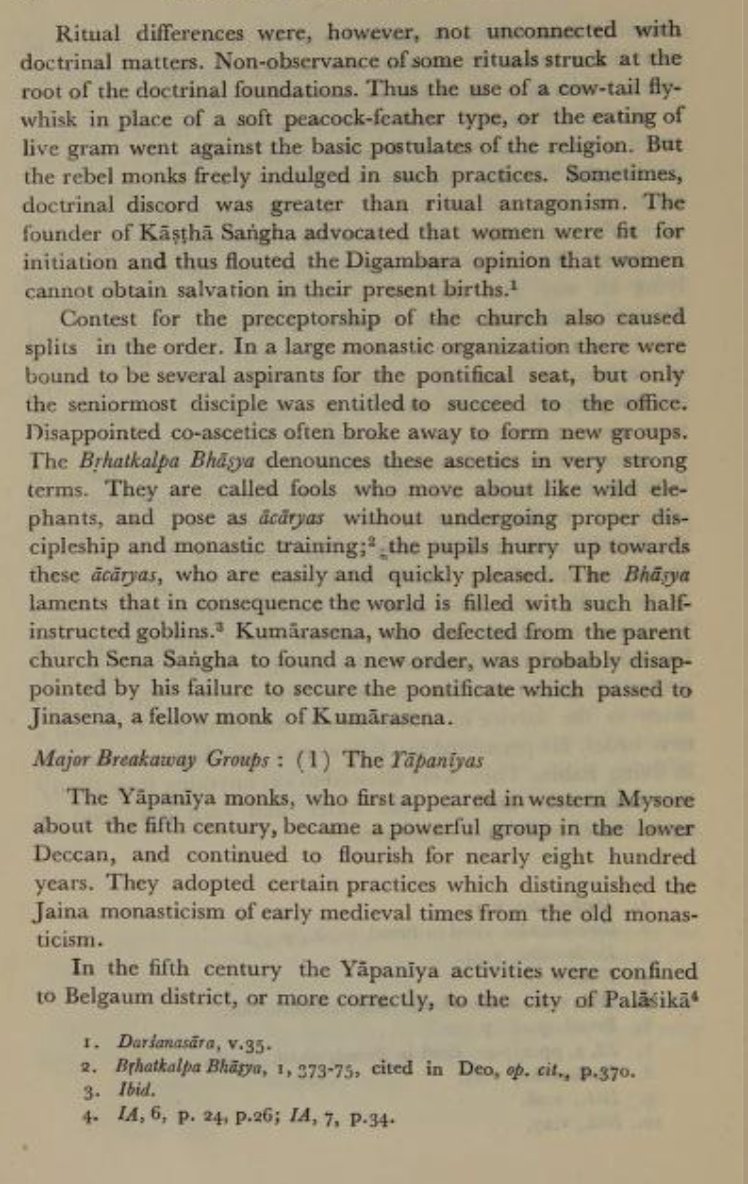
@marthandavelan Some references to the revolting practices, from Religious institutions and cults in the Deccan, c. A.D. 600-A.D. 1000 by Ramendra Nath Nandi.
Drāviḍa Saṅgha, a Digambara monastic order traditionally founded at Madurai by the monk Vajranandi, which provides the precise Tamil Jain milieu within which a learned Jain intellectual could have composed the Kuṟaḷ.
Devasena's Darśanasāra, the earliest systematic history of the Digambara sect, records that Vajranandi, the pupil of the celebrated Ācārya Pūjyapāda, the great grammarian-philosopher who authored the Jainendra Vyākaraṇa and the Sarvārthasiddhi commentary on the Tattvārtha Sūtra, founded the Drāviḍa Saṅgha at Madurai in the south.
According to the text, conventionally rendered as c. 469–470 CE, it claimed affiliation with the Kundakundānvaya lineage, the prestigious spiritual descent from Ācārya Kundakunda (c. 2nd–3rd CE), within the larger Nandi Saṅgha.
//There's chances that the author wrote work as an independent thinker, deriving from multiple of dharmik traditions.// - Exactly.
My position from the article: Vaḷḷuvar's eclecticism, then, is not the dilution of his Jain base; it is the manifestation of a Tamil cultural confidence that ethical truth belongs to all who can recognize it. He drew freely from Arthaśāstra statecraft, from Sanskrit nīti aphorism, from Sāṃkhya-Jain-Buddhist-Vedānta language of liberation-through-knowledge, from the pan-Indian trivarga organization, and from the deepest Tamil substrate of aṇaṅku (sacred power), kaṟpu (chastity), uyir (the life-soul whose protection is the root of virtue), and the akam grammar of voiced human experience. He did not synthesize these; he selected from them, transformed them, and let them speak in a Tamil register that belonged to no sect and to every human being.
If naming Viṣṇu and Indra makes the Kuṟaḷ a Hindu text, then by the same standard, Cilappatikāram, by Iḷaṅkō Aṭikaḷ, a Jain ascetic, is a Hindu text.
It invokes Tirumāl, Śiva, Indra, Kāḷi, Aiyaṉār, and the goddess Pattiṉi across its three cantos. No serious reader has ever called it sectarian Hinduism.
Kural 25 directly refers to "Indra".
ஐந்தவித்தான் ஆற்றல் அகல்விசும்பு ளார்கோமான்
இந்திரனே சாலுங் கரி.
Kural 610:
மடியிலா மன்னவன் எய்தும் அடியளந்தான்
தாஅய தெல்லாம் ஒருங்கு.
The reference அடியளந்தான் is the Vamana avatar of Mahavishnu.
It is a wilful negation of the very text to claim that Kural has nothing to do with Hinduism.
Part of what you are claiming I have discussed in this article.
Jains have a primordial Bhagavān, Ṛṣabhadeva, called Ādinātha and Ādi-Bhagavān, the first Tīrthaṅkara of the present time-cycle. Identification is still contested, but my position is leaning more towards Jaina based on other epithets in the same chapter.
It does share the gṛhastha-centric structure; in my view, it is more aligned with Jain śrāvakācāra.
https://t.co/TSqvccMTOa
@naa_ganesan@sansbarrier@trramesh@sarpame@Banukumar_R Zvelebil concluded by saying that Valluvar was probably a learned Jain with eclectic leanings, an intimate acquaintance with the early works of the Tamil classical period, and some knowledge of Sanskrit legal and didactic texts (subhāṣita).
https://t.co/lmtV9mhN8L
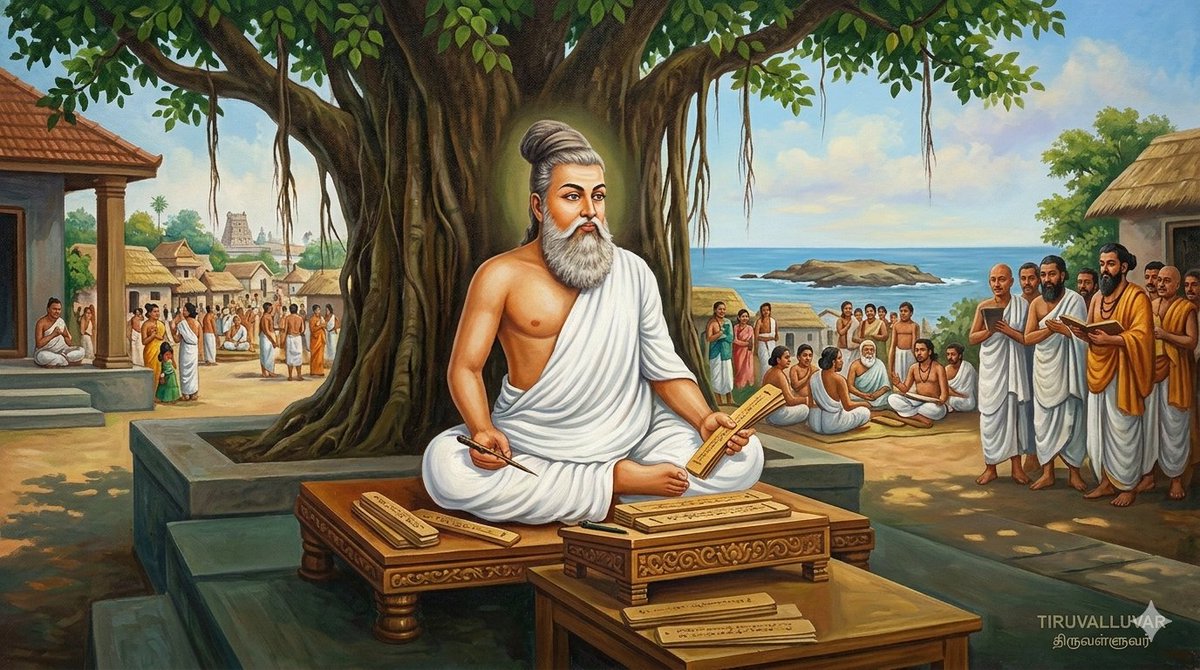
Tiruvaḷḷuvar, a Jaina ascetic? Who should claim the authority over him?
Various scholars have argued that Vaḷḷuvar was either a Jaina, a Hindu, a Samkya, a Buddhist, or a non-sectarian.
What emerges is the portrait of an author of remarkable integration and reach, a Tamil voice speaking in a Tamil idiom to all humanity, rooted in the autochthonous literary inheritance of his land, fluent in the major Indic philosophical literatures of his age, and grounded in a Jain ethical commitment that he chose never to name.
The Tirukkuṟaḷ is, in the deepest sense, a Tamil nīti text, Tamil in language, prosody, and the akam poetic DNA of its third book; nīti in its aphoristic kuṟaḷ veṇpā form and its address to the practical conduct of all human life. Its ethical foundations are Jain; its invocatory chapter draws on Jain hagiographic imagery; its institutional milieu was the Tamil Jain establishment at Madurai; and its philosophical commitments, absolute ahiṃsā, the harm-defined conception of truth, the omission of mokṣa as a separate aim, the jñāna-mediated soteriology, are recognizably Jain.
And the bedrock on which all of this rests is announced by Vaḷḷuvar himself in a single half-line that no dharmaśāstrin could have written:
பிறப்பொக்கும் எல்லா உயிர்க்கும்
piṟappokkum ellā uyirkkum
"by birth all lives are equal" (Kuṟaḷ 972)
And he was not alone. Centuries before him, the Pāṇṭiya king Āriyappaṭai Kaṭanta Neṭuñceḻiyaṉ had already sung the same Tamil ethic in Puṟanāṉūṟu 18, Kaṟṟal Naṉṟē, Learning is Excellent, declaring that even a mother turns toward the learned son over her elder, that even kings call the wise over the firstborn, and that "of the four divisions by birth, if one born low has learned, the one born high will bow to him" (mēṟpāl orūvaṉum aṟkoṇṭu oḻukum).
Two Tamil voices, separated by centuries, a Caṅkam king and a nīti poet, converge on a single conviction: birth confers no rank, uyir and learning do. This is precisely where Tamil ethical DNA parts company with Sanskrit dharmaśāstra, where Manu opens with the varṇa taxonomy that divides humanity at the moment of birth, the Tamil tradition opens with the equal uyir of every living being and the educable mind of every human being.
Vaḷḷuvar's Jain ahiṃsā found its perfect ground in this Tamil soil, because both traditions began from the same axiom, that the worth of a life is what it does, not what womb bore it, and that single Tamil word uyir, the life-soul, is the whole moral architecture of the Kuṟaḷ in seed, the indigenous Tamil ground on which a Jain ahiṃsā could flower into a scripture for all humanity.
Tiruvaḷḷuvar, a Jaina ascetic? Who should claim the authority over him?
Various scholars have argued that Vaḷḷuvar was either a Jaina, a Hindu, a Samkya, a Buddhist, or a non-sectarian.
What emerges is the portrait of an author of remarkable integration and reach, a Tamil voice speaking in a Tamil idiom to all humanity, rooted in the autochthonous literary inheritance of his land, fluent in the major Indic philosophical literatures of his age, and grounded in a Jain ethical commitment that he chose never to name.
The Tirukkuṟaḷ is, in the deepest sense, a Tamil nīti text, Tamil in language, prosody, and the akam poetic DNA of its third book; nīti in its aphoristic kuṟaḷ veṇpā form and its address to the practical conduct of all human life. Its ethical foundations are Jain; its invocatory chapter draws on Jain hagiographic imagery; its institutional milieu was the Tamil Jain establishment at Madurai; and its philosophical commitments, absolute ahiṃsā, the harm-defined conception of truth, the omission of mokṣa as a separate aim, the jñāna-mediated soteriology, are recognizably Jain.
And the bedrock on which all of this rests is announced by Vaḷḷuvar himself in a single half-line that no dharmaśāstrin could have written:
பிறப்பொக்கும் எல்லா உயிர்க்கும்
piṟappokkum ellā uyirkkum
"by birth all lives are equal" (Kuṟaḷ 972)
And he was not alone. Centuries before him, the Pāṇṭiya king Āriyappaṭai Kaṭanta Neṭuñceḻiyaṉ had already sung the same Tamil ethic in Puṟanāṉūṟu 18, Kaṟṟal Naṉṟē, Learning is Excellent, declaring that even a mother turns toward the learned son over her elder, that even kings call the wise over the firstborn, and that "of the four divisions by birth, if one born low has learned, the one born high will bow to him" (mēṟpāl orūvaṉum aṟkoṇṭu oḻukum).
Two Tamil voices, separated by centuries, a Caṅkam king and a nīti poet, converge on a single conviction: birth confers no rank, uyir and learning do. This is precisely where Tamil ethical DNA parts company with Sanskrit dharmaśāstra, where Manu opens with the varṇa taxonomy that divides humanity at the moment of birth, the Tamil tradition opens with the equal uyir of every living being and the educable mind of every human being.
Vaḷḷuvar's Jain ahiṃsā found its perfect ground in this Tamil soil, because both traditions began from the same axiom, that the worth of a life is what it does, not what womb bore it, and that single Tamil word uyir, the life-soul, is the whole moral architecture of the Kuṟaḷ in seed, the indigenous Tamil ground on which a Jain ahiṃsā could flower into a scripture for all humanity.
Was Tiruvaḷḷuvar a Jaina ascetic or Tirukkuṟaḷ a Jaina didactic text?
Various scholars have argued that Vaḷḷuvar was either a Jaina, a Hindu, a Samkya, a Buddhist, or a non-sectarian.
Some critical discussion points often brought up by the scholars:
- Epithets in the Kaṭavuḷ Vāḻttu chapter that align with Jain arhat imagery
- Uncompromising ahiṃsā and moral vegetarianism that constitute the Kuṟaḷ's ethical core
- Saṃkhya-resonant epistemology of liberation through discriminative knowledge
- Vedāntic and Vaiṣṇava elements that complicate any single-tradition attribution
- Exaltation of agriculture and how orthodox Jainism prohibits
Let's break them down.
Origins, influences, and religious labels: does any of it change the essence of the Tirukural? Let me take the bait and see what we can uncover.
The idea that the Tirukkuṟaḷ draws from the 'Dharma-Artha-Kāma' trivarga of Sanskrit literature is nothing new. Proponents typically quote Āpastamba Dharmasūtra, the Manusmṛti, and Kauṭilya’s Arthaśāstra as the foundational texts precursors to the Kural’s structural organization.
The Tirukkuṟaḷ is undeniably organized into three sections (pāls) that align conceptually with the Sanskrit trivarga:
Aṟattuppāl (Virtue) ~ Dharma
Poruṭpāl (Wealth/Polity) ~ Artha
Kāmattuppāl (Love) ~ Kāma
While this tripartite structure mirrors the Sanskrit framework, the content within these sections often diverges significantly from the prescriptive nature of the Dharmaśāstras. Tolkāppiyam (தொல்காப்பியம்), the oldest extant Tamil grammar, predates Tirukkuṟaḷ and already formalizes the categories of aṟam (அறம்), poruḷ (பொருள்), and iṉpam (இன்பம்) as the organizing principles of Tamil life and literature.
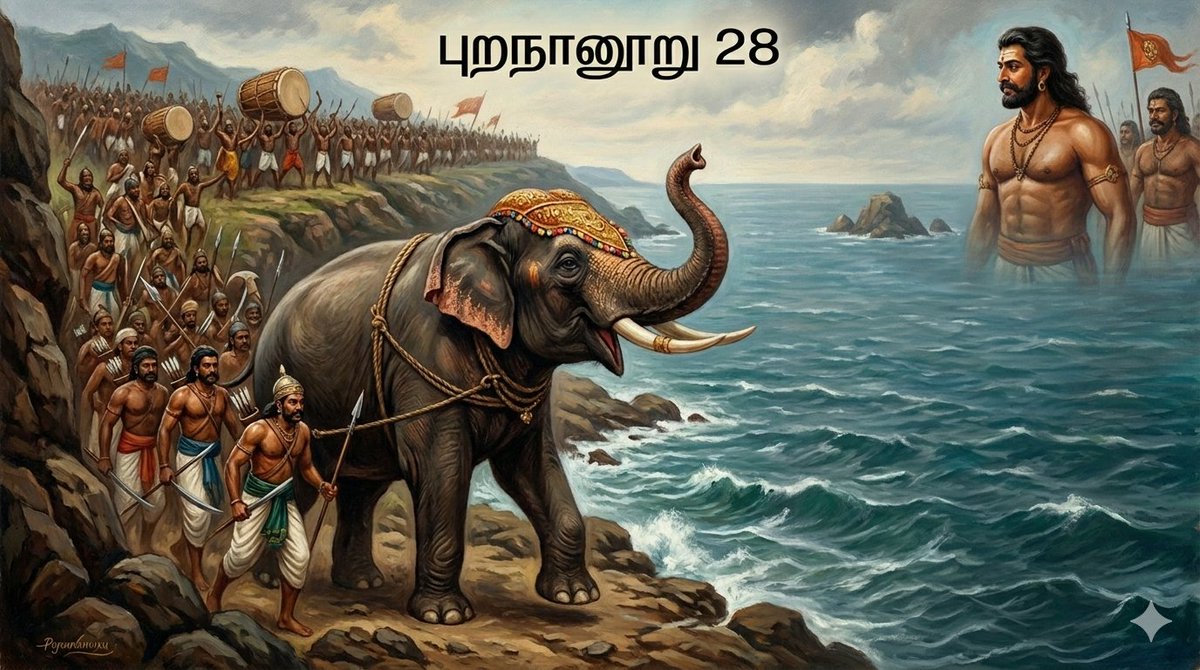
Puṟanāṉūṟu celebrates these three aims of life, righteousness, prosperity, and pleasure in various poems (such as Puṟam 28 and 31), providing these concepts were deeply embedded in the Tamil consciousness long before the didactic era of the 5th–6th century CE, typically attributed to the time when Tirukkuṟaḷ was written.
Excellent thread, supports my intuition that the Hindu repository contains within itself almost everything that’s needed to reconstruct “lost” Paganisms from across the world
As an example, the Turkish word "Hoca" (teacher, Islamic priest) and the Japanese word 和尚 (Oshô, meaning Buddhist priest) come from the same word "Upādhyāya" (teacher) in Sanskrit
upādhyāya -> xwāja (Classical Persian) -> Hoca (Turkish)
upādhyāya -> uvajjhāa (Prakrit) -> 和尚 hwa dzyangH (Middle Chinese) -> 和尚 Oshô (Japanese)
@AudreyTruschke From the earliest scholarship to Keynoyar, there seems to be a reluctance to propose an M-304 seal deity as a proto-form of fertility-ritual deity, as Parpola suggested, later conflated with Śiva?
One of the key scholars of IVC, Asko Parpola (2015), posited that the seated posture of the deity is borrowed from Proto-Elamite seated-bull iconography (as shown in the previous tweet) and that the figure is a buffalo-horned water/fertility deity comparable to Sumerian Enki and the later Vedic Varuṇa. He argued that the Harappan buffalo cult forms the substrate from which the later Mahiṣa myth and the South Indian village buffalo sacrifice descend.
Gregory L. Possehl (2002) concluded that calling the figure a deity is appropriate, that the posture is a form of ritual discipline and a precursor of yoga, and that the buffalo association is real, but that calling it a proto-Śiva would go too far in his book.
She clearly knows how to stir the pot and get the gallery to play to her tune.
The origin of the Master of Animals iconography, which dates back to the early Neolithic, truly deserves genuine academic scholarship.
It is too simplistic a view to conclude that the M-304 seal isn't Śiva but rather an adaptation of proto-Elamite iconography.
🧵An Interpretation of the Master of Animals Iconography and how it relates to the IVC M-304 seal.
It is best understood as a shared Old-World schema, whose compositional logic, the traditional frontal human master with flanking wild animals, originated in the Neolithic cultures of the Near East, spread to later Bronze Age civilizations and adjacent regions, and was locally re-coded in each cultural setting.
The Indus Paśupati seal, M-304, is a culturally distinct Harappan translation of the same old iconography, distinguished by the seated cross-legged posture, either an early mūlabaṁdhāsana representation, or perhaps borrowed from proto-Elamite seated bulls, per Parpola, the buffalo-horned headdress that is typically meant as a king's crown, and a quadripartite arrangement of wild animals.
The earliest layer of the Master of Animals is represented by a hero grasping rampant lions, bovines, or snakes, reflecting the culture in which it was attested.
This isn't Shiva. It's more likely adapted from proto-Elamite iconography, showing an Eurasian deity "lord of animals."
Indian history is amazing, wonderful, and fantastic -- It's well worth getting it right.
Marshall's assertion wasn't without critique.
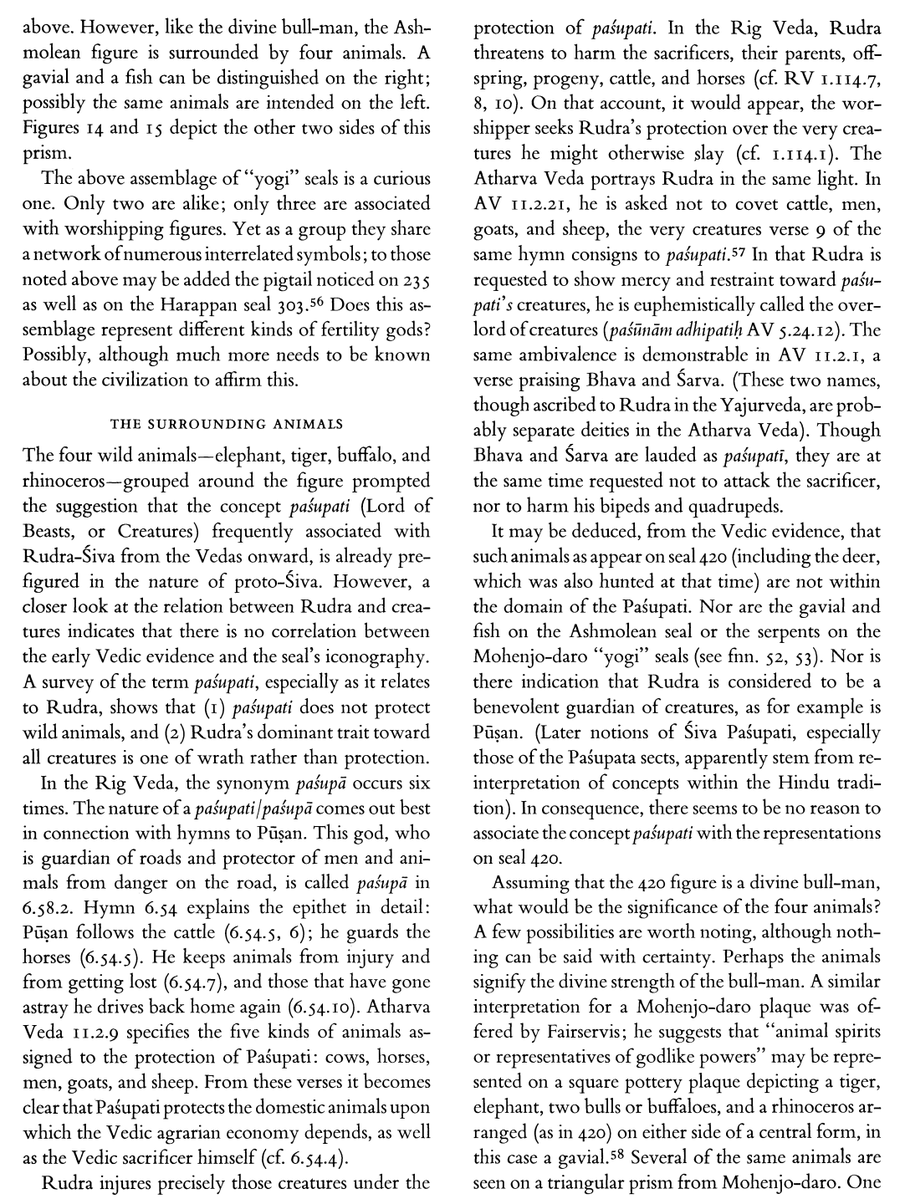
B. A. Saletore (1939) argues that the deity was Vedic Agni, suggesting a tricephalic nature. K. Nilakanta Sastri questioned the three-faced nature and suggested neither three-faced nor even human-faced. Herbert P. Sullivan (1964) argued that the figure was female and that the supposed phallus was a tassel.
Doris Srinivasan (1976) (the same author @AudreyTruschke quoted in her OT), in her "The So-Called Proto-Śiva Seal from Mohenjo-Daro: An Iconological Assessment," proposed that the lateral projections are cow-like ears rather than additional faces, and that the central face has dominant bovine features. Suggested that the figure is a divine bull-man/ buffalo-man with a humanized bucranium, and the surrounding animals constitute a hunting invocation.
She also pointed out that the Vedic Paśupati protects domestic animals, not the wild fauna of M-304, refuting Marshall's fourth reason on its own terms.
Alf Hiltebeitel (1978) supported Srinivasan and argued that the figure is the buffalo god, the iconographic ancestor of Mahiṣa, the buffalo demon slain by Durgā. And, the flanking animals are the vāhanas of the four cardinal-direction deities.
He emphasized that the horns are unambiguously buffalo, not of bulls.