LLMs now make critical decisions in hospitals, defense, banks, and governments. Yet nobody can verify which model actually ran, or whether the output was tampered with. A provider or middleman can swap weights, silently requantize the model, alter decoding, inject hidden prompts, do supply chain attacks, or change the deployment surface without the user knowing.
This problem is already serious. It will become critical.
We think this needs a practical solution, not just a theoretically clean one. CommitLLM is designed to be deployable on existing serving stacks now: the provider keeps the normal GPU serving path, does not need a proving circuit, does not need a kernel rewrite, and does not generate a heavy proof for every response.
In practice, two families of approaches dominated the conversation before this work: fingerprinting, which can be gamed, and proof-based systems, which are theoretically strong but too expensive for production inference.
We built CommitLLM to target the middle ground.
The core idea is to keep the verification discipline of proof systems, but specialize it to open weight LLM inference. The cryptographic core is simple: Freivalds style randomized checks for the large linear layers, plus Merkle commitments for the traced execution. Then a lot of engineering work is needed to make that line up with real GPU inference.
The key trick is this. A provider claims `z = W × x` for a massive weight matrix. Normally you would verify that by redoing the multiply. Instead, the verifier samples a secret random vector `r`, precomputes `v = rᵀ × W`, and later checks whether `v · x = rᵀ · z`. Two dot products instead of a full matrix multiply. In the current implementation, a wrong result passes with probability at most `1 / (2^32 - 5)` per check.
A full matrix multiply, audited with two dot products.
Most of the transformer can then be checked exactly or canonically from committed openings. Nonlinear operations such as activations and layer norms are canonically re executed by the CPU verifier. The one honest caveat is attention: native FP16/BF16 attention is not bit reproducible across hardware. CommitLLM verifies the shell around attention exactly, then independently replays attention and checks that the committed post attention output stays within a measured INT8 corridor. So attention is bounded and audited, not proved exactly.
That means the protocol already gives very strong exact guarantees on the parts that matter operationally most. If an audited response used the wrong model, the wrong quantization/configuration, or a tampered input/deployment surface, the audit catches that exactly. That includes things like model swaps, silent requantization, and provider side prompt or system prompt injection.
Today the implementation and measurements are strongest on Qwen and Llama. But the protocol itself is not meant to be Qwen or Llama specific: we expect it to generalize across open weight decoder only families. What still has to be done is the engineering work to integrate and validate more families explicitly, and we are already working on that.
On the measured path, online generation overhead is about 12 to 14% with the provider staying on the normal GPU serving path. The heavier receipt finalization cost is separate and can be deferred off the user facing path. The main systems costs are RAM and bandwidth, not proof generation.
The full response is always committed, but only a random fraction of responses are opened for audit. Individual audits are much larger, roughly 4 MB to 100 MB depending on audit depth. The important number is the amortized one: under a reasonable audit policy, the added bandwidth averages to roughly 300 KB per response.
After too many weeks without sleep, I’m proud to show what I built with @diego_aligned: CommitLLM. Thanks Diego for your patience. I've been calling you at random hours.
The code and paper still need some cleaning and formalization. We’re already in talks with multiple providers and teams that have cryptography related ideas on how to improve it even more. We’re really excited about this and we will continue doubling down on building products in AI, cryptography and security with my company @class_lambda.
If governments, hospitals, defense and financial systems are going to run on LLMs, verifiable inference is not optional. It is infrastructure.
I will be explaining this in more details in the days to come and I will show how to test it and run it.
Today we presented our Ethereum client at Ethrex Unleashed.
Thanks to everyone who stopped by, and make sure to follow @ethrex_client.
We’re not slowing down 🚀
📢📢For the past year, we've been stealthily developing a #metroidvania
We have a 1 hour Early Access version available that we're excited to share with you! Play now!! https://t.co/b6Hab7uWR2
Comments are appreciated 😻
𝙕𝙆 𝘼𝙍𝘾𝘼𝘿𝙀: 𝙉𝙊𝙒 𝙇𝙄𝙑𝙀 𝙊𝙉 𝙈𝘼𝙄𝙉𝙉𝙀𝙏
If you're one of the lucky 700 people with exclusive early access you can now mint your ZK Arcade Ticket NFT to start playing and earning points 🕹️
Here's everything you need to know to play:
Yesterday was an important day for me and for @class_lambda.
Twenty years ago I entered @UBAonline, the largest Spanish-speaking university in the world, with a community of more than 350,000 people, and consistently ranked among the top 100 universities globally.
Because of work travel and my professional life, after four years I had to stop studying. I became a college dropout, but I always loved the university and its chaotic public system. I came from a private French high school, so moving into a massive public university was a great experience, I had to learn to work with people very different from those I grew up with.
A few years ago I was invited to collaborate with @ingenieriauba. Together with professors and the community we designed the new Computer Engineering curriculum. I also helped create a Computational Thinking course for the 6,000 engineering students. I am deeply thankful to the community for asking me to contribute and for being open to new ideas.
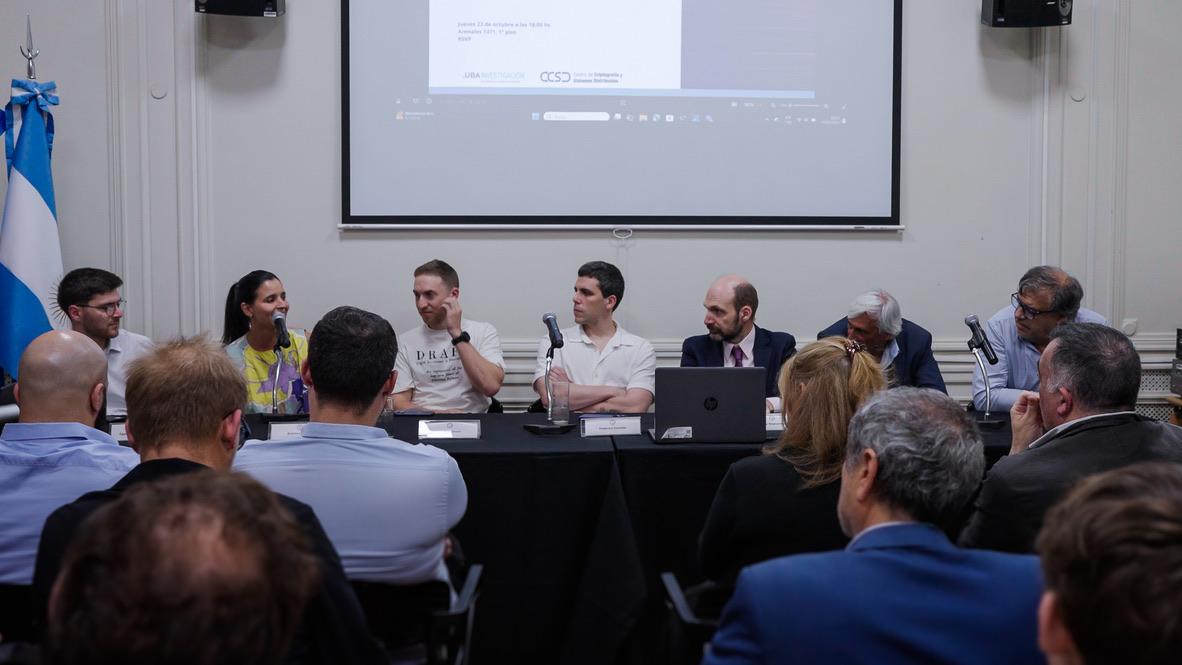
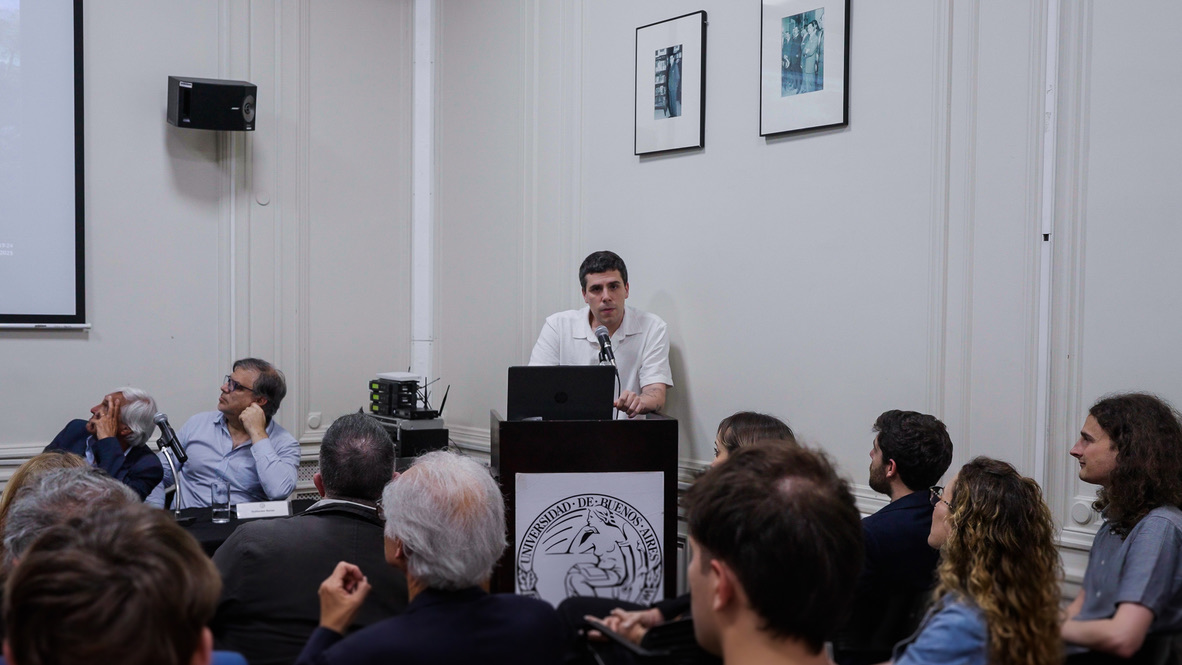
Yesterday we inaugurated the Cryptography and Distributed Systems Research Center together with @class_lambda, @ingenieriauba and @Exactas_UBA. Work has already begun on ZK and Ethereum.
I want to personally thank:
- @WillyDuran65, Dean of @Exactas_UBA
- Alejandro Martínez, Dean of @ingenieriauba
- Raúl Bertero, Vice-Dean of @ingenieriauba
- @SebaCiva, Secretary of Research / Science & Technology at @UBAInvestiga
- @felipevegaterra, Director of @CBCUBA, where more than 100,000 students study, including those taking the Computational Thinking course I created
- @nethan_eth, head of @EFDevcon & Devconnect at @ethereumfndn
- @arantxazapico, cryptographer and researcher at @ethereumfndn
- @DrFrenchmen, cryptographer and researcher at @3miLabs
I also want to thank the current government for sending representatives, the opposition parties, as well as members of the banking sector, regulators, important senators, legislators, the business community and the cybersecurity community.
The support of the @ethereumfndn has been crucial in building a community of cryptography researchers in Argentina and LATAM. They have always been open, and they created the pathway for us to join @ethereum. We are deeply thankful to @VitalikButerin and to the EF in general for all the work they do in developing countries.
Finally, I want to thank my @ergodicgroup and @class_lambda teams, who have been working non-stop with me for the last decade. Also my partner @rj_aligned@diego_aligned@mauro_aligned at @alignedlayer that have been crucial in all this.
Thanks everyone!
🚨ANNOUNCEMENT!
💀⚔️♥️RANDEL’S QUEST: Halloween demo is out!
A slot-driven, Wordle-style roguelike battler. Roll, guess, survive!
(RT's appreciated!)
Play free now 👇🏽 [link in the first reply]
Our @class_lambda AI team wrote about linear-time transformers and implemented an LLM using linear attention.
Efficient attention explained: the math behind linear-time transformers
One of the key components of the Transformer architecture is the Attention layer, which is in charge of making every word (or more generally, every token) learn the context given by every other in a sequence, and was introduced in the seminal paper Attention is all you need. In this post, we will explore this equation and a specific approach that manages to improve its complexity to be linear with a few mathematical tricks, following the work of Shein et al. (2021).
Kenzu is a cat with a terrible task: to save his people from destruction. Using his powerful intuition, he will search for relics of the 7 tribes and meet his destiny.
😼🥷
Thank you #Silksong and #HollowKnight for inspiring us <3
#pitchyavania#metroidvania
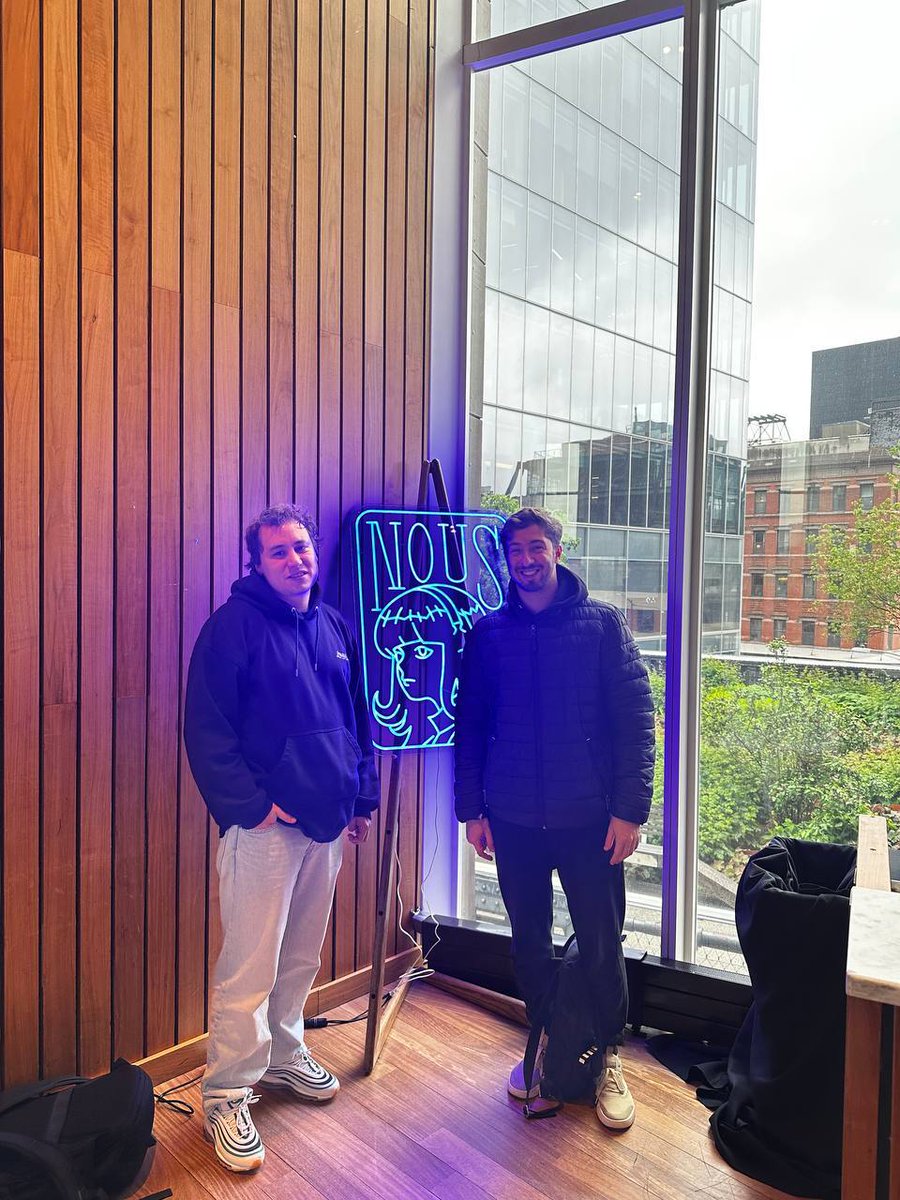
Loved meeting the @NousResearch team at Solana Accelerate!
They brought the conversation on democratizing and decentralizing AI to NYC — and we were there for it.
Announcing the launch of Psyche
https://t.co/ltj3hlHwVA
Nous Research is democratizing the development of Artificial Intelligence. Today, we’re embarking on our greatest effort to date to make that mission a reality: The Psyche Network
Psyche is a decentralized training network that makes it possible to bring the world’s compute together to train powerful AI, giving individuals and small communities access to the resources required to create new, interesting, and unique large scale models.
We are launching our testnet today with the pre-training of a 40B parameter LLM, a model powerful enough to serve as a foundation for future pursuits in open science. This run represents the largest pre-training run conducted over the internet to date, surpassing previous iterations that trained smaller models on much fewer data tokens.
We are launching testnet with the pre-training of a 40B parameter LLM:
- MLA Architecture
- Dataset consisting of FineWeb (14T) + FineWeb-2 minus some less common languages (4T), and The Stack v2 (1T)
The resulting model will be small enough to train on with a single H/DGX and run on a 3090, but it will be powerful enough to serve as the basis for strong reasoning models and creative pursuits. The model will be trained continually without a final "annealing" step, resulting in a true unaltered base model.
Looking ahead, we will draw model ideas from the community via our forum and Discord. By enabling highly parallel and scalable experimentation, we’re betting that the next innovation in model creation and design will come from the open source community.
I’m pleased to announce Lambda’s (@class_lambda) new strategic partnership with Nous Research (@NousResearch). We will work as hard as possible to support Nous Research in their fight for freedom in AI.
Devconnect is coming to Buenos Aires, Argentina from 17-22 November 2025!! 🌞🇦🇷
Devconnect ARG will be different: We want to support an effort the local community has already started — bringing Argentina onchain.
Read about Devconnect ARG & how you can get involved👇
Recent AI breakthroughs challenge the status quo narrative that only closed, mega labs have the ability to push the frontier of superintelligence.
Today we announce Nous Psyche built on @Solana - a cooperative training network for generative AI. Psyche coordinates heterogeneous hardware to join a run and train open-source models.
We retell the myth of Psyche — a mortal’s quest for retribution against divine odds:
Message from the Aligned Foundation
-----------------------------------------
The Aligned Genesis Drop Registration
In total the Aligned Foundation is open to give a tsunami of $ALIGN tokens to almost a 1M addresses.
Today we selected 891,322 addresses that held tokens from different ecosystem at their all-time lows 📉.
SEND PROOFS.
After 9 months of development we are happy to announce that Aligned's ZK verification layer – mainnet beta – is now live on Ethereum.
This means that developers can verify ZK proofs on Ethereum for less than 10% of the cost and that they can submit thousands of proofs per batch.
still need a hackathon project? here are some ideas💡👇
🟩 fast zk bridges and interop solutions
🟩 zk-rollups/appchains verifying on Aligned
🟩 zk oracles: query a price endpoint in rust and generate a proof
🟩 zkML, zk coprocessors for DeFi automation
🟩 apps with a multiproof system leveraging Aligned
🟩 encrypted mempools using SNARKs to show the correctness of the encryption
🟩 new settlement layers (use Aligned + @eigen_da) for rollups and intent based systems
🟩 P2P protocols based on SNARKs (eg payment systems, social networks)
🟩 single player arcade games w/ verifiable scores (zkMario??)
🟩 migrate any Halo2, Risc Zero, or SP1 games and examples to Aligned
not sure what we mean by these? ask below
happy hacking
Announcing: Aligned Builders Hackathon!
Our first virtual hackathon has up to $50,000 in prizes for novel apps using Aligned’s ZK verification layer.
The Aligned Builders Hackathon is the first stage of Aligned’s upcoming mainnet incentives program which will reward developers, partners, and users with points based on usage.
Read on ⬇️