check out also Radar (https://t.co/PbIXMvrbVL) with an MCP exactly for this - point your agent at your cluster, get structured topology, RBAC visibility, GitOps status, cluster audit, all from live state. I work on it so grain of salt. goes much further than "kubectl wrapper" - we benchmarked it 4 times faster getting to root cause https://t.co/UjdiqvHvqf
@DanKornas thanks for posting @DanKornas ! glad you found Radar useful (I'm one of the creators). The MCP is especially worth checking out to connect your agent to k8s - it's way more than "kubectl wrapper" servers
@dibujoslucas@DanKornas thanks! (I'm one of the creators of Radar)
this is why we made it - all the other tools felt not quite what we wanted, either missed features we wanted or not good enough developer experience for some use cases
🔗 GitHub: https://t.co/gxrIk9BQ1w
---
✉️ If you’re into AI, ML, agents, and building real systems, join my newsletter (it’s free): https://t.co/zpXbSNVTis
@learnk8s nice, kubectl-mcp-server is good if you want to stay close to kubectl. we did some analysis of other approaches to k8s MCP - better optimization for AI agents can make agents 4 times faster to diagnose issues: https://t.co/1NIeemyqz8
The tools/list gate is theater, agreed. For K8s specifically, Radar's MCP server (https://t.co/PbIXMvrbVL) strips secret values from manifests before the response leaves, no path for credential leakage regardless of caller behavior. The data layer is where enforcement has to land. (I work on it)
Radar crossed 3,000 stars on GitHub!
Thank you to everyone who starred, forked, filed an issue, or sent a PR! 37 contributors and counting.
If you haven't tried it yet:
brew install skyhook-io/tap/radar
https://t.co/i5BJjBhxQu
The kubelet already restarts containers at 3am without asking anyone. Kubernetes is full of automation like that. AI agents add something different: judgment. Our CPO wrote a framework for deciding how much judgment to delegate.
Hey, one of the creators of radar. We invested quite a bit in optimizing for large clusters.
ram is the one thing that's tricky to bring way down because we need the resource yamls cached in memory for high performance and core features like topology.
Being able to walk across all connected resources in milliseconds means we can do lots of interesting things. Like pre-analyzing all issues in the cluster, and giving an agent more complete context so it takes 2x-4x less time to get to root cause - just posted some data actually: https://t.co/PChuCfHU9t
https://t.co/jelREX8gUj
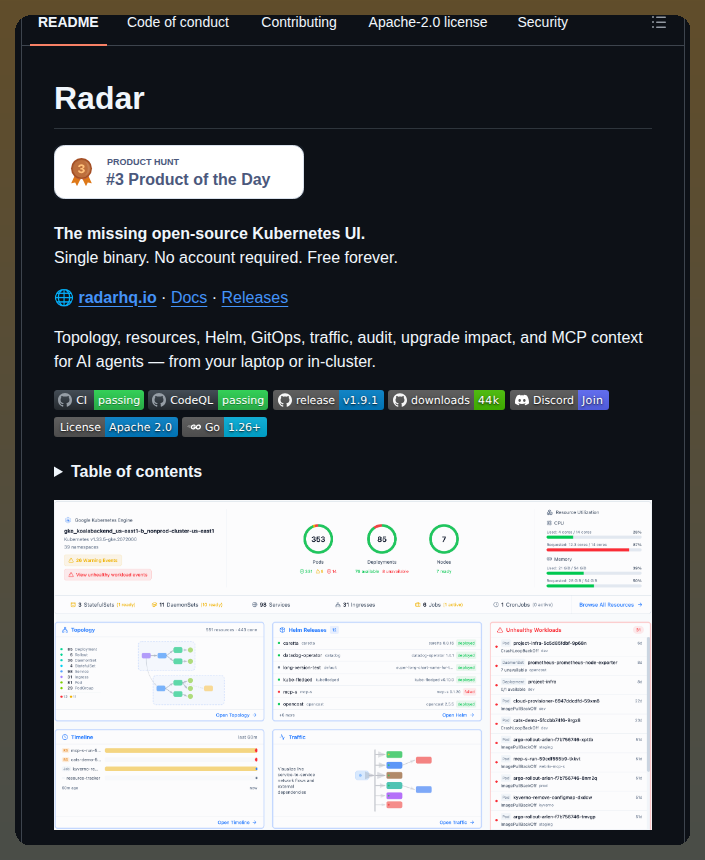
Radar is a portable Kubernetes interface that runs as a single binary from your laptop, offering topology, resource, and traffic visualization along with MCP support for AI agents.
https://t.co/W2qsKua7Pv
@jaimesolis for operational tooling this matters a lot - acting on stale cluster state is risky. we built Radar https://t.co/Bol7nFGPbw MCP server to return live data per call. I work on it so grain of salt, but stateless solves a real problem in k8s ops.
The ownership-chain piece is what makes this useful, knowing which workload owns the SA and what it can actually reach across namespaces. Radar https://t.co/PbIXMvrbVL covers this already: 31-check cluster audit, RBAC blast-radius view, production MCP server. Flagging in case useful as a reference (I work on it). would be intrested to hear what you think and thoughts on how to make radar more useful for secops
@kuberdenis running Claude Code agents inside the cluster is interesting. if you want them to reason over cluster state as they schedule jobs, Radar https://t.co/Bol7nFGPbw has a production MCP for k8s - live topology, RBAC, audit per call. i work on it so biased, but might be useful.
stateless makes sense for k8s ops - the cluster is already the truth, not the agent's session. we ship a production MCP for Kubernetes (https://t.co/PbIXMvrbVL) that returns live topology, RBAC, and audit data on each call. i work on it so grain of salt, but this direction feels right.
your deployment is 0/1 and kubectl logs gives you nothing
correct. there is no pod. admission rejected it and the reason is in a controller status you have not opened.
it also checks whether @argoproj, @fluxcd or helm owns the resource before you apply anything, and tells you your change is about to get reverted on the next reconcile.