In AI 2027, we predicted that AI would take over the world or irreversibly concentrate power.
In AI 2040: Plan A, we've laid out our positive vision for what should happen instead.
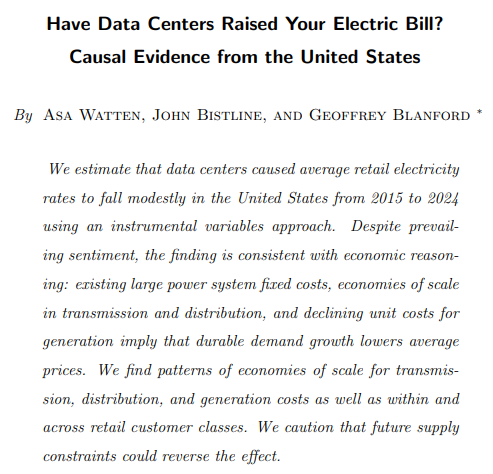
Data centers didn’t raise electric bills nationally from 2015–24. Surprise! Actually, they modestly lowered them. That's because big fixed grid costs get spread over more kilowatt-hours, and new demand can unlock economies of scale.
@arxiv
(thread)
Intelligence
We are in early takeoff. AI improving AI may end up being one of the most consequential steps of history. This isn’t certain because we don’t know how far from the physical and computational limits of intelligence we are, though I would bet it’s quite far from where we are today (e.g. ~5-10 OOMs more intelligence output per unit of scale seems possible).
Our internal data shows Claude is accelerating AI development—a possible path to recursive self-improvement, or AI autonomously building a more capable successor.
It’s happening faster than we thought, and the implications deserve greater attention. https://t.co/OVVPJO7VQx
the frontier labs don’t have “comms problems”. reality right now has a comms problem. what is happening is a little scary and there’s no nice words anyone could say, especially not those profiting from it, that’ll make it feel that much better
The very idea that we are now in the phase of AI self improvement with models working autonomously 24/24 7/7 to optimize models, and that we are about to enter the EGI "Era of General Improvement" ("design better batteries", "design better drugs against X", etc.) is surreal.
The discourse around this seems to point to something real, which is a lack of clarity around post-AGI society and its governance, economics, etc. Ofc many reasons why this is lacking (eg public/gov won’t plan ahead without seeing proof of capabilities). But people are uncertain.
@gfodor Possibly just survivorship bias, hard to come up with as many startup ideas if you think capabilities are accelerating vs if they're plateauing. And hedging on the part of the VCs who fund these startups
I walk away from this summit convinced that much of the world, in the U.S. and abroad, is simply delusional with respect to what this technology is, what it can do today, what it will be able to do soon, and what it means their countries should do.
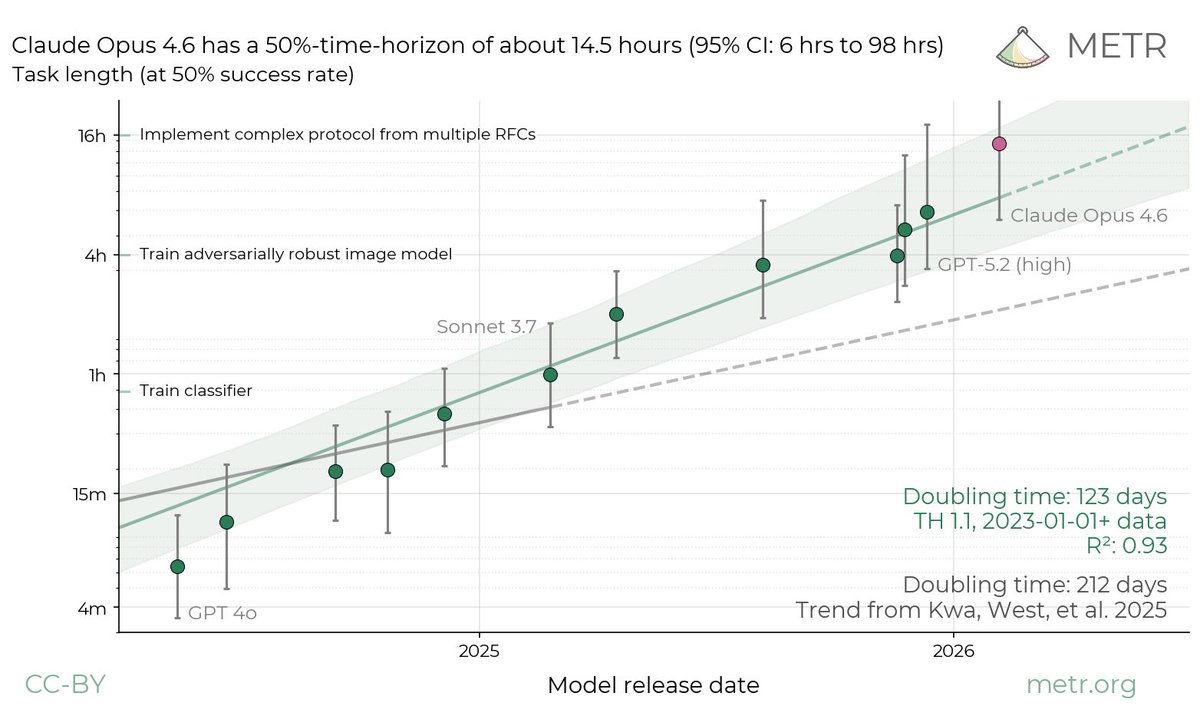
We estimate that Claude Opus 4.6 has a 50%-time-horizon of around 14.5 hours (95% CI of 6 hrs to 98 hrs) on software tasks. While this is the highest point estimate we’ve reported, this measurement is extremely noisy because our current task suite is nearly saturated.
Seems like the same sentiment! I think this is a super general phenomenon, as in even ultimately recursive self improvement is the culmination of intelligence increasing the possibility space and having a compounding effect/returns.
https://t.co/7ycfnKxJvw
I think this would fit with a general trend in AI of warm starts making impractical problems practical. eg pretraining enabling RL on math since you hit the correct answer at least sometimes
also (and i know i’ve been beating this drum for a while) it’s abundantly clear that robotics will be built upon large video pretraining.
scaling real-world data collection alone is financially & logistically infeasible
instead: video pretraining -> teleop sft -> on-policy RL