Terence Tao, known as the "Mozart of Math" and a Fields Medal winner, became a full professor at UCLA when he was just 24.
He says the old idea of getting one degree and staying in the same job for decades no longer works because the world is less predictable. Rather than only learning specific technical skills like one coding language, he encourages young people to focus on being adaptable and building skills that can be used in many situations, especially abstract thinking and strong problem-solving. These abilities will stay important even as AI continues to develop.
Ever seen the film A Beautiful Mind?
The mathematician that film was based on, John Nash, has one of the shortest PhD dissertations ever published: ‘Non-Cooperative Games’.
It has a grand total of 26 pages, and only cites two references.
That thesis went on to found the basis for his paper on the development of game theory, for which he won the 1994 Nobel Prize in Economics.
India today accounts for nearly half of all real-time digital transactions on Earth. Not because of India's size alone, but because the payment system that produced them charges nothing, runs around the clock, and works equally for a street food vendor in Varanasi and a corporate office in Mumbai. The engineer who designed and scaled it is named Dilip Asbe. Most Indians who use it daily have never heard of him.
Before UPI, the math of digital payments worked against ordinary people. Every card swipe meant the merchant paid 1 to 2% to Visa or Mastercard, foreign companies charging Indian merchants on every transaction. Small merchants could not afford those margins. Bank transfers took hours and only worked on banking days. Cash, for hundreds of millions of Indians, was not a preference but a structural necessity.
Dilip Asbe, an electronics engineer from Mumbai, joined NPCI in its earliest years and spent nearly a decade building India's foundational payment rails: IMPS, NEFT, RuPay. By 2009, his team was exploring whether Aadhaar could anchor a new payments layer. By 2015, they realised IMPS was not scalable enough. UPI launched in April 2016 as an open-source, interoperable framework sitting on top of every bank simultaneously, allowing any app to build on it, operating around the clock, at zero fees. On pricing, Dilip's principle was stated plainly: you cannot charge the customer, or the entire model goes for a six.
Today, UPI serves 491 million users and 65 million merchants across 675 banks, processing over 18 billion transactions every month. The IMF has described India as the world's leader in fast payments. Dilip Asbe has been MD and CEO of NPCI since 2018.
A government engineer, working out of a non-profit, built the financial rails for 1.4 billion people.
No IPO. No unicorn. Just UPI.
Jacob Bronowski once told an anecdote about von Neumann.
They had disagreed about some problem and Bronowski realised overnight that von Neumann was right. In the morning, Bronowski telephoned von Neumann to tell him this. Von Neumann apparently replied "You woke me up to tell me that I was right? Please wait until I am wrong."
Also a famous mathematician said, "Von Neumann would often have the solution to a problem before I had even understood the question."
Catch every market wave with real-time updates! Stay ahead of the trends and trade with confidence on Binance. Get started nowCatch every market wave with real-time updates! Stay ahead of the trends and trade with confidence on Binance. Get started now!
Number was born in superstition and reared in mystery...numbers were once made the foundation of religion and philosophy, and the tricks of figures have had a marvelous effect on a credulous people. ( F W Parker)
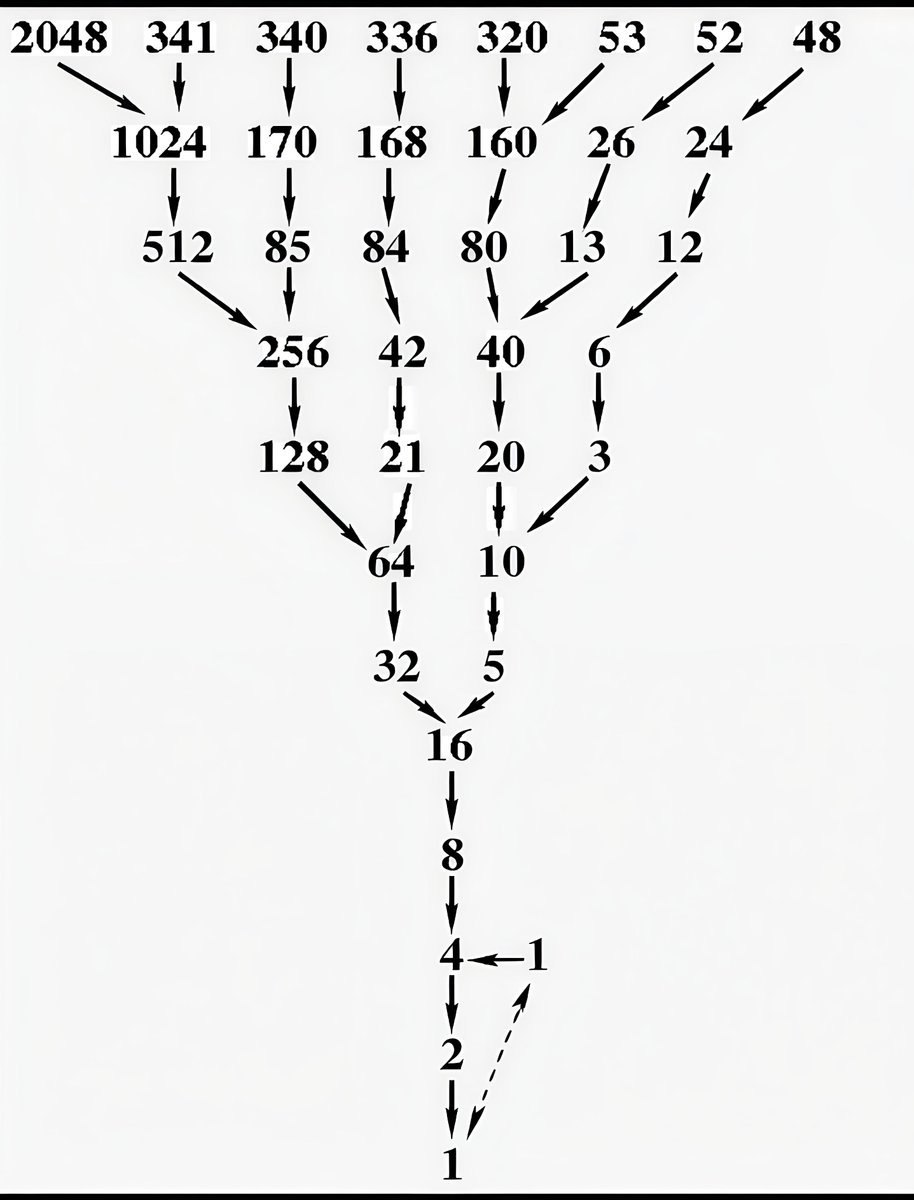
The Collatz conjecture is a simple unsolved math problem: any number, if even divide by 2, if odd multiply by 3 and add 1, eventually falls into a 4-2-1 loop. However, we cannot prove this for all numbers, as infinite possibilities prevent brute force, and we lack the necessary mathematical tools for a rigorous proof.
An epicycloid is a geometric curve traced by a point on a circle rolling along the outside of a fixed circle. Have you ever used its parametric equations to analyze mechanical gear systems?
#MathType#STEM#Geometry#Calculus
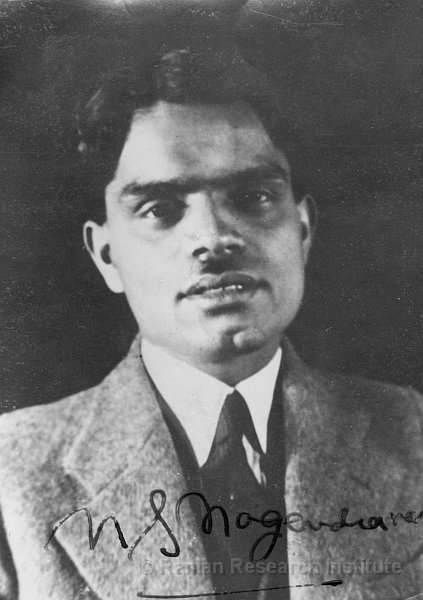
When people think of Chandrasekhara Venkata Raman, they think of the 1930 Nobel Prize for light scattering. But his 2nd breakthrough, executed in Bangalore with his brilliant student N.S. Nagendra Nath, fundamentally changed how humanity controls light waves.
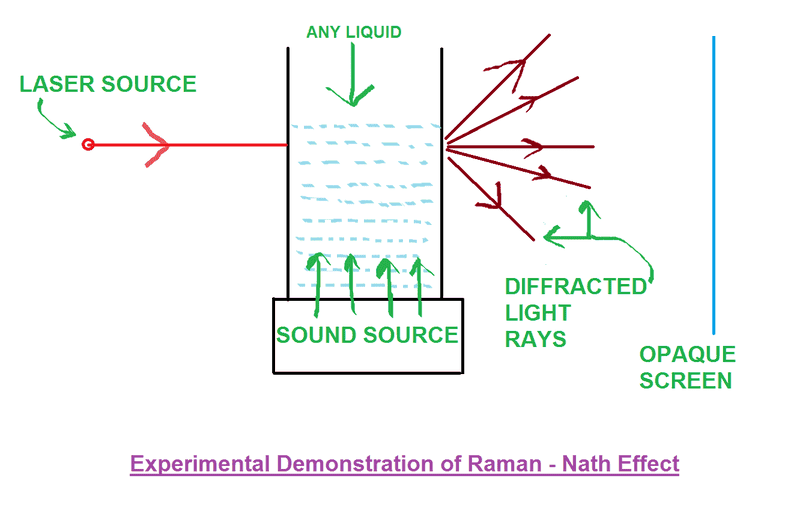
In the 1930s, physicists discovered that if we pass a beam of light through a liquid containing high-frequency sound waves (ultrasonic waves), the light scatters. The sound waves create alternating high & low-density regions in the liquid, acting like a physical grating. Western labs tried to model this using complex, classical diffraction eqns, but the math kept collapsing. They predicted the light would just distort randomly.
Raman & Nath decided to look at the problem from a completely fresh perspective: Wave Phase Modulation. Instead of treating the liquid as a rigid obstacle, they realized that the sound wave acts as a corrugated refractive index that dynamically warps the phase of the incoming light wave.
They built an elegant laboratory setup at the Indian Institute of Science (IISc), modulating light cleanly using sound frequencies. They published a series of papers during 1935-37 creating the Raman-Nath Theory. They mathematically predicted that a single light beam could be sliced cleanly into a highly predictable, mathematically perfect array of multiple beams just by tweaking the acoustic frequency.
This was not just a neat optical trick; it was the birth of Acousto-Optics. Decades later, when lasers were invented, engineers realized they could not turn lasers on & off fast enough mechanically to transmit data. They turned directly to the Raman-Nath experiment.
Today, almost every high-speed laser scanner, Q-switched laser pulse & fiber-optic modulation system uses an "Acousto-Optic Modulator", a device running directly on the exact 1935 eqns written in Bangalore.
Ref: Generalised Theory (a key later paper summarizing & extending the work, 1936):
https://t.co/7LspnJxttZ
In 1636, Pierre de Fermat made a remarkable observation: if you take an integer a, raise it to a prime power p, and then subtract a, the result is always divisible by p. In other words, for a prime p,
aᵖ ≡ a (mod p).
For example, when p = 5:
2⁵ − 2 = 30, which is divisible by 5, and
3⁵ − 3 = 240, which is also divisible by 5.
Fermat found this property elegant and tried to spark interest in this curious corner of mathematics. Not everyone was impressed. John Wallis reportedly dismissed such results, remarking, “Big deal; I could find other relationships just as interesting without much effort, and none of them are important.”
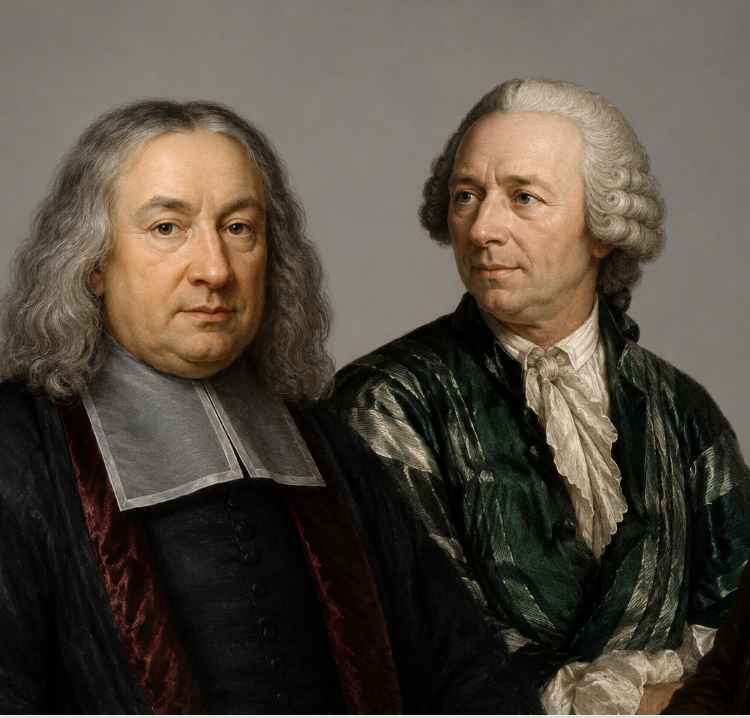
About a century later, Leonhard Euler was encouraged by Christian Goldbach to study Fermat’s ideas. Though initially unenthusiastic, Euler soon uncovered deeper structure within them. His work laid much of the foundation for what we now call modern number theory.
Around 1760, Euler discovered a powerful generalization of Fermat’s result that applies to composite numbers. This is now known as Euler’s theorem: if a is coprime to n, then
aᵠ⁽ⁿ⁾ ≡ 1 (mod n),
where φ(n) is Euler’s totient function.
For example, take n = 15 = 3 × 5. Then
φ(15) = (3 − 1)(5 − 1) = 2 × 4 = 8,
and indeed, 2⁸ − 1 = 255, which is divisible by 15.
At the time, these results seemed like elegant but abstract curiosities.
Fast forward about 200 years. The Euler–Fermat theorem becomes a cornerstone of RSA encryption, one of the most widely used systems for secure communication. Remarkably, nearly every other component of RSA relies on mathematics that was already known centuries earlier—so much so that, in principle, even Thomas Jefferson could have discovered it, had the need arisen.
Number theory transformed from a subject once dismissed as trivial into one of the fundamental pillars of modern civilization.
@svembu Great initiative!
The pillar of craftsmanship is knowledge. I've only recently found out that the Goddess of knowledge, Saraswati is revered as Benzaiten/Sarasantei (薩羅酸底) in Japan.
Here are the side by side images:
His name was E. C. G. Sudarshan.
He was born in Kerala in 1931 and became one of the greatest theoretical physicists India has ever produced.
Yet most Indians have never heard his name.
In 1963, while working in the United States, he solved a fundamental problem in the quantum theory of light.
His work introduced a new way of describing every possible state of light, laying one of the foundations of modern quantum optics.
Over the decades, an entire field of research grew from those ideas.
In 2005, the Nobel Prize in Physics was awarded for pioneering work in quantum optics.
The decision revived a controversy that had existed for decades.
Many physicists argued that Sudarshan’s 1963 work had been fundamental to the field and deserved far greater recognition.
The mathematical representation at the centre of that debate is still widely known as the Glauber Sudarshan representation.
Sudarshan himself believed his contribution had been overlooked.
He wrote to the Nobel Committee, saying that no one had the right to take his discoveries and ascribe them to someone else.
Several scientists also publicly argued that his role had not received the recognition it deserved.
The Nobel Prize was never changed.
It was not the only disappointment.
Over a career spanning more than half a century, Sudarshan was nominated for the Nobel Prize several times but never received it.
He died in Texas in 2018.
One of the greatest minds in modern physics remained almost unknown in the country where he was born.
His name was E. C. G. Sudarshan.
Much of modern quantum optics rests on ideas he helped create, and whether he should have shared the Nobel Prize remains one of the most enduring debates in modern physics.
Follow for stories India deserves to remember.
In 2003, Grigori Perelman solved the century-old Poincaré conjecture, one of mathematics’ greatest problems. Yet he declined both the 2006 Fields Medal and the $1 million Millennium Prize in 2010, stating he had no interest in money or fame.
Living simply with his mother in St. Petersburg, Perelman chose a life guided by his own values.
His life, his rules—and that commands respect.
'Prime number', spoken in nine different tongues, kicks off the latest episode of 'the Tower of Babel'. It's followed by Luci Bonatto discussing her mathematical upbringing in Brazil and its influence on how she thinks and teaches in Oxford.
I can provide training for hard working talented kids for the prestigious mathematical olympiads for India --- of Homi Bhabha Science Education--- RMO and INMO. My WhatsApp is +919619988025
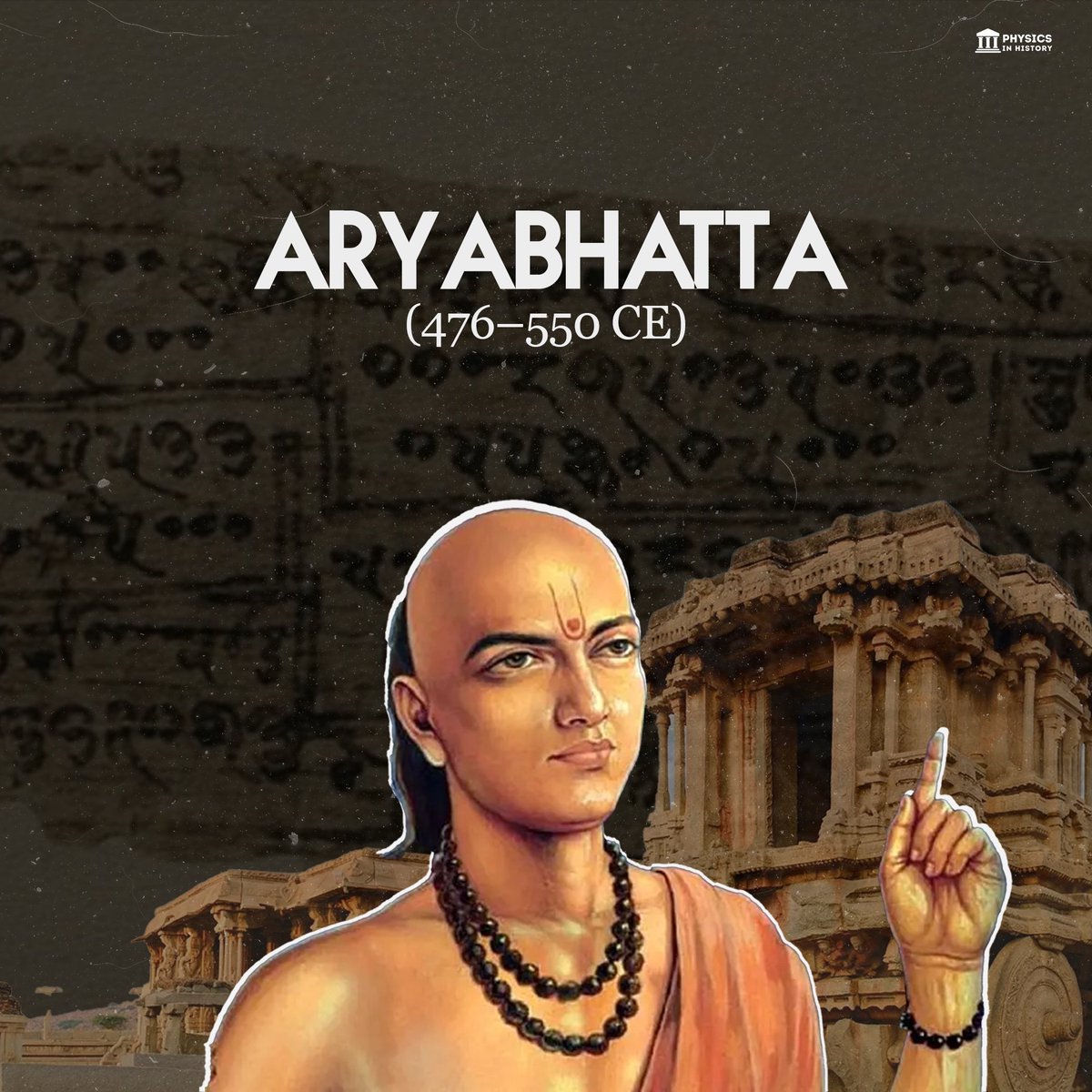
Aryabhatta, a remarkable Indian mathematician and astronomer, wrote his most famous treatise, Aryabhatiya, when he was only 23 years old. It contains 121 verses on various topics of mathematics and astronomy, such as the value of pi, the solution of quadratic equations, the calculation of eclipses, and the motion of planets.