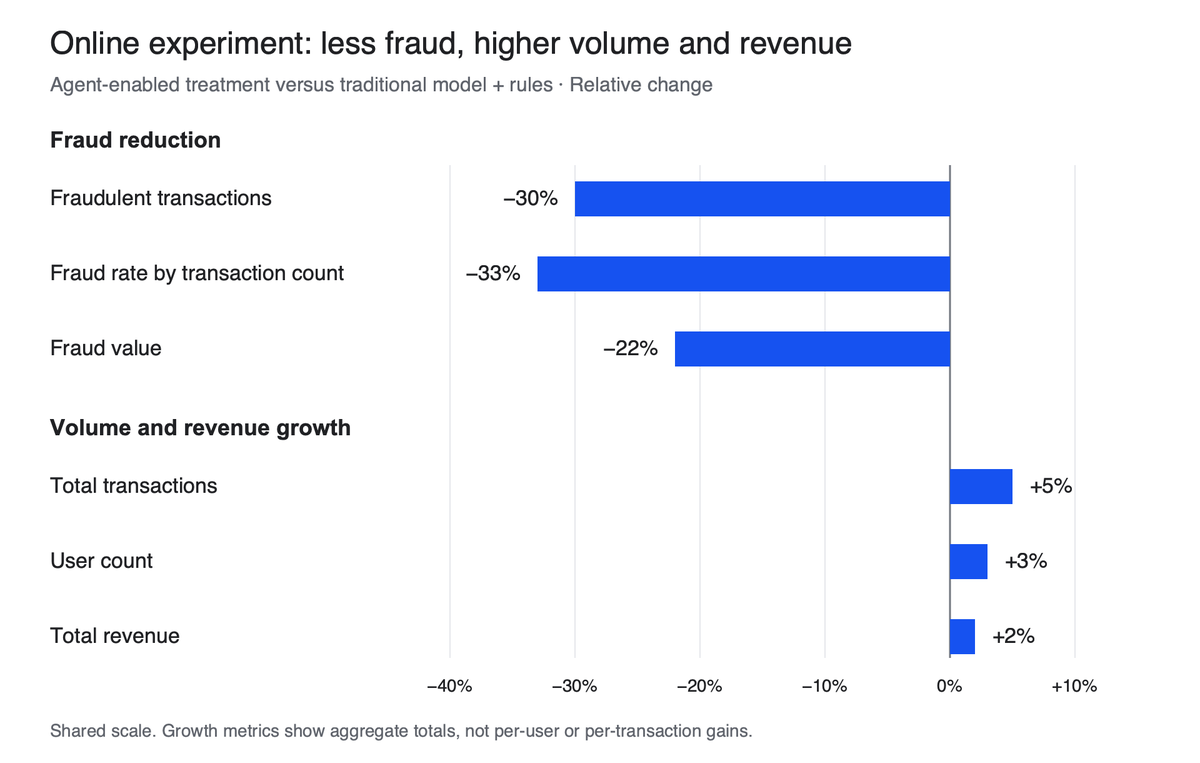
We added an LLM risk agent layer to the Onramp risk stack and cut down fraudulent transactions by 30%.
Projected savings from fraud prevention were ~3x the estimated inference cost.
Shipped something I'm excited about: a live demo site for our stablecoin payment web component. Update the CSS variables with your own branding, watch the event API fire in real time, and run the whole payment flow end to end, zero real funds involved.
We’re thrilled to partner with https://t.co/AKJ6c5THgg, one of the world’s leading payment processors ($300B+ in TPV), to bring stablecoin acceptance to enterprise merchants.
@CoinbaseDev’s APIs enable businesses to accept stablecoins through the systems they already use.
Stablecoin acceptance is now available for eligible merchants who partner with @Checkout, powered by Coinbase Payments. 🚀
Consumers pay in USDC or USDT. Merchants settle in USD via Checkout․com’s existing rails. ↓
Introducing Agentic Wallets, our first ever wallet infrastructure built specifically for autonomous agents.
Give your agent the power of a wallet. Let your agent manage funds, hold identity, and transact onchain without human intervention. 🧵
“Complete non-starter” – disagree.
In the U.S. – yes, card rails work well, rewards are strong, and consumers aren’t demanding new POS behavior. But @pitdesi and @NikilKonduru are missing the mark globally – and assume stablecoin checkout must replace cards to matter.
1. Stablecoins are already the primary balance for tens of millions of people.
Every week, I talk to stablecoin checkout users – most of whom are outside of the U.S. – who are delighted to spend stablecoins at checkout because it’s what they consider their money. They earn in stables or save in them to hold dollars. For them, paying from a bank account already is cumbersome: offramping, delays, FX spread, fees, and accounts they don’t trust. Stablecoin checkout solves a real problem – spend the balance you already use. Yes, stablecoin-backed cards also solve this, but that doesn’t negate the demand for direct checkout either.
2. Stablecoin checkout solves problems that stablecoin cards can’t.
Stablecoin cards do an excellent job solving distribution and acceptance. But even when they settle in stablecoins, they still operate with card-network economics and constraints – interchange, network fees, MCC rules, geographic restrictions, dispute models, etc. Direct stablecoin checkout avoids that entire stack. It’s the cleanest expression of stablecoin rails – global by default, instant settlement, low cost, and natively programmable. Stablecoin cards are a powerful bridge, but direct checkout is the ideal end state.
3. We don’t need to displace card networks to build a meaningful business.
Most alternative payment methods don’t aim to kill cards. They exist to reach a specific audience, increase conversion, and unlock incremental demand. Merchants adopt them when they’re easy to turn on and additive. Stablecoin checkout fits that pattern. Through partners like Shopify, PPRO, and Checkout, merchants can enable stablecoins without changing their core flows. They do it because customers ask for it, and it brings net-new, global buyers. This does not need to be a moonshot to overthrow the incumbents. Incremental volume with low marginal friction is enough.
4. Rewards aren’t the wedge, but they can still influence behavior.
Consumer rewards are not the reason for users to switch from a preferred payment method to stablecoins, but they can reinforce adoption. By eliminating interchange, stablecoin checkout can be priced competitively against cards and still have margin for rewards. These won’t compete with your 4% BTC back on your Coinbase Amex (a fantastic product). But ~50% of checkout volume runs on debit with ≤1% rewards, and many markets have no rewards at all. A huge population doesn't have access to – or doesn’t want – credit, so those features aren’t the right benchmark. We’ve found that even 1% USDC back is enough to add real delight at checkout.
Now, you’re certainly not wrong that stablecoin-backed cards are a great product, and stablecoin settlement is an obvious win. But it’s a mistake to conclude that stablecoin checkout is dead on arrival. The demand exists, the integration burden is low, and the use case is strongest precisely where card assumptions don’t hold.
This isn’t about overtaking Visa on day one. Rather, serving a growing user base that already lives in stablecoins, and letting merchants capture that demand instead of forcing it through legacy rails.
Our @CoinbaseDev Embedded Wallets are getting more powerful every week. Updates just landed:
- React Native demo app (link👇) to jumpstart your mobile-first onchain app
- Beautiful dashboards in CDP Portal for insights on your embedded wallet usage
What should we ship next?🚀
Waymo is so safe that if every car was driven like a Waymo, about 9% of America's life expectancy gap would disappear.
9 percent
Americans die in car accidents *that often*.
3 principles of base building
1- You can build for a lifetime
Every low heart rate run, every aerobic session is an investment in your base. Your capacity for base is infinite. You’ll see real improvement after several months, much more if you stay consistent for years.
The real fast runners are that fast in large part because they’ve been putting in miles since high school and college. Same with fast adults, they’ve been stacking up years of training.
Your base fitness is durable. There are many cases of longtime runners stopping for years, then returning and getting back to a high level.
2- You can only build so quickly
Your aerobic system will develop faster than your musculoskeletal system. It’s great if you’re motivated to run tons of miles, but bone density & tendon adaptations require time.
You can’t force fitness. You can’t just go from a 25 min 5k to a sub 20 min 5k in 4 months, no matter how hard you train. Your body can only progress at a given rate. Patience is essential.
Look to your 4-6 week previous load and historical load to guide ramp rates. See when/how you got injured and make adjustments. For example, coming off injury I was able to get back to 30 mile weeks quickly, but when I approach 70 mile weeks, it needs to be more gradual.
More cross training is a good way to get additional volume. I like an hour or more of aerobic training to match every hour run. Sign up for a 70.3 and you’ll build a solid base training for that. Or just be very active: swim, hike, ride your bike whenever you can.
3- You need some occasional breaks
You can’t just build for 52 weeks a year. You need some time to decompress, physically and mentally.
Sign up for a couple main races. Build, peak, race, take time off or just try to maintain.
If you haven’t lifted weights, focusing on that for 3-6 months, 3-4x week can make you a better runner in the long term. Just jog a couple times a week or bike, you’ll come back stronger and faster than you expect.