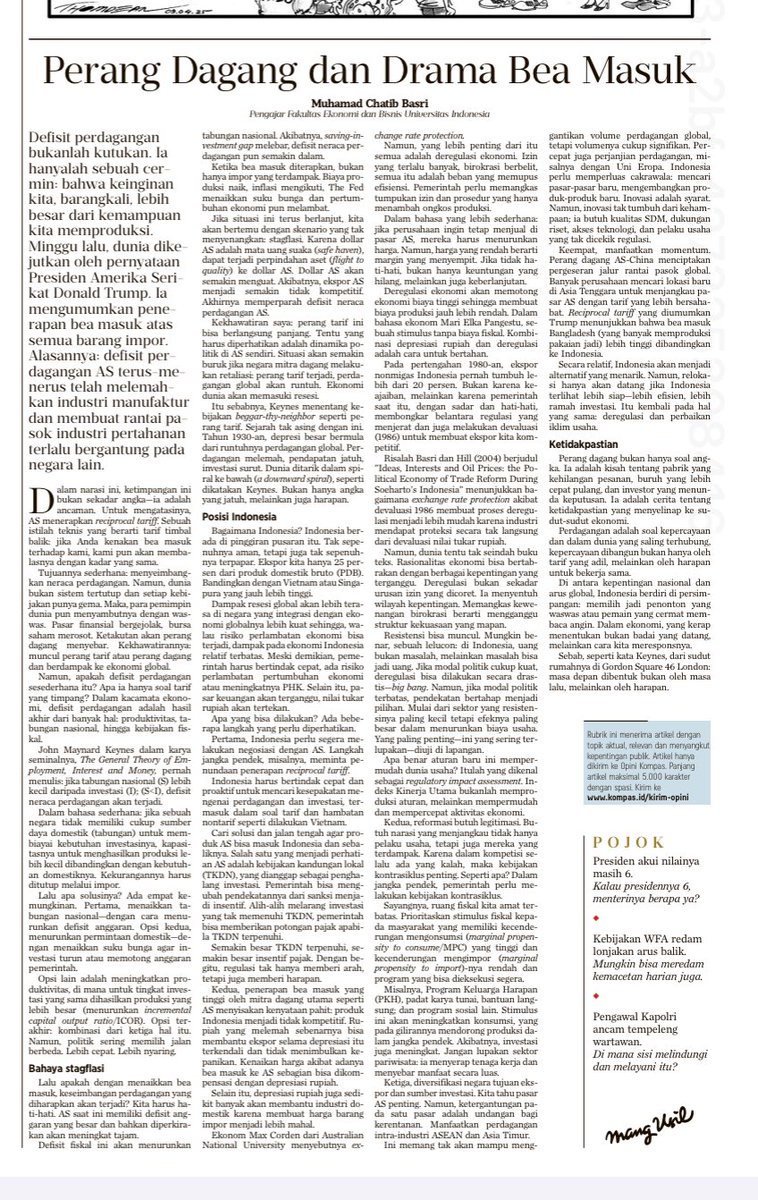
Berikut artikel saya di Kompas 9 April, 2025 soal pentingnya deregulasi ekonomi untuk menghadapi perang dagang
Mungkin benar, sebuah lelucon: di Indonesia, uang bukan masalah, melainkan masalah bisa jadi uang.
“ Perang Dagang dan Drama Bea Masuk”, https://t.co/E7bPADR5PH
PART 1: The Supply Side
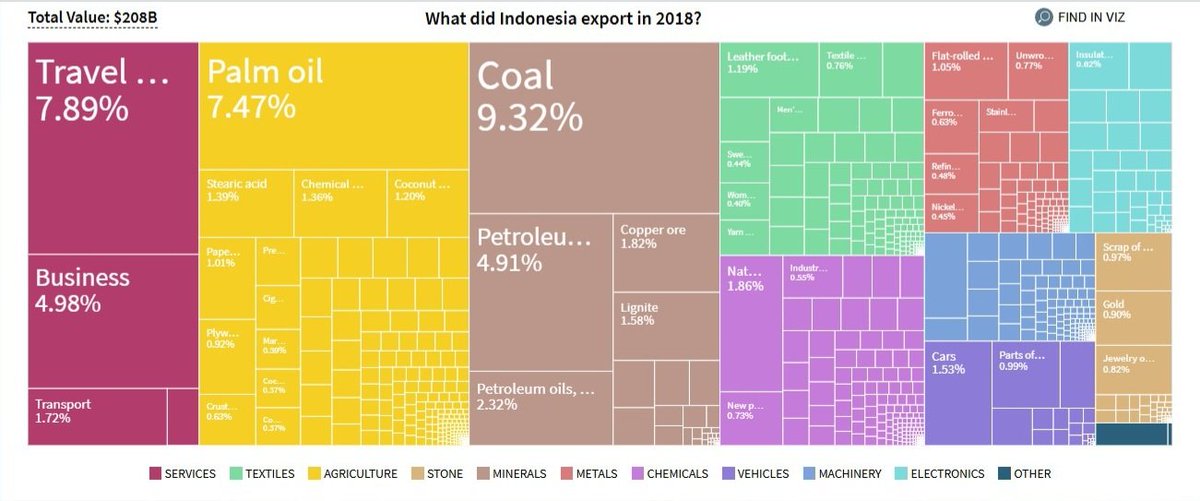
Here’s Indonesia’s export profile in 2018
We’re mainly a commodity-based economy, with slightly over half of our exports being coal, palm oil (CPO), gas, and various metal ores
Batik Air flight ID6723, an Airbus A320, was out of radio contact for almost half an hour during a domestic flight in Indonesia with both pilots being asleep.
This happened on January 25 on the second leg of a return flight with the copilot as Pilot Flying. The captain was taking a nap with permission from the copilot when the copilot also fell asleep. Contact was restored after the captain woke up.
The copilot had advised the captain that he did not have proper rest before the night time flight. His sleep had been interrupted when he assisted his wife to take care of their one-month-old twin-babies.
https://t.co/bgs1z5YYFe
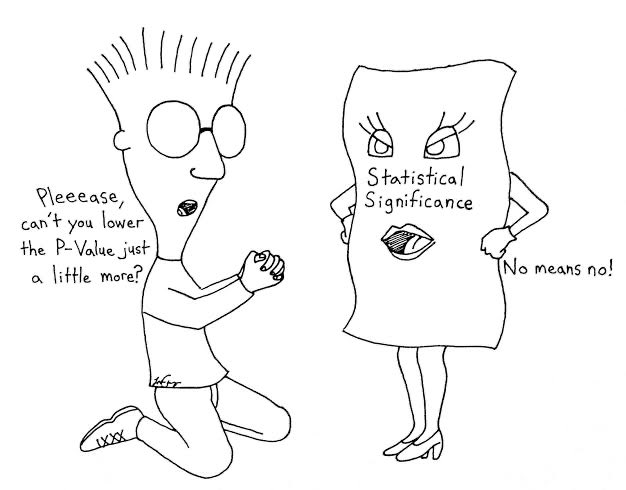
Why We Use p<0.05
🔹 Ever wondered why scientists often use p<0.05 as the threshold for statistical significance? Let's dive into its history, implications, and alternative approaches.
🔹 The p<0.05 threshold can be traced back to Sir Ronald A. Fisher in the 1920s. He suggested the 5% level as a convenient boundary for significance. However, it's important to note he never intended for it to become a rigid rule.
🔹 The p value tells us the probability of obtaining our observed results (or more extreme) if the null hypothesis is true. So, p<0.05 implies there's less than a 5% chance our results happened due to random variation alone.
🔹 However, there are critiques. Relying solely on p<0.05 has led to "p-hacking" - tweaking experiments to achieve this threshold. It's also been implicated in the replication crisis, where many scientific studies couldn't be reproduced.
🔹 So, is p<0.05 the correct way to test a hypothesis? Well, it's a tool. When used correctly and with understanding, it can provide valuable insights. But, like any tool, it has limitations.
🔹 Some suggest a more flexible approach:
•Using different thresholds depending on the field or study.
•Looking at effect sizes alongside p-values.
•Emphasizing confidence intervals to provide a range of plausible values.
🔹 Bayesian statistics is another approach. Instead of frequentist's p-values, it provides a direct probability statement about the parameter in question using prior information and observed data. This can sometimes offer a more intuitive understanding.
🔹 In conclusion, while p<0.05 has historical significance and is widely used, it shouldn't be the sole determinant of a study's validity. Science is ever-evolving, and so should our methods and understanding of data interpretation.
🔹 As always, critical thinking is key! Don't just take p<0.05 at face value. Dive deeper, understand the context, and consider alternative methods when interpreting results.
#DataScience #Statistics
What are global public goods? Something that everyone can use and benefit all of us, like access to fresh drinking water, education, roads & bridges.
A century before @GameofThrones, there was Ser Duncan the Tall and his squire, Egg.
Executive produced by George R. R. Martin, Ira Parker, Ryan Condal, and Vince Gerardis, A Knight of the #SevenKingdoms: The Hedge Knight has received a straight to series order. #StreamOnMax