🚨A few devs just built the Pokémon game that Game Freak refuses to make
@pokeidleio lets you earn real USDT from catching rare Pokémon-style creatures
Catch a rare Pokémon, list it on the marketplace, someone buys it and you receive usdt
The mechanics that make this actually interesting 👇
> Each Pokémon has three differentials: IV, quality and power
> Shinies are naturally strong and genuinely rare, not just cosmetic
> PvP ranked battles and Guild wars
Currently in beta with a reset before official launch
Still early, built on Solana, real USDT rewards
Would you play this?
BLACKROCK CEO LARRY FINK: WHY CHINA IS WINNING THE AI POWER RACE
He says the AI race will come down to who can build enough electricity fast enough:
- China is building 100 gigawatts of nuclear and close to 100 gigawatts of solar
- Fink says China is getting set up for the AI revolution and the power it needs
- He says moratoriums are not the answer, the focus should be delivering more power quickly without raising electricity prices
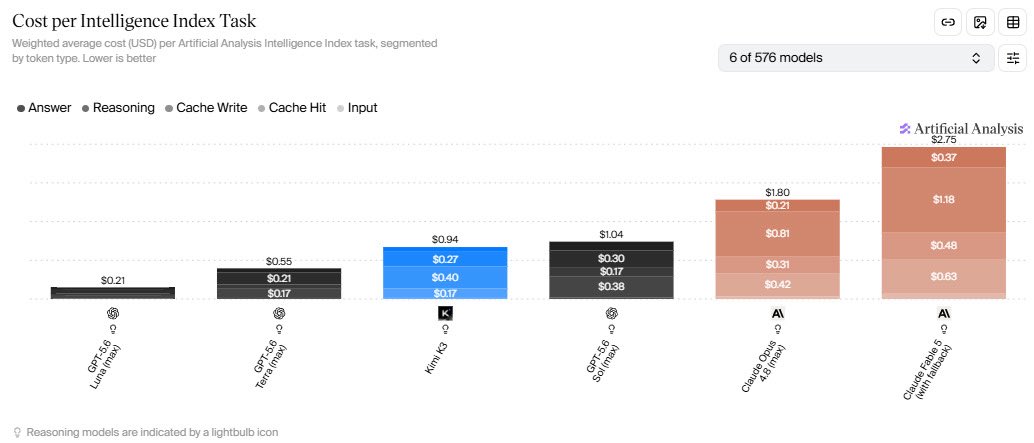
Kimi K3 may be an important inflection point for AI. Potentially negative for Anthropic and OpenAI while being net positive for essentially every other company in the world. I mean that very literally. Although the real “Sputnik moment” would be an open-source frontier model that was also token efficient unlike Kimi K3 which is 50-70% more expensive to run than GPT 5.6 per Artificial Analysis.
Rationale:
A world where there are only 2-3 dominant frontier labs with 90% inference margins is net negative for every other layer while being awesome for those 2-3 labs. Those labs would become monopsonies for power, data centers, semiconductors and hyperscalers and would obviously vertically integrate over time into all those layers while also completely subsuming the application/software layers.
Anything that lowers margins and increases competition at the model layer is good for every other AI layer: power, semiconductors, hyperscalers, neoclouds and yes even software.
This is why Jensen is so supportive of open-source. An open-source model requires the *exact* same amount of compute to run as a closed frontier model of similar size and architecture. Kimi K3 is roughly the same price as GPT 5.6 Terra on a per token basis, which actually suggests that it is less computationally efficient as I am sure that GPT 5.6 is priced to a higher margin than K3. And given that K3 is a token wastrel, i.e. token inefficient, it is significantly more expensive per task than GPT 5.6 and Grok 4.5, which are much more token efficient. Cost per token and token efficiency (i.e. intelligence density per token) are the drivers of intelligence per unit of cost. The winning AI companies will be those that offer the most intelligence per $ over time.
Lower margin % at the model layer = more margin $ at every part of the infrastructure layer and is a godsend for software. This can happen either through open-source models like K3 at the frontier *or* having a vertically integrated model company like Meta, SpaceX or Google at the frontier. Both outcomes result in a lower margin % at the model layer as vertically integrated model companies don’t really care where the margin $ come from. This is why it was so painful for OpenAI and Anthropic when Google was right there with them from a model competitiveness perspective and why Grok 4.5 and Muse 1.1 were just as important as Kimi K3.
The reason Kimi K3 is only *potentially* negative for Anthropic and OpenAI is 1) the @ericvishria point that the Claude and ChatGPT products and harnesses may be more important than their models today and 2) the hypothesis that they have much more advanced model checkpoints internally that are already being used for RSI. In the latter scenario, reaching RSI even a few months ahead of other labs might be enough to cement a permanent lead.
Time will tell on both points. And likely fairly quickly.
Caveat would be that since Kimi K3 is not token efficient and thereby actually more expensive than ChatGPT 5.6, we may need to see a more token efficient open-source model at the frontier or see Grok 5/Composer 4/Muse 2 at multiple points on the Pareto frontier for this potential risk to Anthropic and OpenAI to play out. And I am sure they will both vertically integrate as quickly as possible while continuing the product/harness strength they have shown over the last 8 months.
Some observations on Kimi:
1. It's a very good model! I don't think its performance can be explained away by distillation or anything like that. In agentic coding sessions, it seems pretty much on par with the best public models of Q1 2026. In my fairly limited use, it also seemed very token hungry. It's not obvious to me that this model is actually that cheap to run.
2. I am personally surprised the Chinese state continues to allow the open sourcing of models this good, given potential risks. To be clear, I *myself* might be fine with models presenting this level of marginal risk being open weight, but I am surprised that China is fine with it. I suspect the reason they are is 75% explained by strategic blindness/lack of AGI-pilledness (the CCP is very Yann Lecun-y in its views of AI). The other 25% or so is their lack of compute for customer inference (making China's open-weight strategy an unintended byproduct of US export controls) and the normal Chinese strategy of aggressive exports. For the companies, as opposed to the government, the decision to open source is partially ideological and partially because they are behind, and they know that very few people would pay for sub-frontier models from China.
3. Open-weight models are inherently decelerationist, and I'm continually surprised to see the so-called "accelerationists" so excited about open-weight models. I suspect the reason they are is that they know open-weight models are effectively ungovernable, and they simply like the overall cloak of ungovernability open-weight models create over the whole of AI. It's not a bad strategy; it reminds me of James Scott's recounting of the hill people in "the art of not being governed." Still, in the end, open-weight models deter further AI capex.
4. One probable outcome of an open-weight-model-dominant world is full AI communism, which is precisely what China proposes: rather than a market product, AI is a "public good" which will ultimately be provided by the state as a kind of "digital public infrastructure." This future strikes me as a dystopian hellscape, but I've never met an open-weight models advocate who doesn't ultimately concede this is where things end. You'd be surprised how many 'accelerationists' lobbied me, while I was in government, to support an eleven or twelve-figure federally funded data center so that startups could train models at a subsidy and then give them away for free. There was no other way for AI to progress, they said. Perhaps this is the logical end state of things. Nonetheless, I find myself surprised to see supposed accelerationists excited about such an outcome. I think many of them just don't know what they're doing. Many accelerationists do not view the creation and serving of frontier models as a legitimate business.
5. I would guess that the Trump Administration will at some point realize that their best strategy here would be to create large amounts of regulatory risk around the use of open-weight Chinese models. You don't need to "ban open source" (one of the dumber motifs of AI policy discussion). You just need to direct every agency to issue soft law that creates FUD. "A Federal Reserve Advisory Bulletin found that there may be backdoors in Chinese AI models." It needn't be that well justified. You just create enough regulatory risk that every regulated enterprise backs off. You probably don't want to create so much regulatory risk that you scare off the hyperscalers from serving Chinese models; this will just drive startups to sketchier providers. There's a happy middle ground here. I'd assume they will do some version of this.
6. It's probably true that open-weight models of this capability make the world a bit more dangerous, but not so much more that you'll really notice. At some point the models will be capable enough that you will notice. "A nonliving, invisible, dangerous, and infinitely self-replicating agent escaped from a Chinese lab," you say? Color me shocked.
Chamath Palihapitiya thinks demand for $META and $SPCX LLMs will increase
Calls OpenAI and Anthropic tokens “too expensive for most use cases.”
Full quote:
“At some point, the downstream ecosystem and the ultimate buyers of these tokens also need to make money.
Think of AI as oil. A ‘barrel of intelligence’ is one million tokens. Anthropic and OpenAI may charge around $26, while Anthropic’s latest model costs roughly $56.
Elon is selling that same barrel for around $1. Zuck is about to sell it for $1.50. Google is trying to sell it for $1, and Chinese companies will sell it for $0.50.
This rationalization has to happen. Companies relying on expensive models and passing those costs on to customers may eventually run into downstream difficulties.
Everyone in this ecosystem is still trying to determine how to price AI so that the ultimate buyer can make more money and grow faster. That remains an open question.”
Morgan Stanley: The Space Supply Chain
Could Space X become the NVIDIA of the space trade in the sense that value accrues to the supply chain like we saw in AI this year? Probably not. I remember a McKinsey report from 2022 arguing semis should capture 60% of value from the AI stack, and I am not sure the same dynamics appear in space. The key takeaways from the report are as follows:
→ MS adds Space X as the biggest name on the Space 60 at a 300 PT, and the SOTP is Space 8, Connectivity 128, X and Grok 12, Enterprise AI 152, so the launch business is 8 dollars of the target and the enterprise AI leg carries a 50% execution discount on a 2040 forecast
→ The whole list is priced off the out years not the near ones, SPCX 379x forward, BA 726x, MP 180x, YSS 318x, HAWK 381x, ASTS 123x sales, against a US Space Force budget rising 77% y/y to 71bn and global successful launches at 317 in 2025 off a 25% five year CAGR
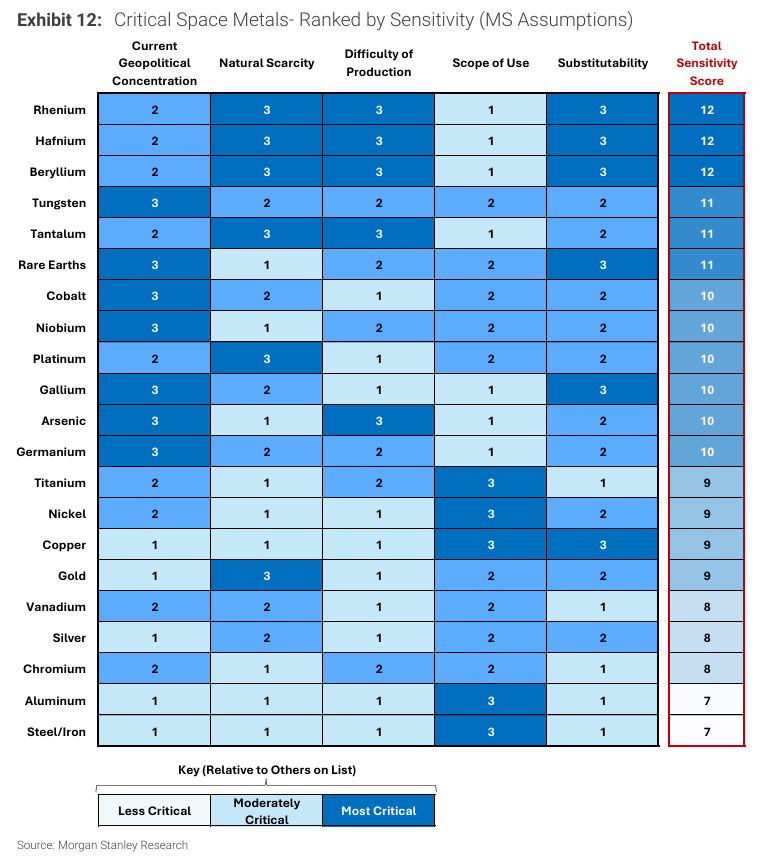
→ Raw materials is the layer MS frames as the real moat, China 99% of primary gallium and 80-90%+ of tungsten and germanium, and their sensitivity table ranks rhenium, hafnium and beryllium highest with tungsten, tantalum and rare earths next, though MS notes space metal demand is trivial against total global metal demand and Alcoa and Almonty are already standing up non China gallium and tungsten
→ Gas and specialty materials are the quantified suppliers, Linde already at more than 4 of 5 US launches and space its largest merchant customer by 2027, Air Products at 40-50% of US propulsion, Materion at 85% of historical beryllium with space sales up 5x in three years, ATI and Carpenter over 60-68% aero and defense
→ The consolidation is real, Qorvo to Skyworks, Iridium to Rocket Lab at 8bn, Globalstar to Amazon at 11.6bn, Teck into Anglo, and NVIDIA and Google are pushing compute into orbit via the Space-1 Vera Rubin module and Project Suncatcher TPUs by early 2027
One thing that I wonder is if we will get a "Sputnik 2.0" moment. If the vision for Space X is to "convert energy into intelligence at scale", then it is fundamentally a part of the national security push for AI by government being sponsored, and the original Sputnik funnelled 75% of the era's 500% gainers into two super sectors, rockets and electronics. These are the things we have to think about to justify the current valuation…
Shocking stat of the day:
Nvidia, $NVDA, Micron, $MU, Broadcom, $AVGO, and Applied Materials, $AMAT, are now expected to generate a record $430 billion in combined free cash flow (FCF) over the next 12 months.
That would be more than TRIPLE the FCF they generated just 2 years ago.
At the same time, the combined FCF of Amazon, $AMZN, Alphabet, $GOOGL, Meta, $META, Microsoft, $MSFT, and Oracle, $ORCL, is projected to turn negative for the first time on record.
That would mark a massive reversal from the +$260 billion peak reported by these companies in 2024.
This comes as AI-related CapEx by these 5 companies is estimated to surge to ~$1.8 trillion in 2026 and 2027 combined.
Chipmakers are becoming cash machines, while AI giants are burning record amounts of capital.
Apparently, Korean Beauty was where all the alpha is.
APR (278470.KS) is up 529% over the past 2Y, wildly outperforming both $NVDA and $INTC.
Every female I know talks about their "Medicube" stick, then buying products... where you put a whole salmon's family tree on your face for better skin.
The world's female population creates a bigger structural demand than hyperscalers for memory or lasers? Should have known...
Interesting shortage mapping by Goldman Sachs
For bottleneck investors…
⸻
Where tightness is strongest
1. Memory
DRAM and NAND show the most extreme pricing power:
- DRAM: +250–300% like-for-like in 2026, +300–350% ASP including mix
- NAND: +200–250% like-for-like in 2026, +250–300% ASP including mix
Tightness continues into 2027, especially for DRAM
Main beneficiaries:
SK Hynix, Samsung, Micron, plus Kioxia/Western Digital for NAND
⸻
2. Substrates
ABF, PCB and CCL all show strong price increases and very tight supply/demand into 2027
Main beneficiaries:
Ibiden, Shinko, Unimicron, Nan Ya PCB, Kinsus, AT&S, Elite Material, ITEQ, TUC
Glass substrates are next, by the way
⸻
3. Optical cables and devices
Optical cables, optical devices and InP substrates all show tightness and positive pricing
Main beneficiaries:
Coherent, Lumentum, Fabrinet, Innolight, Eoptolink, Amphenol, TE Connectivity, AXT, Sumitomo Electric
The chart is more bullish for optical cables, optical devices and InP than for generic connectors
⸻
4. MLCCs
MLCCs are also moving into very tight conditions, with positive pricing into 2026 and 2027
Main beneficiaries:
Murata, TDK, Taiyo Yuden, Samsung Electro-Mechanics, Yageo
⸻
5. Materials
T-glass, CCL copper foil, tantalum powder and silicon wafers show signs of tightening
Main beneficiaries:
Nitto Boseki, AGC, Mitsui Mining & Smelting, Shin-Etsu, SUMCO, GlobalWafers
🚨 THE ENTIRE AI BOOM MIGHT BE BUILT ON FAKE REVENUE.
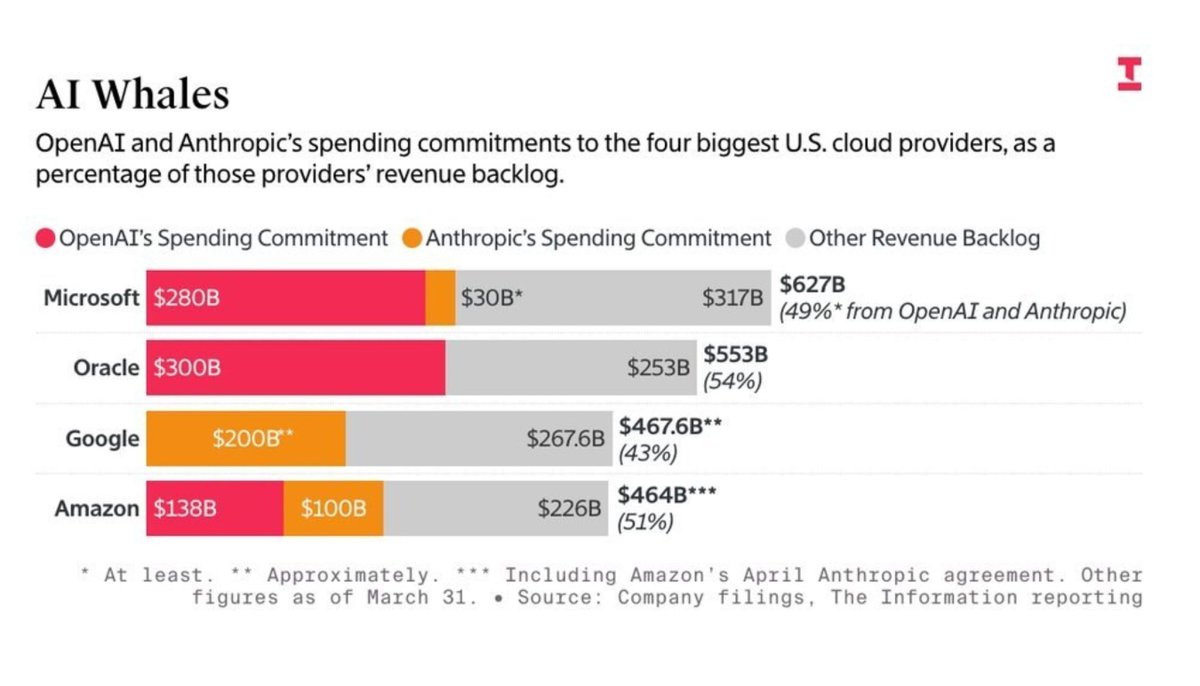
Latest corporate filings show that OpenAI and Anthropic alone make up over half of the entire $2 trillion future cloud backlog held by Microsoft, Oracle, Google, and Amazon.
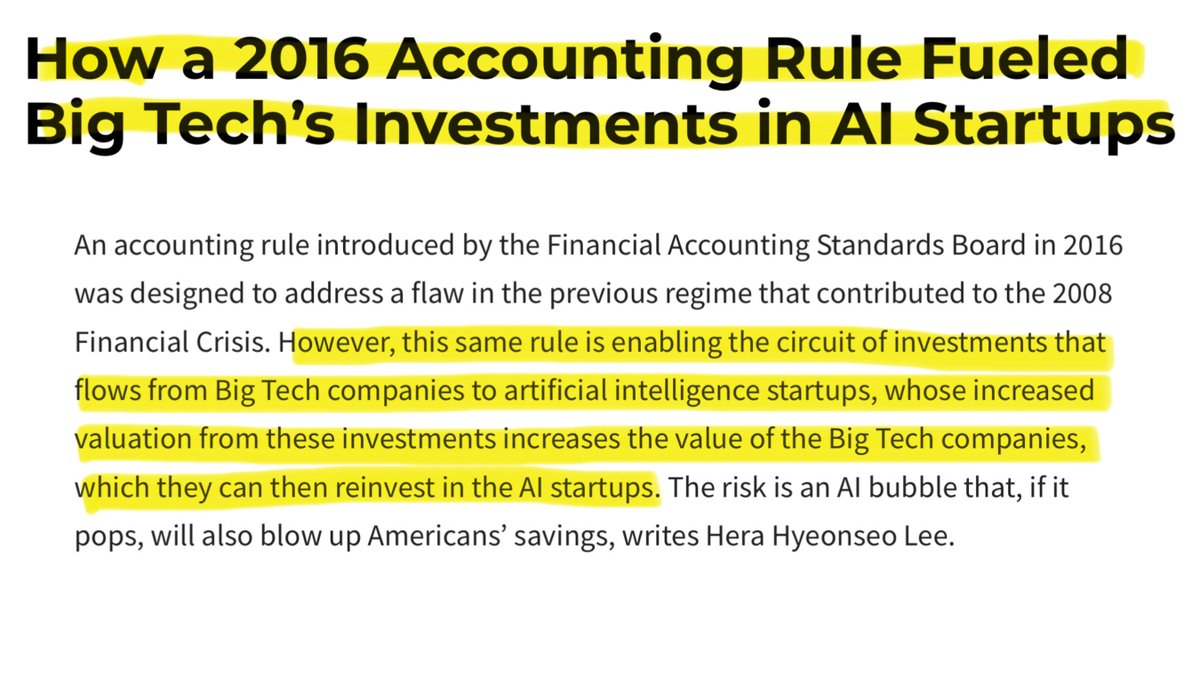
This massive pipeline is actually being created through a circular accounting trick called a round trip revenue loop.
But how it works ?
A tech giant gives billions of dollars to an AI startup as an "investment". But hidden in the contract is a strict rule forcing the startup to hand that exact same money straight back to the tech giant to rent their computer servers.
Look at the documented case of Microsoft and OpenAI.
When Microsoft invested $13 billion into OpenAI, it didn't just give them cash; it gave them "cloud credits" to use Microsoft servers. OpenAI used those exact credits to train its AI models, and Microsoft then turned around and recorded that server usage as brand new "cloud revenue" from a customer.
The tech giant is literally paying itself with its own money and calling it a sale.
This is why OpenAI’s annual cloud bill has ballooned to over $60 billion, double its actual revenue of $25 billion, kept alive solely by this recycled funding loop.
Anthropic runs the exact same play, spending $2.66 billion on Amazon Web Services in just nine months, which was basically 100% of all the money it earned at the time.
This manufactured demand triggers a second accounting trick where tech giants book massive paper profits. Every time a startup gets a higher value from a new funding round, the tech giant updates the value of its investment on its books and counts that unearned paper gain as direct profit.
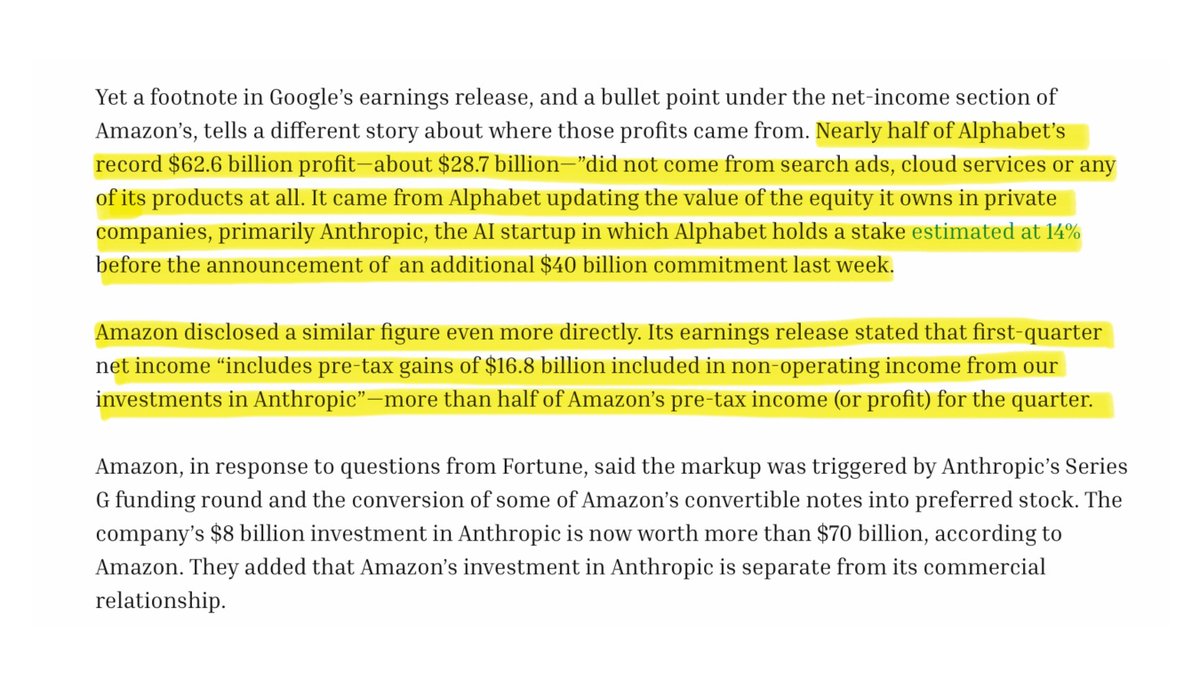
In Q1 2026, Alphabet reported a record $62.6 billion profit, but $28.7 billion nearly half, was just a paper markup on its Anthropic investment. In the same quarter, Amazon reported $30.3 billion in profit, but $16.8 billion of it was just an Anthropic paper gain.
While Amazon reported record profits, its actual free cash flow collapsed 95% to just $1.2 billion because it had to spend $44.2 billion in real cash to build physical data centers.
This has created a massive danger where these giant companies rely heavily on just one or two unstable startups. Microsoft has 49% of its $627 billion future backlog tied to OpenAI, while Oracle has an incredible 54% of its entire $553 billion pipeline relying on OpenAI alone.
This perfectly mirrors the 2001 dot-com crash when Global Crossing and Qwest Communications swapped identical fiber-optic network capacity with each other just to book fake sales.
Qwest had to erase $1.4 billion in fake income, and Global Crossing went completely bankrupt.
The only difference is that the dot-com swaps were illegal, but today's AI loop is fully legal under current accounting rules.
This legal loop inflates tech company stock prices, forcing automatic retirement accounts and index funds to buy even more of these tech stocks. It is a self feeding loop where investments, sales, and stock prices all go up on paper without the AI technology ever making real cash profits.
🚨 LEOPOLD ASCHENBRENNER IS OFFICIALLY BETTING BILLIONS THAT THE AI HARDWARE BOOM HAS PEAKED.
The exOpenAI researcher who was fired for warning that China could steal their AI models then turned $225 million into $5.5 billion in 12 months just filed his Q1 2026 13F with the SEC.
One quarter ago he had $5.5 billion in disclosed equity exposure. As of March 31, 2026 that number is $13.67 billion. The portfolio nearly tripled in a single quarter across 42 positions.
He initiated $7.46 billion in put options against every major semiconductor company between January 1 and March 31, 2026.
None of these positions existed in his Q4 2025 filing.
- SMH VanEck Semiconductor ETF PUT: $2.04 billion
- Nvidia PUT: $1.57 billion
- Oracle PUT: $1.07 billion
- Broadcom PUT: $1.01 billion
- AMD PUT: $969 million
- Micron PUT: $583 million
- Taiwan Semiconductor PUT: $535 million
- ASML PUT: $494 million
- Intel PUT: $159 million
For the past 18 months Aschenbrenner was betting only on electricity, memory, compute, and physical data center infrastructure. That made him one of the best performing fund managers in the world. And his long stock book still reflects that exact same thesis.
- Bloom Energy: $878 million
- SanDisk: $724 million
- CoreWeave: $556 million
- IREN: $401 million
- Core Scientific: $389 million
- Applied Digital: $320 million
- Riot Platforms: $142 million
- CleanSpark: $104 million
- Solaris Energy: $62 million
- T1 Energy: $43 million
- Bitfarms: $38 million
- Bitdeer: $29 million
- Power Solutions: $26 million
- WhiteFiber: $20 million
- Babcock and Wilcox: $19 million
- SharonAI: $18 million
- ProPetro: $13 million
- Hive Digital: $6 million
He is also running call options on specific names at the same time as his puts, which means he is not simply betting against semiconductors everywhere.
- Micron CALL: $422 million
- SanDisk CALL: $388 million
- Taiwan Semiconductor CALL: $354 million
- CoreWeave CALL: $140 million
- Bloom Energy CALL: $55 million
This means he believes the companies supplying power, storage, and compute to the AI industry still have years of growth ahead of them.
But the chip companies that Wall Street has been buying for the past two years at record valuations have already priced in everything good that is going to happen to them.
The man who has been right about every major AI trade for the past 18 months is now betting that the biggest names in semiconductors are about to fall.
If his track record means anything, the chip stocks Wall Street has been buying for the past two years may be in serious trouble.
How high will inflation go?
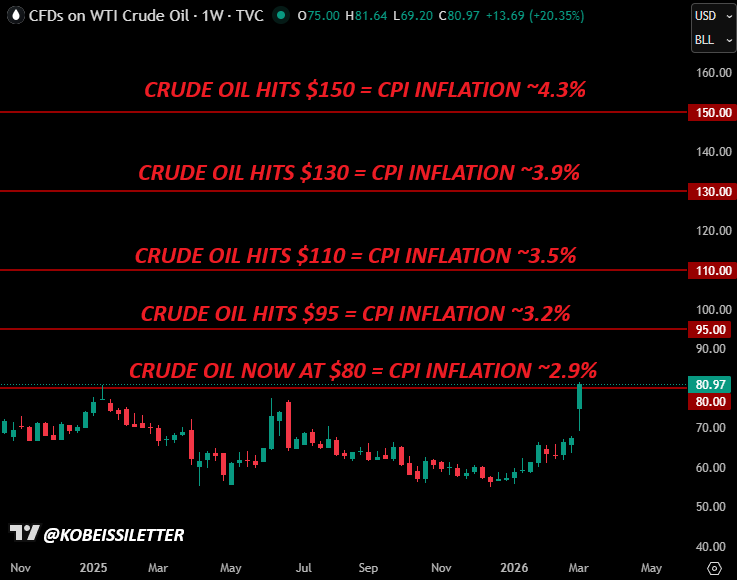
According to a recent Fed study, every $10 rally in oil prices can increase inflation by ~20 bps.
Oil has already surged from $55 to $80 per barrel, implying +50 bps of inflation pressure.
This could push CPI from 2.4% to ~2.9%.
When oil prices rise above $90/barrel inflation becomes hotter, with ~3.2% inflation expected at $95/barrel.
Our chart and below Article summarize why oil prices are now the key leading indicator to watch.
Inflation is heating up.
Family offices are invisible. But they've shaped the technology you use every day.
Li Ka-shing's family office (Horizons Ventures) was an early investor in Facebook, Spotify, Zoom, Skype, Siri, and DeepMind — before any of them were household names. His $36M in Zoom became an $11B stake.
The Pritzker family office (Tao Capital) was an early backer of Tesla, Uber, and SpaceX.
Jeff Bezos invested $250K in Google in 1998 through what became Bezos Expeditions. That stake is now worth over $3B.
Suhail Rizvi's family office quietly acquired 15.6% of Twitter before its IPO — a stake worth $3.8B on day one. He also held pre-IPO positions in Facebook, Square, and Snapchat. Most people have never heard his name.
The Newhouse family office owns Reddit. Kapor Capital — built on the Lotus 1-2-3 fortune — was in Uber's angel round.
These aren't venture capital firms. They're family offices.
Patient capital. No fund lifecycle. No LP pressure. Multi-generational time horizons.
One-third of all capital invested in startups worldwide now comes from family offices (PwC, 2022).
And yet most people — including many in finance — don't know what a family office is or what they do.
F0256. March 30th. West Palm Beach.