@tradeguru@VitalikButerin The progress is glaring. The quantum swaps are my favorite but is what @soqucoin mean that swaps to $SOQ are not quantum protected but swap out are?
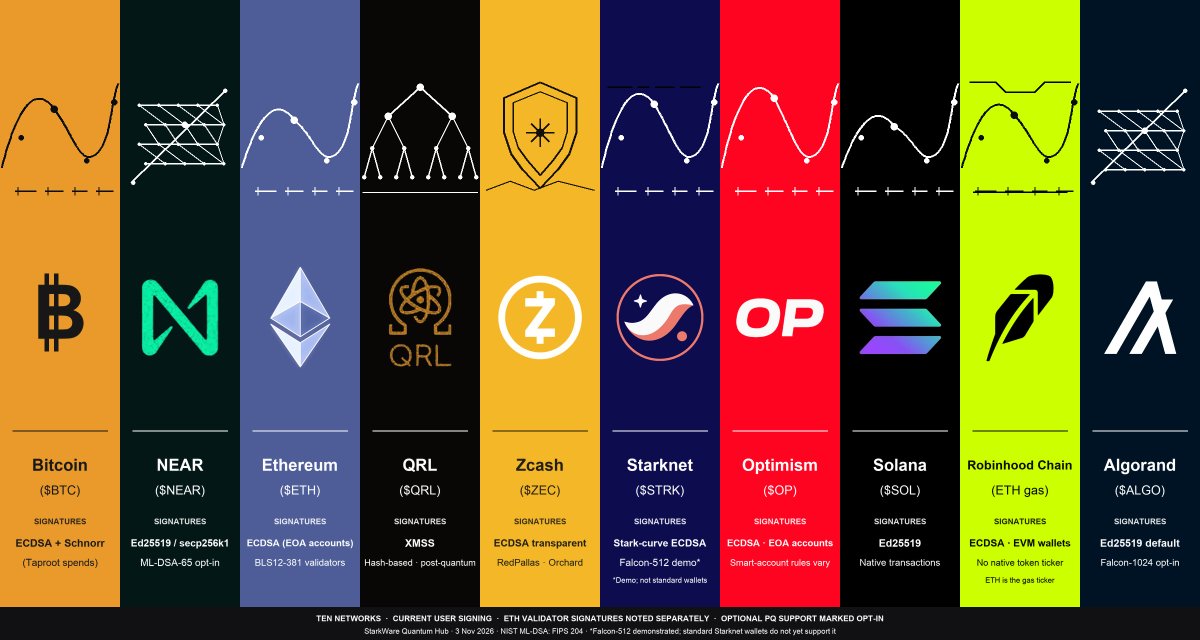
Quantum progress is expanding across crypto.
- @VitalikButerin is pushing leanPCS as a faster path that could run through EIP-8288, which would let a STARK proof be verified for only about 20 to 40K gas.
- Bitcoin has a new improvement proposal, BIP-362, that labels which BTC, address by address, has a public key exposed to a quantum attacker.
- @Cardano's technical committee voted to commission a post-quantum research report, on how quantum computing affects the ecosystem, and a proposal (CIP-0206) to add post-quantum signature (ML-DSA and SLH-DSA) checks to Plutus, its smart-contract language.
- At Devcon, @drakefjustin said the hope is to finish Ethereum's full post-quantum switch by December 2028. Oficial deadline in the books is still 2029.
- @Algorand's latest test release, v5.1.0-beta, builds in support for quantum-safe signatures (Falcon-512 & ML-DSA) and hybrid wallets that can use both old and new keys
- @Stacks moved sBTC on mainnet with a post-quantum signature (Lamport) through an experimental vault, with no protocol upgrade.
- @QuantusNetwork's mobile wallet now swaps in and out of native QTC, with new accounts defaulting to ML-DSA-87.
- @MetisL2's post-quantum Hybrid Rollup is live on Devnet, with ML-DSA planned for sequencer signatures and a testnet targeted for Q1 2027.
- @StellarOrg's new protocol upgrade, Bell, comes with a quantum feature that lets applications verify ML-DSA signatures.
- @Americanfort_io desktop beta (v26.6.0) with @name sends, to launch quantum-resistant signing.
- @ProjectEleven added Strongpoint MPC, a post-quantum threshold signing, inside its institutional custody platform.
stay tuned for more
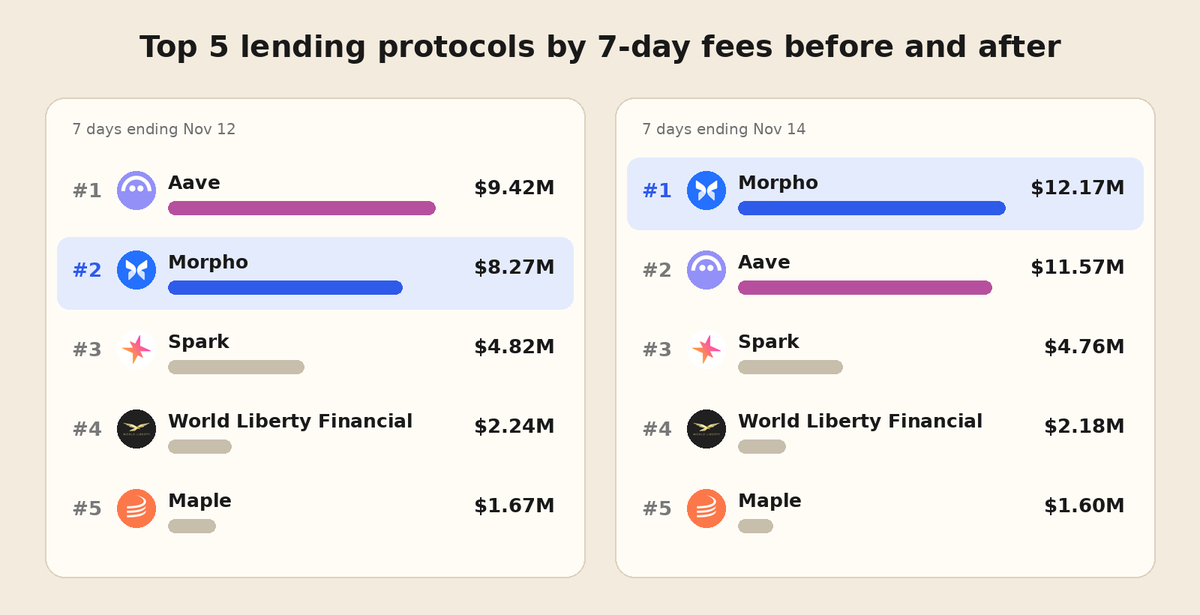
JUST IN: @Morpho surpassed @aave in 7-day fees with a 5.2% lead, $12.17M vs $11.57M.
The jump came from Base. Morpho's daily fees there usually ran between $0.33M and $0.75M, then hit $1.63M on Nov 13 and $2.92M on Nov 14. That's 65% of the week's fees from one chain, and no other chain moved like that on Morpho.
cc: @DefiLlama
8 in 10 crypto workers put in 40 to 50 hours a week, and for traders it doesn't even stop at bedtime.
68% check prices after going to bed and 81% have lost sleep waiting on a trade.
truth is, many of us are putting in the hours, but not much of it pays off.
bottom feeders grind hard and still earn little. ex; writers, community managers, BDs, etc. just big writers average about $45K a year, while the rest fight over a handful of openings willing to pay $10 for 10 posts.
then if you want to move up the food chain a bit to where there is plenty of jobs, you'd find there's smaller paychecks. ex; marketing or analysis for VCs, research hubs, news blogs, etc. the seats are there, only that the money just isn't at the top.
okay maybe you want big pay but can live with fighting over a few job openings, then become a DevOps or smart contract dev. both clear around $100K, only that openings are scarce and often on-site or regionalised.
but if you want the pay and a larger number of job openings, learn Rust or security. Rust devs average about $115K with more openings than almost any other role in crypto.
sources: salaries data from @CryptoJobsList, job posts from @Web3Career, hours from @TechFlowPost, trader sleep from @cex_io
I saw this template from one guy and immediately thought of a crypto version of it.
https://t.co/JtD5Uoodx8
Privacy is going to be the biggest moat for onchain economy in years to come
Below is @NEARProtocol's intents daily volume and within two months, public intents became almost obsolete as more users switch to confidential txns
More and more people will incoporate this!
Under-Explored Quantum Ecosystems #2 - @QuantusNetwork
Quantus has no smart contracts but an ecosystem formed around it anyway.
The secret sauce behind almost every defi-related thing you can do in the ecosystem, is powered by @NEARProtocol.
Let's take a look ↓↓
________
Part one was @QRLedger, a chain that has run on hash-based signatures since 2018.
This one's is a much younger chain with a very different ecosystem built on top.
Quantus is:
- a PoW L1 built only yo move money
- mainnet genesis went live September 9th this year
- every transaction on the chain is signed with ML-DSA; ML-DSA-87 for new wallet accounts, and ML-DSA-65 is also supported.
- it has no smart contracts, by design
- $QTC is the only native asset
So what could grow on a chain built only to move money?
1. An Ordinals-style protocol on a chain without smart contracts: @qlyphsxyz
Since tokens cann't be launched on iQuantus, Qlyphs got around that the way Ordinals did on Bitcoin. Their rules, QLYP-v1, ride on normal QTC transfers, and their indexer reads the whole chain to keep track of who owns which token.
That one idea grew into an economy:
- there are Quarks, numbered one-of-one pieces stored inside transactions since 9 Oct
- there's a launchpad where 0.03 QTC starts a token on a bonding curve, and it graduates to a NEAR pool once the curve fills at 210 QTC
- on top of that, they built a wallet, a Telegram bot and an OTC desk.
The catch is that the chain doesn't know these tokens exist, so your balance depends on Qlyphs' servers, not Quantus.
@Quantinals_ runs another inscription protocol like this, with $QNTS on the trust model.
2. DeFi lives on NEAR
Since Quantus can't run DeFi itself, QTC goes to NEAR for it as a wrapped token. It first traded there on 6 Oct through @near_intents, which now handles swaps from 180+ assets inside the official Quantus wallet and has passed $50M in Quantus volume.
.@rhea_finance added a QTC/USDC pool, the first QTC lending market at up to 60% LTV, and a Quantus-NEAR bridge.
.@MeteorWallet, @auroraisnear and @InstaSwap_io give people more ways to swap in and out.
The bridge between quantus and near is still being built. Also, once QTC leaves Quantus, it loses the chain's post-quantum protection and is only as safe as wherever it sits.
3. The wallet race
For a money-only chain, the wallet is the app. There are already several:
- the official Quantus wallet with in-app swaps and about 16K installs
- Quantus cold wallet which turns an offline android phone into a QR signer
- @KeystoneWallet 3 signs Quantus transactions through firmware
- @Qkeep_app a community wallet
- Qlyphs wallet
4. Mining
In two months, 20 named pools have started mining QTC, including @KryptexMining, @HeroMinerss, @f2pool, @pool2miners and LuckyPool.
But look in the last 24 hours:
- Kryptex mined 60.0% of blocks (3,530 of 5,880)
- LuckyPool only 10.4%
- HeroMiners: 10.1%
- Unattributed: 16.5%
- F2Pool: 0 blocks
5. Explorers and tools
- quantus explorer and an open-source indexer (official)
- qtcscan: community explorer from the Qkeep team, with free JSON data on pools, supply and vesting
- Quantum Resistance Renaissance: a solo builder's hub of ~47 browser tools
- @miningchamp tracks Quantus pools and hashrate
I haven't personally expereinced the community but if i missed anything, pls let me know
Market Outlook #19
➥ THORChain's biggest week of 2026 came from North Korea.
Since the Binance hack, @THORChain's 7-day dex volume is up 222% to $1.48B, climbing to #4 from #27 the week before the hack.
Before the hack, it did just about $41.5M a day.
Volume jumped to $157M and $189M on 30 and 31 Oct as the first stolen TRX was washed through. Then THORChain halted, and volume fell to about $1M a day.
After it resumed on 3 and 4 Nov, volume ran at $180M to $308M a day. The biggest day was 6 Nov at $308M, as stolen XRP was swapped into bitcoin.
The latest full day, 9 Nov, did $279M.
I also noticed from their volume that about $800M is unexplained. My guess is likely: more stolen routes than investigators have published, plus arbitrage around those swaps, but nobody has a sourced breakdown yet.
https://t.co/4klF6L0tKN
let's talk about launchpad infiltration in this space.
the only reason @Enter_Elysium is getting traction right now is cause of extractors.
funny part? there is no official Elysium token or points.
the entire chain's value goes to $KNTQ. so what is everyone farming and who stands to profit the most from this madness?
________
quick context.
Elysium is @Kinetiq_xyz's L2 for Hyperliquid. it uses $HYPE as gas, and settles to HyperEVM right next to the HyperCore.
on Oct 19 they dropped the mainnet date for Nov 9, which is today.
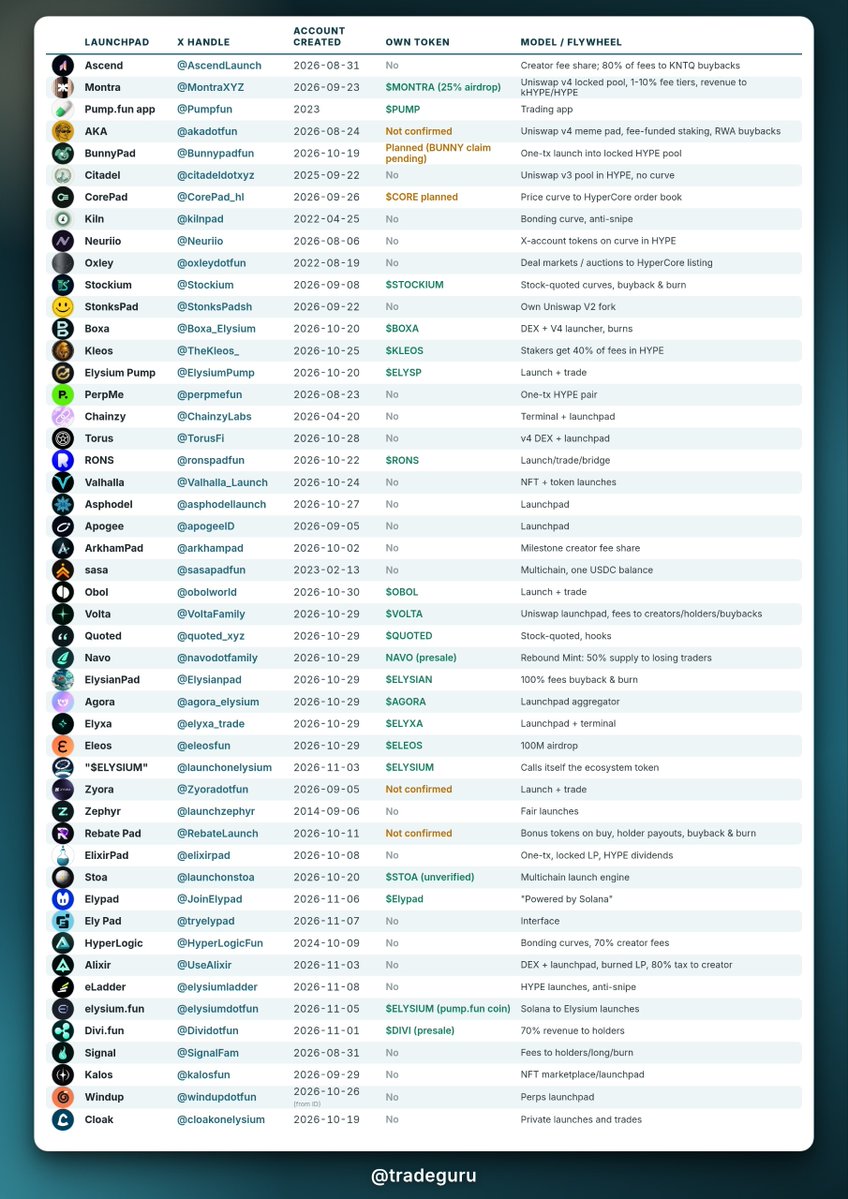
all the maps I've bookmarked however, showed launchpads at about 5 to 10. but they are waaay more than that.
the official Elysium ecosystem page alone tags 20+ projects as launchpads. add the CT mega lists and you have ~49 launch platforms with an X account, even before mainnet even opened.
you know the part that got me? it's the timing.
i went through every account creation date i could find:
> 26 out of 49 (53%) were created on or after Oct 19, the day the mainnet date dropped
> 8 of them in that exact week, one (@cloakonelysium) literally that same day
> 12 more the week after, 7 of them on ONE day (Oct 29), the day after @Pumpfun said it was coming to Elysium
> 6 in the final week, with even one of them created yesterday
it has been a 3 week land rush where half the launchpads on this chain were born.
pre-mainnet, the chain was already in soft launch and the pads were printing tokens like crazy. one tracker counted 15k+ new tokens in a single day (snapshot taken Nov 6) and 30k+ launches across all launchpads, with only 3 tokens above $1M mcap.
3 out of 30k? hold that thought.
are all of them grifters tho? certainly not.
but most of them are, and most of them will die like they did on Arc, MegaETH, Robinhood, and pretty much every new chain that would still launch.
okay, here's fcats from DefiLlama:
Arc (mainnet Sep 16)
- they had 34 launchpads
- 26 of them made under $1K in fees over the last 30 days. 21 made under $100
- the biggest one, @arguspad, did $2.33M in fees on launch day. Now it does about $3K to $4K a day
- Arc's DEX volume peaked at $133.6M on Sep 17. now it's around $15M to $20M a day
MegaETH (mainnet Feb, $MEGA TGE Apr 30)
- dex volume peaked at $137.6M on Apr 30, TGE day. now about $0.5M to $0.7M a day
- @kumbaya_xyz, the main DEX that also shipped a launchpad pre-mainnet, did $125M on Apr 30. now about $0.4M to $0.6M a day
Monad
- 8 launchpads tracked. 7 made under $100 in fees in the last 30 days
- even @naddotfun did $1.63M in fees all-time vs $23K in the last 30 days
Plasma
- @DYORSWAPDEX's launchpad did $381K in fees all-time. last 30 days: $0
Robinhood Chain (the one everyone wants Elysium to be)
- 79 launchpads tracked. 54 made under $1K in the last 30 days, 49 under $100
- but @ponsdotfamily (Pons V2) did $10.04M in fees in the last 30 days alone. That's 87% of every launchpad fee on the chain
so let me probably correct myself. they don't ALL die. maybe one or two pads per chain eat everything (like Pons and Argus) and the other 50+ go to zero. that's the real pattern i see.
another pattern i've seen is that some of these pads are literally the same pads on a new chain:
.@Zyoradotfun was on Arc , now its bio says "live on Elysium", same as @akadotfun and @sasapadfun, who made $178 and $46 respectively in fees over 30 days. now they're on Elysium
.@RebateLaunch literally wrote "same pad, new ground"
let's now discuss the effects of lauchpad infilteration on chains.
1. attention fragmentation
pre-mainnet, about 134K HYPE ($10.4M) was sitting in the Elysium bridge. now split that across 49 launchpads, their own tokens, their own pools, and 15K new coins a day.
you figure every pool ends up thinner. the same meme gets launched on 3 pads at once. @AscendLaunch's co-founder had to address people waking up to copies of their coin trading on Ascend.
bottom line: attention splits, liquidity splits, and nobody gets depth. great for HYPE and KNTQ holders but not so great for the guy holding the 14,000th Elysium cat coin.
2. most of these launchpads are design copiers, not much new tech.
3. liquidity extraction
- at least 13 launchpads already had their own token before mainnet: $KLEOS, $BOXA, $ELYSP, $RONS, $VOLTA, $AGORA, $ELYXA, $STOCKIUM, $ELEOS, $ELYSIUM, $ELYSIAN, $OBOL, $QUOTED
- one of them is literally called $ELYSIUM (by @launchonelysium).
- presales everywhere
- the biggest pad pre-mainnet, @MontraXYZ, got hit with a bundling callout: 69 wallets held over half of $CHAMELEON and $EACCAT at peak and sold ~$415K into buyers.
4. some are here for grants, just in case there's some for builders.
- 25% of Elysium sequencer fees go to apps that consume the blockspace and a launchpad pumping out 15K tokens a day is the fastest way to "consume blockspace"
however, these are the credible ones people swear by:
- @AscendLaunch: no own token, 80% of fees to KNTQ buybacks, Cantina audit on its staking contracts. @ika_xbt called it the #1 launchpad of elysium". downside is it went live during private testing and caught heat for copies of other communities' coins
- @MontraXYZ: ~73% of all launchpad volume pre-mainnet, Uniswap v4, self-funded team, $MONTRA with 25% airdrop. @tradesgiving puts it at top tier. downside is it's anon team
- @VoltaFamily and @quoted_xyz
- @TheKleos_ and @Boxa_Elysium: early traction picks from people like @0xweekend59 and @thefinopps
sadly, that runner you're looking for might not be on Elysium and I'm afraid this chain might be promising but launchpads have become places where chain volumes go to die.
this might also kill @GIWA_by_Upbit too. they have about 28 and counting.
anyways, what's your take?
Crypto is hungry for real quantum progress.
I know because QuantumFi posts are printing the strongest mindshare, or at least mine did this quarter.
So here’s everything in one place, featuring 30+ protocols.
It is official.
Chains still running quantum-vulnerable public-key algorithms now have a deadline to switch to the recommended algorithm.
This is from NIST’s final report on the transition to post-quantum cryptography standards, and it asks @Starknet a fair question: if you are the most agile one, why are you still on elliptic curves?
____________
The simple answer is this. Starknet’s perfect agility score was not about already being post-quantum. It was about being able to switch cryptography without a hard fork.
By design, it can move from elliptic curves to the recommended algorithms. The work is still ongoing in stages.
Before that, let's walk through what NIST just locked in and what is already obtainable on Starknet.
On 27 October, NIST published the final version of Transition to Post-Quantum Cryptography Standards.
Two parts matter for high-impact chains:
> Quantum-vulnerable public-key algorithms are deprecated after 2030
> And are disallowed after 2035
The vulnerable designs include ECDSA, EdDSA, and RSA, still used by most wallets today.
As replacements, NIST points to:
> ML-KEM-768 as the default for keys
> ML-DSA and SLH-DSA for signatures
> LMS and XMSS for hash-based schemes
Starknet’s native account signature uses ECDSA on the STARK curve. That sits in the same NIST quantum-vulnerable bucket.
But Starknet already runs a post-quantum signer for every user, and the account can swap that ECDSA lock for something like ML-DSA or Falcon, while keeping the same address and funds on the chain.
They have already started the transition. Here is what is live so far:
1. The proving layer already uses STARKs, which are hash-based. That covers proofs, not account signatures.
2. Starknet v0.14.3 replaced Pedersen with a BLAKE2s-256 construction for OS program and configuration hashes. That is live on mainnet.
3. OpenZeppelin’s Falcon-512 accounts have moved real value on Starknet mainnet. Experimental and unaudited. Ordinary users cannot adopt it yet.
4. The Falcon Challenge cut verification gas roughly in half in under a week, which makes a post-quantum verifier cheap enough for real wallets to consider.
@EliBenSasson has been saying this for weeks; every chain needs to migrate.
Going post-quantum ready is no longer a choice. Five years from now, if your chain is still exploitable by quantum computers, it'd be serious a skill issue.