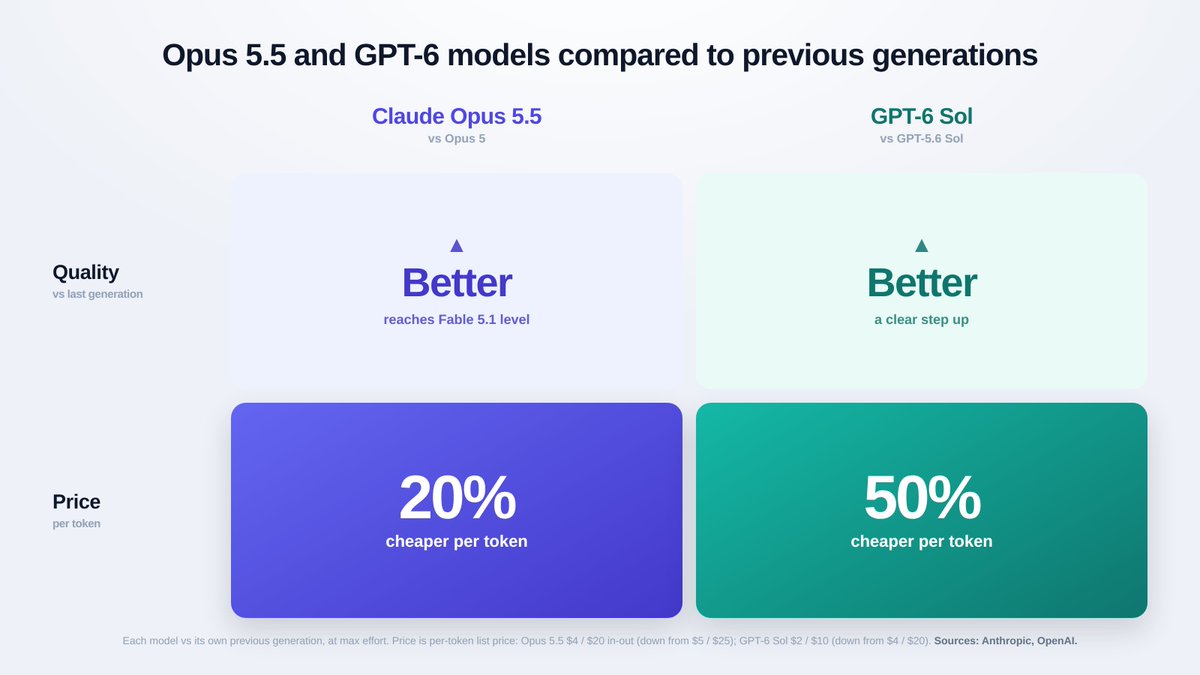
@openai and @AnthropicAI both shipped new models yesterday. Near-frontier intelligence keeps getting cheaper, fast.
Excited to see the workflows this unlocks.
we built muse from scratch, but it is definitely heavily inspired as a product by openclaw. After I used openclaw in january I bought hundreds of mac minis for the MSL team and lots of us fell in love with using openclaw (and other personal agents). @steipete is a genius and his harness was pioneering from the jump. I think a lot of people were inspired by it. our goal with muse was to build something like openclaw that we could make safe and secure and easy to use and scale to billions of people.
I had @Muse create an @amazon return this weekend - it saved me so much time (Amazon return flow is long as expected). I also taught Muse my return preferences and now it can create all my future returns. I just have to drop it off at UPS!
#musecase!
I'm testing @Muse with costco to automate grocery ordering but @Costco seems to block automated login with an invisible popup that Muse browser cannot get past. Any one else seeing similar in other websites?
@armand_ruiz@Muse Great list. I used my Muse yesterday to surface best books for my kid that are available in the local library. It even reserved the books for me and will notify me when they are ready for pickup. Wild!
Testing out @Muse and adding capabilities one at a time. It helped identify best library books based on my kid's interest and reserved them in my local library. It will notify me when they are ready for pickup. Wild! Persistent browser is the killer feature.
The @Apple iPhone lineup is getting hard to keep track of. Why not date them like cars?
A 2019 Miata (ND2) is still sought after. iPhones could do minor spec bumps each year and launch a new generation every 4 to 5 years. At $2k+ for these phones, they are priced like a car anyway.
@joshelman Great article, I especially liked this part:
> with a longer flow, won’t more people drop off? Yes! But the ones who get through are far, far more likely to actually use your product.
Curious if in larger companies different PMs may target different metrics?
The operative word in this interview with Kerr is balance. @rogerfederer has undeniable natural talent and work ethic to achieve success. Very inspiring to see him balance that with things he values - family and kids.
Steve Kerr says Roger Federer taught his Warriors team the secret to sustained success wasn’t outworking everyone, it was building a life around your craft you never want to escape from
“I’ll tell you a great story about Roger Federer. We were playing in China with the Warriors in 2017. Roger was in Shanghai for the Masters tournament, so we invited him to come speak to the team.”
“Draymond Green asked him, ‘How do you sustain success? How have you managed to win majors 20 years after you first won one?’ Everyone was expecting him to say, ‘I work harder than everybody,’ the will, all the clichés.”
“Roger Federer says, ‘I get up every morning and I make breakfast for my kids. Then I take them to school and drop them off. Then I go practice tennis for about two hours, and I’ve figured out a really good routine where I don’t destroy my body, but I can get all the work in I need.”
“‘Then I go have lunch with my wife. In the evening, we cook dinner together. The kids are all home from school. We ask them about school. There’s so much joy in the house. We put them to bed, and then I put my head on the pillow and go, “Man, that was just a great day.” And I’ve been doing that for 20 years.’”
“And it was like, yes. That’s it. That’s the formula. That’s what leads to sustained success. He loves tennis. He loves his family. He loves life. It’s not outworking everybody and banging your head against the wall, ‘I’m going to be better than everybody.’ It’s allowing your natural talent to shine through with a work ethic, with a great family life, with perspective, with peace, with mindfulness.”
“It’s perspective. It’s joy. It’s passion. It’s mindfulness. It’s an awareness that we are truly lucky. To get the most out of ourselves, it’s our daily rituals and experiences and love and joy.”
Astra builds an efficient DSL to solve problems in the ARC-AGI challenge. This feels very advanced and human-like behavior when solving complex problems - where communicating the problem and solution space is very important among members in a group.
GPT-6 Astra represents a step-function change in model capability for interactive reasoning problems. It scores 66% on ARC-AGI-3 using our standard harness, and nearly 100% with a continuous conversation harness and custom compaction, at a cost of roughly $360 per game.
In fact, the continuous harness version significantly outperforms our human baseline in action efficiency across almost all levels. When we examined the reasoning chains to understand how the model operates, we found it performing highly efficient, on-the-fly symbolic world modeling for each game and level. It goes as far as developing its own shorthand DSL to represent in-game situations -- essentially a game-specific algebraic notation.
Overall, Astra exhibits symbolic modeling behaviors we had previously only seen with sophisticated harnesses -- so harness capabilities are increasingly shifting into the model itself.
We see Astra as a major breakthrough in model intelligence.
Read our post on Astra and what these results mean: https://t.co/wJnYxEqYNI
There is a second half to this. Humans are prone to default modes of operating that affects the decision making - ego, emotions, interia and social factors. And I think models have the equivalents of these as well. I'll share these in the separate post.
I have been teaching @claudeai and @ChatGPT to make better decisions using the "Clear Thinking" framework by @shaneparrish. What works for humans works surprisingly well for agents as well.
One way to reduce the cost of this loop is to use the top-tier reasoning models like (Fable or GPT Sol) for the judgement step. For high stakes decisions pull in a human for this step.
It is starting to feel like working alongside a senior engineer who seems to understand the existing patterns and style and writes code in that context.
The most significant improvement in this version is the ability to understand very large code bases - often across multiple repositories - to answer questions and design new features.
Introducing Claude Opus 4.5: the best model in the world for coding, agents, and computer use.
Opus 4.5 is a step forward in what AI systems can do, and a preview of larger changes to how work gets done.