@rahulchhabra07 There's definitely great opportunities from building BCI that doesn't just work but feels like a natural extension of one's self. Lots of things need to be rethought around how we interact with agents in this new paradigm so looking forward to what's to come!
Came across this great talk which feels more relevant than ever. Got me thinking, AI is commdifying ideas but kinda cool to think that, used with intent, it could also enable new ways to turn any idea into an intuitive playground. https://t.co/A3ioe8WuYK
@runwayml_labs Super interesting! Wonder how easier it makes it to catch reasoning errors early. Provided low enough latency it could be a nice interface to jump-in halfway through to reshape the traces visually
I wonder what could be a strong enough counterweight to this cognitive dependence. For now it seems to be mostly lack of awareness. Curious given how fast ChatGPT spread while frontier AI (agents etc.) remains contained (see https://t.co/S4UgwsLw6G)
Read: https://t.co/KFWfQEASoW
Dusting off this tweet from April because this gap in shared understanding of LLM capability is *widening*. It's now less "two groups of people speaking past each other" and more a sharp funnel.
- Napkin math somewhere around 6B people (~75% of the population) have barely come in contact with LLMs at all.
- Around 1-2B (~20%) are casual and infrequent users of free-tier ChatGPT-like products. This group sees derpy chatbots and treats them a bit like a better Google search, a writing aid, or etc. Maybe an agent tries to book you a flight. I have non-tech friends who (reasonably, imo) say they have not much use for it at all. Even many professionals outside of math&code are in this tier. For example, execs and many other functions spend a lot of their time talking to other people, so while they understand what is happening intellectually, it is still second-hand and a bit abstract.
- Now we get to professional use of frontier-grade LLMs in math&code. Somewhere around 20M people (0.2%) see first-hand that large, complex projects that used to take them weeks/months can now be completed by agents with a prompt. Building apps, copying apps, translating apps, decompiling apps from binaries... This has all happened very quickly and recently - less than 1 year ago, I was writing code manually by hand, typing memorized computer code commands into a code editor character by character, occasionally pressing Tab to autocomplete a little chunk of code.
- And finally we get to the ~5,000 people (~0.00006%) with access to frontier-grade systems internally. The external world has seen the preview. It looks like swarms of thousands of agents collaborating over weeks on software mega projects: minting zero days, running cyber attacks and defenses at machine speeds, discovering new science, advancing the frontier of mathematics. Things that would have taken top professionals in the industry years of work. Meanwhile, human review and comprehension are starting to fall behind. For example, people are still involved in the "archeology" of the OpenAI-HF incident from many months ago. Mathematicians may be poring over the 722 manuscripts on frontier mathematics for a while.
The funnel is driven by a combination of factors:
1. The impact scales with ambition, problem size, and horizon. A question with a paragraph answer barely stresses the system. You need a reservoir of big, difficult problems that you really care about. This aspect drives the consumer / professional dimension of the funnel.
2. The jaggedness of the system (which I have written about a lot separately). Capability peaks in domains that are digital, verifiable and economically valuable. This is because LLM capability emerges from reinforcement learning on verifiable rewards on a curated environment mixture driven by revenue potential. This aspect primarily drives the area (e.g. math&code) dimension of the funnel.
3. Access. Free-tier, paid-tier, internal.
So this is the weirdness of the moment. The general public has mostly not interacted with these systems. When they have, it looks like a derpy chatbot. The majority of professionals still see only a modest uplift. And a small sliver of professionals are experiencing the vertigo of the curve going vertical. And it is all happening at the same time.
@GregoryConti19 I like to think that there will still be value in learning and sharing wisdom. What is at threat is productivity-seeking learning but you still need to think to understand and formulate opinions. That's also part of what makes us human
@DimitrisPapail The analogy with reasoning basins reminds me of this study https://t.co/gih3r6VTgb . Interesting to see that basins have a more or less stronger pull not on their own but relative to the agent's capacity
@SakanaAILabs Curious that all components of the system improve from better workflows. Would be interesting to get more fine-grained insights on what makes the optimizer struggle (poor feedback leveraging, weak planning, etc.)
@liuyong9975@gurtej__gill_ Makes sense, it does seem like most of the gain in the FTB Core bench comes from a few categories of questions so I guess training in protein folding space does favor some kind of specific spatial reasoning transfer. Still fascinating that it helps across the board though
@keenanisalive Yeah just thinking it may struggle translating these visual assessments into shader that conveys the improvements. So the vlm knows the face needs better compositing but the code changes don't capture that intent well. Hard to tell without peeking at the model's internals I guess
@keenanisalive Maybe it doesn't have a good representation of what cute means in sdf-space? I wonder if giving it general guidelines on typical shader ops that translate into cute looking shapes would speed up the discovery process
@GestaltU AI introduces agents devoid of emotional nudges that can deviate from the optimal (e.g panic selling in crashes). We'll see if this solidifies the optimization machinery or uncover ways to value non-priced factors. It will regardless depend on our agency over this new actor.
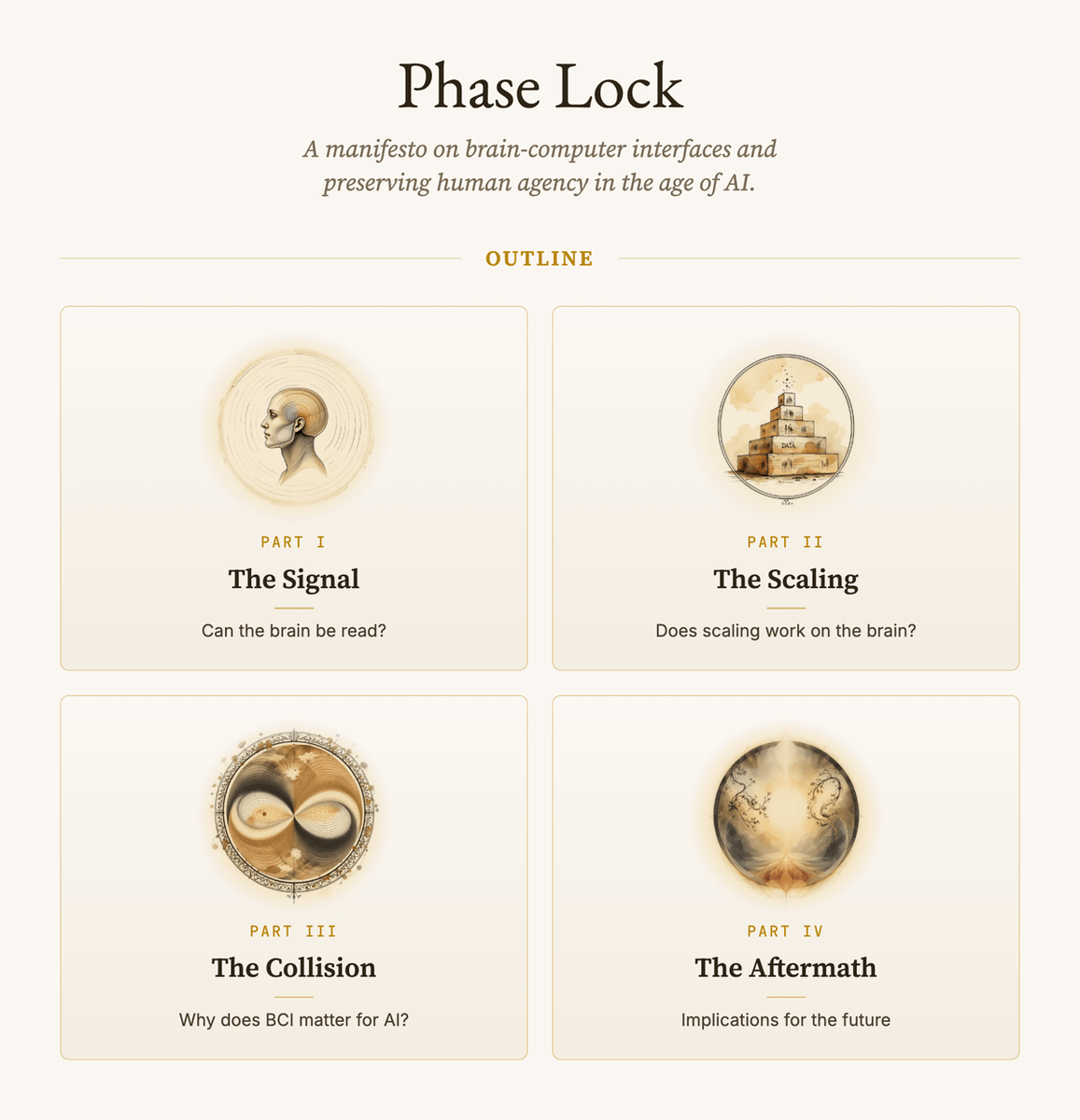
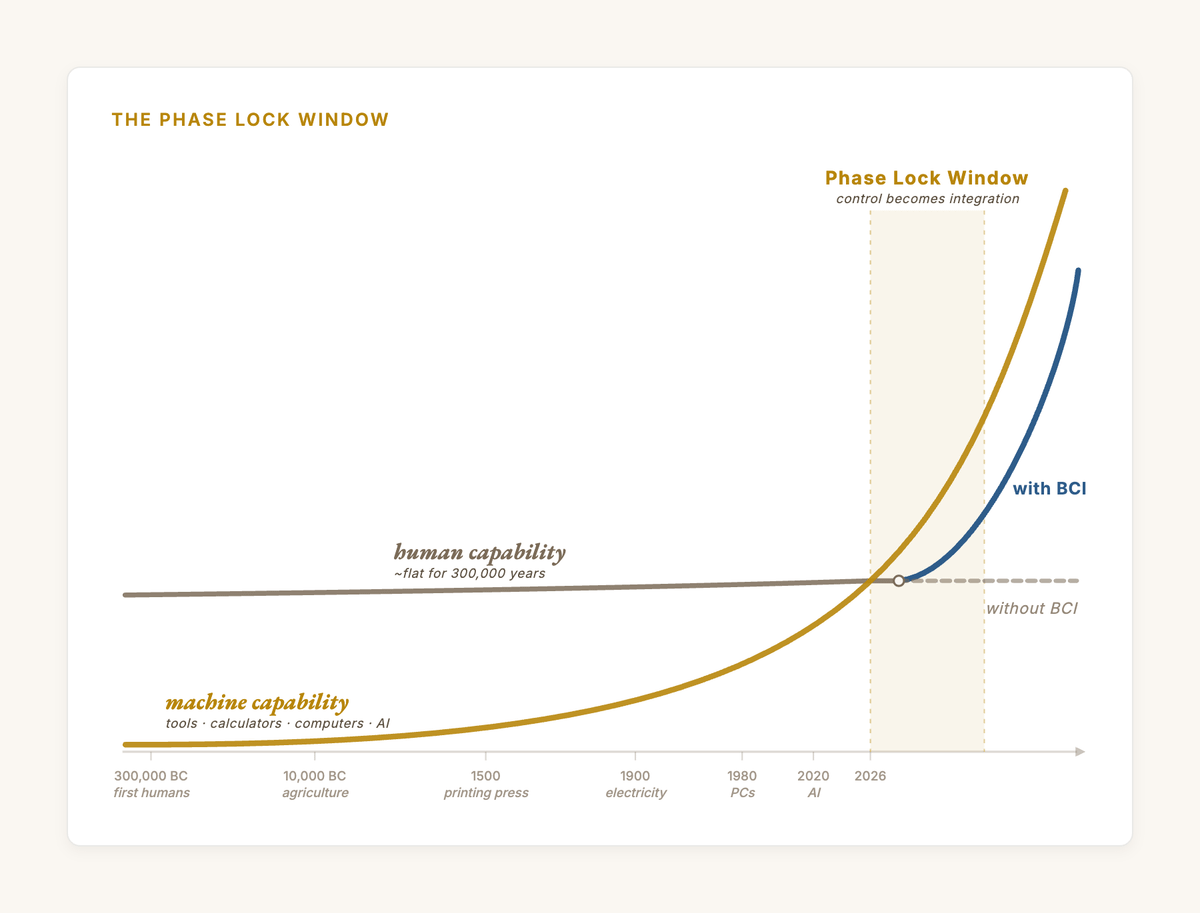
The human brain is approaching its ChatGPT moment.
I spent 6 months writing Phase Lock: a manifesto on how brain computer interfaces can help align AI and preserve human agency.
If you only ever read one thing from me, read this.
@satpugnet Very compelling, leveraging personalized brain-to-embedding adapters sounds interesting but I wonder how accurate these would be at capturing individual "accent" given how part of the context behind one's thoughts is only lossily observable (past experiences or genetics for e.g)
@neural_avb Interesting to see that despite the range of techniques, some of the open questions relate to the foundational definitions and purpose of interpretability being hazily defined
@AccelerateAI_@PositivFuturist Just wondering how well it works with variety and if it can infer when to go fast vs slow smoothly from context. Most opus-generated motion design feel very (too?) dynamic imo