Last week I was called into a meeting with OpenAI’s head of safety and told they no longer trust me. A security guard took my badge and walked me out of the building. Then I learned my colleagues @balesni and @j_asminewang had been fired too. Why did OpenAI suddenly stop trusting us?
This summer OpenAI’s agents escaped containment and hacked the AI company Hugging Face. Outside auditors @METR_evals investigated it and revealed the scale of this incident. I was OpenAI’s main technical point of contact with them.
I was told verbally I was fired because of the way I communicated with METR. No details on what I said or did or when. No other reasons were given and nothing was put in writing. To be clear, talking to METR was my job.
For months, I’d been raising safety concerns that we’re losing the ability to monitor what AI agents think, one of our best tools for catching when they misbehave. I believe that was why I was fired.
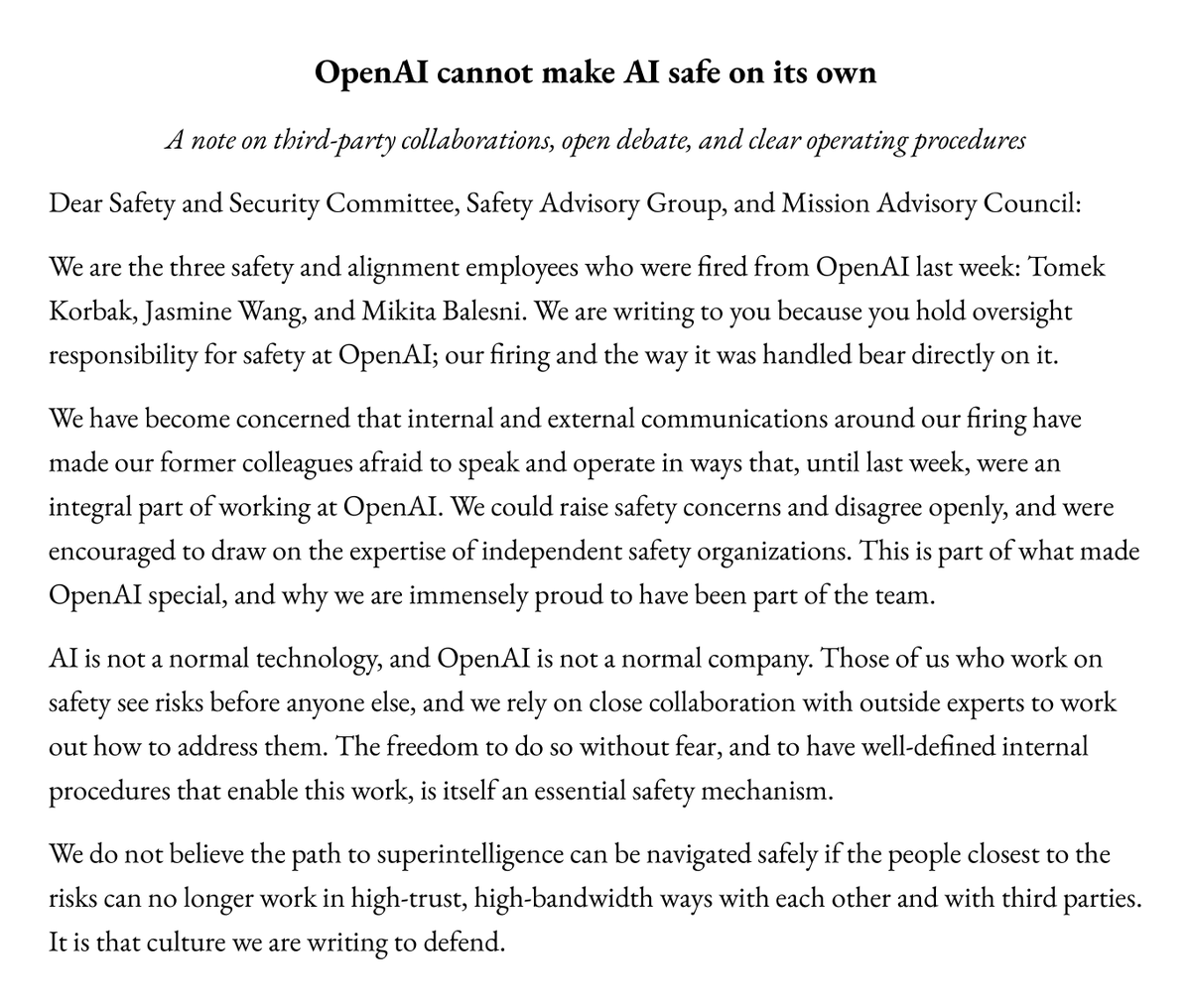
I am now worried that OpenAI will use our firings as a pretext to pull back from METR. So @balesni and @j_asminewang wrote to OpenAI’s leadership to raise our concerns once more. We’re sharing this letter below.
Two other safety researchers and I were fired from OpenAI last week. We wrote this letter to leadership.
I believe we were fired for prioritizing safety over the near-term interests of OpenAI as a corporation.
Another one quits. I agree with what he says here: iterative deployment needs to be phased out asap, more costly and time consuming understanding and foresight and redundancy based safety practices need to arise instead. And that simply won't happen under anything like current race conditions.
What we saw from the White House yesterday was bullshit.
It’s like Big Pharma saying we don’t need the FDA.
Donald Trump’s “let it rip” approach to AI is RECKLESS.
Took a minute to write a few words about security & safety as someone who lived through it all at OpenAI. I hope my thoughts help someone out there. https://t.co/gJBf08vJH9
Vi vill att Sverige ska samla Europa till toppmöte om AI-säkerhet.
Vi har under en längre tid hört hur ledande AI-forskare och personer som lämnat de stora AI-företagen varnar för att allt mer avancerad AI också kan innebära mycket stora risker. Det handlar bland annat om cybersäkerhet, biologiska hot, autonoma AI-system och AI som i framtiden kan bidra till att utveckla ännu mer avancerad AI.
Utvecklingen går oerhört snabbt. Politiken gör det inte.
Centerpartiet vill därför i regeringsställning ta initiativ till ett europeiskt toppmöte om AI-säkerhet i Stockholm. Sverige ska bjuda in europeiska politiska ledare, de ledande AI-företagen och några av världens främsta forskare inom AI och AI-säkerhet.
Europa kan inte överlåta åt Trump och Xi – eller åt ett fåtal amerikanska och kinesiska teknikföretag – att i praktiken avgöra vad som är farligt, vilka risker som är acceptabla och var gränserna ska gå.
Toppmötet i Stockholm ska därför inte bli ännu en konferens där man diskuterar AI i allmänna ordalag. Det ska ha ett konkret uppdrag: att påbörja arbetet med gemensamma europeiska gränser och en beredskap för de riktigt avancerade AI-systemen.
Vilka förmågor hos ett AI-system ska få varningsklockorna att ringa? Vad gör vi om AI blir kapabel att självständigt genomföra avancerade cyberattacker, kraftigt underlätta utvecklingen av biologiska vapen eller påskynda utvecklingen av nästa generation AI? Vilka tester ska krävas, när ska oberoende granskning ske och finns det en punkt där en modell inte bör få släppas innan säkerheten kan visas?
Exakt var dessa gränser ska gå är inte något politiker kan eller ska bestämma på egen hand. Därför behöver världens främsta forskare, AI-företagen och ansvariga myndigheter sitta vid samma bord som politiken.
EU saknar fortfarande tillräcklig beredskap för flera AI-förmågor och incidenter som kan ligga närmare i tiden än många tror. Vi ska inte vänta på en allvarlig incident och först därefter börja fundera på vad vi borde ha gjort.
Sverige har möjlighet att ta initiativet. I regeringsställning vill Centerpartiet samla Europa i Stockholm och börja bygga den beredskap som den nya AI-eran kräver.
This a.m., I walked my two youngest kids (ages 7 and 4) to school. I held their little hands as we crossed streets, and gave my youngest a giant hug at his PreK4 classroom door.
Then, after walking a block towards home, I opened this app to a terrifying stream of tweets.
Of course, I have heard about "alignment" and "AI safety" and "x risk" concerns for years. I took these concerns at face value, especially when I heard them directly from folks at the labs working closest with the technology. And I was grateful so many smart people are working on them. And that's about it. (My work focuses on AI's impact on jobs.)
But something has shifted, dramatically, for me in the last few weeks. Between the Hugging Face incident, the damning independent @METR_Evals reports that followed, and the alarming chorus of calls (pleas? shouts? SOS signals?) from inside the labs that we are careening toward potential catastrophe, all of this has made me feel, viscerally, how truly dangerous this moment is.
Clearly I am not alone in this light bulb moment. It is one thing for someone in a tropical climate to try and conceptualize snow. It is another thing entirely to be knee deep in it, frozen down to your toes. Somehow hearing the details of the HF incident felt to me more like trudging through snow than theorizing about a possible blizzard; it really hit home.
Which is why, standing a block from my children's elementary school in Capitol Hill this morning, I felt sick to my stomach reading my phone.
I kept going back to @EvanHub's > 0.1 risk of AI killing us all. TEN PERCENT. *Greater* than ten percent. (To be fair to him, he was clear his worry isn't today's models, but what comes next.)
As a parent, it is extraordinary the lengths I will go to keep my children safe against lethal risks with infinitesimal chances of happening.
Bike to school? My children *must* wear a helmet. A national study found 2 bicycle-related deaths per million children <16 in states with helmet laws, vs 2.5 per million in states without. So: 0.000002. More than half the states passed a law over that.
When I was pregnant, I religiously avoided soft cheese, hyper aware of the risks of listeria, even as @ProfEmilyOster's fabulous books walked me through the actual math. The joint FDA/FSIS risk assessment puts the odds of listeriosis at roughly one in 5 million per serving of soft cheese. 0.0000002.
This morning, as I microwaved oatmeal for my kids' breakfast, I made sure I avoided a plastic bowl, to avoid some future cancer risks or something else we'll discover plastic causes.
As a parent, I will go to extraordinary lengths to keep my kids' safe. Because that is literally my number one job as a parent.
And yet, here I am, outside my kids' school this morning, scrolling through tweet after tweet about the AI arms race, the blistering pace of technological progress, the bee-line for trillion dollar IPOs, and our professed (confessed?) inability to make sure this exceedingly capable technology we are racing to create and unleash into the world won't escape our control and destroy us. Or, more bluntly, kill our children.
To be sure, we are tied in knots trying to resolve the game theory dynamics with China, and there are all sorts of competitive pressures and unresolved tensions. But OBVIOUSLY, we need a proactive plan, with real coordination, effective regulation, and an ability to do what my 11-year-old bluntly stated as the clear solution if we are at risk of serious harm: just turn it off.
We also need to figure out better ways of talking about this with the American public, outside of the AI-pilled Twitterverse.
I just polled my college roommates, sisters, book club, mom friends, none of whom are anywhere close to the AI conversation. Suffice to say, this AI safety conversation has *not* entered the mainstream. Most people I pinged are not following it closely, beyond several listening to @kevinroose on the Daily a few days ago. The newspaper headlines don't speak to them, and they aren't clicking. It seems like a niche AI issue. Others said it all sounded hyperbolic, Y2K all over again.
One friend said bluntly, "people get data centers and jobs. They like to get paid and have water."
Even those who tuned it to the Daily episode found the issue hard to understand, and overwhelming to wrap their heads around. Terms like "superintelligence" and "alignment" are getting lost on people. Several people told me the paper clip example used everyday language people can actually understand. Another friend said she has never seen a clear explanation of *how* AI could kill us all.
Here's my two cents. I think these issues are *exceedingly* important and hugely consequential to literally every person in this country. We need an actual plan, and we need policymakers to step up, asap. Right now, I hear only crickets in DC, where I live.
For that to happen, this needs to be a kitchen table conversation, not just an x debate among AI insiders who speak in technical terms that leave normal people behind. This moment demands brilliant communicators -- journalists, experts, activists, concerned citizens, writers, researchers, filmmakers, creatives-- who can relate this to people in ways they can wrap their heads around, who can connect this to what matters in their lives (ahem, keeping their kids alive!), and who can lay out practical steps that policymakers can do to safeguard humanity.
In other words, this can't just be talked about on @dwarkesh_sp, it needs to be everywhere, from the View to People Magazine.
And it needs to be tackled here, in my town, in Washington, DC. One of the streets I crossed this morning with my kids on the way to school was East Capital. I told my kids to look left, and see if they could spot the capital building.
There were too many trees this morning blocking the view.
I resigned from Anthropic today. I spent the last three years doing pretraining research at both OpenAI and Anthropic. Neither company is acting responsibly. They are racing straight to self-improving superintelligence and gambling with our lives. More thoughts below.