I've been building startups for a few years now. Looking back, I wanted to summarize a few lessons I've learned. Hopefully they'll help others - especially first-time founders:
1. Entrepreneurship has very little to do with IQ or EQ most of the time.
Building a company is incredibly mentally demanding. Unlike physical exhaustion, which you can recover from with a good night's sleep or a meal, mental energy is much harder to replenish. Entrepreneurship can completely drain you. One of the most important skills is learning not to get trapped in your own thoughts or obsess over every problem. Iteration matters. Good business direction can be analyzed. Technical solution has something to do with IQ but entrepreneurship most of the time has nothing to do with EQ and IQ. Pure persistence and fast iteration with careful planning.
2. Entrepreneurship is fundamentally an idealistic pursuit.
Building something innovative is a Don Quixote story. Innovation is not driven by materialism—it is driven by idealism.
The more idealistic people you have in your team and in your life, the stronger you become. Three idealists are enough to build a small team. Ten or twenty can take you a long way. A hundred can build a world-class company.
If you're not an idealist, I honestly wouldn't recommend starting a technology company. Without a strong mission, even small temptations or setbacks can cause people to give up, and you'll struggle to lead a team.
Starting a company just to make money is a mindset from the last century. Back then, business was often about copying what already existed. Today, it's about thinking differently and creating something new.
3. What you build matters less than who you build it with.
People problems are always the biggest problems.
4. Choosing the right investors is one of the most important decisions you'll make.
A great investor can change your trajectory even if they only invest one dollar. Their value isn't the money—it's how much they help you grow as a founder and how much they contribute to the company's success.
The best investors grow alongside founders. They're almost like founders standing beside you.
Fundraising isn't really about raising money. If you wouldn't casually choose a husband or wife, you shouldn't casually choose investors either—even if you're desperate for capital.
I've met incredible investors, and I've also met terrible ones. During one of our fundraising rounds, an investor repeatedly told us they were investing and even encouraged us to tell others they were committed. I finished raising from everyone else, and then they disappeared completely, leaving me in an impossible position. Looking back, I'm actually grateful it happened.
5. The ideal time to start a company is when you're alone.
I honestly can't imagine starting a company while also having a spouse or a family to support.
It's very easy to drag the people closest to you into your struggles. You'll feel pressure both inside and outside of work, and everyone ends up exhausted.
No matter what, keep your own pressure to yourself. Don't make the people around you carry it. You chose this path—don't ask others to bear the consequences.
6. Take equity seriously.
Many first-time founders don't.
Equity mistakes are incredibly difficult—and expensive—to fix later. If you wouldn't casually give someone part of your home, don't casually promise them equity.
Be patient when granting ownership. It's far better to vest equity over time than to give everything away in the excitement of the moment.
Giving someone equity is like inviting them to live in your house. You're agreeing to build a life together. Sometimes abstract concepts become much clearer when you compare them to everyday life.
7. Hire a great lawyer and accountant from day one.
Building a startup isn't just about making a product people will buy.
Building a company is a complex system, and that's much harder. Your finances and legal structure can't afford major mistakes.
Great lawyers are expensive—but fixing legal problems later is even more expensive.
8. Your founding team shouldn't be driven primarily by money.
It's not that money doesn't matter.
But if making money is everyone's number one priority, there's a good chance the company either won't become great—or won't survive at all.
9. If something or someone feels like a compromise, it's probably the wrong decision.
Don't settle.
Missing one person or one project won't stop your company from flying.
Hiring the wrong person or making the wrong compromise, however, might cause the entire plane to crash.
Founders are always flying the plane while simultaneously repairing it.
I used to think my most important job was serving the team and helping everyone do their work. Eventually I realized that's just repairing the plane.
Your real job is flying it.
Your judgment is your most valuable asset. If you lose that, you're failing the entire company. The whole team should do everything they can to protect the founder's ability to make good decisions.
10. Ultimately, every great business creates value for society.
The most important thing isn't what you build—it's whether people's lives become better because of it.
The more people you genuinely help, the bigger your business can become.
Great founders can often explain exactly how their company will make money five years from now, but they often can't clearly explain how they'll make money over the next two years.
Building a company requires long-term thinking.
Which brings us back to the importance of both founders and investors.
11. Truly innovative companies rarely know how they'll make money at the beginning.
Most groundbreaking ideas don't start with a proven business model.
If something is obviously profitable from day one, it's usually not that innovative. Its ceiling is often easier to predict.
Founders spend their lives balancing innovation with commercialization.
Investors are trying to balance those same two forces.
Neither side has an easy job.
12. There's a quote often attributed to Napoleon:
A lion leading a flock of sheep is stronger than a sheep leading a flock of lions.
Knowing yourself is just as important as leading others.
If you're a lion, lead with strength while taking care of your people.
If you're a sheep, be the best sheep you can beside a great lion.
Everyone lives better that way.
The real danger is not knowing who you are—when lions think they're sheep, or sheep think they're lions.
Stay hopeful. Stay optimistic.
But also learn to be content.
13. Your reputation is everything.
Nothing is more valuable than your reputation.
When you build a reputation for integrity, opportunities—and money—start finding you instead of the other way around.
M&A is going nuts right now for AI startups.
It's Monday at 10:58am and 2 people have already emailed me trying to buy my company, unsolicited.
The X timeline is saying the "death of software" and RIP good times, I think there are TONS of buyers to scoop up AI native startups (with EBITDA). Some data:
1. Startups buying other startups jumped 18% in the first half of last year, driven almost entirely by a 30%+ surge in early-stage deals.
2. Private equity is sitting on over $2 trillion in dry powder and competing so hard they're paying about 3 turns of EBITDA more than strategic buyers just to win deals.
3. The market flipped to rewarding profit over growth: in 2021 growth mattered 2.5x more than profitability, and in 2026 a profitable business growing 25% beats one growing 50% while burning cash.
This is one of the best times to build there has ever been. Cheap tools, hungry buyers, and insane opportunity to build the AI-native version of things.
Anecdotally, based on a lot of people I know, there's a ton of M&A for startups that aren't reliant on Google SEO and built something truly AI-native in hardware, mobile apps, or vertical AI agents.
Tune out the doom. Build something worth buying.
Keep going.
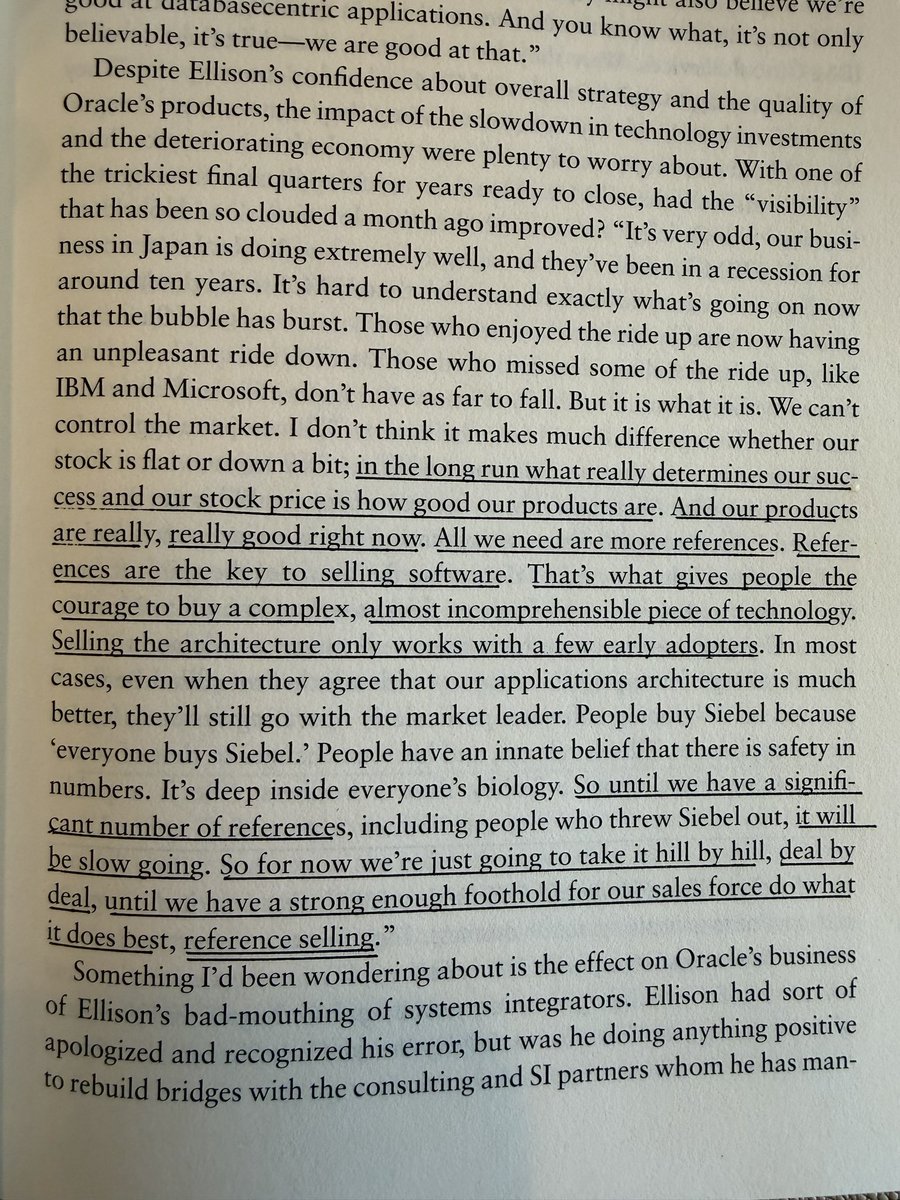
Larry Ellison in 2001 on the power of references when selling a complex B2B product – even at Oracle’s then-$10B revenue scale, new products were a deal-by-deal slog until there were sufficient references.
(book is Softwar)
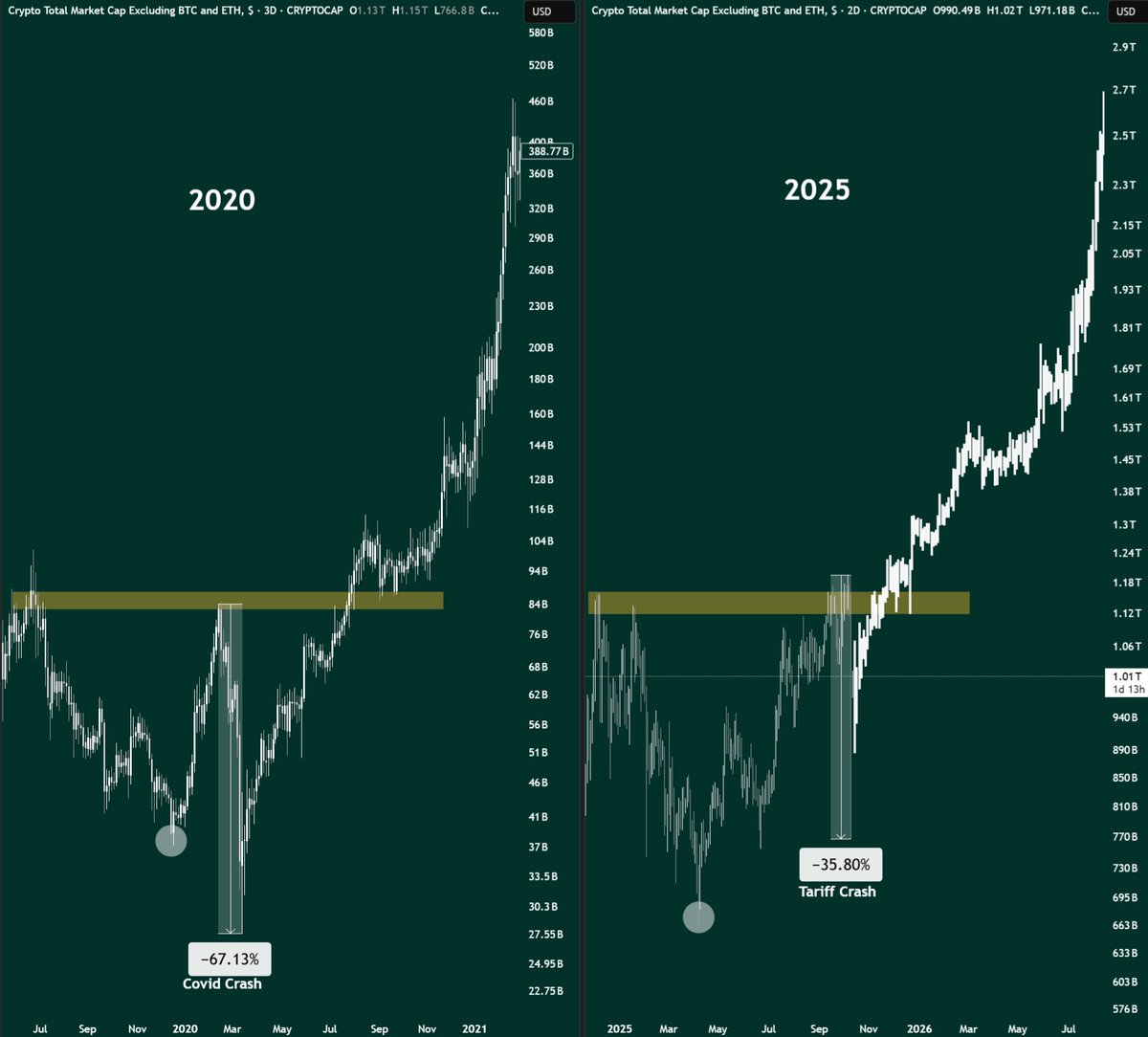
$jellyjelly a coin on solana hit $400M today out of no where
what this tells me is there’s still a TON of sidelined liquidity in the trenches
- they’re waiting for conditions to improve and change to feel safe about holding a coin
- they’re substantially more selective with their bets, since the market has become overly saturated (20K+ launches daily)
pumpfun, binance, any other big chains that want to attract big money need to find a way to instill buyer confidence.
the trader not the deployer is the key to a revival of this ecosystem, and they should be the primary focus.
- stop letting people auto bot launches
- stop letting multiple coins with the same name
- creator rewards need a huge nerf, literally the only posts I’ve been seeing lately have been people making money as the devs
- we need to eliminate scams and rugs and this can easily be done by stopping bundles pre migration and wallet transfers. (Binance proved this is doable)
if these are all fixed all we need is one viral moment or meme like 67, ChillGuy, or some viral thing like the Coldplay incident or Hawk Tuah and almost immediately everyone will pile into memecoins again
if you want to see this change happen, support this tweet and let’s make our voices heard.