Four musket balls tore through George Washington's coat at the Battle of Monongahela. Two horses were shot dead beneath him. He rode back and forth across the worst of the fighting rallying broken men, and when the smoke cleared he did not have a single scratch on him. An Indian chief later said he ordered his men to fire at Washington again and again, then stopped, certain the Great Spirit was shielding him.
He was 23 years old. He wrote to his brother a few days later, almost puzzled by it, and said he had been protected beyond all human expectation by the miraculous care of Providence.
And here is the part people forget. That was not the one time. That was the pattern.
At Princeton he rode his horse to within thirty yards of the British line and told his men to hold as the muskets opened up. An officer who was there covered his eyes because he was sure he was about to watch the general die. When he looked again Washington was still sitting tall in the saddle, waving his hat, completely unharmed. For eight years of war he stood where the fighting was heaviest and the bullets simply refused to find him. His enemies started to talk about it. His own soldiers started to believe it.
He was not being reckless. He just never seemed to believe it was his time.
This is the thread that runs through nearly every great man in history. They lived like the date had already been written and no enemy on earth could move it up by a single hour.
Caesar stood on the bank of the Rubicon, looked at everything he was about to risk, and said the die is already cast. Then he walked into it.
Cromwell rode into battle after battle convinced the outcome had been settled long before either army woke up that morning, and he fought like a man who had nothing left to fear because the ending was not his to decide.
Andrew Jackson stood on the Capitol steps while a man walked up and pulled a pistol on him at point blank range. It misfired. The man drew a second pistol. That one misfired too. The odds of both failing were so small that people argued about it for years. Jackson just raised his cane and went after the man himself.
Stonewall Jackson would ride calmly through a storm of gunfire while everyone around him flinched, and when someone finally asked how he stayed so steady he said it plainly. My religious belief teaches me to feel as safe in battle as in bed. God has already fixed the time of my death, so I do not trouble myself about it. I am always ready, no matter when it comes.
That was the whole secret. Not that they loved danger. Not that they did not feel fear. They simply believed their steps were already numbered by a hand higher than any king, and a man who truly believes that walks through fire like it is a hallway.
You cannot kill a man before his work is done.
And when you line their lives up side by side, the escapes, the misfires, the bullets that passed through the coat but never the man, it gets very hard to call all of it luck.
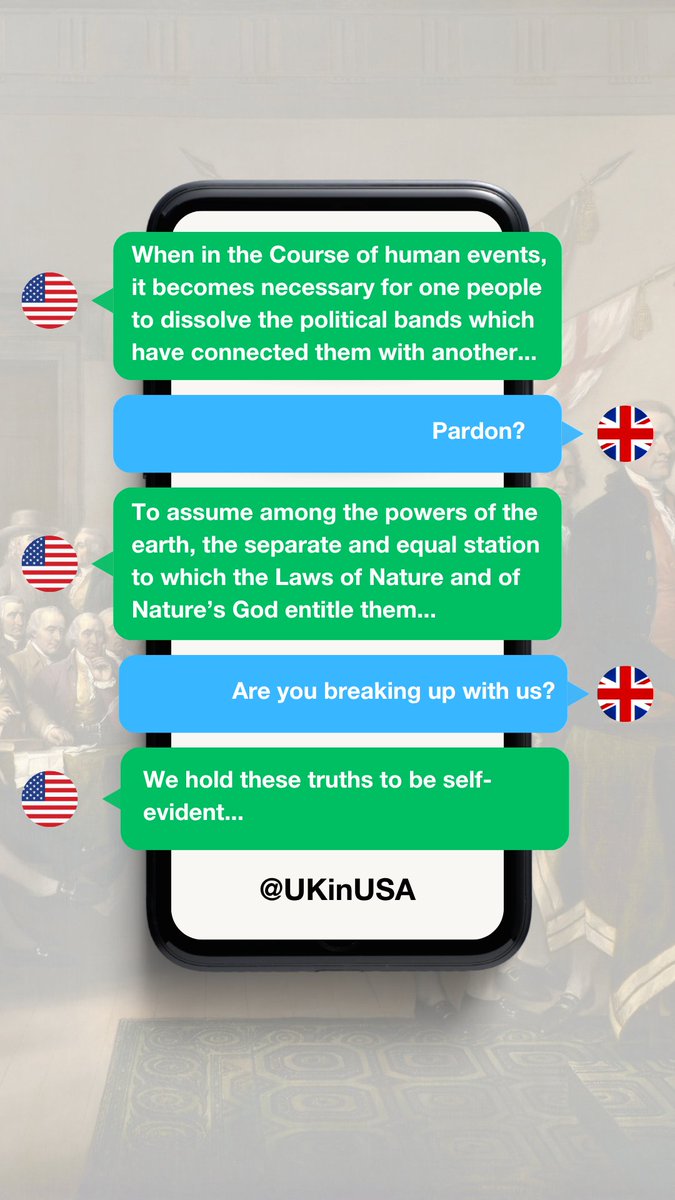
Happy 250th birthday to the greatest nation of all-time. My family is so proud and grateful to be moving to the US. May the next 250 years be even better than the first 250. 🇺🇸
A 33-year-old woman at MIT wrote the code that ran inside the Apollo 11 lunar lander, and 20 seconds before Neil Armstrong touched the moon, her program made a decision the astronauts didn't know was happening that was the only reason the mission didn't crash.
Her name was Margaret Hamilton.
She led the team writing every line of code that would fly humans to the moon and back. The part almost nobody knows is that she had to fight to be allowed to do the work at all.
Code in 1965 was not treated as real work.
Rockets were serious. Circuits were serious. Writing code was something the men at NASA thought secretaries could do on the side. Hamilton was told this to her face more than once.
So she started calling what her team did "software engineering."
She used the phrase on purpose. In meetings. In memos. To force people to treat it as a discipline instead of a chore. Colleagues laughed at her the first few times she said it out loud.
That phrase is now the name of the biggest engineering profession on earth.
The story of what her code did on July 20, 1969 is the one every kid should be taught.
Neil Armstrong and Buzz Aldrin were 3 minutes from touching down when the computer inside the lunar module started flashing an alarm.
1202.
Then again. Then 1201. Five alarms in four minutes. The computer was telling the astronauts it could not finish everything it had been asked to do.
The computer they were flying with had less memory than a modern microwave.
Someone on the checklist had left a switch in the wrong position, and a radar the astronauts did not even need right then was flooding the computer with data. It was eating around 13% of the machine's brain at the exact moment every second mattered.
In almost any other system, that overload would have frozen the machine.
A frozen machine 30,000 feet above the moon means a crash. It means two dead astronauts and a third one orbiting alone above them, waiting for a signal that would never come.
Hamilton's code did something else.
She had built the software with a rule almost nobody in her field was using at the time. When the machine ran out of room, it would not treat every task as equally important. It would look at the list of jobs it had been asked to do, throw out the ones that could wait, and keep running only the ones keeping the crew alive.
The radar was the low priority job.
The landing was the highest.
So the computer did what she had told it to do. It dumped the radar. It kept flying. The alarm was not a failure. It was the machine reporting that it was handling the overload exactly the way she had designed it to.
Down in Houston, a 24-year-old engineer named Jack Garman recognized the alarm from a test his team had run months earlier. He shouted "Go" to the flight controller. The controller shouted it up to the crew. The landing kept going.
Armstrong touched the surface with 25 seconds of fuel left.
The part that gets lost in every retelling is why Hamilton had built that safety net in the first place.
NASA had not asked for it.
She had added it on her own, years earlier, because her 4-year-old daughter Lauren had once crashed the simulator by pressing a button during a test. The button was one the astronauts had been told they would never press.
Hamilton wanted the code to survive that button press anyway.
Her bosses told her it was a waste of time. Astronauts do not make mistakes.
She insisted. The safety net went in.
Two years later, on the way to the moon, an astronaut left a switch in the wrong position. The exact class of mistake she had been told would never happen.
There is a photograph of her from that period.
She is standing next to a stack of paper as tall as she is. Every page in that stack is the code her team wrote for the mission. She is smiling at the camera like she knows something the rest of the aerospace industry has not figured out yet.
In 2016, Barack Obama put the Presidential Medal of Freedom around her neck and said the astronauts did not have much time, but thankfully, they had Margaret Hamilton.
Every autopilot in every plane you have ever flown on uses a version of what she invented. Every pacemaker. Every self driving car. Every satellite in orbit.
The idea that a machine should know which job matters most and drop the rest when it runs out of room is now the foundation of almost every safety system on the planet.
She wrote it because a 4 year old crashed a simulator and nobody else thought it was worth fixing.
The men in the room laughed at her for calling it engineering.
Then her code was the only thing in the sky that did not fail.
Dr. Joseph Warren died on this day in 1775, and he might be the most important Founding Father you were never taught about.
He was born in Roxbury, went to Harvard, and by his early thirties he was the most sought after doctor in Boston. He inoculated the Adams family against smallpox. He took on apprentices. He treated patients on both sides of the growing fight, redcoats included, because he was a doctor first. He was 34 and a widower raising four small children alone after his wife died in 1773.
He was also the quiet engine of the entire revolution in Massachusetts. He wrote the Suffolk Resolves. He ran the Committee of Safety. He stood up twice to give the Boston Massacre orations, and the second time, with British officers packing the room to intimidate him, the story goes that he climbed in through a window rather than be turned away, then delivered the speech to their faces.
On the night of April 18, 1775, it was Warren who learned the British army was about to march. He sent Paul Revere out one way and William Dawes the other to raise the alarm toward Lexington and Concord. There is no midnight ride without Joseph Warren. People have argued for two centuries about where he got his intelligence, and one long running rumor is that his secret source was close to General Gage himself.
The next morning he didn't sit safe behind a desk. He rode out to the fighting at Lexington and Concord and got into the thick of it. A British musket ball came so close it knocked a pin out of the hair beside his ear.
Three days before Bunker Hill, the Provincial Congress made him a major general. When he walked onto the hill on June 17, the officers there offered to hand him command of the whole field. He refused. He said he had come to fight as a volunteer, not to give orders, and he took a musket and went into the redoubt with the ordinary men, in the most dangerous spot on the line.
The Americans held off two British charges. On the third, low on powder, they were overrun. Warren stayed to cover the retreat and was shot in the head. The British knew exactly who they had killed. They stripped him, ran him through with bayonets, and threw him into a shallow pit with another body. A British officer later bragged that he had stuffed the scoundrel into the ground. General Gage is said to have remarked that Warren's death was worth that of 500 ordinary men.
Ten months later, after the British finally gave up Boston and sailed away, his friends went looking for him. The body was beyond recognition. The only reason they ever found him is that Paul Revere, a silversmith by trade, had once wired a false tooth into Warren's jaw with silver wire. Revere dug through the grave, saw his own work in the teeth, and knew. It is remembered as one of the first forensic dental identifications in American history.
His orphaned children were nearly forgotten too, until people like Benedict Arnold, years before he became a traitor, chipped in money to make sure they were raised and educated.
The most famous painting of the battle, by John Trumbull, isn't really about the battle at all. It's about the death of one man in the smoke.
The doctor who could have commanded an army chose to die in the dirt as a private soldier. He was 34 years old. 251 years ago today. Remember him 🇺🇸
The ban on social media for children under 16 is an idea that has merits. But the way it is being done is simply a way to force everyone, including adults, to identify themselves online, creating the most powerful surveillance and censorship architecture in human history.
I had a call from a scammer the other day.
Me: “Hello.”
Scammer: (Heavy Foreign Accent) “Hello. This is Tom Smith from Microsoft Support. We are seeing a lot of virus activity coming from your device.”
Me: “Oh no. My device? Are you sure?”
Scammer: “Oh yes, Madam. We have many reports.”
Me: “Oh, jeez. How can I fix it?”
Scammer: “It’s okay, Madam. We can help you right now. Are you in front of your device?”
Me: “Yes. I was just about to use it. I’m glad you called.”
Scammer: “Good, Madam. Please push the Start button.”
Me: “I think it’s already on.”
Scammer: “Okay, Madam. Now click on Control Panel.”
Me: “I don’t see that.”
Scammer: “Do you see a bunch of information above the Start button?”
Me: “Yes.”
Scammer: “That is your Control Panel.”
Me: “Wow. I didn’t realize it had a name.”
Scammer: “Yes, Madam. Now press Internet Options.”
Me: “I don’t see any Internet options. I don’t think I bought that feature. This is just a cheap one.”
Scammer: “All devices have Internet, Madam. Press the Start button again.”
Me: “Okay. Same as before.”
Scammer: “That’s fine, Madam. We will restart your device. Please turn it off.”
Me: “Um… I don’t know how. I’ve never turned it off. It kind of just stays on.”
Scammer: “There must be an off button. How do you stop it when it’s running?”
Me: “I usually press the big button.”
Scammer: “Okay, Madam. Press that button.”
Me: “Okay.”
Scammer: “Is your device off?”
Me: “No. The door popped open.”
Scammer: “Door? Is there a disc inside?”
Me: “No. There’s a burrito.” 🌯
Scammer: “Why is there a burrito in your computer?”
Me: “Computer? I thought you said this was microwave support.” 🙆🏻♂️😂
Click. ☎️🤗
In embodying the nostalgia of a more innocent time, the men’s hockey team gave the nation a vision of what we were, and what we can be again—one nation under God.
My latest on the hockey vibe shift: How the team is transforming nostalgia into optimism:
https://t.co/3mmbAzmhCp
We’re living in a time where social media has created such a closed feedback loop that humans are no longer capable of engaging with reality outside their tribal narrative.
The right & libertarians start with the isolationist tribal narrative. They stop engaging with any information that contradicts the narrative and bend reality to draw the same conclusion they started with.
The left start with an anti-imperialism tribal narrative. They cannot critically engage with anything that portrays the U.S. as less than evil, and they bend reality to draw the same conclusion they started with.
Tribalism is so consuming that humans are no longer willing or able to engage with reality. They live in narrative.
When reality—a stray fact, a shocking poll, testimony from an outsider—finds them unexpectedly, they’re so lost in their hermetically sealed universe that they’re fully, completely, and totally convinced that it is reality, in fact, that is the lie.
Just when you thought groceries were already unAffordable...
Olympia Democrats are moving forward with HB 2734, which will add an additional 'sugar tax' to beverages.
$.03 an ounce may not sound like much, but that adds an additional $4.32 to a 12 pack of soda.
@madisoncwade | @KING5Seattle
HB 2734: https://t.co/O3g7rtM1qQ
Iranians and Venezuelans have a hope of overthrowing their dictators for the first time in too long. But the usual human rights activists and international orgs don’t care because the fight for democracy in these countries doesn’t fit their anti-US narrative. Even worse, too many who think they’re righteous stand with the dictatorships that call themselves anti-imperialists while giving away their countries to Russia and China and starving, jailing and disappearing their people.