The fascinating thing about J.K. Rowling’s handwritten spreadsheet is that she wasn’t simply keeping track of Harry Potter’s adventures. She was practically running an entire fictional world like a television production.
And the funniest part? This particular sheet was for Order of the Phoenix. She divided the story into chapters, months, titles and individual plotlines, including the prophecy, Harry and Snape, Cho and Ginny, Dumbledore’s Army, the Order of the Phoenix, and Hagrid and Grawp. She was literally tracking how several different storylines progressed alongside one another.
Think about how much of that book is happening simultaneously. Harry is struggling with his connection to Voldemort, Umbridge is tightening her grip on Hogwarts, Hermione is secretly organising resistance, the Order is working behind the scenes, and the prophecy is gradually becoming more important. These aren’t random events thrown together. They’re separate narrative threads deliberately moving towards the Department of Mysteries.
What’s even more impressive is that Rowling had planned the overarching seven-book story years before the first book was published. She spent five years mapping out the series and drafting Philosopher’s Stone. In a 2000 Scholastic interview, she explained that she always had a basic plot outline but deliberately left certain things undecided because she enjoyed discovering them while writing.
And looking back at the books, you can appreciate why. Details introduced casually in earlier instalments eventually become significant revelations. The films sometimes had to compress or remove these connections because of their runtime, but the books had the space to develop them across several years.
Honestly, the spreadsheet is fascinating because it shows just how much work went into making Hogwarts feel like a place where things continued happening even when Harry wasn’t looking.
Imagine having an entire magical universe in your head and still needing to organise it on a handwritten spreadsheet. J.K. Rowling was operating differently. 😭
A smartphone takes a baseline 5-volt USB input, regulating it down internally to charge its 3.7-volt lithium-ion battery. A modern laptop charger can deliver up to 48 volts at 5 amps through the exact same physical port.
USB-C prevents accidental destruction through a strict digital handshake. When you plug in, the power line defaults to 5 volts. A compliant charger is forbidden from delivering 9, 15, 20, or 48 volts until the phone explicitly requests it.
That conversation runs over a dedicated Configuration Channel wire (the CC pin). Instead of using the high-speed data pairs, the charger and phone communicate over CC at 300 kbps using Biphase Mark Coding. The charger advertises its available Power Data Objects, the phone selects an optimal voltage, and only after both sides exchange formal confirmation packets does the power supply ramp the rail.
The physical vulnerability sits inside the plug's mechanical geometry.
A USB-C receptacle packs 24 pins into an opening roughly 8.3 millimeters wide, spaced at a contact pitch of just 0.5 millimeters. On that dense connector tongue, the high-voltage power pin (VBUS) sits directly adjacent to the communication pin (CC).
If a cheap cable suffers from poor stamping tolerances, worn latch springs, or metal pocket debris, inserting the plug at an angle can bridge the high-voltage VBUS contact directly into the neighboring CC pin.
While VBUS uses heavy copper traces to deliver high current, the CC line leads directly into low-voltage CMOS logic rated for 5.5 volts maximum. When an active 20-volt contract jumps that 0.5-millimeter gap, the overvoltage punches through the thin gate oxide of the controller's input transistors. The junction suffers irreversible dielectric breakdown, permanently disabling the phone's charging controller.
Many assume onboard surge protection stops these events. Phones do incorporate Transient Voltage Suppression (TVS) diodes, but they are engineered for electrostatic discharge lasting only nanoseconds. A surface-mount TVS package cannot dissipate continuous DC wattage. When forced to clamp a sustained 20-volt fault from a 100-watt power supply, the diode absorbs continuous power far beyond its thermal limits, entering thermal runaway and burning open.
Modern high-end smartphones mitigate this risk using dedicated short-to-VBUS protection chips with 24-volt-tolerant CC inputs and fast isolation switches that trip in nanoseconds. But countless budget phones, tablets, portable docks, and accessories wire their CC pins straight to controllers without secondary protection. In those devices, the surge travels unobstructed into the charging silicon.
This physical reality also exposes a limitation in popular security advice. Many travelers use physical "USB condoms" or data blockers at public charging kiosks to prevent juice jacking. A standard data blocker physically severs the USB data lines (D+ and D-), but leaves the VBUS power and ground pins completely connected. If a malfunctioning or malicious public port delivers a raw, unnegotiated 20-volt spike down the line, a standard data blocker cannot block it. The voltage passes directly into the phone's power input.
USB-C unified charging by turning a power cable into an intelligent digital bus. But because high-voltage power and low-voltage logic share a 0.5-millimeter contact pitch, the physical survival of your motherboard depends on that 300 kbps digital negotiation remaining intact.
Prince Metternich, the great Austrian Chancellor, once remarked to an English diplomat: "In Vienna, even the common people speak French better than the educated classes of London."
The diplomat's sharp reply came at once: "Your Highness would do well to remember that Napoleon never came to London twice to teach them."
> be me
> macbook air is bricked, needs a reinstall
> no second mac to build a bootable installer
> find a github actions workflow that builds macOS installers for free, no mac required
> perfect.jpg
> trigger a build, artifact is a 17.6GB .dmg.img
> click download
> kb/s
> literal kb/s
> theoretical connection is 10MB/s
> discover artifact lives on azure blob, signed URL expires in 10 min
> write a bash script that resolves the azure SAS url fresh, hands it to aria2c with 16 parallel streams
> 16 connections, still kb/s
> mfw it's a per-IP throttle, not per-connection
> repo author literally has a line in the workflow: "Enable Cloudflare WARP for faster download"
> install Cloudflare WARP on my ubuntu box
> single stream jumps 20KB/s -> 1.6MB/s
> aria2c 16x -> 10MB/s, pinned to my ceiling
> 17.6GB in ~an hour, sha256 matches github's published digest
> oknowweiscooking.webp
> dd it to a USB SSD
> paranoid it won't boot apple silicon because it was built on an intel runner
> boots apple silicon just fine, i was wrong, shut up
> installer runs, reinstall chugs along
> STOPS
> "OS Personalization" PREFLIGHT_PERSONALIZE portioncomplete:0.15000 estimatedtimeremaining:-1
> 70000 log lines of stalled:NO
> the mac can ping apple/com
> it can ping cupertino
> but personalization "no connections witnessed"
> i don't fucking get it
> try to sniff the wifi to see what it's talking to
> can't
> WPA2 isn't a hub, it's a switch, i can't decrypt the mac's traffic as a third client
> feel stupid
> dig into it
> test apple's personalization signing servers from my box
> gs/apple/com -> https 000
> gsp-ssl/apple/com -> https 000
> albert/apple/com -> 403 (works)
> gs/apple/com is the signing server and it's IPv4-ONLY
> my ISP (DIGI, romania) has broken IPv4 routing to apple's 17.0.0.0/8
> ICMP works, IPv6 works, CDN works, the ONE /8 macOS needs to sign firmware is a black hole
> that's why it could "ping cupertino" but personalization silently died
> fix: repoint the mac's IPv4 default gateway from the router to my ubuntu pc
> my pc has IP forwarding + NAT masquerade + Cloudflare WARP
> mac's IPv4 now tunnels through cloudflare, bypassing my ISP's broken path
> watch the signing handshake complete in tcpdump, SYN -> SYN-ACK -> ClientHello -> kilobytes of signed data
> portioncomplete climbs past 0.15
> weactuallydidit.jpg
> STOPS AGAIN at 0.29
> silent on IPv4
> oh
> the mac's IPv6 still goes straight to the router, bypassing my box
> i literally cannot see it
> disable IPv6 on the mac so everything falls back to the working IPv4 path
> it reboots
> flashes the apple logo 4 times
> i'm dying
> it boots
> it works
> 29 hours
> i had to MITM my own home network because my ISP couldn't route to one (1) /8
> the mac is back
> i'm buying a framework
>text still isn't green
General Ne Win seized power in Burma in 1962 and immediately launched "the Burmese Way to Socialism," transforming Asia's rice bowl into a laboratory for economic destruction. He nationalized every major industry, banned private enterprise, severed trade relationships, and handed economic planning to bureaucrats who had never grown a grain of rice or balanced a ledger.
The results arrived swiftly and brutally. Burma's rice exports, once feeding much of Asia, collapsed as state planners allocated resources based on political connections rather than market signals. Black markets flourished while official stores sat empty. The currency became worthless paper as central planners printed money to fund their fantasies. Education deteriorated as resources flowed to party apparatus instead of schools and universities.
Within a generation, Ne Win transformed one of Southeast Asia's wealthiest nations into one of the world's poorest. Living standards plummeted. Shortages became permanent features of daily life. The country that once exported food to its neighbors couldn't feed its own people. Free market economists predicted exactly this outcome, but Ne Win's advisors dismissed market mechanisms as capitalist propaganda.
By 1988, mass protests finally forced the regime to abandon its socialist experiment, but the damage was done. Twenty-six years of central planning had destroyed the accumulated capital, knowledge, and institutions that make prosperity possible.
Every socialist claims their system will work differently this time. The laws of economics don't bend to political will.
If you look closely at the canopy of some modern fighters (or even attack helicopters), you will notice a strange, zig-zagging line embedded right in the glass. It may look like an innocent defroster wire, but it’s actually a live explosive device - a Miniature Detonator Cord, or MDC to be exact. In fighter flying, where every single fraction of a second matters during an emergency, this thin explosive cord gives pilots a fighting chance to survive. 1/2
Marcus Reilly noticed it first. Every morning, pigeons roosted on the security cameras outside First Continental Bank's downtown Portland branch. Not near them. *On* them. Directly on the housings, unbothered. Real cameras emit a faint heat signature. Birds avoid them. Marcus, a retired electrician, mentioned it to a city inspector friend over beers. She filed a query. The audit revealed that nine of the branch's twelve exterior cameras were hollow plastic decoys - had been since a 2019 renovation contractor pocketed the installation budget. The contractor faced fraud charges totaling $340,000. The bank quietly replaced every camera within a week. The pigeons haven't come back.
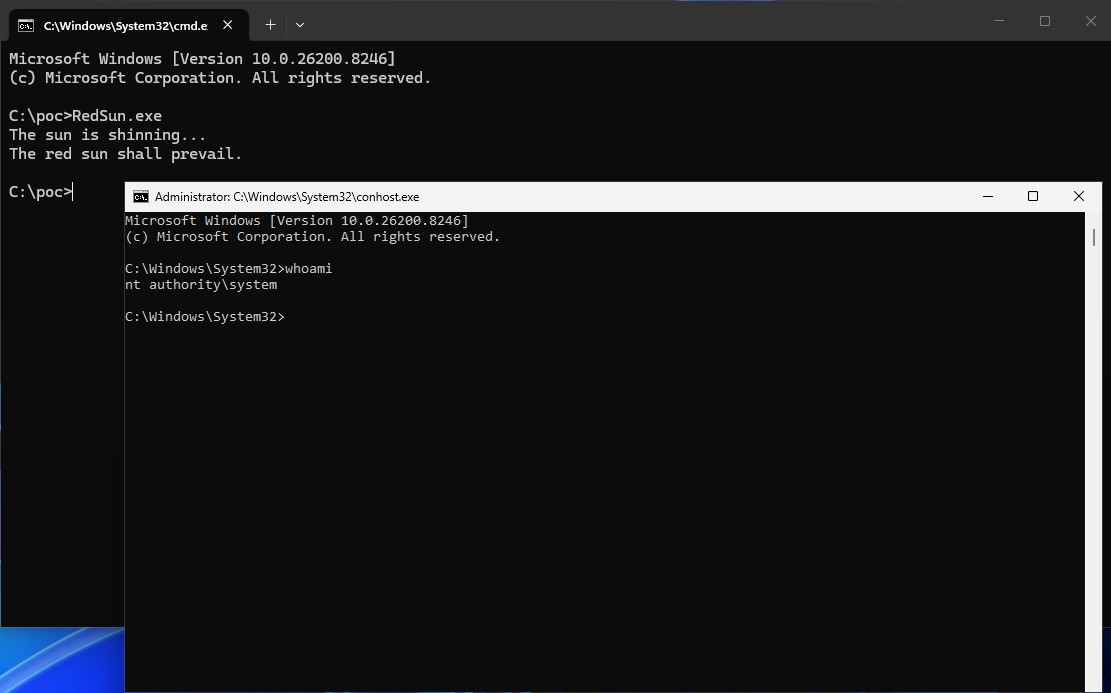
the Red Sun vulnerability is genuinely one of the funniest bugs i've seen in a while
Windows Defender finds a malicious file with a cloud tag and instead of quarantining or deleting it...
it helpfully rewrites the file back to its original location
the antivirus. protecting you. by restoring the malware.
the PoC abuses this to overwrite system files and escalate to admin privileges
the core idea is brilliant in the most embarrassing way possible
sometimes the best vulnerabilities aren't clever exploits
they're just Microsoft being Microsoft
We have gigantic creatures in the sea which can sing for hours and have arteries so big you can crawl through them. (whales)
We have birds that fly 50,000 miles every year. From the antarctic to the arctic and back again. (arctic tern)
We have living creatures which never get old and never die naturally. (jellyfish)
We have animals which you can force through a sieve, and they can reassemble themselves. (sponges)
We have an ancient line of animals which once had 30 or more successful species, and has gone extinct down to just one single representative, and that representative has conquered the entire world (us).
We have horrors that look just like rocks and if you step on them your whole world becomes agonizing pain. (toadfish)
We have animals who hide inside other animals, and when you eat that animal, they enter your intestines and live there. (tapeworms)
We have plants which live on other plants and never touch the ground.
There's a fruit tree that grows around another tree, and eventually kills and replaces it. (strangler fig)
We have gliding lizards, marsupials, snakes, frogs, and rodents.
What the heck do you need fairies for?
I was watching this YouTube video of this Russian dude who traveled to North Korea to go sightseeing.
North Korea is notoriously strict on what visitors can and cannot do. Throughout most of the trip he risked his own safety by illegally filming around North Korea on his cell phone.
At one point during the trip he managed to sneak away from his appointed North Korean tour guide. He approached a group of people sitting down, ... just kind of hanging around ..., doing something.
They were very friendly to him.
During the conversation he asked them what they'd like to do in the future. One of the men said, "I hope some day to travel. I really want to see Yugoslavia"
The fuckin' Russian guy looked at him like this when he said "Yugoslavia"
Why don’t oil rigs rust in the sea?
In truth they do rust, but nowhere near as fast as they would if it weren’t for one very elegant solution that protects them.
There is an engineering philosophy here of sacrificial protection.
Corrosion is an aggressive and destructive force, so what if you offer the corrosion gods a sacrifice to satiate their appetite for destruction and to spare your important things?
Behold the Subsea Anode!
Subsea anodes are large blocks of aluminium that weigh maybe 1-2 tonnes each and you will see this welded onto subsea or underwater equipment and they’re kinda odd and inexplicable looking.
But what these aluminium anodes do, is to create a galvanic electrical current between the aluminium, the steel and the sea.
Electricity actually flows through these things once they are in the water and has the effect of protecting the corrosion of the steel by flooding the sea with free aluminium ions.
As a result the aluminium anodes slowly dissolve away, but these huge 30,000 tonne steel structures can stand in the sea for 40-50 years without rusting.
So that’s the secret.
It’s a gloriously simple solution, to a very challenging existential problem for the offshore industry.
You just have to make your sacrifice to nature, and she lets you pass.