Its noticeable how much of the whole practice of working with AI - the prompts, the skill files, the connectors, retrieval work, the markdown files, etc. - is a substitute for the real problem of continual learning. If that ends up being solved, a lot of things will change fast.
I think you are misunderstanding what this tech demo actually is, but I will engage with what I think your gripe is — AI tooling trivializing the skillsets of programmers, artists, and designers.
My first games involved hand assembling machine code and turning graph paper characters into hex digits. Software progress has made that work as irrelevant as chariot wheel maintenance.
Building power tools is central to all the progress in computers.
Game engines have radically expanded the range of people involved in game dev, even as they deemphasized the importance of much of my beloved system engineering.
AI tools will allow the best to reach even greater heights, while enabling smaller teams to accomplish more, and bring in some completely new creator demographics.
Yes, we will get to a world where you can get an interactive game (or novel, or movie) out of a prompt, but there will be far better exemplars of the medium still created by dedicated teams of passionate developers.
The world will be vastly wealthier in terms of the content available at any given cost.
Will there be more or less game developer jobs? That is an open question. It could go the way of farming, where labor saving technology allow a tiny fraction of the previous workforce to satisfy everyone, or it could be like social media, where creative entrepreneurship has flourished at many different scales. Regardless, “don’t use power tools because they take people’s jobs” is not a winning strategy.
This is such a great book on Natural and Artificial Intelligence. I wish it was around in the early 2000’s, when I first entered college.
https://t.co/DCQMSLNqNU
If LinkedIn had a flavor of "exclude managers from seeing my posts", I may consider using it. That place feels soulless when the content is only dominated by launch posts and everyone is celebrating each other for stuff no practitioner cares about.
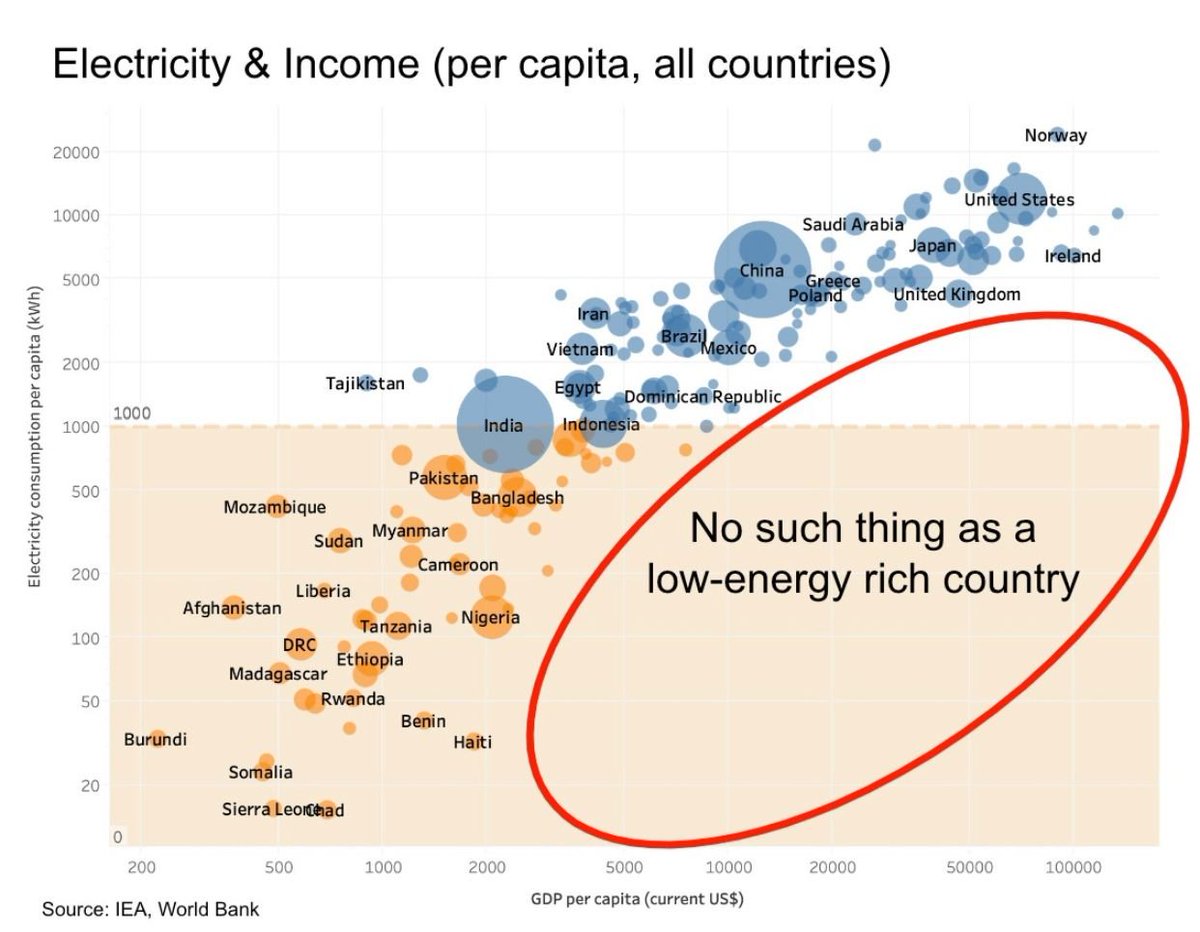
Humanity has a moral obligation to produce as much energy, as cheaply, and as cleanly, as possible.
Anything less is asking the future to be worse than the present.
Just read https://t.co/Eh6xDoScdZ
TLDR; it’s a short story that reads like a historical explainer/technical doc of the first human upload.
Without spoiling it, the story describes the image as having been executed for a combined total of 162 billion emulated years, with somewhere between 6.5 and 10 million instances running at any given moment.
The folks who think that primitives for digital scarcity (like NFTs) only have use cases in internet trading games or digital art are really missing the bigger picture.
In the long arc of progress, “not your keys, not your crypto” becomes “not your keys, not your exclusive control over your digitally uploaded self”.
While intelligence *leverages* compression in important ways in representation learning, intelligence and compression are by nature opposite in key aspects.
Because intelligence is all about *generalization to future data (out of distribution)* while compression is all about *efficiently fitting the distribution of past data*. If you're optimal at the latter, you're terrible at the former.
If you were an optimal compression algorithm, the behavior policy you would develop during the first 10 years of your life (maximizing your extrinsic rewards such as candy intake, while forgetting all information that appears useless as per past rewards) would be entirely inadequate to handle the next 10.