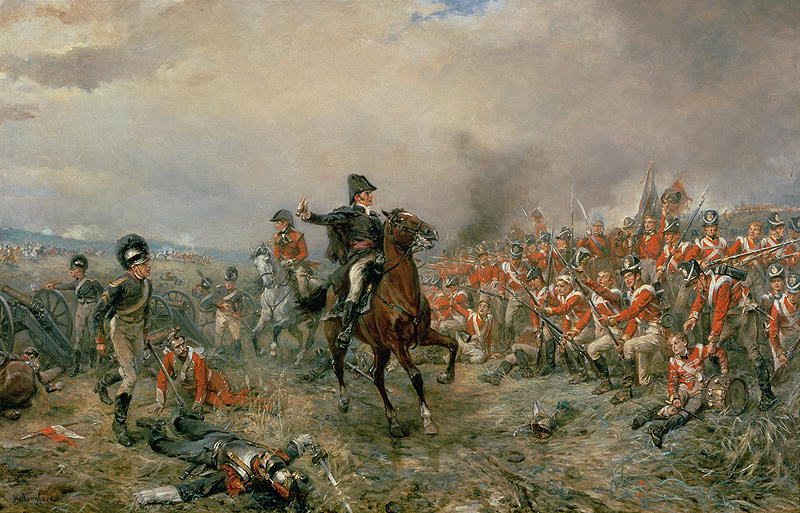
The French had finally captured La Haye Sainte.
In an attempt to shore up the centre, The 27th Inniskillings had been placed in square just behind the crossroads where they took the brunt of the fire, they died in square, taking 478 casualties, out of 698 men present (68%).
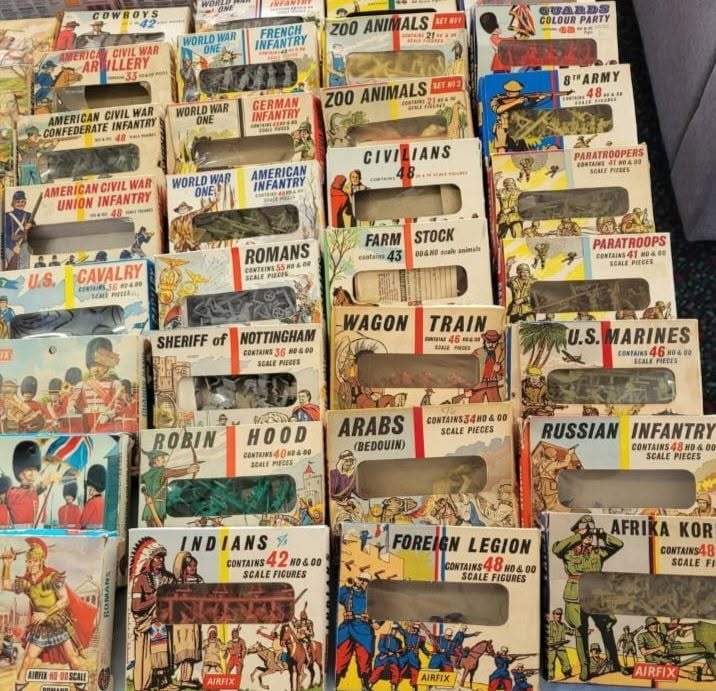
Throwback Thursday!
Who had any of these classic kits in their stash when they were a kid?
Which ones bring back the most memories, and which would you love to see reintroduced to the range?
Drop your favourites in the comments below! 👇
📸 FB/ Lawrence Leung
#Airfix
On this day in 1815, British forces and their European allies stood together at Waterloo in one of history's most decisive battles.
Facing sustained artillery fire and fierce close-quarters fighting, thousands of soldiers endured immense hardship and sacrifice. With the arrival of Prussian forces, the battle was won, bringing an end to the Napoleonic Wars.
Today, we remember all those who served at Waterloo and honour the sacrifices they made. Their service remains an enduring part of our shared history.🌺
Photo: Thomas Jones Barker, Public domain, via Wikimedia Commons
Napoleon delayed the Battle of Waterloo because the ground was too muddy to move his cannon
It had rained heavily the night before
So he waited for it to dry
That delay gave the Prussian army time to march and arrive on his flank
The word the world uses for catastrophic defeat was caused by mud
RIGHT NOW in 1815, the first shots of the Battle of Waterloo are being fired. The fighting continues for nine hours and generates 65,000 casualties. When it's over, Napoleon Bonaparte's 'hundred day' comeback is finished.
Footage from 'Waterloo' (1970)
On this day in 1775, around 1,200 colonial militia crept up a hill outside Boston in the dark and dug an entire dirt fort in a single night. They were tired, they were untrained, and most of them were farmers, blacksmiths, and shopkeepers who had left their families weeks earlier. When the sun came up on June 17, the British fleet sitting in the harbor could not believe what they were staring at. A homemade fortress had appeared on the high ground overnight, aimed straight at them.
This was only two months after Lexington and Concord. The British still figured these colonists were a disorganized mob that would scatter the moment real soldiers showed up. So they made a decision that they would regret for the rest of the war. Instead of going around, they would march straight up the hill in the open and frighten the rebels off the field.
They did it in the worst way possible. Full wool uniforms in the June heat, heavy packs on their backs, marching uphill in tight formation across open grass. The colonists were dangerously low on gunpowder, so the word passed down the line was simple. Do not waste a single shot. Hold your fire until you can see their faces. Wait until you cannot miss.
The British came up the first time and walked into a wall of musket fire at point blank range. Whole front lines went down. They fell back, regrouped, and came again. Same result. The grass was covered with red coats. Officers were dropping at a shocking rate because the colonists were aiming for the men giving orders.
On the third charge the Americans finally ran out of powder. With nothing left to fire, they fought with rocks and swung their empty muskets like clubs before falling back across the neck of land behind them. The British took the hill. On paper it was their victory. In reality it was a slaughter of their own men. More than 1,000 British soldiers were killed or wounded, including a staggering number of officers, the heaviest single day of losses they would suffer in the entire Revolution.
The cost did not stop there. During the fight the British set the town of Charlestown on fire, and people in Boston climbed onto rooftops to watch the whole thing burn while the battle raged. The Americans lost good men too, including Dr. Joseph Warren, a leader of the rebellion who could have sat safely in command but instead grabbed a musket and fought in the front line as an ordinary volunteer. He was killed in the final assault.
One British general wrote afterward that a few more victories like that one would have put an end to British rule in America. That single line says everything. The rebels lost the ground, lost the hill, and lost the battle, and they still walked away having proved to the entire world that ordinary colonists could stand toe to toe with the most powerful army on earth and make it bleed. The legend that they were too weak to fight died on that hillside. That was Bunker Hill, June 17, 1775.
In a film overflowing with star power, Edward Fox managed to steal the spotlight.
His BAFTA-winning portrayal of General Horrocks in A Bridge Too Far lasted less than 20 minutes on screen, yet remains one of the movie's most memorable performances.
With the real Horrocks present during filming, Fox had a unique chance to study the man behind the legend.
Today in 1977, the beloved three-hour WWII epic 'A Bridge Too Far' premieres. Based on Cornelius Ryan's bestselling book about the Allies' ill-fated Operation Market Garden, it features an all-star cast and eye-popping battle scenes. Required viewing. Any questions?
I think this and Zulu Dawn are two great examples of how historically incorrect movies can still convey the absolute drama and desperation of a battle.
B-17 Flying Fortress Makes Emergency Belly Landing (WWII) 🇺🇸
Heavily damaged by flak over Europe, this B-17 crew jettisons the ball turret and brings their Flying Fortress home for a wheels-up landing on a grass field.
The pilot keeps perfect control as the plane skids across the turf, propellers bending on impact, before coming to a safe stop.
A testament to the incredible toughness of the B-17 and the skill of her crew.
82 years ago today, paratroopers of Easy Company (plus a few men from the 4th Infantry Division) pose for a picture in the town square of Sainte-Marie-Du-Mont the day after surviving their first combat jump into Normandy 🪂
@Dr_TheHistories#Normandy#WW2: The D-Day June 6, 1944, invasion of France was successful due to what the Canadian infantry, British Commandos, Calgary Tank Regiment, #RAF, etc., learned at #Dieppe in 1942. They had ~85% casualties, far worse than at Omaha Beach... https://t.co/zV8Y1NxSj8
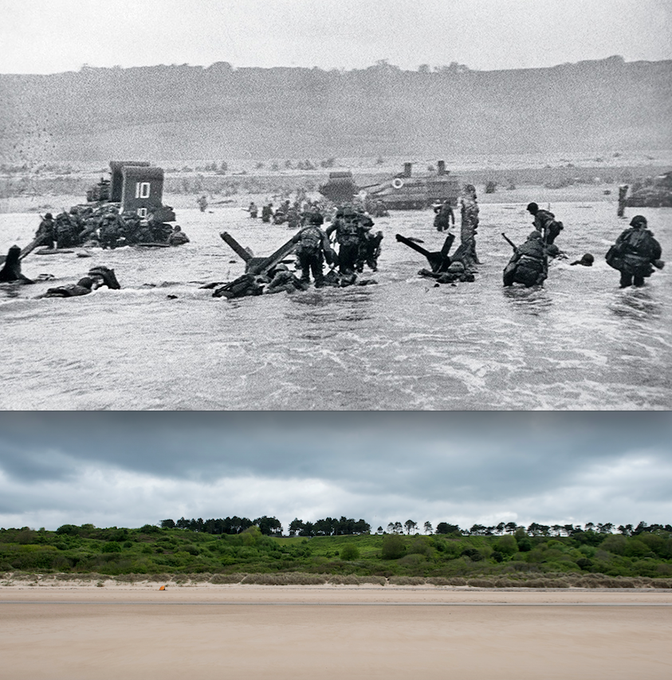
'Easy Red Sector', Omaha Beach - approx. 0700 on the 6th June 1944
Photographer Robert Capa landed at Easy Red Sector, Omaha Beach with the men of Easy Company, the 2nd battalion, 16th Infantry Regiment, US Army 1st Division.
After completing his task of photographing the landings, Capa’s survival instincts took over. Seeing another craft approaching the beach, he fled towards it. After he was hoisted aboard, the vessel took a direct hit from a German shell and several men on board were killed. Capa survived and transferred to a troop ship for the return journey to England.
On arriving in Weymouth, Dorset, Capa put the four rolls of 35mm film in a courier’s pouch together with several 120mm rolls that he had shot before the invasion. He also included a note to John Morris, Life’s London office picture editor, that stated, ‘John – all the action’s in the 35mm.’ With his films safely on their way, Capa boarded the first boat returning to France.
When the courier arrived at the Life office, Morris urged his staff to develop the films quickly in order to meet the publication deadline. They were given to 15-year-old darkroom assistant Dennis Banks to develop.
The incident that followed has become as famous as Capa’s images. A few minutes later, Banks returned to Morris’s office in tears, saying, ‘They’re ruined! Capa’s films are all ruined!’ In the rush to process and dry the films, Banks had placed them in a wooden drying cabinet and closed the doors. The heat had been so intense that the emulsion had melted and all that was left, as Morris discovered as he examined the films, was ‘a brown sludge in frame after frame’.
Only 11 of the 108 original frames were salvaged.
This photograph is contact screen frame 7/neg. 35
Robert Capa's amazing shot was taken around this time. Note the soldiers pinned down on the beach. 900 Americans were killed on Omaha. Capa survived and his images are the iconic photos of Omaha. See more on https://t.co/EEg00P0EnE
The deadliest place on D Day on this longest of days, where the sacrifice has been greatest: Dog Green Sector, Omaha Beach, where 19 Bedford Boys have died, where more than half of their infantry company has been slaughtered, and where the opening scenes of Saving Private Ryan are set.
Today is the 82nd anniversary of D-Day – the Allied landings in Normandy, which significantly hastened the countdown to the Nazis' collapse in World War II. It is one of the most important moments of unity among the defenders of life in human history, and it was less than a year until the peoples’ aspiration for freedom and the hope of peace prevailed in May 1945. It happened then. We are working to make it happen again today.
And although yesterday in Petersburg another cynical order to continue killing was issued for the army trying to destroy our freedom, history has seen this before. The Nazis also had their own hopes after D-Day. But freedom still wins. And even in the darkest circumstances, people find ways to come together to protect life.
I thank all those who are now helping to protect the values that prevailed in World War II. I thank everyone who is defending life. Glory to Ukraine!
Righteous warriors gather now for a group photo before boarding the C-47 behind them. They are the very first Americans to see combat on the ground on D Day. Pathfinders from the 502nd PIR. Stick One. Plane One. Courage counts.